
A low repair estimate doesn’t automatically mean your truck is economical to repair. In a truck repair cost dispute with a third-party insurer, the key comparison is between repair costs and the truck’s market or agreed value under the relevant state legislation. Repairs also can’t be imposed if the truck cannot be safely restored to its previous condition.
It’s understandable to question an insurer’s assessment when your truck is essential to your work and the repair figure seems unfair. The right evidence can help you assess the estimate, challenge a disputed claim and decide whether a cash settlement is suitable.
This article explains how repair costs and vehicle value affect the decision, what to document during negotiations, and what accepting cash means for arranging repairs and dealing with the repairer.
Key Takeaways
- Weigh repair costs against the truck’s market or agreed value, and consider whether it can be safely restored.
- Support a disputed assessment with clear reasons and relevant repair evidence.
- Before accepting a cash settlement, understand that arranging repairs and resolving issues with the repairer will be your responsibility.
- Know how choosing your own repairer differs from an insurer-authorised repair.
- Keep the actual repair invoice and supporting parts or subcontractor invoices to substantiate your costs.
Is it economical to repair the vehicle?
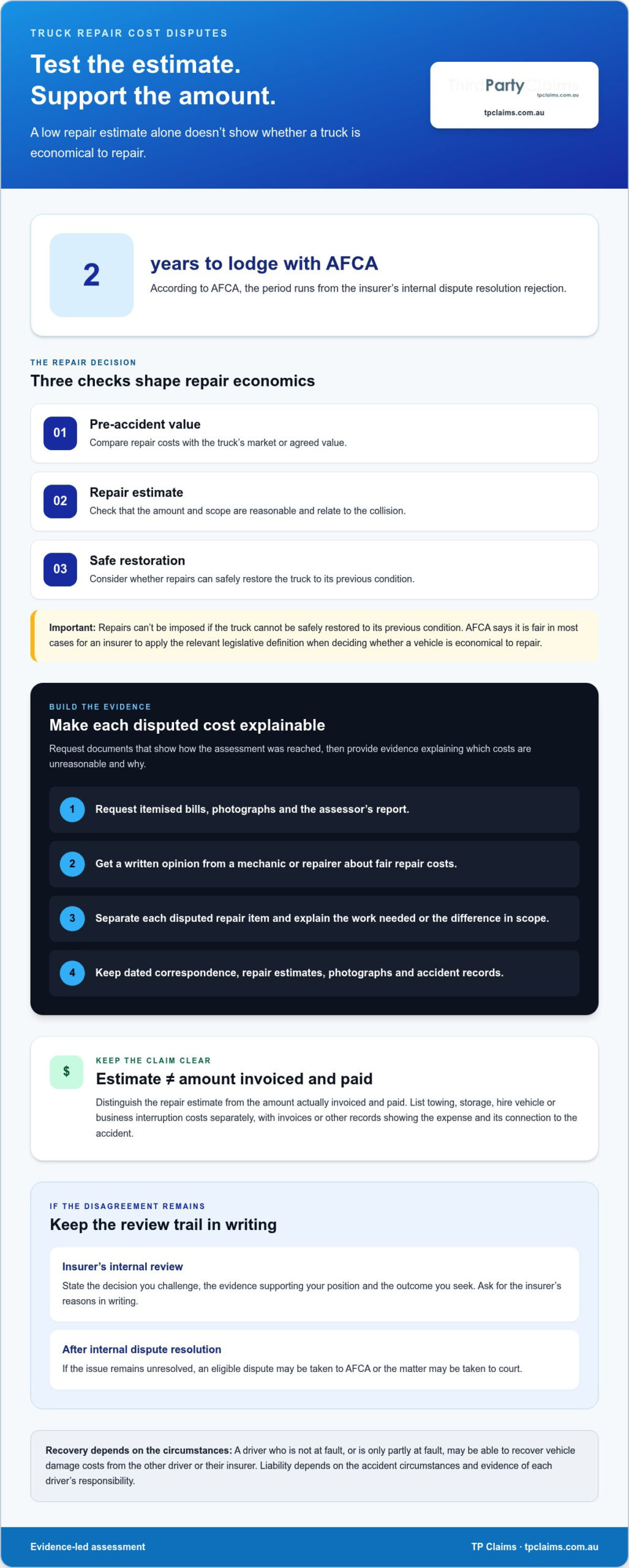
Repair economics depend on the truck’s pre-accident value, the repair estimate and whether it can be restored safely. Your claim also needs to show that the property damage costs sought are reasonable.
Who is liable for truck repair costs after a road accident in Australia? A driver who is not at fault, or is only partly at fault, may be able to recover vehicle damage costs from the other driver or their insurer. Liability depends on the circumstances of the accident and the evidence of each driver’s responsibility.
You can’t claim directly on another driver’s insurance policy. The process can depend on how the other driver and their insurer handle the claim. If they don’t, you can pursue the at-fault driver for the damage. Keep your repair estimate, photographs and accident records to support the amount you seek.
Assessing Reasonable Repair Costs
Reasonable repair costs are necessary expenses to restore accident damage safely and fairly, not costs unrelated to the collision. They matter because you should minimise your financial loss, and a repair claim may be challenged if its amount or scope appears excessive.
Compare the repair estimate with the truck’s pre-accident market or agreed value, and consider whether repairs can restore it safely. AFCA says it is fair in most cases for an insurer to apply the relevant legislative definition when deciding whether a vehicle is economical to repair.
Disputing Repair Costs with Evidence
An evidence-based dispute means challenging a repair amount with documents that explain which costs are unreasonable and why. You can request itemised bills, photographs and the assessor’s report, then provide a written opinion from a mechanic or repairer about fair repair costs.
Write to the insurer or driver with your reasons and supporting evidence, and request a review through the insurer’s internal dispute resolution process. When handling a truck repair cost dispute with third party insurer processes, TP Claims assists owners in compiling this evidence effectively.
How long does a third-party insurer have to respond to a repair cost dispute? Response times depend on the claim, the evidence available and whether further assessment is needed. Keep dated records of your correspondence. If discussions stall, ask the insurer to state its position through its internal dispute resolution process.
What are typical heavy vehicle repair and assessment costs in Australia? Costs depend on the damage, parts, labour, truck type and assessment required. Past industry disputes show why an estimate should be distinguished from the amount actually invoiced and paid.
What legal options are available if an insurer refuses to pay reasonable truck repair costs? You can request an internal review, then pursue an eligible dispute through AFCA or take the matter to court. According to AFCA, you have two years from an insurer’s internal dispute resolution rejection to lodge a dispute with it.
Can truck owners claim towing, storage, hire vehicle or business interruption costs from a third-party insurer? Include these costs in your demand when they relate to the accident, and provide invoices or other records showing the expense and its connection to the damage. List each cost separately from the repair estimate so the insurer can assess the evidence and basis for recovery.
Negotiating with another driver’s insurer
After a car accident, negotiations focus on responsibility, the repair assessment and the amount supported by evidence. A clear written position helps keep discussions focused on vehicle damage, rather than assumptions about the insurance policy.
Contacting the Other Driver’s Insurer
Contacting the other driver’s insurer means notifying it of your property damage claim and providing information for assessment. It can be useful to contact the insurer, but doing so may not be enough to start a claim under the other driver’s policy.
In your written notice, identify the driver, accident date, truck and damage. Attach the repair assessment, photographs and any available invoice, and keep a copy of your message. If the insurer requests more information, respond to each point clearly and retain the reply with your claim records.
Negotiating the Repair Cost Dispute
Negotiation involves exchanging evidence and proposals to agree on a fair amount for the loss. Separate each disputed repair item from the rest of the assessment, then explain why the work is needed or why the proposed amount doesn’t reflect the work required.
For example, if an assessment excludes replacement of a damaged component, provide photographs and the repairer’s explanation. Ask the insurer to explain the basis for its figure, and respond in writing to any difference in repair scope. A written offer can also specify the amount it covers and which costs remain unresolved.
Handling an Insurer Dispute
An insurer dispute arises when you and the insurer can’t agree on responsibility, repair scope or the amount payable. Ask for the decision and reasons in writing, then use the insurer’s internal dispute resolution process to request a review with your supporting documents.
Keep your complaint focused: state the decision you challenge, the evidence supporting your position and the outcome you seek. If an internal review doesn’t resolve the issue, an eligible dispute may be taken to the Australian Financial Complaints Authority. You have two years from an insurer’s internal dispute resolution rejection to lodge a dispute with AFCA.
Some disagreements may require court proceedings if no agreement is reached. Before rejecting a settlement offer, weigh the evidence, repair amount and potential cost consequences. That example shows why a written offer and its terms deserve careful consideration.
Accepting a cash settlement for repairs
A cash settlement gives you money towards repairs instead of having the insurer arrange and pay a repairer directly. Before accepting, compare the offer with the truck’s repair needs and understand who will manage the work afterwards.
Understand what the payment covers
Read the written offer alongside the repair assessment, then compare the proposed amount with the listed damage and work. Check whether it covers all identified repairs or only specified items. If the assessment excludes a damaged component, raise the issue before accepting and support your position with photographs or the repairer’s explanation.
Ask the insurer to put the settlement terms in writing. The document should clarify which parts of the insurance claim the amount covers and what you must do after payment. If it says the amount settles the whole claim, understand what that means before accepting. A clear written record helps prevent disagreements about what was agreed.
Compare cash with insurer-managed repairs
When a policyholder accepts money from their insurer to carry out repairs, they arrange the work and handle any issues with the repairer. Accepting a cash payment can leave you responsible for arranging repairs and dealing with repairer issues. By contrast, when an insurer authorises and pays a repairer directly, it is responsible for workmanship and materials, and must handle complaints about timeliness or the repairer’s conduct.
This difference matters if dismantling reveals further damage. With a cash payment, you’ll need to manage the repairer and any issues with the completed work yourself. Before choosing this option, consider whether you have time to manage bookings, follow up on delays and resolve disagreements.
Check whether the amount is reasonable
Assess the offer against the repair scope, not just its headline amount. Review the parts, labour and work needed to return the truck safely to its previous condition. If the repairer’s estimate differs from the insurer’s assessment, identify the specific line items behind the gap and ask for a written explanation.
Keep the disclosure and payment records together: the offer, assessment, correspondence and later invoices. If the insurer’s amount doesn’t cover the reasonable repair work, explain the shortfall before accepting and provide relevant supporting documents. Don’t assume a cash figure will automatically increase if repairs later cost more.
For a third-party insurance claim, distinguish a cash offer from an arrangement under your own policy. The stated responsibility for cash settlements applies when an insurer pays its policyholder money for repairs. In either situation, consider the offer’s wording, repair scope and practical demands before accepting. If you agree, keep the settlement confirmation and track each repair decision against the truck’s actual needs.
Policy terms and repairer choice
The insurance policy sets out what the insurer must do for its own policyholder. If you’re claiming against another driver, the insurer may assess the truck, but you can choose your own repairer.
How can you get an independent truck repair quote or assessment in Australia? Arrange a written estimate from a repairer you choose, with the damage, parts and labour itemised. You can also request the insurer’s assessment documents to compare the proposed work.
Understanding Policy Terms
Policy terms set out the insurer’s obligations to its policyholder, including how it handles repairs and complaints. They matter because a third-party claimant isn’t automatically bound by the other driver’s policy terms.
Read the relevant documents to understand the insurer’s position, but keep that separate from your own repair choices. For example, an excess under the other driver’s policy concerns their insurance arrangement, not the repair quote you obtain for your truck.
Choosing a Repairer or Assessment
Choosing a repairer means deciding who assesses and completes work on your truck. An independent written quote can help you compare the repair scope with the insurer’s assessment and identify specific differences.
An insurer may ask to inspect the damaged truck or have its chosen repairer assess it. You can discuss using your own repairer with the insurer. Keep the quote, photographs and assessment documents together so you can match each disputed item to visible damage or proposed work.
If the insurer authorises and pays a repairer directly, it is responsible for the workmanship and materials. It must handle complaints about repair timeliness or the repairer’s conduct. This differs from accepting cash: when an insurer pays its policyholder money for repairs, the policyholder arranges the work and handles repairer issues.
Before deciding, ask what arrangement the insurer is proposing: an inspection, an assessment, direct payment or cash. These options affect who deals with the repairer and manages concerns about completed work. Put questions and responses in writing, especially if the insurer’s assessment changes the repair scope.
For example, your chosen repairer may quote to replace a damaged component while the insurer’s assessment allows for a repair. Compare the written reasons, not just the total amount. Ask the repairer why replacement is needed and the insurer to explain its alternative. This gives both sides a clear basis for discussing the difference.
Keep a simple record of each decision: the inspection date, who assessed the truck, the documents received and the repairer’s proposed work. If the truck is a work vehicle, note how the repair plan affects its return to service. Clear records help explain why your repair choice is reasonable and keep discussions focused.
Actual repair invoices and proof of loss
An actual repair invoice shows what it cost to fix motor vehicle accident damage, rather than what repairs might cost. Keep it with the claim correspondence so the insurer can connect the amount sought to the completed work and the truck involved.
A quote and an invoice serve different purposes. A quote estimates proposed work; an invoice records the charges after repairs. If the truck hasn’t been repaired, use the assessment and quotes to explain the anticipated loss. Once repairs are complete, provide the actual invoice to support the amount claimed.
Check that the invoice identifies the truck and clearly describes the accident-related work. Itemised entries make it easier to identify which repairs, parts and labour relate to the damage. Keep supporting invoices for parts or subcontracted work as well. When assessing repair cost claims, insurers should request the actual repair invoice and any parts and sublet invoices included in it.
Keep supporting evidence together, including dated photographs, the repair assessment, correspondence about extra work and proof of payment. If a repairer finds further damage after dismantling, ask for an itemised explanation and photographs before the work proceeds. This helps distinguish newly identified accident damage from unrelated maintenance or pre-existing faults.
A Queensland motor vehicle dispute shows why an invoice’s origin matters. The invoice offered as proof of loss came from an entity associated with the plaintiff’s legal representatives, not the vehicle’s actual repairer. The Magistrate awarded the actual repair costs, rather than the larger amount claimed. A document’s connection to the work matters as much as the figure printed on it.
Separate accident repairs from later rectification. AFCA says repair costs don’t include the cost of fixing poorly executed repairs. If workmanship needs correction, keep the original invoice and a separate record describing the problem. Don’t combine rectification charges with the original accident damage without explaining the difference.
Use a simple evidence file with the claim reference, truck details, repair dates and the purpose of each document. Label quotes as estimates and invoices as charges for completed work. If the insurer questions an item, answer that specific point with the relevant document rather than resending an unexplained bundle. A product disclosure statement may help explain cover under your own policy, but it doesn’t replace evidence of the third-party repair loss.
For help managing a third-party property damage claim, get support with your claim and its repair evidence.
TP Claims: Third Party Property Damage Claims
TP Claims manages third-party property damage claims for individuals and businesses, including disputes about truck repair costs. If you’re unsure how to present repair evidence or negotiations with the other driver’s insurer have stalled, TP Claims can manage the claims process and insurance negotiations. It also handles claims for uninsured drivers and can arrange accident replacement vehicles, subject to conditions.
The firm manages claims on a no-win-no-fee basis. Its role is to help with third-party accident claims, not personal injury claims or comprehensive insurance policies. If you need support with a truck collision claim, contact TP Claims.
Move your truck claim towards a clear decision
A truck repair cost dispute with a third-party insurer can leave you weighing the claim against the practical demands of keeping your business moving. Decide what outcome you’re seeking and make sure your claim file supports your position. A clear account of the dispute helps keep discussions focused and explain what remains unresolved.
TP Claims manages third-party property damage claims, negotiates with insurers and handles claims for uninsured drivers. This support can help when insurer discussions are taking up your time or you need assistance managing a third-party property damage claim.
You don’t have to manage every part of the claims process alone. Contact TP Claims to discuss your dispute and explore a practical next step. With a clear direction, you can move forward with greater confidence.
Frequently Asked Questions
Do I have to pay for the property damage?
If you caused a road accident, you may be responsible for damage to another person’s vehicle or property. Third-party property damage insurance covers damage you cause to others, but not damage to your own vehicle when you’re at fault. An Australian driver who isn’t at fault, or is only partly at fault, may be able to recover vehicle damage costs from the other driver or their insurer.
Do you have a dispute resolution process?
Yes. Set out your complaint and the outcome you seek, then ask the insurer to review its decision through its internal dispute resolution process. Keep the insurer’s response and review outcome with your claim documents. If the insurer rejects your complaint through that process, you have two years from the rejection to lodge a dispute with the Australian Financial Complaints Authority (AFCA).
How does relevant state legislation apply?
State legislation can affect how an insurer decides whether a vehicle is economical to repair or a total loss. The relevant definition may compare repair costs with the vehicle’s market or agreed value. AFCA says it is fair in most cases for an insurer to apply the relevant legislative definition. The same repair estimate may therefore lead to different outcomes depending on the applicable state rules and vehicle value.
What if I do nothing?
Ignoring a property damage demand can allow the other party or insurer to start court proceedings, which may increase your costs. In Western Australia, get legal advice as soon as possible after receiving a demand. If you receive a Statement of Claim in New South Wales, you must respond within 28 days. Keep the demand and any court documents, and note each response date.
What if the amount claimed is unfair?
Challenge the amount in writing, explaining which charges you dispute and why. In Western Australia, you can request itemised bills, photographs and the assessor’s report, then provide a written opinion from a mechanic or repairer about fair repair costs. Include evidence addressing the disputed work, rather than simply saying the total seems excessive. Ask the insurer to review its position through internal dispute resolution.
How to dispute a truck repair bill with a third-party insurer in Australia?
For a truck repair cost dispute with a third-party insurer, identify the specific repair items you contest and explain why in writing. Support your position with relevant photographs, repair documents or a written repairer’s opinion. Ask the insurer to review its assessment through internal dispute resolution. If the insurer rejects the complaint, an eligible dispute can be lodged with AFCA within two years of that rejection.
What evidence is needed to challenge an insurer’s truck repair assessment?
Useful evidence includes clear photographs of the truck’s damage, an itemised repair assessment and a written opinion from a mechanic or repairer addressing disputed work. If repairs are complete, include the actual repair invoice and any supporting parts or subcontractor invoices. Keep documents relating to the truck and accident together so the insurer can see how each item supports the repair costs you’re claiming.
Can an insurer choose the truck repairer or require a specific repair method?
An insurer may ask to inspect a damaged vehicle or have its chosen repairer assess it, but the owner may refuse and use their own repairer. An insurer can’t insist on repairs if the vehicle can’t be safely restored to its previous condition. If the insurer authorises and pays a repairer directly, it is responsible for workmanship and materials, and must handle complaints about repair timeliness or conduct.