
A truck is damaged in a collision, its trailer is off the road, and your team is suddenly juggling driver reports, repair records and insurer calls. If another driver appears responsible, heavy vehicle fleet accident recovery against negligent driver starts with protecting people and preserving clear evidence.
One collision can disrupt operations, especially when responsibility or the extent of the damage is disputed. A well-organised third-party property damage claim helps set out what happened and supports your business in seeking recovery from the party considered responsible.
This guide covers what to do after a collision, which records can support your claim and how to manage information across drivers, vehicles and insurers. TP Claims manages third-party property damage claims for businesses, including complex truck collision disputes, and handles insurance negotiations on a no-win-no-fee basis. We also cover accident replacement vehicles, which can help keep your business mobile while repairs and claim processing are under way.
Key Takeaways
- Put people’s safety and emergency response first after a collision. Gather evidence only when it’s safe to do so.
- For heavy vehicle fleet accident recovery against negligent driver, organise evidence that helps establish what happened and document the physical damage.
- Keep incident, vehicle, repair and claim records together so drivers, managers, repairers and insurers can work from consistent information.
- Check the reporting obligations and time limits that apply to your circumstances before taking the next steps in a property damage claim.
- TP Claims manages third-party property damage claims and insurance negotiations for businesses on a no-win-no-fee basis, helping reduce the claims administration burden.
Heavy vehicle fleet accident recovery: what to do first
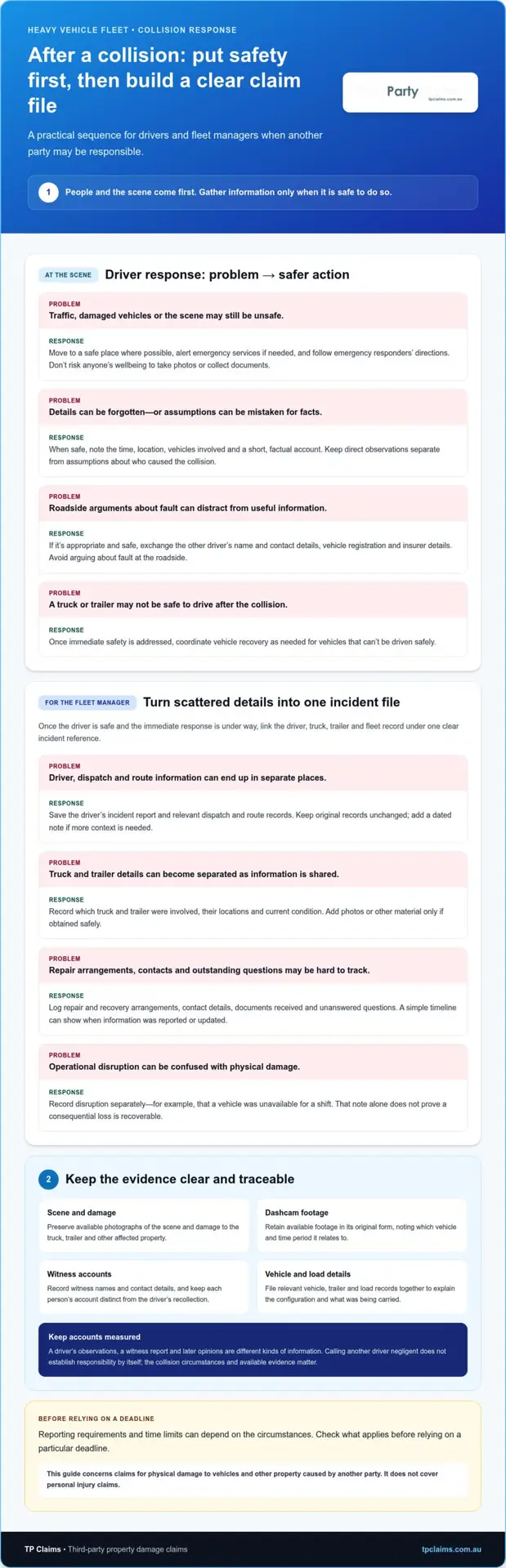
A collision can put drivers’ safety, vehicles and daily operations under pressure at the same time. In the first moments, focus on people and the scene, not the claim file. A calm, consistent response gives your business a clearer starting point for heavy vehicle fleet accident recovery against negligent driver, while keeping safety first.
What should a heavy vehicle driver do at the scene?
Drivers should follow emergency responders’ directions and avoid approaching damaged vehicles or traffic if it’s unsafe. Record details or exchange information only when conditions allow. Evidence matters, but it must never take priority over a person’s wellbeing.
- Make the scene safer. Move to a safe place where possible, alert emergency services if needed, and follow responders’ instructions. Don’t put yourself or others at risk to photograph vehicles or collect documents.
- Record the basics when safe. Note the time, location, vehicles involved and a short, factual account of what happened. Keep direct observations separate from assumptions about who caused the collision.
- Exchange details where appropriate. If it’s safe, record the other driver’s name and contact details, vehicle registration and insurer details. Avoid arguing about fault at the roadside.
- Arrange vehicle recovery as needed. Once immediate safety is addressed, coordinate assistance for vehicles that can’t be driven safely. Vehicle recovery covers different ways vehicles may be moved after a breakdown or collision.
What should the fleet manager record straight away?
Once the driver is safe and the immediate scene response is under way, create one incident file. Give it a clear reference that links the driver, truck, trailer and fleet record. This helps prevent records for a truck and trailer from becoming separated as information passes between your team, repairers and insurers.
- Save the driver’s incident report and relevant dispatch and route records. Keep original records unchanged, and add a dated note if more context is needed.
- Record which truck and trailer were involved, their locations and their current condition. Add photos or other material to the incident file if they were obtained safely.
- Log repair and recovery arrangements, contact details, documents received and outstanding questions. A simple timeline can show when information was reported or updated.
- Note operational disruption separately from physical damage. For example, record that a vehicle was unavailable for a shift, but don’t treat that note alone as proof that a consequential loss is recoverable.
Later claim administration: Once urgent scene actions are complete, check the file for missing details, organise records in date order and keep communications together. This makes it easier to provide a consistent account if responsibility or the extent of vehicle damage is disputed. Reporting requirements and time limits can depend on the circumstances, so verify what applies before relying on a particular deadline.
This guide concerns claims for physical damage to vehicles and other property caused by another party. It doesn’t cover personal injury claims. Calling another driver negligent doesn’t establish responsibility by itself. The circumstances and available evidence matter. Keep the first record factual and complete, then add information as repair and claim details become available.
How responsibility and a heavy vehicle property damage claim are assessed
A third-party property damage claim seeks recovery for physical property loss caused by another party. For a fleet, that may include damage to a truck, trailer or other affected property. The claim is directed towards the party considered responsible, but describing a driver as negligent doesn’t prove fault. Responsibility depends on the collision circumstances and the evidence available.
Keep the record measured. Separate what the driver directly observed from what a witness reported and from later opinions about how the collision occurred. For example, “the truck was travelling through the intersection when the other vehicle entered its path” is a factual account. “The other driver was speeding” is an allegation unless supported by evidence. Clear distinctions help others assess the file without overstating what’s known.
What evidence can help establish how the collision happened?
Build a timeline from original records and first-hand accounts. A driver’s own description, written as soon as practical, can capture details that may become harder to recall. Don’t edit the original account to make it sound more certain later. Add dated notes for new information and make clear where each item came from.
- Preserve scene photographs and images of damage to the truck, trailer and any other affected property.
- Retain available dashcam footage in its original form, noting which vehicle and time period it relates to.
- Record witness names and contact details, along with what each person says they saw. Keep each witness’s account distinct from the driver’s recollection.
- File relevant vehicle, trailer and load details together. These records can help explain the vehicle configuration and what was being carried at the time.
Evidence is most useful when it can be traced to its source and considered alongside the full sequence of events. For further context on truck collision property damage disputes, see how the wider recovery process may involve assessing responsibility and documenting damage.
Which losses belong in a property damage claim?
Keep physical damage and its supporting documents at the centre of the claim file. A clear repair record helps show what was damaged and what work was assessed or completed. It doesn’t, by itself, determine who was responsible or what may ultimately be recovered.
- Collect repair assessments and invoices for the damaged truck, trailer or other property.
- Keep towing records and related documents with the vehicle’s repair history.
- Label each document with the relevant vehicle or trailer reference so costs and damage aren’t confused across the fleet.
Record downtime, lost revenue or other business effects separately from physical damage. Including them in a file doesn’t establish that they’re recoverable, so don’t present them as guaranteed claim outcomes. If coordinating evidence and insurer communications is taking time away from fleet operations, TP Claims’ third-party property damage claims management can help your business manage the process and insurance negotiations on a no-win-no-fee basis.
Build a strong fleet accident recovery file with clear records
A fleet claim can involve several people and systems: a driver records the incident, a manager coordinates the response, a repairer assesses damage and an insurer requests information. One well-maintained file helps keep those accounts connected. Give the incident a unique reference and use it on documents, emails and updates so information about the truck and trailer stays together.
A well-organised claim file connects incident evidence with documented property damage. It should make clear what happened, which property was affected and where each record came from. Keep original files intact, date new notes and distinguish direct observations from later assessments.
What should go into the incident and vehicle file?
Start with the incident record, then add evidence and vehicle details as they become available. Capture the date, time and location, the driver’s notes, truck and trailer identifiers, and details exchanged with the other party. Where safe and practical, document the vehicle and trailer condition before repairs, including clear images of affected areas. Store original photographs and dashcam files rather than relying only on copies sent through messaging apps.
- Incident: Driver notes, date and time, location, other-party details, witness contacts and relevant correspondence.
- Vehicle condition: Truck and trailer identifiers, damage photographs and any available dashcam footage.
- Repair: Assessments, towing documents, invoices and key communications about repair progress.
- Business administration: Claim reference, file owner, dates of important updates and a list of documents still needed.
How can businesses track repair and operational records?
Keep repair and towing documents alongside claim communications, but separate them from operational tracking. A record of vehicle availability and replacement arrangements can help managers understand fleet movements during repairs. It also keeps physical damage evidence distinct from business impacts that may need separate consideration.
Assign an owner to each record type and agree on a shared naming format, such as the incident reference followed by the document date and type. If a repair assessment is updated, retain the earlier version and label the new one clearly. This lets the file show how information developed, rather than making it look as though earlier records were replaced or changed.
| Item | Purpose | Suggested file owner |
|---|---|---|
| Driver notes and scene evidence | Preserve first-hand accounts and original material | Fleet manager |
| Truck and trailer condition records | Identify affected property and document visible damage | Vehicle or workshop coordinator |
| Repair assessments, towing documents and invoices | Track assessment and repair-related records | Repair liaison or fleet administrator |
| Availability and replacement records | Track operational arrangements separately from damage | Fleet operations team |
Consistent records can make it easier to respond when an insurer or another party asks for information, particularly if different teams hold separate parts of the story. Don’t assume every recorded operational impact, such as downtime or lost revenue, is recoverable as property damage. For help organising a third-party property damage claim and insurance communications, TP Claims’ claims management service can reduce the administration involved in pursuing recovery.
Steps to pursue recovery after a heavy vehicle fleet accident
Once the immediate response is complete, a clear process can move a fleet property damage claim from scattered records to organised discussions with the other party or insurer. Heavy vehicle fleet accident recovery against negligent driver depends on the evidence and circumstances, so don’t assume a particular outcome or recovery amount.
- Bring the file together. Gather the incident account, relevant photos or footage, vehicle and trailer details, witness information and correspondence. Use one incident reference across the documents so everyone is working from the same file.
- Summarise the physical damage. Connect each affected vehicle or item of property to repair assessments, invoices and towing records. Keep operational impacts, such as vehicle downtime, separate rather than treating them as automatically recoverable.
- Check what requirements apply. Reporting obligations and time limits can vary according to the circumstances and jurisdiction. Verify current requirements before acting on a deadline or assuming a particular reporting step applies.
- Set out the claim clearly. Present a factual account, identify the property damage being claimed and organise the records that support it. Keep copies of material provided and note when it was sent.
- Manage communications and responses. Record questions, document requests and responses in a dated log. If responsibility or damage is disputed, note the specific issue and organise relevant supporting information before replying.
How does a fleet claim move from records to negotiation?
Start with a concise summary supported by the underlying records, not assumptions about fault. Keep a dated communication log showing who contacted whom, what was requested and what was supplied. Responsibility, evidence of damage and the other party’s response can all affect progress. An orderly file makes it easier to address specific questions without losing track of the claim.
For broader information about the recovery process, explore third-party property damage claim help. Check reporting duties and legal time limits against current requirements for the particular matter.
How can a business manage vehicle disruption during repairs?
Keep repair planning separate from the question of who is responsible for the collision. Track the vehicle’s repair progress and availability for fleet planning, while maintaining the claim file for physical damage and insurer communications. An accident replacement vehicle may help maintain business mobility during repairs and claim processing. See the Australian replacement vehicle guide for related information.
Managing documents and insurer discussions can add pressure to a busy fleet team. TP Claims manages third-party property damage claims for businesses, including insurance negotiations on a no-win-no-fee basis. Get support with a fleet property damage claim and reduce the administrative load while the matter is handled.
How TP Claims supports heavy vehicle fleet accident recovery
A collision can leave your team coordinating vehicle repairs, collecting records and responding to insurer questions while trying to keep the fleet moving. TP Claims manages third-party property damage claims for businesses, helping organise the claims process and insurance negotiations after a heavy vehicle collision.
For heavy vehicle fleet accident recovery against negligent driver, the claim still depends on the circumstances and supporting evidence. No service can guarantee that another party will accept responsibility or that a particular outcome will follow. TP Claims manages the property damage claim and negotiations, reducing the administrative load on your business as the matter progresses.
What can claims management take off a fleet operator’s plate?
A truck collision dispute may involve records from drivers, fleet managers and repairers, along with questions from an insurer. TP Claims helps manage the claims process and insurance negotiations, bringing relevant property damage information together and handling claim communications. This can help your team spend less time coordinating each exchange while keeping its focus on day-to-day fleet needs.
Rather than having different staff respond separately with incomplete details, a managed process helps keep information and communications organised. This is particularly useful when a dispute involves both a truck and trailer, or when responsibility or the scope of physical damage is challenged. TP Claims handles complex truck collision disputes, focusing on third-party property damage recovery and claims management.
The service operates on a no-win-no-fee basis. This doesn’t mean recovery is guaranteed; the available evidence and circumstances remain important to how a claim is assessed. Keep your business records accurate and share relevant updates as the repair and claims process develops.
What happens when a business asks TP Claims for help?
Start by explaining the collision circumstances and sharing the property damage records available. These may include the driver’s account, truck and trailer details, photographs, repair assessments, invoices and relevant communications. You don’t need to turn a collection of documents into a polished claim summary before seeking support. Clear source records give the claims manager material to organise and work with.
TP Claims can then manage the third-party property damage claim and insurance negotiations. The process is designed to reduce the burden of coordinating claim information and responses while keeping your business informed. Progress and outcomes depend on the individual matter, so there’s no promise of a set settlement or timeframe.
Vehicle disruption may need attention alongside the claim. TP Claims provides accident replacement vehicles to help businesses remain mobile during repairs and claim processing. The arrangement is separate from deciding responsibility for the collision.
If your fleet is dealing with a truck collision dispute, TP Claims can manage the property damage claim and related insurer discussions. Get help with a fleet property damage claim and take a straightforward next step towards easing the claims workload.
Give your fleet a clearer path forward
After a collision, consider how much of the claims workload your team can realistically manage while keeping vehicles moving. If pursuing heavy vehicle fleet accident recovery against negligent driver is adding to an already stretched operation, you don’t have to coordinate every claim detail alone.
TP Claims supports businesses with third-party property damage claims, including complex truck collision disputes. Its claims management and insurance negotiation are provided on a no-win-no-fee basis, without guaranteeing a particular recovery or outcome. A dedicated claims partner can help keep the process organised while your team focuses on its operations.
Share the collision circumstances and the property damage records you have, then take the next step for your business. Get help managing your fleet’s property damage claim with TP Claims. With the claim workload organised, your team can focus on getting the fleet back on track.
Frequently Asked Questions
Can a business claim for damage to a truck and trailer after another driver causes a crash?
Yes, a business may pursue a third-party property damage claim for physical damage to its truck, trailer or other property. The outcome depends on the circumstances, available evidence and assessment of responsibility. Link each repair assessment and invoice to the vehicle or trailer it concerns, particularly if more than one fleet asset was involved. Don’t assume downtime or other financial impacts will be treated as property damage.
What evidence should a fleet collect after a heavy vehicle accident?
Gather the driver’s account, scene and damage photographs, available dashcam footage, witness details and information about the other driver, where it’s safe and appropriate. Add truck and trailer identifiers so records can be matched to the right assets. Keep repair assessments, towing documents and relevant messages together. A dated index showing who supplied each item can help explain where the information came from.
Can a fleet make a claim if the other driver disputes responsibility?
Yes, a disagreement about fault doesn’t automatically prevent a business from pursuing a claim. Heavy vehicle fleet accident recovery against negligent driver turns on the collision circumstances and supporting evidence. Identify exactly what’s disputed, such as the sequence of events or the damage attributed to the collision. Keep direct observations separate from assumptions, and note which records may help clarify each point.
What if the driver who caused the heavy vehicle accident is uninsured?
An uninsured driver doesn’t automatically mean there’s no way to pursue a property damage claim, but the available path depends on the circumstances. Keep a record of the driver’s details and any communication about their insurance status. TP Claims manages third-party property damage claims, including claims management for uninsured drivers. This support can help organise the matter, but it can’t guarantee recovery.
Can my business recover lost revenue while a truck is being repaired?
Not automatically. A truck being unavailable may affect operations, but lost revenue and related business costs aren’t necessarily recoverable as property damage. Keep operational records, such as vehicle allocation changes and affected work schedules, separate from repair documents. These records may help explain the business impact, but they don’t establish that a loss is recoverable. The circumstances and applicable requirements need to be considered for each claim.
Can a fleet use a replacement vehicle while its heavy vehicle is being repaired?
A replacement vehicle may help your business maintain mobility while repairs and claim processing are under way. TP Claims provides accident replacement vehicles for businesses as well as individuals. The right arrangement depends on the claim circumstances and your operational needs, so don’t assume a particular vehicle type or expense will suit every fleet. Keep replacement arrangements separate from evidence of physical damage to the truck or trailer.
How long does a heavy vehicle fleet accident recovery claim take?
There’s no single timeframe that applies to every fleet claim. Progress may depend on how quickly relevant information is available, how the damage is assessed and whether responsibility is disputed. Keep a dated record of requests and responses so your team can see what’s outstanding and follow up with the right information. For more detail on factors that can affect progress, read the Australian third-party claim timeframe guide.