
A damaged car’s claim can include more than repair costs. In NSW, you may be able to claim reasonable towing, storage and salvage-related losses from the negligent driver, provided they’re connected to the accident; for a written-off vehicle, the claim may include its pre-accident value less any relevant salvage value. Keep invoices and other records to support the amounts you claim.
Extra bills are frustrating when you’re already dealing with a crash, particularly if an insurer disputes what is reasonable. This guide explains which towing, storage and salvage costs may form part of a property damage claim, what evidence can help, and how to respond if the claim is challenged. It also covers why prompt decisions about storage matter as fees accumulate.
Key Takeaways
- Reasonable towing and storage costs may form part of a NSW property damage claim when they’re linked to the accident.
- Keep towing invoices, proof of payment, photographs and related correspondence to support the costs you’re seeking to recover.
- Act promptly when storage fees are accumulating, as the reason for storage, its duration and the amount charged can affect whether the costs are considered reasonable.
- For a written-off vehicle, a claim may include its pre-accident value less relevant salvage value.
- If the insurer disputes liability or expenses, clear evidence and a well-supported response can help you address the disagreement.
Car Accident Towing Costs NSW: What Can You Claim?
After a motor vehicle accident, a property damage claim may include reasonable costs connected to the damage. These can include towing and storage, as well as losses involving a written-off vehicle.
Property Damage Claims
A property damage claim seeks compensation for financial losses caused by another person’s negligence in a motor vehicle accident. It matters because the claim may cover more than repairing your vehicle, including reasonable towing and storage expenses. Keep invoices, photographs and repair records together. Retaining towing invoices and receipts helps show what you paid and why.
Towing and Storage Rules
Towing and storage rules differ across jurisdictions, so there is no single national fee rule. Relevant court rules recognise a motor vehicle towing claim where the tow follows damage alleged to have been caused by another person’s negligence when you seek to claim towing and salvage fees from negligent driver. Explain how the tow relates to the accident and support the amount with an invoice.
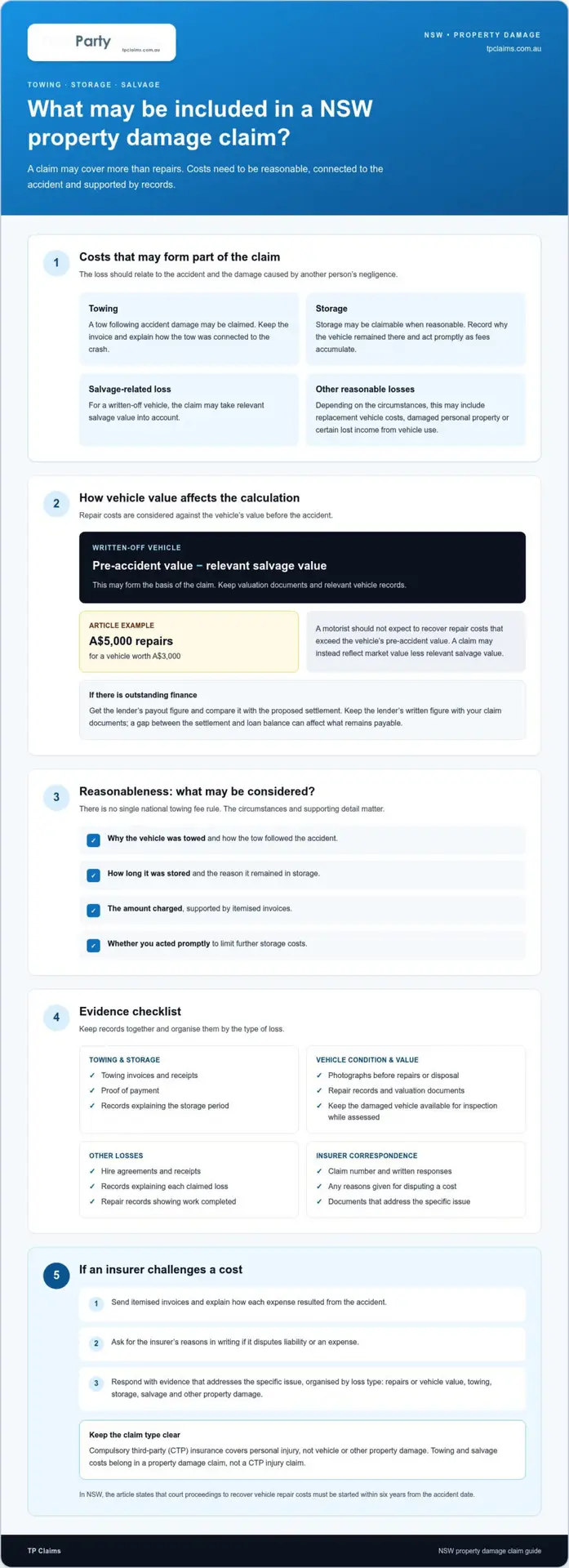
For repairs, the reasonable cost of fixing accident damage may be claimed from the at-fault driver. The amount must be considered against the vehicle’s value before the accident. For example, a motorist should not expect to recover A$5,000 in repairs for a vehicle worth A$3,000. If repair costs exceed the vehicle’s pre-accident value, a claim may instead reflect its market value before the crash, less relevant salvage value.
A written-off vehicle can leave you comparing the insurer’s valuation with any outstanding finance. The claim calculation may use the vehicle’s pre-accident value, less its relevant salvage value. If a lender has a financial interest in the vehicle, get its payout figure and compare it with the proposed settlement. Keep the lender’s written figure with your claim documents, as a gap between the settlement and loan balance can affect what remains payable.
Other reasonable losses may also form part of a property damage claim. Depending on the circumstances, these can include replacement vehicle costs, damaged personal property and certain lost income if you used the vehicle to earn income. Keep hire agreements, receipts and records explaining each loss. A temporary transport expense is easier to assess when you show how it relates to the damaged vehicle being unavailable.
Keep the damaged vehicle available for inspection while its condition and repair options are assessed. Photograph the damage before repairs or disposal, and retain repair records showing the work completed. If the vehicle is stored, record why it remains there and act promptly as charges accumulate. These steps help document the vehicle’s condition, accident damage and the basis for each claimed expense.
Making a claim through the at-fault driver’s insurer
If the other driver has third-party property or comprehensive insurance, ask for the insurer’s claim number. Then contact the insurer about damage to your vehicle and related losses. Give a clear account of the accident and provide supporting documents, such as invoices, photographs and repair records.
Compulsory third-party insurance in Australia covers personal injury, not damage to vehicles or other property. Towing and salvage costs therefore belong in a property damage claim, not a CTP injury claim.
An insurer may assess whether repair costs are reasonable or whether the vehicle is a total loss. If it is written off, the claim may be based on its pre-accident value, less relevant salvage value. A settlement should reflect the vehicle’s condition and value before the accident, not simply the cost of replacing it with a newer model. Keep valuation documents and relevant vehicle records to support your position.
Check what the at-fault driver’s insurance policy actually covers. Some Australian third-party property policies provide limited cover for damage to the insured driver’s own vehicle when the other driver was at fault, uninsured and identifiable. The limit is usually A$3,000 or A$5,000. That limited benefit is for the policyholder’s car. It isn’t a general cap on what an injured property owner may claim from a negligent driver.
Your comprehensive insurance policy may cover accident damage, depending on its terms. If you claim through your insurer, an excess may apply. Your insurer can explain how the excess affects your claim and whether it will pursue the at-fault party for recovery. Don’t assume the other insurer will automatically reimburse your excess. Keep the excess receipt and any written response about recovery.
For towing, storage or salvage expenses, send the insurer itemised invoices and explain how each cost resulted from the accident. The insurer may consider why the vehicle was towed, the storage period, the amount charged and whether you acted promptly to limit further costs. If it disputes an item, request its reasons in writing and respond with documents addressing the specific issue.
If the insurer rejects liability or challenges the amount, organise your evidence by loss type: repairs or vehicle value, towing, storage, salvage and other property damage. In NSW, a person has six years from the accident date to start court proceedings to recover vehicle repair costs. For help addressing a disputed insurer response, support with an insurance claim dispute can help you understand the next steps.
Determining who is responsible for damage
Responsibility depends on how the accident happened and which losses the evidence connects to it. A clear account of events helps you pursue payment or respond to a dispute.
In NSW, you have six years from the accident date to start a court case to recover vehicle repair costs. Include towing and salvage expenses in your written demand promptly, with invoices and records showing how they relate to the accident.
Responsibility is assessed from the circumstances, not simply from who owns each vehicle. Useful evidence includes photographs, witness details, dashcam footage, repair records and the drivers’ accounts. For example, a driver who turns across another vehicle’s path may be assessed differently from one travelling straight through an intersection. Describe what happened and connect each claimed loss to the accident.
If both drivers contributed to the accident, the amount recoverable can be reduced to reflect shared responsibility. In an example involving A$12,000 damage to the other vehicle, a driver found 50% responsible would pay A$6,000. The same principle can affect towing and salvage expenses: explain why the charge arose and how the fault assessment relates to the amount sought.
To pursue the at-fault driver, send a written demand describing the accident, your losses and the amount requested. Attach invoices and other evidence, keep a copy and record when it was sent. In NSW, a letter of demand can serve as evidence in court that you asked the other driver to pay vehicle repair costs. If the driver is insured, send the demand and supporting documents to their insurer.
A dispute may concern fault, the vehicle’s value or whether a particular expense was reasonable. Respond to the specific issue raised instead of resending the same material. For example, if the insurer challenges storage charges, provide the invoice and explain the reason and period for storage. Get legal advice before taking formal court steps if the disagreement remains unresolved.
Property Damage Settlements
A property damage settlement is an agreement to resolve a claim by paying an agreed amount for accident-related losses. Before accepting, compare the written offer with your documented repair, towing and salvage expenses. Check which losses it covers and whether it closes the entire claim. Signing a settlement can limit your ability to seek further payment for losses covered by the agreement.
Towing Fees as Property Damage
Towing fees are an accident-related property loss when the damaged vehicle needed transport because of the collision. Keep the towing invoice, proof of payment, tow date, location and destination. If the other party disputes the charge, these details help show what service took place and how it relates to the accident. The invoice should clearly state the amount claimed.
Recovering reasonable towing and storage costs
In NSW, you can seek payment for towing and storage when the expense has a sufficient connection to the accident and the amount is reasonable. The reason for storing the vehicle, how long it remained there, and supporting invoices all matter. Keep the towing company’s details, proof of payment, tow date, location and destination with your claim records.
Storage costs need particular attention because charges can accumulate while responsibility is disputed. Record why the vehicle could not be moved or inspected sooner, and keep messages with the insurer, repairer or storage yard. Acting promptly to arrange an inspection or move the vehicle can help limit unnecessary losses. The invoice should clearly show the storage period and charges.
If fault is shared, the recoverable amount may reflect each driver’s responsibility. This can affect towing, storage and repair expenses, not just the vehicle’s repair bill. Explain how the accident occurred and provide evidence such as photographs, witness details or repair records. The circumstances help establish who is liable and what proportion of the loss may be recovered.
Repair quotes can help show whether the proposed work and amount are reasonable. Get two quotes that identify parts and labour, and keep any inspection or repair report. Compare the listed work with the visible accident damage. If the vehicle is written off, the claim may instead use its pre-accident value, less relevant salvage value. Registration details and vehicle records can help identify the car and support its pre-accident condition and value.
Keep salvage documents with the valuation. If the insurer proposes a salvage deduction, ask for its calculation and retain any written valuation or disposal records. A clear breakdown helps distinguish the vehicle’s pre-accident value from the value attributed to salvage. This ensures the claim reflects the loss without seeking payment twice for the same vehicle value.
If the insurer rejects reasonable expenses, respond to each disputed item with evidence and a short explanation. A towing invoice can show the service and destination; storage records can explain the duration; repair quotes can support the repair amount. If negotiation does not resolve the dispute, court proceedings are another option. In NSW, you have six years from the accident date to start a court case to recover vehicle repair costs. Get legal advice about the evidence and costs before choosing that route.
Before accepting a settlement, compare its written breakdown with your documented losses. Check whether it includes towing, storage, repairs or the vehicle’s value, and whether it accounts for salvage. Keep the agreement and payment record. A settlement that omits an expense may leave that loss unresolved, while an agreement covering the full claim may affect your ability to seek more later.
Can I claim towing and salvage fees from the at-fault driver in Australia?
Yes. Reasonable towing and storage costs can form part of a motor vehicle property damage claim when they result from the accident. A salvage deduction may also affect the amount claimed for a written-off vehicle. The key questions are whether the loss relates to the accident, whether the other driver was responsible and whether the amount is reasonable.
For towing, show why the vehicle needed transport and where it went. A tow from the accident scene to a repairer or storage yard has a clear purpose when damage made the vehicle unsafe or undriveable. Keep the invoice, proof of payment, tow date, pickup location and destination. Photographs of the accident damage and messages with the insurer or repairer can help explain the circumstances.
Storage costs also need a clear explanation. Record why the vehicle remained at the yard, when it could be inspected or moved, and what the invoice covers. Prompt action matters because ongoing storage charges can increase the loss. If access, inspection or repair arrangements delayed removal, keep the relevant correspondence to show the timeline.
Salvage usually becomes relevant when damage makes repairs uneconomic and the vehicle is treated as a write-off. The property damage calculation may use the vehicle’s pre-accident value less its relevant salvage value. Keep valuation documents and any salvage assessment. If you disagree with a valuation, identify the evidence supporting your view, such as the vehicle’s condition, service history and comparable features before the crash.
Fault also affects recovery. If the other driver disputes responsibility, preserve evidence showing how the collision occurred, including photographs, witness details and each driver’s account. Where responsibility is shared, the amount recoverable can reflect each party’s share of fault. For example, a driver assessed as partly responsible may have their recoverable expenses reduced accordingly.
Present the claim as an itemised schedule, not one unexplained total. Separate towing, storage, salvage-related loss and other property damage. Match each amount to an invoice, receipt or valuation, then explain how it relates to the accident. This makes it easier to identify whether a disagreement concerns liability, the evidence or the reasonableness of a particular expense.
If the insurer rejects an item, ask for its reasons in writing and respond to the point it raises. A disputed towing charge needs evidence of the tow and its purpose; a storage challenge needs the dates and reason for keeping the vehicle there. Keep copies of all claim documents and replies. For support with a contested property damage claim, get help managing your accident claim.
TP Claims: Third Party Property Damage Claims
TP Claims manages third-party property damage claims, including discussions about accident-related towing, storage and salvage losses. If the other driver is uninsured, its claims management can help you organise the claim and supporting documents. TP Claims also provides insurance negotiation services to help address disputes with an insurer over liability or the amount claimed.
TP Claims can help when you’re unsure how to present your losses or an insurer has challenged your evidence. Keep your towing and storage invoices, photographs, repair records and any written insurer response together so the details are ready to discuss.
For help with a third-party motor vehicle property damage claim, contact TP Claims to discuss your situation.
Take the next step with a clear claim
When an insurer disputes a towing or salvage expense, keep the response focused: identify the cost, explain how it resulted from the accident and show what evidence supports it. A clear written response can move the discussion forward and keep your claim organised.
If you need to claim towing and salvage fees from a negligent driver, TP Claims can assist with third-party property damage claims and insurance negotiations. It also manages claims for uninsured drivers, which can help when no insurer is handling the other driver’s claim. The right support depends on the circumstances and the help you need with your property damage claim.
You don’t have to work out how to present every disputed item alone. Contact TP Claims for help discussing your accident-related property damage claim, and take the next step with greater clarity.
Frequently Asked Questions
What about storage fees?
Storage fees may be included when keeping the damaged vehicle is necessary and the charges are reasonable. Keep a dated record of when the vehicle arrived, why it remained there and when it was released or moved. Ask the storage yard for an itemised invoice that includes any inspection or removal charges. If the vehicle is ready to move, arrange collection promptly to avoid adding unnecessary days to the claim.
What if the other driver or insurer disputes the cost?
Ask for the reason for the dispute in writing, then respond to that specific issue. If the insurer challenges a tow, provide the invoice and explain where the vehicle was taken and why. If it disputes storage, set out the dates and circumstances. Keep copies of your response and supporting records. An item-by-item reply helps distinguish a disagreement about the amount from one about fault or the connection to the accident.
Who covers the towing charges?
The at-fault driver’s insurer may pay reasonable, accident-related towing charges as part of a property damage claim where liability is accepted. Your own insurer may cover towing under your policy, depending on its terms and the accident circumstances. Compulsory third-party insurance relates to injury claims, not vehicle damage. Check which claim is being handled before assuming a CTP insurer will pay a towing invoice.
What towing and salvage costs are recoverable in an Australian car accident claim?
A claim may include reasonable towing and storage expenses connected to the accident. For a written-off vehicle, the property damage calculation may include its pre-accident value less relevant salvage value. You can claim towing and salvage fees from the negligent driver by itemising each loss and linking it to the crash. Separate towing, storage and vehicle valuation documents so the insurer can assess each component.
Who is liable for towing, storage and recovery fees after a crash in Australia?
The driver responsible for the accident may be liable for reasonable property damage losses caused by it, including towing and storage. The initial invoice and ultimate responsibility for the loss are separate questions. If responsibility is shared, recovery may reflect each party’s share of fault. Provide evidence of the accident circumstances alongside invoices identifying the service, dates and vehicle involved.
What evidence and receipts are needed to claim towing and salvage costs?
Keep the towing invoice, proof of payment, tow date, pickup location and destination, along with storage invoices and any salvage valuation. Add photographs of the vehicle and relevant messages with the insurer, repairer or towing company. Legal Aid NSW recommends keeping invoices and receipts for accident losses, including towing. A record explaining why each cost arose can help connect the documents to your claim.
How do I claim towing and salvage fees from the negligent driver’s insurer?
Ask the other driver for their insurer’s claim number, then send the insurer a written account of the accident and an itemised list of losses. Attach invoices, receipts and salvage valuation records, and explain how each expense resulted from the collision. Keep copies of what you send and the insurer’s replies. If the insurer rejects an item, request its reasons and answer the specific point with relevant evidence.
What are reasonable towing and vehicle storage charges after an accident in Australia?
Reasonableness depends on why the vehicle needed towing or storage, how long it stayed, the amount charged and whether an invoice supports the cost. An urgent tow from an accident scene to a suitable repairer has a clear purpose if the vehicle cannot be driven. For storage, records explaining inspection delays or why the vehicle needed to remain there can clarify the period claimed. Avoid unnecessary delays in arranging its next move.