
If you’re asking what happens if an at-fault driver has no money to pay repairs, they may still be responsible for reasonable accident-related damage costs, but recovering payment can be difficult if they have no assets. If you have comprehensive car insurance, your policy may cover repairs to your vehicle, although an excess may apply. Compulsory third party insurance covers injuries, not damage to cars or other property.
It’s frustrating to face repair bills after someone else caused a crash, especially if they can’t pay. Legal responsibility and recovering money are separate issues: you may be owed compensation, but collecting it can take time and may not be possible if the driver has no assets or income available.
This guide explains who may be liable for crash damage, how insurance can help, and what may happen when the at-fault driver has no money or assets. It also covers the difference comprehensive insurance can make, what options may apply if you’re uninsured, and how claims and recovery generally work in Australia.
Key Takeaways
- The at-fault driver may still be liable for reasonable crash damage, even if they can’t afford to pay.
- Compulsory third party insurance covers injuries, not repairs to vehicles or damage to property.
- Your own comprehensive policy may help cover repairs when the other driver is uninsured, subject to the policy terms and any excess.
- If you’re uninsured, the options for recovering costs depend on the evidence, the share of fault and the other driver’s ability to pay.
- A court order can establish a debt, but collecting it may be difficult when the person has no money or assets.
Compulsory third party, third party property damage and comprehensive insurance
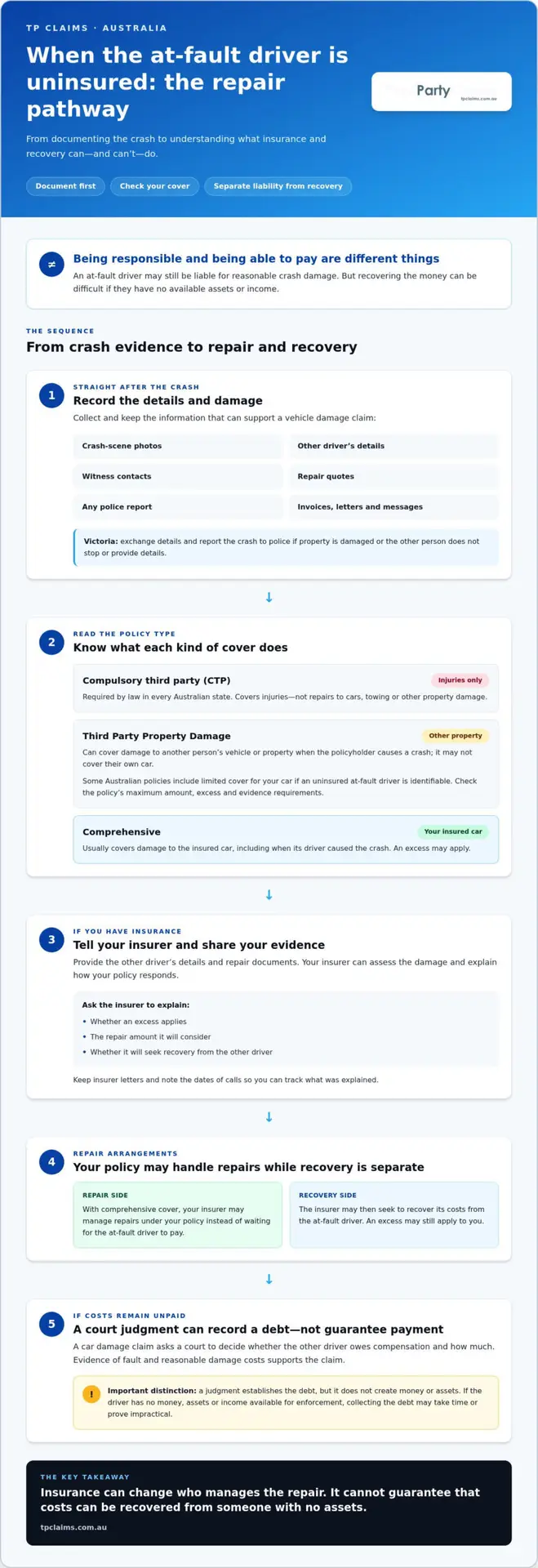
In Australia, compulsory third party insurance is required by law in every state, but it does not pay to repair cars or other property. CTP covers injuries, while vehicle damage depends on other insurance or recovering costs from the responsible driver.
To support a vehicle damage claim, gather photos from the crash scene, the other driver’s details, witness contacts, repair quotes and any police report. Keep invoices, insurer letters and messages together to document the damage, repair amount and discussions.
CTP insurance covers an at-fault driver against compensation claims for injured people’s medical and rehabilitation costs. It does not cover the other party’s car repairs, towing or property damage. Victoria provides a clear example: vehicle registration includes personal injury insurance administered by the Transport Accident Commission, but damage to other cars or property is excluded.
Third Party Property Damage insurance is different from CTP. It can cover damage to another person’s vehicle or property when the policyholder causes a crash, but may not cover repairs to the policyholder’s own car. For example, if a driver with third-party cover hits another car, their policy may address the other car’s damage, while their own repair bill remains theirs.
Some Australian third-party property policies include limited cover for the policyholder’s car when an uninsured at-fault driver is identifiable. Check the policy wording for the maximum amount, excess and evidence required, then provide the insurer with the other driver’s details and repair documents.
Comprehensive insurance usually covers damage to the insured car, including when its driver caused the crash. In Victoria, an excess may apply. If you have comprehensive cover and the at-fault driver has no money, your insurer may handle repairs under your policy rather than waiting for that driver to pay. The insurer may then seek to recover its costs from the at-fault driver.
Before accepting a repair arrangement, compare the policy response with the claim being made. Ask the insurer to explain the excess, the repair amount it will consider and whether it will seek recovery from the other driver. Keep each letter and note the dates of calls. When neither driver has insurance, agreeing how to handle repair costs and keeping clear evidence and written records can be especially useful.
Court action and difficulty recovering a debt from someone with no assets
Court action can establish a legal debt, but a judgment doesn’t create money or assets to pay it. If the responsible driver has little to recover, collecting repair costs may remain difficult.
Starting court action
A car damage claim asks a court to decide whether the other driver owes compensation and how much. Before filing, explain the basis of your claim and gather evidence of fault and reasonable damage costs. Court filing fees and procedures differ across Australian states and territories, depending on the court and claim amount. The process generally involves lodging a claim, serving it on the other party and following the court’s directions.
If you receive a Statement of Claim, get legal advice immediately and respond within the applicable court timeframe. In Australia, you must respond within 28 days. Missing the deadline may lead to a judgment against you without the court considering your defence. Legal aid may help eligible people understand their options, while legal advice can clarify a disputed claim or repair amount.
What follows a court judgment
A court judgment formally records the debt the responsible party must pay. It can give the creditor enforcement options, but doesn’t guarantee payment. In Western Australia, a judgment for an unpaid debt may allow the creditor to take and sell the debtor’s assets, including a home or car. Legal and court costs may also be added if the dispute goes to court.
Recovery still depends on the debtor’s financial position. If they have no money, assets or income available for enforcement, collecting the judgment debt may take time or prove impractical. A person pursued over a crash debt may be liable for six years in Australia, except in the Northern Territory, where the period is three years. A judgment and actual payment are separate outcomes.
Insurer recovery and policy effects
An insurer that pays for damage may pursue the at-fault driver to recover its outlay. In Victoria, an insurer may seek payment from an uninsured driver and take them to court if they don’t pay. This can leave the driver with a debt even though their own insurer wasn’t involved in the crash.
Your excess and no-claim bonus are separate policy issues. The terms of your policy and the claim outcome determine how they’re treated. Ask your insurer to explain any excess charged, whether it will pursue recovery and how the claim affects your bonus. Keep its letters and record the explanation so you understand the amount you may still need to pay.
Comprehensive cover when the at-fault driver is uninsured
After an accident with an uninsured or insolvent driver, tell your insurer and preserve evidence. In Victoria, exchange details and report the crash to police if property is damaged or the other person doesn’t stop or provide details.
Who pays for repairs
If you have comprehensive cover, your policy generally covers damage to your car, even when the other driver has no insurance or money. Your insurer assesses the damage and manages repairs under the policy. An excess may apply, so check what you must contribute before repairs proceed.
For example, if an uninsured driver damages your parked car, you can lodge a claim under your comprehensive policy. The insurer can assess the vehicle and manage the repair claim, while separately seeking to recover its outlay from the responsible driver. That recovery doesn’t mean the driver can pay immediately.
Without comprehensive cover, you may need to meet your own repair costs first, then seek payment from the at-fault driver. A successful claim depends on showing the driver was responsible and supporting the amount claimed with evidence. Even if liability is clear, recovering money may be difficult when the driver has no assets or income.
Some third-party property policies include limited cover for your car if the uninsured driver is identified. The amount depends on the policy’s terms and conditions. Check the wording for eligibility, limits, excess and required documents. This cover is distinct from comprehensive insurance and may not meet the full repair bill.
Steps after an uninsured driver crash
Start by recording what happened and gathering the details needed to support your claim. Photograph the vehicles, damage, road position and relevant signs. Note the other driver’s name, contact details and registration, and collect witness details if available. Keep repair quotes, invoices and messages together so you can trace the damage and claimed amount.
In Victoria, drivers must exchange details with the other driver or the owner of damaged property, even when nobody is hurt. Consider reporting the accident to police if property is damaged or the other person does not stop or provide details. These steps help create a clear record of the accident and the people involved.
Tell your insurer about the crash as soon as possible, even if you don’t intend to claim. Share the evidence and ask how your policy applies, including any excess and the repair assessment process. If you’re uninsured, obtain a repair quote and keep a written record of your requests and the other driver’s responses.
If the driver cannot pay, separate the value of your claim from the likelihood of collecting it. A clear repair quote and evidence of responsibility support your case, but they cannot create funds the driver doesn’t have. Your insurance cover, the driver’s identifying details and their financial circumstances shape the practical options available after the accident.
Liability for damage caused in a crash
A driver’s ability to pay doesn’t decide who caused a crash. In Australia, an uninsured at-fault driver remains responsible for reasonable damage costs caused by the accident. Establishing liability means assessing each driver’s conduct, the damage linked to the crash and the fair amount claimed.
Insurers assess liability using available evidence, including the drivers’ accounts, photographs, witness information, police records and vehicle damage. If the evidence indicates that one driver caused the collision, that driver may be responsible for the other party’s reasonable repair costs. Disagreement about the circumstances or repair amount can make the assessment more complex.
Fault can also be shared. If both drivers contributed to a crash, each may be responsible for a share of the other party’s reasonable damage costs, based on their respective shares of fault. In Victoria, a court may find both drivers partly at fault. For example, if one driver failed to give way and the other also drove carelessly, responsibility may be divided rather than placed entirely on one person.
The claim amount must reflect reasonable vehicle damage, not an unrelated upgrade or betterment. In general, reasonable vehicle damage costs are the repair cost or the vehicle’s market value, whichever is lower. If repairs would cost more than the vehicle’s market value, the claim may instead be assessed against that market value. The vehicle’s condition and the damage caused by the crash matter when assessing the amount.
Fair related expenses can form part of a claim. In Western Australia, a driver found at fault would normally be responsible for repair costs up to the other car’s market value if it was written off, plus fair costs such as towing or a hire car. The other driver or insurer can recover only costs that are fair in the circumstances. They don’t have to obtain multiple repair quotes or let the at-fault driver inspect the vehicle.
That doesn’t mean every amount in a demand is automatically correct. Compare the claimed work with the accident damage, and separate crash-related repairs from pre-existing damage. A repair quote or assessment helps explain how the amount was calculated. If liability or property damage costs are disputed, Legal Aid Queensland advises that seeking legal advice is a good idea.
Keep the distinction clear: fault establishes responsibility, evidence supports the amount, and the at-fault driver’s finances affect recovery. A driver may owe reasonable costs even if they cannot pay immediately. If you’re partly responsible, your share of fault may reduce what you can recover, while a disputed assessment may require further evidence or resolution.
In Australia, who pays for car repairs if the at-fault driver has no money?
If the at-fault driver has no money, your own comprehensive insurer may cover repairs under your policy, subject to its terms and any excess. Without applicable insurance, you may have to meet repair costs yourself while seeking payment from the responsible driver. A debt claim doesn’t guarantee you can recover money from someone with no assets.
The practical outcome depends on the cover available and whether the driver can pay. Consider three common situations:
- You have comprehensive cover: claim for your vehicle damage through your insurer. The insurer can assess repairs and pursue the at-fault driver for costs it pays.
- You have third-party property cover: check whether your policy includes limited cover for your car when an uninsured driver is identified. The policy limit and conditions affect the amount paid.
- Neither driver has insurance: the parties need to settle repair costs directly. If the responsible driver cannot pay, you may need to pursue a debt, but collecting it depends on their financial position.
If you’re uninsured and not at fault, start by obtaining a repair quote and keeping evidence that connects the damage to the accident. A written demand can set out the amount claimed and how it was calculated. Keep the other driver’s response, including any payment proposal, with your records. If the driver has no income or assets, an agreement or legal decision can establish responsibility without producing funds immediately.
Where an insurer is pursuing an at-fault driver, financial hardship can affect repayment discussions. Under the General Insurance Code of Practice, an insurer that agrees a person is experiencing financial hardship will work with them on a payment arrangement. Options can include extra time, a reduced lump sum, instalments, deferred payments or a combination. An at-fault driver should not agree to instalments they cannot afford.
In Western Australia, an at-fault driver who cannot afford any of a fair claim can write to the insurer, or to the other driver if they’re uninsured, asking them to stop collecting the debt. The other driver or insurer doesn’t have to accept a lower settlement or instalment offer. A person facing financial hardship can call the National Debt Helpline on 1800 007 007 for free financial counselling.
If you’re uninsured and need help handling a third-party property damage claim, Claims Management for Uninsured Drivers can help manage the claims process. It can be useful when you need to organise evidence, communicate about the repair claim and pursue costs from the responsible driver.
TP Claims: Third Party Property Damage Claims
Third-party property damage claims may arise after a motor vehicle accident. If you’re not at fault and the other driver can’t pay, managing evidence, repair costs and insurer discussions can become difficult. TP Claims handles claims management and insurance negotiations, including for uninsured-driver claims. In many cases, yes, rental-car assistance is available, subject to conditions.
Claims support can help you present the damage and costs clearly, but it can’t create assets or guarantee that an at-fault driver can pay. If you need help with a third-party property damage claim, contact TP Claims to discuss your situation.
Move your repair claim forward with a clear plan
If you’re still weighing what happens when the at-fault driver has no money to pay for repairs, focus on the next decision: how to pursue your claim without making it harder to manage. A clear record of the crash, your communications and the costs being claimed can help you understand your options and explain your position.
TP Claims offers Third Party Property Damage Claims, Insurance Negotiation Services and Claims Management for Uninsured Drivers. These services may suit you if you need help managing a property damage claim or dealing with the insurer and other driver. The next step is to discuss your circumstances and the support you need.
Contact TP Claims for help with your third-party motor vehicle claim. Taking one practical step can help you move forward with greater clarity.
Frequently Asked Questions
At fault with no car insurance: What happens now?
An at-fault driver without car insurance remains responsible for reasonable crash damage, but you may need to pursue payment directly or claim through your own policy. If you’re asking what happens if an at-fault driver has no money to pay repairs, the practical issue is whether your cover responds and whether the driver has assets. Record their details, vehicle registration, photos and witness contacts to support your claim.
Does my level of insurance impact what I can claim?
Yes. Comprehensive cover generally protects your own vehicle against accident damage, while third-party property insurance mainly covers damage you cause to someone else’s property. Some third-party policies include limited cover for your car if an uninsured driver caused the crash and can be identified. Check your policy’s terms, excess and limits to understand what it covers. If you’re partly at fault, your share of responsibility can also affect recovery.
Can I claim car repairs from my own insurer if the other driver is uninsured?
Yes, if your comprehensive policy covers the damage, you can lodge a claim with your insurer even if the other driver has no insurance. Provide the crash details, photographs and repair information, and ask how the policy excess applies. Your insurer can assess the damage and may pursue the other driver to recover what it paid. Keep claim correspondence so you can track the assessment and any recovery action.
Does third-party property insurance cover damage to my car if I am not at fault?
Some third-party property policies provide limited cover for your own car when an uninsured at-fault driver is identifiable. It’s not the same as comprehensive cover, and the policy conditions determine whether you qualify. Give your insurer the other driver’s identifying details and documents supporting the damage, then check the applicable limit and excess.
How can I recover repair costs directly from an uninsured at-fault driver in Australia?
Set out your claim in writing, identifying the accident, why you say the driver was responsible and how you calculated the repair amount. Attach supporting material such as photographs, a repair quote and relevant invoices. Keep a copy of the letter and the driver’s response. If they dispute fault or the amount, clarify the specific disagreement and preserve related messages. A court claim is another avenue, but payment can remain difficult if they lack assets.
Can I take an at-fault driver to court or a tribunal to recover car repair costs?
You can pursue a property damage debt through court, where the process and filing fees depend on the state or territory and claim. A tribunal may have jurisdiction over particular disputes, but it isn’t a universal route for every car damage claim. If you’re uninsured and the insured at-fault driver’s insurer has handled the claim, you may be able to complain to AFCA when the damage is under A$19,000, as at 1 January 2024, and the other driver claimed through insurance.
Can an at-fault driver be made to pay repair costs in instalments or through a payment plan?
An insurer that agrees a person is experiencing financial hardship must work with them under the General Insurance Code of Practice on a payment arrangement. This may involve extra time, instalments, deferred payments, a reduced lump sum or a combination. If the debt is owed directly to an uninsured person, they don’t have to accept instalments or a lower settlement. An at-fault driver should avoid agreeing to repayments they cannot afford.
What happens if the at-fault driver has no assets or income and cannot pay a court judgment?
A judgment records the debt, but it can’t produce money or property that the debtor doesn’t have. If there are no available assets or income, enforcement may not recover the repair costs, even after a successful claim. In Western Australia, a judgment can allow assets to be taken and sold, but there must be assets available to enforce against. The creditor’s practical options therefore depend on the person’s financial circumstances.