
A third-party insurer may offer to arrange repairs through its preferred repairer, but that does not automatically mean you must accept. Whether a third-party insurer can force you to use its repairer depends on how the claim is handled and the terms that apply to your situation. In Australia, there is no law requiring drivers to use an insurer-chosen repairer, but there is also no automatic legal right to choose your own.
It is understandable to want a repairer you trust, especially when your car has been damaged and you want to avoid delays or unexpected costs. The key is to understand what the insurer has authorised and whether choosing another repairer could leave you responsible for a cost gap.
This article explains how policy terms and claim arrangements affect your choice, what repair authorisation means, and how repair costs may be recovered. It also covers what to consider before agreeing to an insurer-arranged repair or proceeding with your preferred repairer.
Key Takeaways
- Your policy terms and the way the claim is handled shape whether you can choose the repairer. The Product Disclosure Statement explains the repairer-choice conditions that apply to your cover.
- Choosing your own repairer doesn’t automatically invalidate a claim, but repairs still need the insurer’s assessment and authorisation.
- Before accepting a cash settlement or arranging repairs, understand how the approved amount and repair costs could affect any gap you may need to pay.
- If you disagree with a repair or write-off decision, raise your concerns through the insurer’s internal dispute process and keep written records of the discussions.
- If you’re uninsured and seeking repair costs from the at-fault party, claims management and insurance negotiation support can help manage the process.
How repairer choice depends on the policy and claim arrangements
If you are asking whether a third-party insurer can force you to use its repairer, first distinguish a claim under your own insurance from a claim against another driver’s insurer. Your policy, the insurer’s assessment and any repair authorisation affect what happens next.
Repairer choice under the policy
Repairer choice means nominating who repairs your vehicle under the terms of your insurance policy. In Australia, whether you can choose your own repairer depends on that policy, including any choice-of-repairer clause in your Product Disclosure Statement.
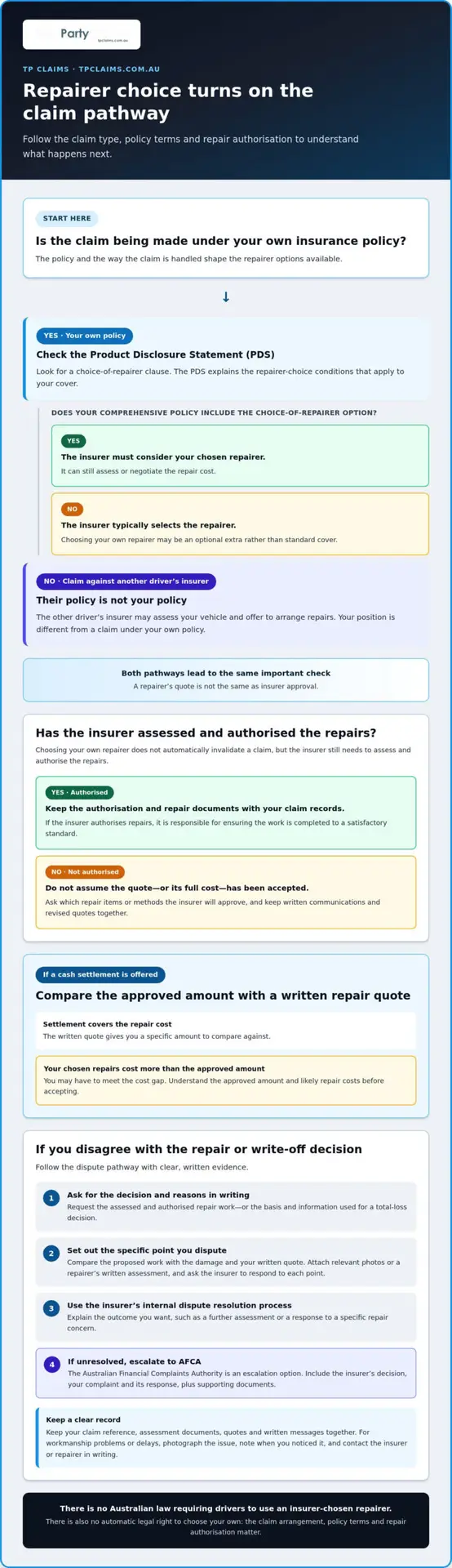
If your comprehensive policy includes that clause, the insurer must consider your chosen repairer, although it can assess or negotiate the repair cost. Without that option, the insurer typically selects the repairer, and choice may be an optional extra rather than standard cover. A third-party claimant’s position is different: the other driver’s policy is not your policy, but their insurer may assess your vehicle and offer to arrange repairs.
Repair choices and claim outcomes
Repairer choice affects who prepares the quote and how the insurer assesses the proposed work. Choosing your own repairer does not automatically invalidate an insurance claim, but the insurer still needs to assess and authorise the repairs under the policy.
For example, if a third-party insurer offers a cash settlement, compare the amount with your repairer’s written quote before accepting. You may have to meet a cost gap if your chosen repairs cost more. For an insured vehicle, the owner’s policy will usually let the insurer choose whether to repair it or declare it a total loss. The insurer can choose repairs when they are economical and the damage does not meet non-repairable criteria.
Negotiating with the insurer
Negotiating repairer choice means providing the chosen repairer’s quote and repair method for the insurer to assess. Some Australian insurers consider a preferred repairer’s quote when the costs and proposed work are reasonable.
A written quote makes the discussion specific by setting out the damage, parts and work required. If the insurer disputes the amount, ask which repair items or methods it will not approve. The insurer may negotiate costs, but that does not mean every proposed repair is automatically payable. Keep written communications and revised quotes together so you can see what the insurer has assessed and authorised.
Parts and warranty conditions also matter. Your vehicle manufacturer’s warranty and the repair terms can affect which parts are used and how warranty questions are handled. Before authorising work, ask for the proposed parts and repair method in writing, then compare them with your policy conditions and vehicle warranty documents.
Approval is a key dividing line. Do not assume a repairer’s quote means the insurer has accepted the work or its full cost. If the insurer authorises repairs, it is responsible for ensuring the work is completed to a satisfactory standard. Keep the authorisation and repair documents with your claim records.
Your Car, Your Choice – Can My Insurance Company Force Me to Use Their Repairer?
A repair or write-off decision can affect your vehicle, claim and next steps. If you disagree, focus on the insurer’s assessment and the reasons for its decision. Whether a third-party insurer can force you to use its repairer depends on the claim arrangement, but you can raise concerns about the proposed repairer or decision.
Start by asking the insurer to explain its decision in writing. If it proposes repairs, request details of the work it has assessed and authorised. Compare those details with the damage and any written repair quote you have. If it declares the vehicle a total loss, ask for the basis of that assessment and the information used. Clear reasons help you identify exactly what you dispute.
For example, you might agree that damaged panels need repair but disagree with the proposed method or parts. Set out the specific difference, attach relevant photos or a repairer’s written assessment, and ask the insurer to respond to each point. A clear account of the disputed work is easier to assess than a general objection.
If the disagreement remains unresolved, use the insurer’s internal dispute resolution process. Explain the outcome you want, such as a further assessment or a response to a specific repair concern. Keep your claim reference, assessment documents, quotes and written messages together. A dated record makes it easier to explain what happened and when.
If the insurer’s internal process does not resolve the dispute, you can take an unresolved insurance or repair complaint to the Australian Financial Complaints Authority (AFCA). Include the insurer’s decision, your complaint and its response, along with documents supporting your position. AFCA is an escalation option, not a substitute for first explaining the issue clearly to the insurer.
Raise workmanship problems and delays promptly. A paint mismatch, incomplete repair or missed update is easier to describe while the details are fresh. Photograph the issue, note when you noticed it, and contact the insurer or repairer in writing. Repairs completed through an insurer’s repair network typically have a workmanship guarantee from the insurer. Keep the guarantee information and repair paperwork with your claim records.
If repairs are delayed, ask for the current status, what work remains and the reason for the hold-up. For a quality concern, identify the exact area and explain what needs attention. This gives the insurer a practical issue to address rather than a general expression of dissatisfaction.
If a third-party insurer dispute needs structured follow-up, insurance negotiation support can help you present the repair issue and supporting documents clearly.
Using an insurer or the courts to claim repair costs
After an accident, an uninsured driver can pursue the at-fault party’s insurer or seek recovery through the courts if needed. The route affects how repair quotes, assessments and related expenses are considered.
The claim and repair process
An uninsured driver who was not at fault can seek the cost of repairing damage from the responsible party, including through that party’s insurance company. Under established legal principles, the person who causes a crash is responsible for the damage they cause.
For example, you can send the other driver’s insurer your accident details, photographs and repair quote, then keep a written record of its response. A claim for towing or a hire car can also be supported with invoices and an explanation of how each expense arose from the accident. These costs are considered separately from the vehicle’s repair bill.
Paying privately may suit a small cosmetic repair when the quote is close to or below your insurance excess. Compare the repair quote with your excess and consider whether making a claim would involve other policy terms. For a larger repair, an insurance claim or court claim may provide a way to pursue the repair costs.
Quotes, assessments and repair disputes
Quotes and assessments describe the damage, proposed repair work and its cost. In a third-party motor claim, the insurer may assess the vehicle and consider a quote from your chosen repairer when the costs and repair methods are reasonable.
If the insurer’s assessment differs from your repairer’s quote, ask which repair items, parts or methods it disputes. Keep both documents and the insurer’s written explanation. This gives you a clear basis for discussing the difference, rather than relying on a general disagreement about the total.
You can claim repair costs through an insurance company or, if necessary, through the courts. The Insurance Contracts Act 1984 (Cth) and the General Insurance Code of Practice are cited in relation to insurers handling claims fairly and responsibly. If discussions stall, keep a dated record of offers, assessment details and replies, and remember that TP Claims can guide you through the process.
Before authorising private repairs, consider whether the insurer has assessed the damage and what amount it is prepared to meet. If you proceed first and the insurer later disputes the work or cost, you may need to explain why the repairs were necessary and how the quote relates to the accident. Keep photographs, invoices and repair records together.
Repair authorisation and policy terms
Repair authorisation is the insurer’s approval for specified work on a vehicle. Before a workshop starts repairs, understand what the insurer has assessed and authorised, because a quote alone does not establish approval.
For an insured driver, the Product Disclosure Statement (PDS) sets out the policy’s repairer-choice terms. Repair authorisation requirements vary between insurers, so read the sections covering repairs and claims. For example, a policy may let you nominate a repairer while still requiring the insurer to assess the damage and approve the work.
Choosing your preferred repairer does not automatically invalidate an insurance claim. However, the insurer still needs to assess and authorise repairs under the policy. Send the repairer’s written quote to the insurer and ask which work it approves before giving the workshop permission to proceed.
For a third-party claim, the at-fault driver’s policy is not your own cover. The other insurer may assess your vehicle and offer to arrange repairs, but distinguish that offer from approval of repairs at your chosen workshop. Ask for a written statement of the proposed work, authorised amount and any conditions attached to the offer.
Compare the authorisation with the quote line by line. If your repairer proposes replacing a panel but the insurer’s assessment allows for repair, ask both parties to explain the difference. Keep the quote, assessment and insurer’s response together. This shows which parts of the repair remain disputed before work begins.
Authorisation also matters if the repair changes after work begins. For example, the repairer may find additional damage once a panel is removed. Ask the workshop to document the new damage and send the revised scope to the insurer for assessment before proceeding with the extra work.
If the insurer authorises repairs, it is responsible for ensuring the work is completed to a satisfactory standard. Keep the authorisation, repair invoice and any written communication about changes. If the finished work differs from the approved scope, these records help you describe the issue and request a response.
Parts can raise a separate question. Your vehicle’s warranty conditions and the repair terms affect parts and manufacturer-warranty matters. Before approving a repair, ask the workshop to identify the proposed parts in writing, then compare that information with your vehicle warranty and the insurer’s authorisation.
Whether an insurer can require its preferred repair network
An insurer may recommend a repairer from its network, but you can ask to use another workshop. Whether it can require its network depends on the claim arrangement and, for its own policyholder, the policy’s repairer-choice terms. In Victoria, there is no law requiring drivers to use an insurer-chosen repairer, and no automatic legal right to choose their own.
For your own comprehensive claim, start with the Product Disclosure Statement (PDS). If it includes a choice-of-repairer option, the insurer must consider your nominated repairer, although it may assess or negotiate the repair cost. If your policy does not include that option, the insurer may require you to use its preferred network. Check whether repairer choice is standard cover or an optional extra under your policy.
A third-party claim is different. You are not the other driver’s policyholder, so their policy terms do not give you the same contractual repairer-choice option. The at-fault driver’s insurer may assess your vehicle and offer to arrange repairs. You can ask to nominate another repairer, but clarify what the insurer will approve and how it will assess the proposed cost before authorising work.
For example, if the insurer proposes a network workshop and you prefer another repairer, provide that repairer’s written quote and repair method. Ask the insurer to identify any difference between its assessment and your quote. It may consider your chosen repairer if the costs and methods are reasonable, but approval of a quote is not automatic. If the insurer offers a cash settlement, consider whether it would cover your chosen repair or leave a gap.
Keep the decision and its reasons in writing. A useful reply should explain the approved work, repair method and amount, and any limits attached to the offer. If you are using your own policy, compare the reply with the PDS clause. If you are claiming against another driver’s insurer, keep your repair quote and its assessment together. This distinction helps you see whether the insurer is applying your policy terms or making an offer on a third-party claim.
Before agreeing to a network repair, weigh the insurer’s proposal against your concerns about the workshop, repair method and parts. If you prefer another repairer, make the request before repairs begin and keep the response. If the insurer will not approve the proposed work, ask which items it disputes and why. Often, the issue is the authorised scope and cost, not simply the repairer’s name.
If you’re dealing with a third-party repair dispute, get help managing your insurance claim and presenting the repair information.
TP Claims: Third Party Property Damage Claims
TP Claims manages third-party property damage claims for people dealing with vehicle damage after an accident. If you are uninsured and the other driver’s insurer is assessing your car, claims management can help organise your repair claim and supporting documents. TP Claims also provides insurance negotiation services when discussions about repair costs or claim handling become difficult.
If your vehicle is unavailable after an accident, TP Claims also provides accident replacement vehicles, subject to conditions. The right support depends on what you need help with, whether that is managing an uninsured driver claim, pursuing property damage or negotiating with an insurer. Contact TP Claims to discuss your situation and the claims process.
Contact TP Claims about your claim.
Take your next step with clarity
If you are still asking, “Can a third-party insurer force me to use its repairer?”, focus your next conversation on the outcome you want and the documents that support it. A clear written account of your position can help keep discussions focused on resolving your claim, rather than adding to the stress of an accident.
TP Claims can assist with third-party property damage claims, insurance negotiations and claims management for uninsured drivers. If you want support dealing with the claim, contact TP Claims for help.
You can take the next step with a clearer plan and support through the claims process.
Frequently Asked Questions
Why choose your own repairer?
Your own repairer may give you more confidence in the workshop handling your vehicle and help you discuss repair details directly. For example, you might already know how that repairer communicates or prefer a particular approach to parts. Before work begins, make sure the insurer has assessed and authorised the proposed repairs. Compare the written scope with any settlement offer so you understand what costs could remain yours.
I’m not at fault, do I have to accept the insurer’s repairer in Victoria?
No Victorian law requires you to use a repairer selected by an insurer, but there is also no automatic legal right to choose your own. If you are claiming against the other driver’s insurer, it may assess your vehicle and offer to arrange repairs. You can ask to use another repairer, provide a written quote and clarify what work and costs the insurer will approve.
In Australia, can a third-party insurer require you to use its preferred repairer?
A third-party insurer may recommend its repair network or offer repairs through one of its workshops. Your own policy’s repairer-choice clause does not automatically bind another driver’s insurer, because you are not its policyholder. Ask the insurer to explain its offer in writing and say how it will consider a different repairer’s quote. The proposed work, assessment and settlement terms matter to the claim.
Can I choose my own repairer when claiming against the at-fault driver’s insurer in Australia?
You can ask to use your preferred repairer, but the other driver’s insurer still assesses the damage and proposed costs. For instance, send the insurer a written quote that separates repairs, parts and labour, then ask it to respond to the specific scope. Do not treat the quote as approval to begin work. Confirm the authorised repairs and any settlement terms before committing to the workshop.
Who pays repair costs if I use my own repairer instead of the insurer’s preferred repairer?
The at-fault driver is responsible for the damage they cause, and their insurer may handle the claim on their behalf. The insurer’s assessment and any settlement offer affect what it agrees to pay. If you accept a cash settlement that is lower than your chosen repairer’s bill, you may need to cover the difference. Keep the quote, settlement offer and invoice to show how the final amount was reached.
Can the insurer refuse or reduce payment for repairs done by my chosen repairer?
An insurer may dispute repair costs or methods it considers unreasonable, and can assess the work before agreeing to payment. If it offers less than your repairer quoted, ask which items it excluded and why. A written breakdown from the repairer can help address each point. If repairs have already started, keep evidence of the damage and completed work, along with all insurer communications.
What should I do if the other driver’s insurer delays repairs or disputes liability?
Ask the insurer for a written update stating what is holding up the claim, what information it needs and when it will respond. If it disputes liability, provide a clear account of the accident with relevant photos, witness details and any available report information. Keep dated records of calls and emails. Raise an unresolved complaint through the insurer’s internal dispute process, then consider AFCA for an unresolved insurance dispute.
How do state and territory rules affect third-party motor vehicle insurance claims in Australia?
The repairer-choice question can depend on the claim arrangement and applicable policy terms. In Victoria, no legislation requires drivers to use an insurer-chosen repairer, and no law gives drivers an automatic right to choose their own. Do not assume that position applies identically across every state and territory. For a claim elsewhere, distinguish your own policy rights from an offer made by another driver’s insurer, and get the terms in writing.