
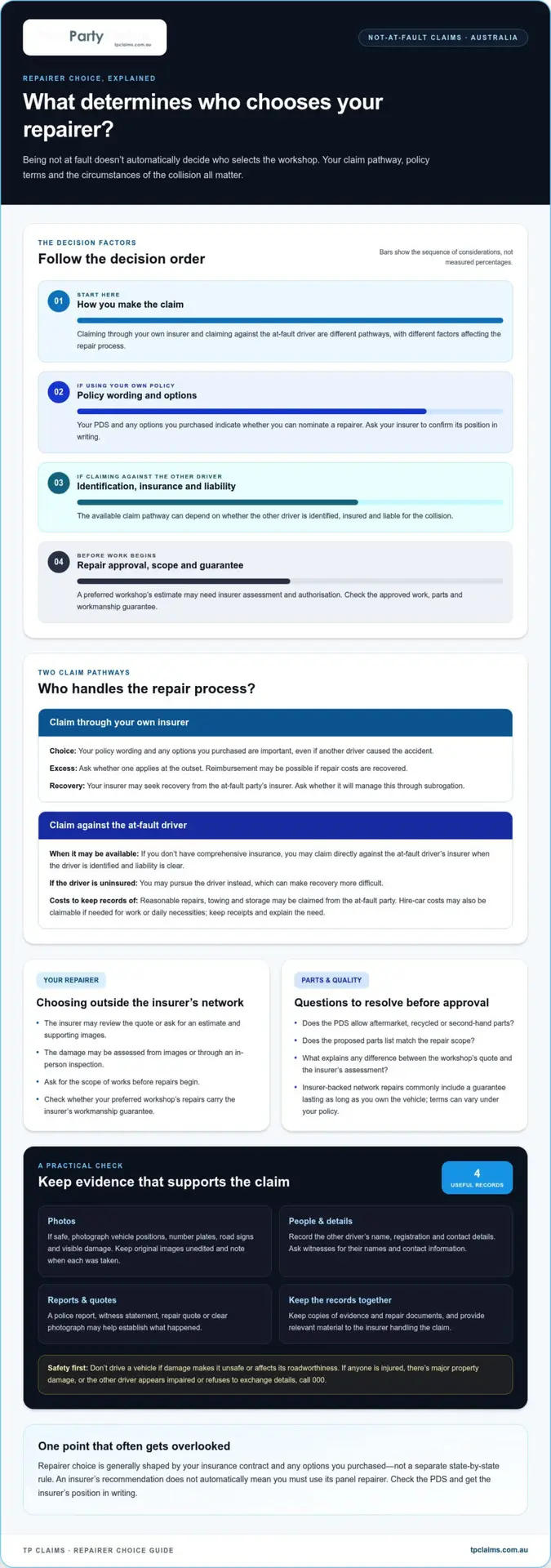
Being not at fault doesn’t automatically decide who chooses your repairer. Your choice-of-repairer rights in a not-at-fault claim in Australia depend on how you claim: if you use your own policy, its wording and any options you purchased matter; if you claim against the other driver, liability and the circumstances can affect the repair process.
It’s understandable to want a trusted workshop to repair your car while avoiding delays, unexpected excess payments and confusion about who pays. An insurer may recommend a panel repairer, but that doesn’t automatically mean you must use one. If you claim through your own insurer, your policy terms are important.
This guide explains how repairer choice can differ by claim pathway, what to do when another driver caused the damage, and what happens if your car is written off. You’ll also learn what evidence can support a claim and how to weigh repair and settlement options, helping you make a more informed decision during a stressful time.
Key Takeaways
- Your repairer choice depends on how you make the claim and, if you use your own policy, what its terms say.
- Photos, repair quotes, witness details and a police report can help support your account of how the collision happened.
- An insurer’s recommended repairer isn’t automatically your only option; understand how your policy handles repair quality and warranties.
- If another driver caused the damage, the available claim pathway can depend on whether they’re identified, insured and liable.
- A write-off settlement may use agreed or market value, while a statutory write-off cannot return to the road.
What happens when you’re in a car accident and not at fault?
After a car accident, your next steps are to record what happened, check for injuries and protect evidence. The claim pathway depends on who caused the collision, whether they’re identified and their insurance position.
Proving who caused the collision
Evidence supports your account of how the other driver caused the crash. It matters because an insurer assessing a claim needs to consider responsibility, not just the damage to your car. If it’s safe, photograph vehicle positions, number plates, road signs and visible damage. Record the other driver’s details and ask witnesses for their names and contact information.
A police report, witness statement, repair quote or clear photograph may help establish what happened. For example, photos of the damage and the vehicles’ positions may support your description of a rear-end collision. Keep copies together, note when each image was taken, and provide the material to the insurer handling the claim. Keep original images unedited.
Repair costs and recovery claims
A recovery claim seeks repair costs from the driver responsible for the collision or their insurer. If you don’t have comprehensive insurance, you may claim directly against the at-fault driver’s insurer when the driver is identified and liability is clear. If the other driver is uninsured, you may pursue the driver instead, which can make recovery more difficult.
Who pays for repairs when you are not at fault and do not have comprehensive insurance in Australia? You can seek reasonable repair costs from the at-fault driver or their insurer. If you claim through your own insurer, an excess may be payable initially, with reimbursement possible if costs are recovered.
With comprehensive cover, you can lodge a claim with your own insurer, which may then seek recovery from the at-fault party’s insurer. Ask whether your insurer will manage recovery through subrogation and whether an excess applies at the outset. The answer depends on your policy and how the insurer handles the claim.
Before moving the car, photograph its position and damage if it’s safe. Don’t drive a vehicle if damage makes it unsafe or affects its roadworthiness. If you’re unsure whether it’s safe to drive, arrange an assessment rather than risk further damage or danger. Keep towing and storage records, as you may also claim these costs from the at-fault party.
Can you claim hire-car costs while your car is repaired after a not-at-fault accident in Australia? You may be entitled to claim vehicle-hire costs if you need a car for work or daily necessities. Keep receipts and explain why you needed a replacement vehicle while yours was being repaired.
If anyone is injured, there’s major property damage, or the other driver appears impaired or refuses to exchange details, call 000. Otherwise, record the driver’s name, registration and contact details, then notify the relevant insurer. If the other driver is uninsured or won’t provide details, preserve your photos, witness information and repair documents. Those records help explain your recovery claim and the losses connected with the collision.
Ask a Smash Repairer: Do I Have to Use the Repairer My Insurer Recommends?
An insurer’s repair network can simplify assessment, but a recommendation doesn’t automatically take away your choice. Your policy wording and claim pathway help determine who selects and authorises repairs.
State and territory differences in repairer choice
Repairer choice is mainly shaped by your insurance contract and any options you purchased. Do repairer-choice rules differ by Australian state or territory? The key distinction is generally whether your policy allows you to nominate a repairer, rather than a separate state-by-state rule. Read the Product Disclosure Statement (PDS) and ask the insurer to confirm its position in writing. This matters because your policy’s repair terms may apply when you claim through your own insurer, even if another driver caused the accident.
Risks of choosing your own repairer
Choosing a workshop outside an insurer’s network can mean extra assessment or disagreement over its estimate. What are the risks of choosing your own repairer for a not-at-fault claim? The insurer may review the quote, and the repairer may need to provide an estimate and supporting images before work is authorised. Ask whether repairs by your preferred workshop carry the insurer’s workmanship guarantee. Insurer-backed network repairs commonly include a guarantee lasting as long as you own the vehicle, while terms can vary under your policy.
Repair quotes and disputes
A repair quote sets out the proposed work and its cost for the damaged vehicle. How do repair quotes and disputes work for not-at-fault car claims in Australia? After you nominate a repairer, the workshop may send its estimate and images to the insurer. The insurer can assess the damage from images or request an in-person inspection. Ask for a scope of works before repairs begin, so you can see what work is approved and how it will be completed.
Repair networks are workshops with agreements to complete work at set rates. A network repairer may make coordination with the insurer more straightforward, but the PDS still matters: it can explain whether aftermarket, recycled or second-hand parts may be used. Check the proposed parts against the repair scope and ask the insurer to explain any difference between the quote and its assessment.
Repair quality also depends on whether the completed work meets the agreed scope. An insurer is responsible for the quality of repairs performed by repairers it chose and authorised. If your own repairer is approved, keep the written authorisation, final invoice and repair documents. These records help show what work was agreed if a defect or disagreement arises later.
If your vehicle has manufacturer-specific repair procedures, ask the workshop to explain how its proposed work accounts for them. A clear answer should connect the repair plan to the damaged areas, parts and methods described in the scope. Don’t treat “manufacturer approved” as a substitute for details about the actual work. If the insurer disputes an estimate, request its assessment and compare each item with the repairer’s supporting images and quote.
If an insurer-authorised repair remains disputed, raise the issue through its complaints process and keep the correspondence. For help with managing a third-party property damage claim, a claims support service can help organise the claim and insurance discussions.
How to choose a repairer when not at fault
After an accident, your repairer can affect how damage is assessed, approved and fixed. Understanding your choice of repairer rights in a not-at-fault claim in Australia helps you compare options before committing. First, identify the claim pathway. If you use your own policy, its Product Disclosure Statement (PDS) and repair options apply. If you claim against the other driver’s insurer, clarify who will assess the damage and authorise repairs before booking work.
Compare workshops using details you can verify, not just their location or an insurer’s recommendation. Ask how the repairer documents damage, prepares an estimate and explains the proposed work. The workshop may submit its estimate and supporting images to the insurer for assessment. The insurer can review images remotely or request an in-person inspection.
- Confirm your choice in writing. Ask whether your policy lets you nominate a workshop. Keep the insurer’s written reply with your claim documents.
- Clarify repair authorisation. Find out whether the insurer must approve the estimate before work starts. Beginning without approval can lead to disputes over the agreed work.
- Ask about workmanship cover. Confirm whether the insurer will guarantee repairs by your preferred repairer, and retain its answer.
- Review the scope of works. Check which damaged areas are included and how the workshop proposes to repair them. Ask about exclusions or changes.
- Understand parts options. Your PDS may explain whether aftermarket, recycled or second-hand parts can be used.
Convenience matters, but weigh it alongside the repair process. A workshop near home may suit your routine, while one near work could make drop-off and collection easier. Ask how the workshop will share assessment updates and completed-work documents. This gives you a practical way to follow progress without relying on informal conversations.
Repair quality involves more than appearance. Compare the repair plan with your damage records and the workshop’s estimate. Ask how the proposed work addresses each damaged area and whether the insurer has approved it. If the insurer’s assessment differs, request its scope and compare each item with the repairer’s estimate.
Network repairs commonly include a workmanship guarantee for as long as you own the vehicle. An insurer is responsible for the quality of repairs performed by repairers it chose and authorised. If you nominate another workshop, ask how the guarantee and responsibility apply before accepting the arrangement. This gives you a clearer basis for weighing your preferred repairer against the network option.
Keep estimates, approvals, scopes of works, invoices and repair communications together. These records show what the workshop proposed and what the insurer authorised if a dispute arises. Your choice of repairer rights when you’re not at fault depend on the claim route and policy terms, so understand the arrangements before work begins.
What to do when another person caused the damage
Once another driver has caused damage, decide how to handle the claim before repairs begin. You can approach their insurer directly or lodge a claim through your own insurer. The right route depends on whether the other driver is identified and insured, how clear their responsibility is, and what your policy covers. Keep claim communications and decisions in writing.
If you contact the at-fault driver’s insurer, provide your account and documents supporting your claimed losses. The insurer assesses responsibility and may delay repair authorisation while considering liability. A repairer’s estimate can help explain the work required, but wait for approval before treating repairs as authorised. Ask who will assess the vehicle, what documents they need and how they’ll confirm the approved scope.
Claiming through your own insurer can provide a route to organising repairs under your policy. Ask whether it will manage recovery from the other driver’s insurer through subrogation. If an excess applies at the start, ask how reimbursement works if recovery succeeds. Read the policy disclosure documents for relevant excess and repair terms, then keep the insurer’s written explanation with your claim file.
If the other driver is uninsured, you may pursue repair and related costs from that driver. This route can be harder to resolve because no insurer is handling the other person’s side. Keep the claim focused on documented losses, such as repair, towing and storage costs. AFCA can’t consider a complaint where the other driver is uninsured, so an AFCA complaint isn’t the route for recovering those costs.
Costs beyond repairs can matter while your vehicle is unavailable. A not-at-fault claimant may seek reasonable vehicle-hire, towing and storage costs from the at-fault party. Keep invoices and explain how each cost relates to the accident. For hire, record why you needed a replacement vehicle, such as for work or daily necessities, and retain the receipts.
If your own insurer handles the claim and you disagree with its decision, use its internal complaint process. Set out the issue clearly, attach supporting documents and state what outcome you’re seeking. The insurer has 30 days to provide its internal dispute resolution decision in writing after you complain. Keep the response, because it records the insurer’s position and helps clarify the next step.
Throughout the process, give a consistent account of the accident and promptly disclose relevant information to the insurer handling the claim. If the other driver’s account differs, identify the specific point in dispute and provide evidence that addresses it. Keep copies of repair estimates, approvals and insurer messages. This makes it easier to track what has been accepted, what remains disputed and who is expected to handle each part.
Not-at-fault write-off claims
A write-off can change your claim from funding repairs to seeking a settlement for the vehicle. If another driver caused the collision, responsibility, insurance cover and the vehicle’s assessed value shape the recovery process. A car may be written off when repair costs reach around 60-70% of its market value. Insurers also consider whether damage makes the vehicle unsafe to repair.
There are two write-off classifications to understand. A statutory write-off is unsafe to repair and cannot return to the road; it may only be sold for scrap or dismantled for parts. A repairable write-off can be repaired, but it must pass a government-approved inspection before it can be re-registered. The classification affects what can happen to the vehicle after the insurance claim.
If the at-fault driver’s insurer accepts responsibility, it may settle the vehicle’s value instead of paying for repairs. A written-off car’s payout may be based on agreed value or market value at the time of the accident. If you claim through your own comprehensive policy, check its Product Disclosure Statement for how it defines the settlement value and whether an excess applies. A not-at-fault claim through your own insurer may involve recovery from the other party’s insurer.
Review the settlement offer against the vehicle’s condition and market value before accepting. For a market-value offer, gather comparable listings for vehicles with the same make, model, year and kilometres. Note differences in condition and features, then explain how those comparisons support your view. This gives the insurer concrete information to consider if you dispute its valuation.
Keep the insurer’s valuation, your comparison listings and claim correspondence together. Ask the insurer to explain how it reached its figure, including which vehicle details it used. If the offer relies on a different model year or kilometre reading, point out the discrepancy and provide documents supporting your vehicle’s details. Clear, relevant comparisons make a valuation dispute easier to assess.
Registration refunds are separate from the vehicle settlement. You may be eligible for a refund of the unused portion of your registration after a write-off, and the process varies by state. Keep your registration details and settlement documents handy when dealing with the relevant state process.
Before accepting a settlement, confirm whether the vehicle is classified as statutory or repairable, which valuation basis applies, and how the claim handles any excess. These answers affect the payout and what happens to the car next. If the fault driver’s insurer disputes responsibility or the settlement, get support with a third-party property damage claim and insurance negotiations.
TP Claims: Third Party Property Damage Claims
TP Claims manages third-party claims after a motor vehicle accident for people who were not at fault, helping them deal with the at-fault driver or insurer and pursue eligible accident-related costs. If the at-fault driver is uninsured, TP Claims can manage the claim process. Rental-car assistance is available in many cases, subject to conditions, while your vehicle is off the road.
Gather your accident details, photographs, repair documents and any insurer correspondence before discussing your situation. This information helps the claims team understand what happened and where the claim stands. If another driver caused the damage and you’d like support with your third-party claim, contact TP Claims for a free initial claim assessment, with no obligation.
Take your next step with confidence
Knowing your choice of repairer rights for a not-at-fault claim in Australia can help you approach the next conversation with a clearer idea of what needs deciding. Before the claim moves forward, consider what matters most: a repair arrangement you understand, a clear response on liability or help progressing a recovery claim. A written note of your preferred outcome can keep discussions focused as the parties assess responsibility and repair arrangements.
TP Claims offers Third Party Property Damage Claims, Insurance Negotiation Services and Claims Management for Uninsured Drivers. This support may suit you if you’re dealing with a disputed claim, confusing insurer communications or an uninsured driver, and want help managing the property-damage process.
Contact TP Claims for support and take the next step with a clearer plan. You can deal with the decisions one at a time.
Frequently Asked Questions
Need Support with Your Not-at-Fault Repair?
TP Claims can manage a third-party property damage claim if another driver caused the damage. Before seeking support, gather your claim reference, the other driver’s details, repair documents and insurer correspondence. These records help clarify whether liability has been accepted and what remains unresolved. If you’re unsure how to progress a repair or recovery claim, contact TP Claims for a free initial claim assessment, with no obligation.
Do You Choose Your Own Repairer After An Accident?
You may be able to choose your repairer, but the claim pathway and policy wording matter. If you’re claiming under your own policy, look for a choice-of-repairer option in the Product Disclosure Statement. For example, a policy may let you nominate a workshop while still requiring the insurer to assess its estimate. Ask the insurer to confirm its decision in writing before authorising repairs or agreeing to a different workshop.
What Does “Approved Repairer” Actually Mean?
An approved repairer is generally a workshop accepted by an insurer to handle repairs under its network arrangements. The insurer may have agreed rates and processes with that workshop, shaping how estimates and approvals are handled. “Approved” doesn’t, by itself, explain the repair scope or parts being used. Read the proposed scope and ask what work is authorised, especially if it differs from your repairer’s estimate.
What Happens If You’ve Paid for “Choice of Repairer”?
If your policy includes choice-of-repairer cover, check the PDS to understand how that option works for your claim. It may allow you to nominate a workshop, while the insurer still reviews the quote and authorises the repair scope. For example, your preferred repairer might submit an estimate and images for assessment before work starts. Keep evidence of the option you purchased and the insurer’s written response about using your nominated repairer.
In Australia, can a not-at-fault driver choose their own car repairer?
Often, a not-at-fault driver can nominate a repairer, but the way you claim affects the arrangements. If you claim on your own policy, its repair terms and any purchased options are relevant. If you pursue the other driver’s insurer, liability and repair authorisation can affect the process. Before work starts, ask who will approve the estimate and whether the insurer will guarantee repairs by your chosen workshop.
What does Australian law say about an insurer choosing the repairer for a not-at-fault claim?
There isn’t a general rule requiring drivers to use an insurer-selected repairer; repair arrangements for a claim on your own policy depend on the insurance contract. The PDS may explain whether you can choose a workshop and what options apply. An insurer’s recommendation alone doesn’t necessarily prevent you from nominating another repairer. Ask the insurer to identify the relevant policy wording and explain any limits in writing.
Can a not-at-fault driver claim directly against the at-fault driver’s insurer in Australia?
Yes, you may pursue repair costs from the at-fault driver’s insurer instead of claiming under your own policy. The other driver must be identified, and the insurer will assess responsibility before authorising repairs or settling the claim. For example, if liability is disputed, photographs, witness details and a repair estimate may help explain your position. Keep claim documents and insurer communications organised so you can track what’s accepted or still under review.
Can you use a preferred repairer instead of the insurer’s network repairer?
You can nominate a preferred repairer, but the insurer may assess the workshop’s quote before approving the work. Its network recommendation doesn’t automatically mean you must use that repairer; your policy terms and claim pathway matter. Before booking, ask whether your preferred workshop can submit an estimate and supporting images, and get written approval for the scope. This helps avoid starting repairs before the insurer has agreed to the proposed work.