
A total-loss payout isn’t automatically what you paid for your car. In a total loss vehicle settlement dispute over market value versus payout, the key is whether the insurer’s assessment reflects your vehicle’s value immediately before the accident: market-value cover is based on that value, while agreed-value cover uses the amount set out in your policy schedule.
It’s understandable to question an offer that doesn’t seem to cover the cost of replacing your car. But the purchase price alone doesn’t settle the issue. The vehicle’s age, condition, kilometres travelled, features and comparable cars can all affect its assessed market value.
This guide explains how actual cash value is assessed, how agreed value differs from market value, and what to check in a valuation. You’ll also learn how to compare the insurer’s figures with relevant evidence and make a clear, well-supported challenge if the payout seems too low.
Key Takeaways
- Understand how an insurer weighs pre-accident condition, comparable vehicles and repair considerations when assessing a total loss.
- Compare the certainty of an agreed value with a market-value assessment based on your vehicle’s value before the loss.
- Review the valuation report for mismatched vehicle details or comparisons that don’t reflect your car’s condition and features.
- If the payout seems too low, build a clear challenge using relevant comparable vehicles and evidence that supports your assessment.
How Is Actual Cash Value Calculated on a Total Loss?
An insurer considers whether repairs can return a vehicle to a safe condition and whether they make financial sense. If the vehicle is covered, its pre-accident value helps determine the settlement.
Repairability and write-off assessment
An assessor reviews the damage, repair methods and whether the vehicle can be returned to a safe condition. They compare expected repair costs with the car’s value and salvage considerations to decide whether repairs are uneconomical. Safety and cost are separate tests: a car may be repairable but uneconomical to fix, or too unsafe to return to the road even when repairs appear financially viable.
Actual cash value calculation
Actual cash value is the insurer’s assessment of what the vehicle was worth immediately before the loss. The insurer considers its make, model, age, kilometres, options and condition, then weighs relevant comparable vehicles. Your purchase price can provide context, but it doesn’t establish the car’s current value on its own. Check the insurer’s vehicle details against your car’s actual features and condition.
| Assessment option | Safety criterion | Cost criterion | Valuation criterion |
|---|---|---|---|
| Repair | Can it be restored safely? | Are repairs economical? | Value supports repair |
| Total loss | Is safe repair impractical? | Do repairs outweigh the case for repair? | Pre-accident value informs settlement |
Choose your next step by identifying whether the disagreement is about safety, repair costs or the vehicle’s assessed value.
There’s no universal deadline stated here for challenging an offer, so review its terms promptly and raise concerns before accepting. Acceptance can affect your ability to negotiate, so put your objection and supporting evidence in writing.
If you still owe money on the vehicle, the settlement may go to the lender first. Any amount left after the loan and applicable fees are paid goes to you, while a shortfall can leave money owing.
Before selling a vehicle, tell your insurer and arrange a policy change or cancellation to match the sale. Don’t assume the cover transfers automatically to the buyer.
For a valuation dispute, ask the insurer to explain its figures and correct any inaccurate vehicle details. If its internal complaint process doesn’t resolve the issue, use the insurer’s external dispute-resolution pathway. Keep the valuation, comparable vehicle details and written communications together.
What’s the difference between agreed and market value?
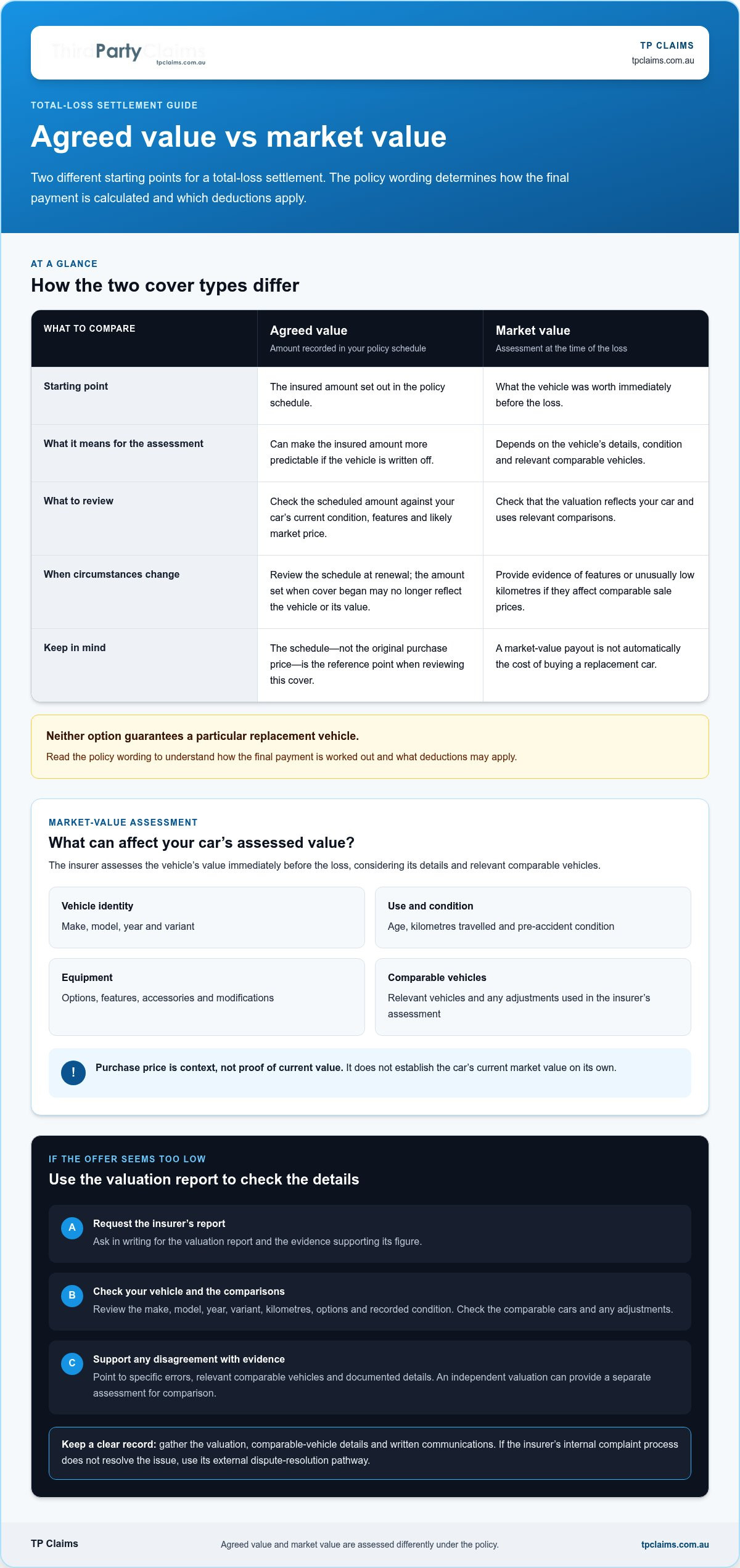
Agreed value and market value provide different starting points for a total-loss settlement. Agreed value is the amount recorded in your policy schedule, while market value is an assessment of what your vehicle was worth immediately before the loss. In either case, read the policy wording to understand how the insurer calculates the final payment and applies deductions.
Agreed value can make the insured amount more predictable if your vehicle is written off. Before choosing it, compare the scheduled figure with your car’s current condition, features and likely market price. The amount set when you first took out cover may not reflect changes to your vehicle or its value by renewal. Use the schedule, not the original purchase price, as the reference point when reviewing your cover.
Market-value cover is based on the vehicle’s value at the time of the loss, rather than the cost of buying a replacement. It may suit owners who want cover linked to current value, but the assessment depends on the vehicle’s details and condition. For example, if your car has added features or unusually low kilometres, provide evidence that these affect comparable sale prices.
- Choosing agreed value: Compare the scheduled amount with the value you’d need to replace the car and check what the policy says about settlement deductions.
- Choosing market value: Consider whether you’re comfortable with a post-loss assessment based on the car’s pre-accident value.
- At renewal: Review the schedule and update vehicle details, including modifications and condition changes.
Neither option automatically guarantees a particular replacement vehicle or covers every related expense. The policy terms decide what the insurer pays and which deductions apply. If a market-value assessment looks out of step with your evidence, keep the discussion focused on comparable vehicles and documented vehicle details. For help with a contested third-party claim, insurance negotiation support can help you put your position forward.
Requesting and reviewing a valuation report
A valuation report shows how the insurer arrived at its offer. Review the vehicle details, evidence and adjustments before deciding whether to challenge the assessment.
Requesting a valuation report
Ask the insurer in writing for its valuation report and the evidence supporting its figure. Check the make, model, year, variant, kilometres, options and recorded condition against your vehicle. Then review the comparable cars and any adjustments. The report sets out the basis of the insurer’s offer, giving you something specific to compare with your own evidence.
Independent vehicle valuations
An independent valuation gives you a separate assessment to compare with the insurer’s report. Provide accurate details, including the vehicle’s pre-accident condition, service history, accessories and kilometres. Ask the valuer to explain the assessment and identify the comparable vehicles considered. Unlike simply correcting an error in the insurer’s report, an independent assessment offers another considered view of the vehicle’s value.
Evidence of valuation errors
Identify specific mistakes rather than disputing the total without explanation. For example, point out an incorrect model variant, missing factory options, understated kilometres or a condition rating that conflicts with dated photographs. Service records, purchase documents and receipts for fitted accessories can support corrections. Link each document to the report entry it challenges so the insurer can see exactly what needs review.
Pre-accident vehicle valuations
The relevant figure is the vehicle’s fair market value immediately before the loss, not its value in its damaged state afterwards. A pre-accident valuation considers the car as it was before the collision, including its condition, specification and market context. Use dated photographs, maintenance records and accurate vehicle details to document that condition. Unlike a repair estimate, this evidence supports the vehicle’s value before the damage occurred.
Disputing a market-value assessment
For a total-loss vehicle settlement dispute over market value versus payout, focus your challenge on specific valuation errors. Show where the insurer’s assessment differs from your vehicle’s details or relevant comparable cars, rather than relying only on the gap between its offer and the amount you expected.
Start by checking that the insurer’s report records the correct make, model, year, variant, kilometres, options and condition. Then assess each comparable vehicle: does it match your car’s specification and condition? A different variant or substantially higher kilometres may make a comparison less relevant. Identify the mismatch and explain how it could affect the valuation.
Make your counteroffer precise. State the insurer’s assessed value and the amount you’re requesting, then attach evidence to support your figure. Comparable listings can indicate asking prices, while service records, dated photographs and purchase documents can establish your car’s details. Keep comparisons as like-for-like as possible, including location and specifications where available.
- Identify the error: Point to the incorrect detail or unsuitable comparable in the report.
- Support your position: Attach documents or listings that address the specific issue.
- State your request: Set out the insurer’s value and your proposed amount in writing.
- Keep a record: Save your submission and the insurer’s response with your claim documents.
For example, if the report describes your car as a base model, provide purchase or registration documents showing its higher factory variant. Ask the insurer how it accounted for that difference and whether it will reassess its comparisons. A second valuation can also support your position if it explains its method and evidence. This gives your total-loss vehicle settlement dispute over market value versus payout a clear, documented basis.
If the insurer doesn’t address your evidence, make a formal complaint through its complaints process. Include the valuation, your counteroffer and the disputed details. For a valuation dispute involving a truck collision, get help with a truck collision dispute and organise your claim evidence.
TP Claims: Third Party Property Damage Claims
TP Claims manages third-party property damage claims, including negotiations when a vehicle’s assessed value or settlement is disputed after an accident caused by another driver. If you’re dealing with an insurer and need help organising your claim, TP Claims can manage the claims process and insurance negotiations.
TP Claims also manages claims involving uninsured drivers. This can be relevant if the at-fault driver has no insurance and you need to pursue a property damage claim. The service focuses on vehicle damage claims, not personal injury or insurance cover.
If the accident has left you without transport, TP Claims can arrange an accident replacement vehicle in many cases, subject to conditions, while your claim is being managed. Contact TP Claims to discuss your third-party motor vehicle claim and the support you need.
Take the next step with your claim
Before taking further action, decide what you need the insurer to reconsider. A clear written position keeps the discussion focused: identify the part of the assessment you dispute, explain why it matters and state the outcome you’re seeking. Keep your supporting documents and correspondence together so you can respond consistently if the insurer asks for clarification.
If another driver caused the accident and you’re dealing with a total-loss vehicle settlement dispute over market value versus payout, TP Claims offers Third Party Property Damage Claims and Insurance Negotiation Services. It also manages claims involving uninsured drivers. These services are for third-party motor vehicle claims, not personal injury matters or insurance cover.
You can contact TP Claims for help with your claim and discuss a practical next step. A clear, evidence-based approach puts you in a stronger position to move the conversation forward.
Frequently Asked Questions
Can my agreed value end up lower than my car’s actual worth?
Yes. The agreed value in your policy schedule can be lower than what your car might sell for at the time of a loss. For example, your car’s market price could rise if it becomes more desirable or gains valuable features, while the scheduled amount stays the same. Review the figure at renewal and update it if your vehicle’s circumstances have changed.
Does the deductible come out of a total loss settlement?
It depends on the policy and the claim. Check the settlement calculation and policy wording to see whether an excess applies and how it affects the payment. If another driver caused the accident, the excess may be handled differently from a claim under your own policy. Ask the insurer to identify any deduction and explain its basis in writing.
How is the market value of my car calculated in a claim?
The insurer assesses what your car was worth immediately before the accident, rather than simply refunding its purchase price. The vehicle’s age, variant, kilometres, features and condition help determine that value, along with comparable vehicles. For example, a higher-spec model shouldn’t be treated as identical to a base model. Check the report’s vehicle description and comparisons for details that could affect the assessment.
The work is relevant evidence of your vehicle’s pre-accident condition, but an invoice doesn’t automatically increase the settlement by the full amount spent. Provide the invoice, repair details and any warranty documents, then explain how the work affected the vehicle’s condition or market appeal. The insurer assesses the car’s value before the accident, not reimbursement for each repair expense.
How is a vehicle’s market value calculated for an insurance total loss settlement in Australia?
For market-value cover, the assessment focuses on the vehicle’s value immediately before the loss. The insurer considers the car’s identifying details, condition, kilometres and equipment, then compares it with similar vehicles. Australian listings can help you judge whether the comparisons resemble your car. Look beyond advertised prices: differences in variant, age or condition can make a listing a poor match.
What is the difference between agreed value and market value car insurance in Australia?
Agreed value is the amount stated in your policy schedule; market value is an assessment of what your car was worth immediately before the loss. The first gives you a scheduled figure to refer to, while the second depends on the vehicle’s details and market evidence at claim time. When reviewing cover at renewal, compare your schedule with your car’s current circumstances.