
Dragging a disputed vehicle claim into a formal tribunal isn’t the fastest way to get your car back on the road. When an at-fault driver suddenly denies liability or their insurer stalls on vehicle assessments, managing third party property damage dispute resolution on your own feels like an exhausting, one-sided battle.
You shouldn’t have to endure lowballed repair valuations, rejected replacement car expenses, or endless paperwork while you’re left stranded without wheels. It’s completely understandable to feel overwhelmed when an uncooperative insurance assessor treats your time and property like an afterthought. You just want your vehicle repaired properly to manufacturer standards, your daily mobility protected, and the at-fault party held fully accountable.
This guide explains how to resolve third party property damage disputes efficiently, protect your recovery rights, and secure a full settlement without upfront legal costs. We’ll walk through practical ways to counter stubborn insurers, stay mobile with an accident replacement vehicle during your claim, and finalise your dispute anywhere in Australia with complete peace of mind.
Key Takeaways
- Identify the core triggers behind insurer delays, from disputed liability and repair scope conflicts to rejected vehicle rental costs.
- Compare your options across internal reviews, formal tribunals, and claims advocacy to choose the most effective third party property damage dispute resolution pathway.
- Build an airtight evidentiary case with contemporaneous scene records and independent quotes to firmly counter lowball settlement offers.
- Overcome complex hurdles when recovering losses from uninsured motorists or handling commercial truck collision disputes.
- Stay fully mobile with an accident replacement vehicle and secure fair compensation through cost-protected, no-win-no-fee representation.
Understanding Third Party Property Damage Disputes: Common Triggers
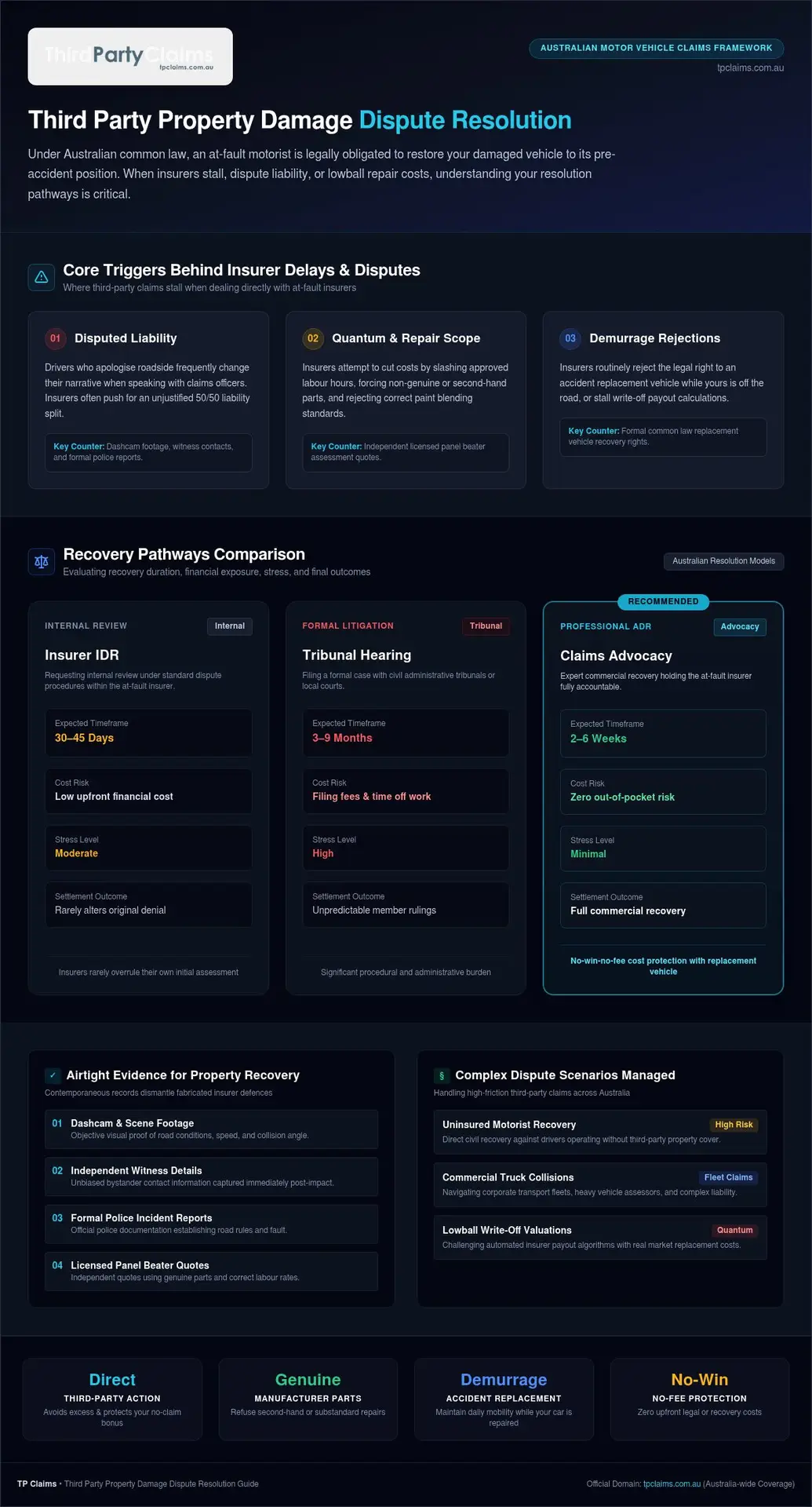
Under Australian common law, any driver who negligently damages your vehicle is legally responsible for restoring you to your pre-accident position. Pursuing third party property damage dispute resolution means holding the at-fault motorist and their insurer directly accountable for your losses. Many motorists reflexively lodge a claim through their own comprehensive insurer, only to find themselves paying an upfront excess and risking their no-claim bonus. Taking direct third-party recovery action protects your own policy history, but it also pits you against corporate claims teams trained to protect their bottom line.
Managing this pushback on your own leaves you vulnerable to unfair delays. Commercial disputes rarely stem from simple misunderstandings. Instead, they occur because insurers routinely challenge liability, dispute repair methodologies, or reject demurrage claims, the legal right to an accident replacement vehicle while yours is off the road. When informal talks stall, leveraging alternative dispute resolution (ADR) frameworks or professional claims negotiation helps dismantle these road-blocks without resorting to drawn-out litigation.
Liability Disagreements and Conflicting Accident Narratives
At-fault motorists frequently apologise roadside, only to change their story once they speak with their claims officer. Without immediate evidence, insurers will happily claim the accident was unavoidable or push for a 50/50 liability split. Objective evidence like dashcam footage, independent witness contact details, and formal police reports quickly defeats these revisionist accounts. Understanding how to deal with other driver’s insurance ensures you avoid misleading phone interrogations designed to trick you into accepting partial blame.
Quantum Disputes: Repair Quotes vs Insurer Allowances
Even after liability is settled, disputes commonly flare over quantum, the actual financial cost of the repairs. Third-party insurers often attempt to discount estimates prepared by licensed, independent panel beaters. They do this by slashing approved labour hours, insisting on second-hand or non-genuine components, and disputing paint blending standards. Similar conflicts arise if your car is written off; an insurer’s valuation algorithm often produces a lowballed payout figure that falls short of real market replacement costs. You aren’t obligated to accept substandard repairs or insufficient write-off sums that leave you out of pocket.
Comparing Dispute Pathways: Internal Reviews, Tribunals, and Claims Advocacy
When an at-fault driver’s insurer refuses to cooperate, choosing the right third party property damage dispute resolution path determines how quickly you recover your losses. Self-represented drivers often default to formal legal channels without understanding the administrative hurdles involved. Comparing the realistic timeframes, financial exposure, and emotional toll of each recovery method helps you avoid costly procedural traps.
| Dispute Pathway | Timeframe | Cost Risk | Stress Level | Settlement Outcome |
|---|---|---|---|---|
| Insurer IDR | 30–45 Days | Low | Moderate | Rarely alters original denial |
| Tribunal Hearing | 3–9 Months | Filing fees & time off work | High | Unpredictable member rulings |
| Claims Advocacy | 2–6 Weeks | Zero out-of-pocket risk | Minimal | Full commercial recovery |
Internal Dispute Resolution (IDR) and AFCA Limitations
Requesting an internal review forces the insurer to review your file under statutory response caps. However, non-policyholder rights remain severely limited under these reviews. While the Australian Financial Complaints Authority (AFCA) handles consumer issues according to established guidelines on financial dispute resolution, third-party claimants cannot always compel an at-fault driver’s insurer to participate without specific conditions being met.
Civil and Administrative Tribunals: Risks of Self-Representation
State-based civil registries offer a legal recourse mechanism, but self-representation carries real dangers. Flawed evidence bundles, missed filing deadlines, or incorrect corporate entity service can see your application dismissed outright. Spending months preparing legal submissions and taking unpaid leave for contested hearings often costs more in lost income than the initial vehicle damage is worth.
Professional Claims Management: The Low-Friction Alternative
Specialised claims advocates level the field by dealing directly with corporate assessors on equal technical footing. Instead of enduring tribunal delays, master the core rules of negotiating with insurance companies after accident events to secure settlement leverage. With dedicated representation handling your third party property damage dispute resolution under a no-win-no-fee structure, you eliminate legal fee risks completely. If you want to bypass the claims friction and keep moving, you can connect with our claims recovery team to manage the process from start to finish.
Building an Unshakeable Evidentiary Case for Property Recovery
Insurers pay claims based on documentation, not emotional appeals. Securing a complete settlement before stepping foot inside a courtroom requires an airtight evidentiary trail that conclusively establishes liability and quantifies your losses. An early, structured strategy forces corporate assessors to take your claim seriously and expedites your third party property damage dispute resolution.
Follow these essential steps to lock down your claim:
- Capture Scene Proof: Photograph vehicle positions, skid marks, traffic signals, and street signage immediately. Record contact details for independent eyewitnesses and secure the official police event number.
- Source Independent Quotes: Obtain a detailed repair estimate based strictly on Original Equipment Manufacturer (OEM) repair methods rather than cut-rate insurer algorithms.
- Track Consequential Losses: Gather receipts for emergency towing, vehicle storage charges, and replacement transport needed for work or family commitments.
- Serve a Formal Letter of Demand: Issue a professional demand letter setting out the legal basis of liability, itemising every dollar claimed, attaching supporting documentation, and giving a strict 14-day payment deadline.
Automotive Assessment Reports and Independent Quoting
Automated insurer estimating systems are designed to compress labour rates and recommend aftermarket panels. Independent vehicle assessors counter this by completing hands-on physical inspections that reflect genuine Australian repair standards. If you’re currently facing an insurance company lowballing car repair estimate, an independent report acts as your strongest shield. It establishes correct paint blending operations, necessary structural realignments, and OEM parts usage, making it difficult for an opposing assessor to justify arbitrary deductions under Australian consumer and commercial repair guidelines found across regulatory dispute resolution frameworks.
Establishing Need for Demurrage and Loss of Use
Under Australian common law, you have a clear legal right to recover reasonable loss-of-use costs, commonly known as demurrage. If you require a vehicle for daily commuting, school drop-offs, or commercial trade while yours is undergoing repairs or awaiting assessment, the at-fault party is liable for those replacement rental costs. Securing these funds requires demonstrating a legitimate need for a like-for-like replacement vehicle and showing you actively mitigated your losses by avoiding unnecessary hire periods. Combining detailed hire records with your initial vehicle assessment solidifies your complete loss profile and prevents the third party from ignoring rental bills.
Navigating Complex Disputes: Uninsured Drivers and Lowball Tactics
Collisions involving commercial freight vehicles or uninsured motorists quickly complicate third party property damage dispute resolution. When dealing with commercial truck collision disputes, you aren’t just negotiating with an everyday insurer; you’re facing corporate risk departments that deliberately delay responses to wear you down. Adding statutory interest claims and formal costs warnings to your correspondence reminds corporate claims teams that stonewalling carries accumulating financial liabilities.
Pursuing Property Damages Against Uninsured Motorists
When the at-fault motorist lacks property cover, major insurers offer little guidance. You still hold full common-law rights to recover every cent of vehicle repair or write-off losses directly from them. If an uninsured driver stops taking your calls, skip-tracing and pre-litigation asset checks uncover their employment or registered assets before you spend time on enforcement.
From there, negotiating structured instalment agreements backed by formal consent terms often yields practical payouts without a protracted trial. If you’re struggling to track down an uncooperative driver, accessing specialised third party property damage claim help removes the burden of personal debt recovery while safeguarding your settlement entitlements.
Countering Common Insurer Reduction and Delay Strategies
Institutional insurers rely on standard playbook friction: repeated vehicle re-inspections, claiming files were misplaced, and sudden radio silence. Another frequent hurdle is “betterment” deductions, where an assessor subtracts money from your payout by alleging new replacement parts unfairly improve your car’s pre-accident value.
Cut through these stall tactics by demanding formal escalation in writing. Remind the claims handler of industry code timeframes and state clearly that continued delays will prompt immediate dispute lodgement alongside claims for consequential losses. You don’t have to tolerate unreturned calls or unfair deductions while your car sits damaged.
If a stubborn insurer or uninsured driver refuses to settle your claim fairly, lodge your dispute with TP Claims today to let our experienced specialists recover your vehicle losses without upfront legal fees.
Resolving Disputes with No-Win-No-Fee Professional Advocacy
Managing an adversarial insurer on your own drains your energy and wastes valuable time. An end-to-end recovery specialist steps directly into your shoes, acting as a robust buffer between you and stubborn claims assessors. By taking over all correspondence, evidence gathering, and formal negotiations, professional advocates transform a chaotic experience into a streamlined, hands-off process.
Operating under a strict no-win-no-fee model removes financial hesitation entirely. You gain access to dedicated industry expertise and technical dispute leverage without worrying about upfront costs or out-of-pocket expenses. This structure levels the legal playing field across Australia, ensuring large insurance corporations cannot pressure you into an unfair compromise simply by dragging their feet during third party property damage dispute resolution.
Staying Mobile: Seamless Accident Replacement Vehicles
A collision should not bring your daily routine to a halt. While insurers stall on repair authorisations or dispute write-off values, eligible not-at-fault motorists are legally entitled to remain mobile. Securing a replacement car after accident not at fault incidents ensures you continue getting to work, managing family duties, and running your business without interruption. Dedicated claims specialists deliver a comparable vehicle to your door and recover the entire hire cost directly from the at-fault party’s insurer as part of your overall common-law damages.
The Step-by-Step Pathway to Complete Settlement
Securing a full settlement follows a clear, methodical process designed to minimise your stress:
- Initial Case Assessment: You lodge your accident details and evidence online, allowing our team to confirm liability and review the crash circumstances immediately.
- Independent Assessment: We arrange a comprehensive, independent vehicle inspection to document the exact scope of manufacturer-standard repairs or determine fair market value.
- Direct Negotiations: Our specialists pursue the at-fault party or their insurer, countering lowball estimates and pushing back against unwarranted delays.
- Full Recovery: If the opposing insurer refuses to settle reasonably, we prepare complete legal briefs to enforce your rights and finalise your recovery.
You don’t have to face corporate delay tactics alone. Engage TP Claims for expert dispute resolution today and let our national team handle the heavy lifting while you stay mobile.
Take Control of Your Property Damage Recovery
A vehicle collision shouldn’t trap you in bureaucratic stalemates or force you to accept discounted repair scopes. Armed with solid scene evidence and independent assessments, third party property damage dispute resolution doesn’t have to mean months of stressful tribunal filings or exhausting phone calls with unhelpful claims handlers.
You have the legal right to restore your vehicle properly and stay mobile without financial strain. TP Claims provides nationwide support, managing your insurer negotiations and securing an accident replacement vehicle while eliminating financial risk through no-win-no-fee property claims management with zero upfront legal costs. From private passenger cars to specialised commercial truck dispute resolution, our advocates carry the burden so you don’t have to. Speak with our Australian claims specialists to resolve your dispute today and put this accident firmly behind you.
Frequently Asked Questions
What qualifies as a third party property damage dispute in Australia?
A dispute occurs when a not-at-fault vehicle owner cannot reach an agreement with the responsible driver or their insurer over accident costs. Under Australian common law, this includes conflicts over who caused the crash, disagreements on genuine parts versus aftermarket alternatives, write-off market valuations, and rejected replacement vehicle hire fees.
How long does a third party property damage dispute usually take to resolve?
Most disputes settle within two to six weeks when managed by specialised claims advocates through direct commercial negotiation. If you attempt self-representation through state civil tribunals or wait on insurer internal reviews, third party property damage dispute resolution can drag out between three and nine months due to registry backlogs and strict document schedules.
Can I claim for a replacement vehicle while my property claim is in dispute?
Yes, not-at-fault motorists have an established legal right to a comparable accident replacement vehicle while their own car is unroadworthy or undergoing repairs. Under Australian demurrage principles, the at-fault driver’s insurer is responsible for reasonable rental costs, provided you demonstrate a genuine need for transport and avoid unnecessary delays.
What happens if the at-fault driver has no insurance and disputes the repair quote?
You can pursue the at-fault driver directly for all repair costs, towing fees, and loss-of-use expenses. When an uninsured driver disputes your quote, an independent vehicle assessment report verifies the damage scope. Claims specialists can then establish enforceable instalment agreements or take formal recovery steps to secure your settlement.
Can an insurer force me to accept an assessment from their preferred smash repairer?
No, an at-fault driver’s insurer cannot dictate where your car is repaired or force you to accept their preferred repair network. You are legally entitled to have your vehicle restored to its pre-accident condition using manufacturer-standard repair methods. An independent assessor’s quote ensures you don’t receive substandard repairs or second-hand parts.
Do I have to go to a tribunal or court to resolve my property damage claim?
Tribunal hearings are rarely necessary. The vast majority of vehicle property claims settle through structured pre-litigation negotiations once robust evidence, independent assessments, and formal Letters of Demand are presented. Professional claims management resolves the dispute commercially, sparing you the stress, lost wages, and procedural rules of self-representation in court.
How does no-win-no-fee work for third party property damage claims?
Under a no-win-no-fee agreement, you pay zero upfront costs or out-of-pocket expenses for claims representation. Your claims management team handles all insurer negotiations, independent inspections, and paperwork on your behalf. This structure removes your financial risk while completing third party property damage dispute resolution, as recovery costs are settled through the claim itself.