
When an at-fault driver’s insurer contacts you, they aren’t looking out for your best interests; they’re protecting their own balance sheet. If you’re feeling stressed by lowball quotes, dismissive claims handlers, or vehicle downtime, you aren’t alone. Successfully negotiating with insurance companies after accident damage shouldn’t feel like an exhausting battle, yet innocent motorists across Australia are routinely pressured into substandard repairs or left stranded without transport.
You shouldn’t have to compromise on vehicle safety or shoulder the cost of someone else’s mistake. In this guide, you’ll discover how to counter insurer settlement tactics, enforce your legal rights, and recover your full repair costs to restore your vehicle to pre-accident condition. We’ll also explain how to secure a comparable replacement car without upfront rental fees, giving you the confidence to protect your position or hand the stressful dispute over to an experienced advocate on a no-win-no-fee basis.
Key Takeaways
- Recognise how at-fault insurers use internal claim targets and remote desktop assessments to undervalue your property damage.
- Protect your vehicle’s safety and value by insisting on independent quotes and manufacturer-standard repairs over cut-price network fixes.
- Discover why negotiating with insurance companies after accident disputes through an independent claims specialist removes stress and prevents settlement shortfalls.
- Structure your repair documentation and formal settlement demands methodically to eliminate insurer delays and liability disputes.
- Exercise your Australian common law right to remain mobile in a comparable replacement vehicle while repairs proceed, without paying upfront rental fees.
Why Negotiating with Insurance Companies After an Accident Favours the Insurer
When you enter talks with an at-fault driver’s insurer, you aren’t dealing with a neutral referee. You’re confronting a multi-billion-dollar commercial business focused squarely on managing financial loss. A deep conflict of interest exists between an innocent driver seeking full restoration and an insurer balancing underwriting margins. For the insurer, every dollar stripped from your vehicle repair estimate directly protects their annual profit.
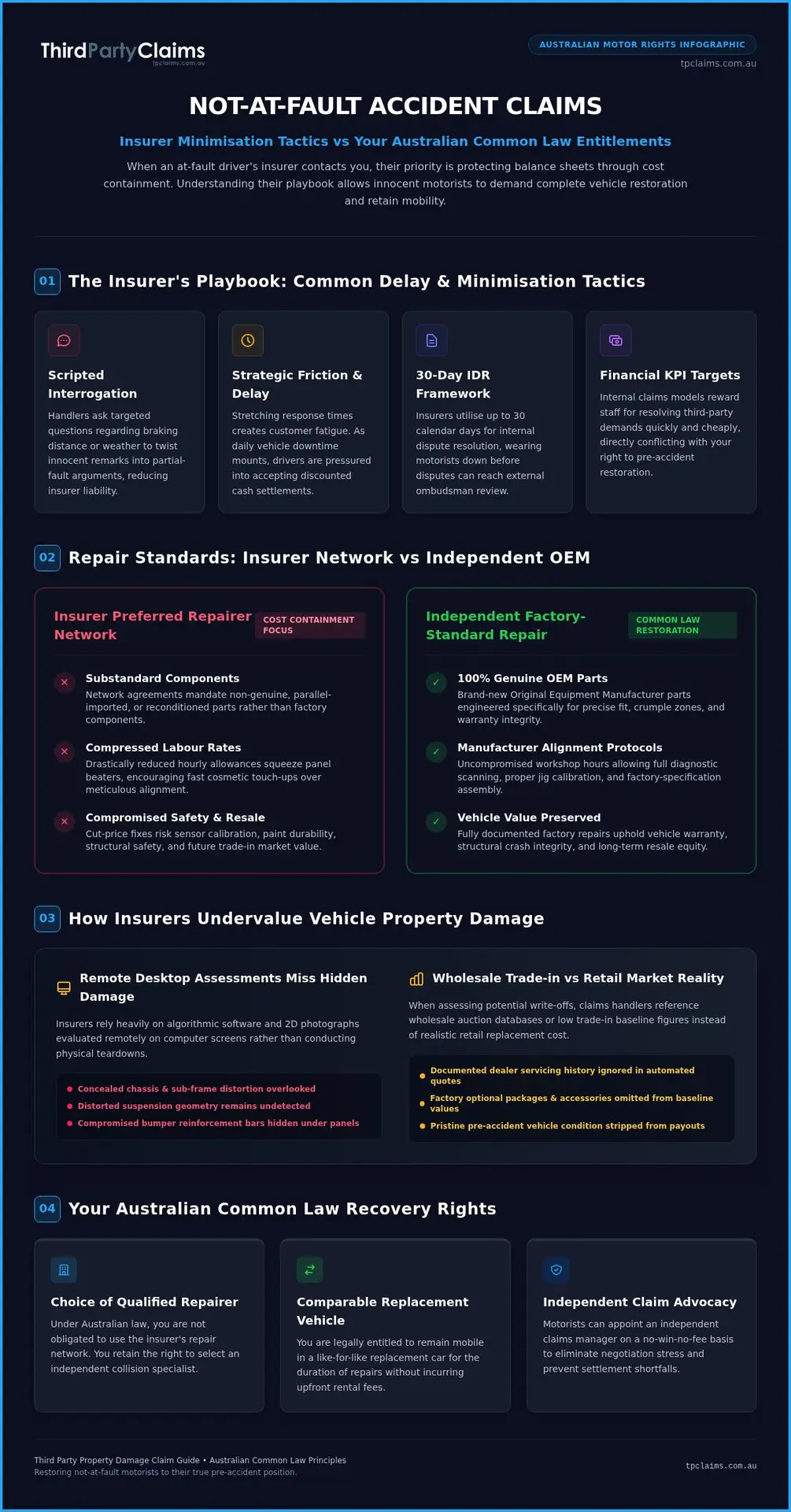
Internal claims-handling models are designed around cost containment rather than restoring your vehicle to its pre-loss state. Claims teams work under strict financial KPIs, rewarding staff who resolve third-party demands quickly and cheaply. If you attempt negotiating with insurance companies after accident damage without expert backing, adjusters rely heavily on friction and delay. They know that as your vehicle sits idle, daily inconvenience mounts. Many drivers eventually give in, accepting reduced cash payouts simply to end the administrative headache. To protect yourself from day one, review our detailed guide on how to deal with other driver insurance before opening discussions.
The Corporate Playbook: Common Delay and Minimisation Tactics
Insurers often stall communications intentionally. By stretching response times, they generate customer fatigue that forces early, discounted settlements. During phone conversations, claims handlers use carefully scripted questions to prompt inadvertent remarks about braking distances or weather conditions. They then twist these innocent comments into partial fault arguments to reduce liability.
Internal dispute resolution (IDR) frameworks can also drag negotiations out for weeks. Under regulatory rules, insurers have up to 30 calendar days to deliver an IDR response. While genuine disputes may eventually escalate to the Australian Financial Complaints Authority, unrepresented motorists often exhaust their patience and compromise long before external adjudication takes place.
The Problem with Preferred Repairer Networks and Cheap Parts
Insurers frequently push not-at-fault drivers toward their preferred repairer networks. While framed as a convenient service, this network structure often relies on aggressive cost cutting:
- Substandard Components: Network agreements frequently mandate non-genuine, parallel-imported, or reconditioned parts rather than brand-new Original Equipment Manufacturer (OEM) components.
- Compressed Labour Allowances: Drastically reduced repair rates squeeze panel beaters, encouraging fast cosmetic fixes over meticulous, factory-spec structural alignment.
- Sacrificed Resale Value: Inadequate repairs compromise vehicle safety systems, paint longevity, and future trade-in value.
Australian common law principles grant you the explicit right to restore your property properly. When negotiating with insurance companies after accident collisions, you have the right to select an independent, qualified collision repairer who prioritises manufacturer standards over an insurer’s profit margins.
How Insurers Assess Motor Property Damage and Undervalue Claims
Insurance companies increasingly rely on algorithmic quoting tools and remote desktop assessments to evaluate property damage. Instead of sending a qualified assessor to physically dismantle and inspect your car, a claims officer reviews low-resolution photos on a screen. This shortcut inevitably misses concealed structural defects, distorted suspension geometry, and compromised bumper reinforcement bars beneath modern composite panels.
When assessing overall loss, insurers benchmark your car against wholesale auction databases or private trade-in figures rather than current retail replacement value. By leaning on selected base figures, they systematically strip away the real-world value of optional extras, documented mechanical history, and pristine condition. If you are struggling with a low assessment, consulting a dedicated service for third party property damage claim help ensures every physical loss and vehicle depreciation factor is properly evidenced from the outset.
Challenging Total Loss Valuations and Unfair Write-Offs
Insurers write off a vehicle when estimated repair costs, combined with anticipated salvage returns, exceed their calculation of its pre-accident market value. You are never obligated to accept an arbitrary baseline payout figure. Challenging an insurer’s deflated pre-accident valuation requires replacing internal trade estimates with documented retail proof.
To overturn a deficient total loss figure, gather 5 to 10 live advertisements of comparable vehicles on major Australian automotive sales platforms, ensuring identical make, model, year, trim, and odometer readings. If you wish to retain your damaged car, common law allows you to claim the agreed pre-accident retail value minus an independently verified, fair salvage quote rather than an inflated insurer salvage estimate.
Recovering Hidden Consequential Losses and Demurrage
Under Australian common law and the principles outlined in the ASIC Moneysmart guide to claiming on car insurance, restoring your position goes beyond superficial panel repairs. True recovery covers all financial losses resulting directly from the collision:
- Diagnostic Testing: Pre-repair and post-repair electronic diagnostic scans and ADAS radar sensor recalibrations are essential safety items that must be paid in full.
- Towing and Safe Holding: You are legally entitled to recover all reasonable initial towing costs, secondary recovery transport, and daily secure holding yard fees.
- Commercial Demurrage: Owners of revenue-generating work vehicles, tradie utilities, or transport rigs can recover documented lost operating profit for every day their vehicle sits off the road.
Mastering the complexities of negotiating with insurance companies after accident events shouldn’t pull you away from your daily work. If you suspect an adjuster has omitted critical structural repairs or undervalued your claim, getting support from an experienced recovery specialist at tpclaims.com.au can ensure your property rights are fully protected without upfront costs.
Self-Negotiation vs Professional Claims Management: Evaluating Your Options
Facing a major insurer on your own can quickly turn into an exhausting part-time job. Adjusters manage hundreds of files each month and possess significant tactical advantages over everyday drivers. When negotiating with insurance companies after accident damage as an unrepresented motorist, your settlement demands often encounter automated resistance, deflated labour rates, and protracted delays. In contrast, claims lodged by recognised industry specialists signal that the claim will be pursued to its full common law entitlement.
Many community resources assume you must either represent yourself or incur heavy upfront legal bills with a private solicitor. That is an unnecessary choice. The table below highlights how managing your claim compares across available pathways:
| Recovery Avenue | Out-of-Pocket Expense | Time and Administrative Burden | Settlement Leverage |
|---|---|---|---|
| Self-Negotiation (DIY) | Nil initially, but risks unfair shortfall cuts | Extremely high; constant calls and paperwork | Low; adjusters exploit procedural unfamiliarity |
| Traditional Solicitor | High hourly fees and retainer costs | Moderate; requires frequent client instructions | High; formal litigation pressure |
| Claims Management | Strictly no-win-no-fee; zero upfront costs | Zero; fully managed on your behalf | High; deep industry expertise and peer standing |
The Hidden Risks of Handling Complex Insurance Negotiations Alone
A single misspoken phrase can severely undermine an innocent driver’s financial recovery. Claims handlers frequently exploit slight ambiguities regarding speed or road positioning to argue contributory negligence, slashing legitimate payouts by arbitrary percentages. Accepting a quick verbal settlement or signing premature release forms before obtaining comprehensive independent assessment quotes leaves you personally liable for hidden mechanical damage.
Missing statutory deadlines or failing to issue compliant letters of demand under court rules can derail your claim entirely. While the official Moneysmart guide to car insurance claims outlines baseline rights, enforcing those standards against uncooperative corporate assessors demands relentless follow-up.
The No-Win-No-Fee Claims Management Model Explained
Independent claims management provides a level playing field against corporate insurers without putting your finances on the line. Working on a strict no-win-no-fee model, dedicated specialists take full control of your third-party claim from the moment of impact. They coordinate rigorous independent inspections, challenge lowball valuations, and direct all correspondence away from your personal phone.
Under Australian common law tort indemnity, the at-fault driver’s insurer is legally liable for reasonable management and recovery costs incurred in restoring your property. This proven framework allows you to secure proper vehicle restoration and protect your legal position without paying upfront professional fees.
Step-by-Step Guide: How to Structure and Negotiate Settlement Demands
Successfully negotiating with insurance companies after accident collisions requires a disciplined, evidence-first strategy. At-fault insurers bank on missing documentation to challenge liability or trim repair estimates. Under Australian tort law, an innocent motorist is entitled to full restitution, meaning the liable party must place you back into the exact physical and financial position you occupied before the collision occurred. Securing that standard depends entirely on the strength of your initial demand file.
Step 1: Compiling Complete Liability and Technical Evidence
Before contacting the other party’s insurer, assemble an irrefutable portfolio of facts. Clear evidence prevents handlers from disputing basic roadside events:
- Liability Verification: Secure front-and-rear dashcam footage, high-resolution crash scene photographs showing skid marks and vehicle positions, independent witness statements, and the official police event number.
- Technical Repair Assessment: Obtain an itemised quotation from a licensed, independent repairer specifying Original Equipment Manufacturer (OEM) repair methodologies and mechanical safety diagnostics.
- Direct Expenses: Collate all secondary towing tax invoices, secure storage yard dockets, and emergency vehicle recovery receipts.
Step 2: Formulating an Irrefutable Letter of Demand
Draft a formal Letter of Demand addressed directly to the at-fault driver and their insurer. State the exact date, time, and physical dynamics of the collision, confirming the third party’s sole negligence. Clearly enumerate every loss component, referencing your attached quotes and towing receipts as numbered annexures.
Set a strict 14-day or 28-day settlement deadline for payment in full. State plainly that failure to settle within this statutory timeframe will result in immediate recovery escalation through civil proceedings without further notification.
Step 3: Handling Insurer Counteroffers and Apportionment Tactics
Insurers routinely counter valid demands by asserting 20% to 50% contributory negligence, claiming you braked suddenly, failed to keep a proper lookout, or travelled too fast for conditions. Never accept these apportionments over the phone.
Respond strictly in writing, dismantling their claims using your physical evidence, photographic telemetry, and road-rule references. If an adjuster remains dismissive or continues to delay your rightful payout, do not spend weeks arguing in circles. You can transfer the burden entirely by choosing to appoint an expert motor claims specialist at TP Claims to enforce your full recovery on a strict no-win-no-fee basis.
Securing Your Complete Legal Entitlements Without Out-of-Pocket Expense
When you’re the innocent party in a crash, your legal remedy extends far beyond basic panel repairs. Australian common law protects your right to maintain your normal routine while your vehicle is repaired or replaced. Losing the daily use of your car is a recognised form of property damage, meaning you aren’t expected to rely on public transport or burden family members. Securing a replacement car after an accident at no upfront cost is an established legal entitlement, ensuring your mobility remains seamless from the moment of impact.
As a national third-party claims management specialist, TP Claims acts as your dedicated protective barrier. We step directly between you and defensive insurance assessors, coordinating manufacturer-aligned repairs, securing replacement transport, and managing all legal paperwork. You never have to compromise your entitlements or pay upfront fees, because our full claims management operates on a strict no-win-no-fee foundation.
Your Right to a Comparable Replacement Vehicle During Repairs
Under established High Court precedent, not-at-fault drivers have a clear right to recover the reasonable cost of a broadly equivalent, like-for-like vehicle. This principle compensates you for loss of amenity and physical inconvenience during repair downtime. Whether you drive a family SUV, an electric vehicle, or a commercial utility, you are entitled to a comparable class of car.
These rental charges are recovered directly from the at-fault driver’s insurer as consequential property losses. You won’t pay upfront daily hire rates or risk unexpected bills while awaiting settlement.
Resolving Uninsured Driver and Heavy Vehicle Commercial Disputes
Challenging scenarios multiply when the liable motorist is entirely uninsured or operating a commercial freight vehicle. When negotiating with insurance companies after accident collisions involving corporate fleet insurers or heavy transport rigs, drivers face aggressive resistance from commercial litigation teams.
Uninsured drivers often attempt to evade financial accountability altogether, while commercial fleet adjusters dispute repair quotes to minimise fleet downtime payouts. Expert claims managers handle these hostile interactions directly, enforcing debt recovery and defending your rights against commercial opposition.
Taking Action: How to Initiate Independent Claims Management
Recovering your vehicle shouldn’t drain your personal energy. Stepping away from adversarial negotiations requires just three simple steps:
- Lodgement: Submit your accident details, driver exchange records, and crash photos through our secure, paperless online form.
- Mobility: Receive immediate delivery of a comparable replacement vehicle while your damaged car is safely booked into an independent repair facility.
- Resolution: Let dedicated claim advocates finalise all third-party demands, repair invoices, and settlement negotiations.
Take control of your claim today. Hand over the exhausting paperwork to TP Claims and let qualified advocates recover your vehicle’s full pre-accident standard without paying a cent out of pocket.
Reclaim Your Peace of Mind and Protect Your Vehicle Entitlements
Dealing with the aftermath of a crash is stressful enough without corporate assessors cutting corners on your repairs. Successfully negotiating with insurance companies after accident damage requires constant vigilance, from challenging deflated market valuations to demanding manufacturer-approved structural repairs. Most importantly, you hold the legal right to stay mobile in a comparable replacement car while your vehicle is restored to pre-accident standard.
You don’t have to carry this administrative burden alone. Let TP Claims handle the insurance company for you with dedicated, 100% no-win-no-fee third-party motor property claims advocacy across Australia. Our team decisively counters lowball repair estimates, coordinates an accident replacement vehicle to keep you moving, and shields you from aggressive dispute handlers. Hand over the paperwork today and get back on the road with total confidence.
Frequently Asked Questions
Can I negotiate directly with the at-fault driver’s insurer myself?
Yes, you can negotiate directly, but you face an uphill battle against trained corporate teams. While self-representation is permitted, negotiating with insurance companies after accident damage without professional representation often leads to low settlement offers, delayed responses, and pressure to accept non-genuine parts. Having an independent advocate manage your claim eliminates that friction, ensuring your rights are upheld and every dollar of damage is properly recovered.
What happens if the other driver’s insurer rejects my repair quote?
If an insurer rejects your quote, they must provide technical evidence justifying why your repairer’s scope is unreasonable. They cannot simply dismiss a manufacturer-approved estimate because it exceeds their internal computer estimates. You can challenge their decision by submitting an itemised breakdown from an independent assessor or lodging a formal complaint. Claims specialists often intervene here, compelling the insurer to accept legitimate, safety-compliant quotes.
Do I have to use the insurance company’s preferred smash repairer?
No, you have no legal obligation to use the at-fault insurer’s preferred repairer. As the not-at-fault party under Australian common law, you are entitled to choose any licensed, qualified smash repairer you trust. Preferred networks often operate under strict cost constraints that mandate cheaper aftermarket components. Selecting an independent repairer ensures your vehicle is restored using genuine parts and correct factory repair standards.
How long does an insurance company have to respond to a letter of demand in Australia?
Australian insurers are generally given 14 to 28 calendar days to respond to a formal letter of demand. Under the General Insurance Code of Practice, companies must respond to general claim enquiries within 10 business days. If they fail to reply or make an acceptable settlement offer before the deadline expires, you have the right to escalate the matter immediately through formal dispute mechanisms or legal debt recovery proceedings.
Can I claim for a replacement car while my vehicle is being repaired?
Yes, innocent drivers have an established common law right to a like-for-like replacement vehicle while theirs is off the road. When negotiating with insurance companies after accident damage, you don’t need to accept basic budget hire or rely on friends. The reasonable rental costs are recovered directly from the liable driver’s insurer as consequential losses, meaning you remain mobile without paying upfront rental fees.
What if the at-fault driver was uninsured or refuses to respond?
You can still pursue property compensation directly against an uninsured driver through formal civil recovery. If they ignore your calls or refuse to pay for repairs, an independent claims management specialist can track down their details, issue legally binding demands, and negotiate structured repayments on your behalf. This shields you from awkward or hostile confrontations while ensuring your vehicle repair costs are vigorously pursued.
How does no-win-no-fee third-party property damage claims management work?
No-win-no-fee claims management ensures you bear zero financial risk while recovering your collision costs. A specialist advocate handles every aspect of your claim, from securing independent quotes and arranging replacement transport to negotiating with the liable insurer. Recovery costs are collected directly from the at-fault insurer under tort indemnity principles, meaning you never pay out of pocket if property damages cannot be recovered.