
When another driver crashes into you, their insurer is not on your side. Working out how to deal with other driver’s insurance often feels like a trap designed to protect their balance sheet at your expense. You are suddenly left worrying about whether you will be lowballed on repair quality, forced to hand over an excess through your own policy, or left stranded on the curb without transport while assessments drag on.
It is completely unfair, and you shouldn’t have to carry the financial strain or logistical headache for a collision you didn’t cause. In this guide, you will learn how to protect your legal rights, secure a comparable replacement vehicle at no cost, and return your car to its pre-accident condition without paying a cent of excess. We walk you through the entire claims process step by step, showing you how to bypass insurer runarounds and get back on the road with total peace of mind.
Key Takeaways
- Preserving clear scene photos and driver details immediately after an impact establishes clear liability and stops disputes before they start.
- Understanding how to deal with other driver’s insurance shields you from settlement traps and lowball repair quotes designed to protect their balance sheet.
- Choosing the right claims pathway lets you restore your car to pre-accident condition without paying an upfront excess or risking your no-claim bonus.
- Australian law entitles not-at-fault drivers to a comparable, like-for-like replacement vehicle at no cost for the entire duration of your repairs.
Essential Steps at the Accident Scene: Gathering Your Evidence
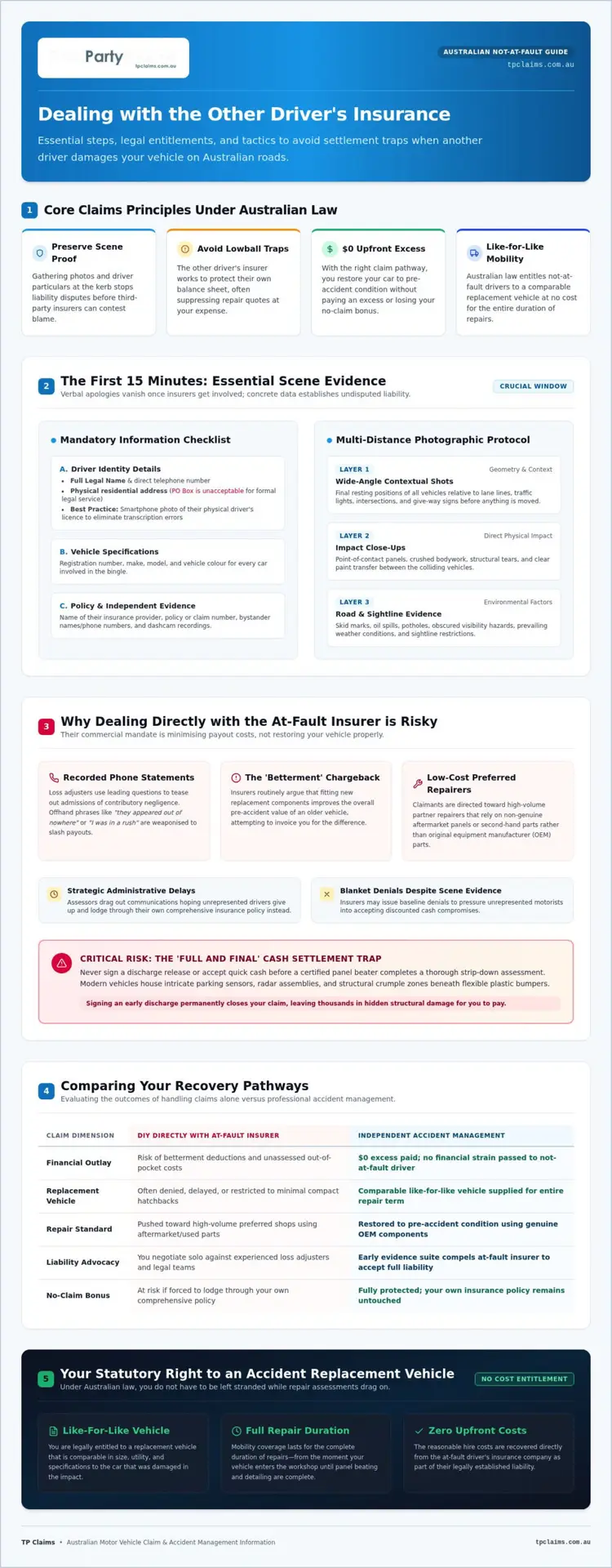
The first fifteen minutes following a collision dictate the entire trajectory of your recovery. While your adrenaline is running high, the at-fault driver is often apologetic, but verbal apologies vanish quickly once insurers get involved. If you want to know how to deal with other driver’s insurance without facing delayed repairs or unfair liability disputes, your evidence collection must start before either car leaves the kerb.
Independent accounts prevent a straightforward claim from deteriorating into a toxic dispute. If bystanders saw the impact, ask for their full names and phone numbers immediately. Dashcam footage is equally vital. Independent accident management services frequently rely on this early evidence suite to establish undisputed liability right away, compelling the at-fault insurer to accept full responsibility for all vehicle losses without passing costs onto you.
What Information Do You Actually Need?
Never leave the scene with just a first name and a mobile number. To lodge an airtight claim, capture:
- Full identity details: The driver’s full name, current residential address (a PO Box is unacceptable for formal service of claim documents), and direct telephone number.
- Vehicle specifications: The registration number, make, model, and colour of all vehicles involved in the bingle.
- Coverage details: The name of their insurance provider and their policy or claim number if they can access it on the spot.
Take a clear smartphone photo of the other driver’s physical driver’s licence. This single snapshot avoids transcription errors and confirms who was behind the wheel.
Documenting Damage Like a Professional
Modern insurers scrutinise crash geometry to minimise payouts. Take comprehensive photos from multiple distances rather than just snapping the broken bumper:
- Wide-angle contextual shots: Capture the final resting positions of both vehicles relative to lane lines, traffic lights, intersections, and give-way signs.
- Impact close-ups: Photograph point-of-contact panels, crushed bodywork, structural tears, and direct paint transfer between the vehicles.
- Road and environmental factors: Record skid marks, oil spills, potholes, obscured visibility hazards, weather conditions, and sightline restrictions.
Knowing how to deal with other driver’s insurance effectively begins with creating an objective visual record that leaves their claims assessor zero room to dispute who caused the crash.
Why Dealing with the Other Driver’s Insurer is Risky
The other driver’s insurance company is not your friend. While their customer service representative might sound polite, their commercial priority is clear: minimise payout costs on behalf of their policyholder. When you attempt to work out how to deal with other driver’s insurance alone, you step into an inherently adversarial arrangement where their loss adjusters use practiced tactics to save money at your expense.
One dangerous trap is the recorded phone statement. Adjusters frequently ask leading questions designed to tease out admissions of contributory negligence. An offhand remark like “they appeared out of nowhere” or “I was in a bit of a rush” can instantly be weaponised to argue that you share partial blame, slashing their financial liability. Insurers also routinely raise arguments around “betterment”, claiming that fitting brand-new replacement parts improves the value of your older vehicle and attempting to invoice you for the difference.
Tactics to Minimise Your Payout
Corporate claims teams rely on well-worn strategies to suppress vehicle restoration expenses:
- Directing work to low-cost repairers: They often direct claimants toward high-volume preferred shops that use non-genuine aftermarket panels or second-hand parts rather than original equipment manufacturer (OEM) components.
- Strategic delays: Assessors drag out communications, hoping you will abandon the third-party route and lodge through your own comprehensive policy instead.
- Contesting clear-cut liability: Despite photographic evidence from the scene, they may issue blanket denials to pressure unrepresented drivers into accepting lower cash compromises.
The Trap of the ‘Full and Final’ Settlement
Never sign a release or accept a quick cash settlement before a certified panel beater completes a comprehensive strip-down assessment. Modern vehicles house intricate parking sensors, radar assemblies, and structural crumple zones beneath flexible plastic bumpers. Superficial scratches frequently conceal thousands of dollars in internal alignment faults or damaged sensors that only reveal themselves once components are dismantled.
Signing an early discharge form closes your claim permanently. If hidden structural defects emerge later, or if repair delays leave you stranded without transport, the other insurer will refuse to cover additional expenses. Rather than tackling these risks by yourself, using professional insurance negotiation services provides an experienced advocate who manages the entire recovery process on your behalf, safeguarding the quality of your repairs while keeping your out-of-pocket costs at zero.
Your Options: DIY, Your Insurer, or Professional Management?
Following an accident where you were entirely blameless, you have three primary routes to repair your car. Many drivers assume claiming through their own policy is the default solution. Consumer advocates often recommend this path for pure convenience, but they routinely gloss over the immediate cash penalty it creates. Deciding how to deal with other driver’s insurance requires evaluating the trade-offs between upfront costs, administrative burden, and control over your vehicle’s repairs.
Pursuing the DIY approach directly with the third-party insurer theoretically avoids upfront expenses, but it places you in direct confrontation with hardened dispute teams. For innocent motorists who want complete vehicle restoration without endless phone tag or out-of-pocket costs, seeking independent third party property damage claim help provides a structured alternative that prioritises your rights.
The Excess Dilemma Explained
Lodging a claim through your own comprehensive policy often requires an immediate excess payment, even when you did nothing wrong. Insurers only waive this fee upfront if you provide every detail of the at-fault motorist and their own recovery team explicitly confirms the other party accepts total responsibility. If that driver delays reporting the collision, your insurer will demand your standard excess, often between $800 and $2,000, before releasing your car to a repair shop.
Recovering that cash later can take months of administrative friction. Worse still, your pending claim status can temporarily impact your no-claim bonus when your policy comes up for renewal. Independent claims management completely bypasses this friction. Because the claim is made against the at-fault driver’s property damage liability cover, you never pay an excess to commence repairs.
The Claims Management Advantage
Working with a dedicated management firm shifts the operational workload entirely off your plate. Experienced dispute specialists handle all interactions, eliminating the stress of arguing with uncooperative third-party adjusters:
- Direct negotiation: Specialist negotiators liaise directly with the at-fault driver’s insurer, asserting your common law rights to full pre-accident restoration.
- Independent quoting: You retain the freedom to select quality repairers using genuine OEM parts rather than accepting lower-tier fleet body shops.
- No-win-no-fee representation: A no-win-no-fee structure aligns your advocate’s incentives with your own, ensuring all repair and mobility expenses are recovered directly from the responsible insurer.
Mastering how to deal with other driver’s insurance does not mean shouldering the legal and logistical struggle yourself. Handing the entire process to professional advocates protects your wallet, your vehicle, and your sanity.
Navigating the Claim Process for Property Damage
Transforming scene evidence into a funded repair requires proving liability beyond doubt. In Australian property law, the burden of proof rests on you as the claimant. If the other party alters their story after leaving the scene, their insurer will treat the incident as a contested word-of-mouth dispute. Knowing how to deal with other driver’s insurance means presenting an evidence dossier that leaves no room for creative retellings.
The legal catalyst that forces an insurer to act is a formal Letter of Demand. This document outlines the facts of the crash, attaches verified repair quotes, and provides a strict deadline for payment. Once an insurer receives a structured demand backed by independent quotes, their ability to drag out discussions shrinks dramatically. If negotiations stall or you face an uncooperative claims team, you can lodge your claim with TP Claims to have experienced dispute specialists enforce your rights from start to finish.
When the Other Driver Has No Insurance
Finding out the driver who ran into you lacks insurance is every motorist’s nightmare. Fortunately, the absence of an insurance policy does not extinguish their personal legal liability for your property loss:
- Direct personal recovery: You hold the legal right to pursue the responsible driver directly for the full cost of repairing your vehicle.
- Enforcing payment: When individuals refuse to cooperate or ignore written demands, recovery requires formal letters of demand followed by civil court or tribunal proceedings.
- Managing recovery friction: Uninsured drivers often claim financial hardship. Specialist claims managers secure legally binding settlement agreements or payment plans so you aren’t left absorbing the loss alone.
From Quote to Completion
Securing an independent quote is the only way to establish the real cost of returning your car to factory safety benchmarks. Insurer-mandated assessment centres often utilise compressed labour times and budget paint processes. When you exercise your choice of repairer, your chosen technician inspects structural alignment and Advanced Driver Assistance Systems (ADAS) sensor calibration rather than rushing cosmetic patches.
Once quotes are submitted, an independent assessment confirms that the other insurer authorises every necessary panel replacement and recalibration. After repairs conclude, your repairer conducts a final quality inspection before hand-over. Understanding how to deal with other driver’s insurance guarantees that you never sign off on an incomplete repair, keeping your vehicle safe, roadworthy, and structurally sound.
Staying Mobile: Your Right to an Accident Replacement Vehicle
Losing the use of your car throws your daily life into disarray. Between school runs, commuting, and family commitments, being left without transport creates immediate friction. When figuring out how to deal with other driver’s insurance, many people mistakenly assume they must rely on public transport or pay out of pocket for a rental. Under Australian common law, established through binding High Court precedent, not-at-fault drivers have a legal right of restitution to recover the hire cost of an equivalent replacement vehicle while theirs is off the road.
The at-fault driver’s insurer pays for the hire car. Rather than forcing you to foot the bill and seek reimbursement months later, TP Claims manages the entire process by organising an accident replacement car after accident not at fault. The daily hire charges are recovered directly from the at-fault party’s insurer as part of your overall property damage claim, leaving you with zero rental costs.
What is a ‘Like-for-Like’ Replacement?
Australian law protects you from being arbitrarily downgraded during repairs. If you drive a seven-seat family SUV, the at-fault insurer cannot restrict you to a compact three-door runabout. The legal benchmark is a “like-for-like” standard:
- Vehicle equality: You are entitled to a car of broadly similar size, safety rating, and functionality.
- Commercial continuity: Tradies and couriers driving an essential van or ute receive a comparable commercial vehicle to protect their livelihood.
- Eligibility criteria: You must be 100% not at fault, hold the at-fault driver’s complete details, and require the vehicle for standard daily travel while your car undergoes repairs or awaits total-loss payout.
Professional Advocacy with TP Claims
Our team removes the administrative strain from the moment you make contact. As an established national firm across Australia, we step between you and the other party’s insurance company, handling every negotiation so you never have to deal with aggressive claims departments. We track repair progress with your chosen repairer and ensure your replacement car remains available until your vehicle is safely returned.
Every third-party property damage claim we handle operates under a clear no-win-no-fee structure. We ensure that asserting your legal rights never becomes a source of financial stress. Understanding how to deal with other driver’s insurance means knowing you don’t have to face the process on your own. We advocate on your behalf, protect your vehicle’s value, and keep your life moving forward without delay.
Protect Your Rights and Get Back on the Road
A collision you didn’t cause shouldn’t drain your bank account or disrupt your routine. As a not-at-fault driver, your legal rights are clear: full vehicle restoration to factory safety standards, zero excess deductions, and an equivalent replacement vehicle for the entire repair duration. You never have to accept lowball repair scopes or endure stalling tactics from a company focused on protecting its own bottom line.
Working out how to deal with other driver’s insurance does not mean fighting corporate dispute teams on your own. With national coverage across Australia, our expert insurance negotiators manage the communication, organise accident replacement vehicles, and recover every dollar directly from the responsible insurer. Let TP Claims manage your not-at-fault claim today under our no-win-no-fee structure and enjoy complete peace of mind while we do all the heavy lifting.
Frequently Asked Questions
Do I have to pay an excess if the accident wasn’t my fault?
No, you do not pay an excess when claiming against the at-fault driver’s insurance. Excess fees only apply to claims lodged under your own insurance policy. When you pursue third-party property damage directly or through an independent claims management team, the at-fault driver’s policy covers all losses. You pay zero upfront costs to initiate repairs or secure a replacement vehicle.
Can I choose my own repairer when claiming against the other driver’s insurance?
Yes, you have the legal right to choose your preferred licensed repairer. The other driver’s insurer may strongly encourage you to use their fleet repair centres to cut corporate expenses, but they cannot legally force you. Choosing your own independent repairer ensures your car is restored to original manufacturer specifications using genuine OEM parts rather than cheap non-genuine substitutes.
What happens if the other driver’s insurance company denies my claim?
A denial is rarely the final word. Third-party insurers often issue initial rejections if liability is disputed or if their policyholder refuses to lodge an incident report. Knowing how to deal with other driver’s insurance effectively means gathering corroborating evidence, such as dashcam video and witness statements. Independent claims specialists can issue a formal Letter of Demand or escalate the matter to AFCA.
How long does it typically take to resolve a third-party property damage claim?
A straightforward claim usually resolves within two to six weeks, depending on parts availability and booking schedules. Under the General Insurance Code of Practice, insurers must provide written decisions within 10 business days of receiving all necessary details and give updates every 20 business days. Complex claims involving truck collisions or uncooperative drivers take longer, but active claims management keeps pressure on adjusters.
Am I entitled to a hire car if my vehicle is damaged but still driveable?
Yes, but your entitlement begins once the vehicle becomes unavailable for road use. If your car is structurally sound, safe, and legal to drive, you continue driving it until your scheduled repair date. Once you drop your car off at the panel shop, your right to a like-for-like accident replacement vehicle kicks in immediately and remains active for the full duration of repairs.
What should I do if the other driver refuses to give me their insurance details?
Drivers are legally required to provide their name, residential address, and vehicle registration after an accident, but they are not strictly obligated to disclose their insurer. If they refuse to provide basic details, record their registration plate, take scene photographs, and report the collision to the police immediately. A police event number enables claims managers to track down the registered owner and enforce legal recovery.
Does dealing with a third-party insurer affect my no-claim bonus?
No, pursuing a third-party claim will not impact your rating or no-claim bonus. Because you are not lodging a claim against your own comprehensive insurance, your policy record remains entirely untouched. Understanding how to deal with other driver’s insurance outside your own insurer protects you from premium hikes and prevents your excess from being tied up during recovery negotiations between competing insurance brands.
What if the cost of repairs is higher than the value of my car?
If the repair cost exceeds the market value of your vehicle, the at-fault insurer will assess the car as a total loss. In this scenario, they must pay you the fair pre-accident market value rather than funding repairs. You are entitled to keep your replacement vehicle until the total-loss settlement payment formally clears into your bank account, ensuring you aren’t left stranded during car shopping.