
That initial assessment from an insurer isn’t a binding verdict; it’s simply an opening cost-control baseline. When you’re dealing with an insurance company lowballing car repair estimate figures, it’s completely natural to feel overwhelmed. You want your car repaired properly, yet an adjuster is pushing an assessment that falls thousands below an independent smash repair quote, risks your warranty with substandard parts, or pressures you into a hasty cash settlement.
You don’t have to accept a cut-price outcome. In this guide, you’ll discover why insurers undervalue repair quotes, how to dispute lowball assessments, and how to enforce your rights under Australian consumer and insurance codes. We’ll give you the practical steps needed to reject unreasonable scopes of work and restore your vehicle to genuine manufacturer standards with total peace of mind.
Key Takeaways
- Recognise the warning signs of an insurance company lowballing car repair estimate quotes, including trimmed labour hours and unapproved aftermarket parts.
- Uncover why photo-based desktop assessments miss structural panel damage and how insurers use them to reduce initial repair allowances.
- Dispel common industry myths so you can confidently assert your right to choose an independent, certified smash repairer.
- Follow a proven step-by-step dispute framework to demand an itemised scope of works, gather technical evidence, and challenge unfair assessments.
- Learn how independent claims management services protect not-at-fault drivers by handling insurer negotiations and securing equivalent replacement vehicles without upfront costs.
What Does It Mean When an Insurer Lowballs Your Repair Estimate?
At its core, a repair lowball is an insurer’s calculated attempt to minimise claim expenditure by approving significantly fewer repair operations than your vehicle actually requires. When you run into an insurance company lowballing car repair estimate figures, their assessment rarely reflects real-world vehicle safety or factory repair standards. Instead, it serves as an aggressive cost-containment metric designed to protect corporate loss ratios.
While severe claim mishandling in foreign jurisdictions is classified under insurance bad faith doctrines, Australian drivers experience this practice through subtle technical omissions. Adjusters systematically strip out necessary labour allowances, reject adjacent panel colour blending, and demand the use of cheaper parts. An initial assessment from an insurer represents their opening budget, not a safe standard of workmanship.
Common signs of an artificially reduced estimate include:
- Arbitrary cuts to mechanical labour and panel preparation hours.
- Refusal to authorise essential blend coats on adjacent panels, causing visible paint mismatches.
- Substituting Original Equipment Manufacturer (OEM) components with uncertified parallel imports or salvage parts.
The Definition of an Inadequate Scope of Works
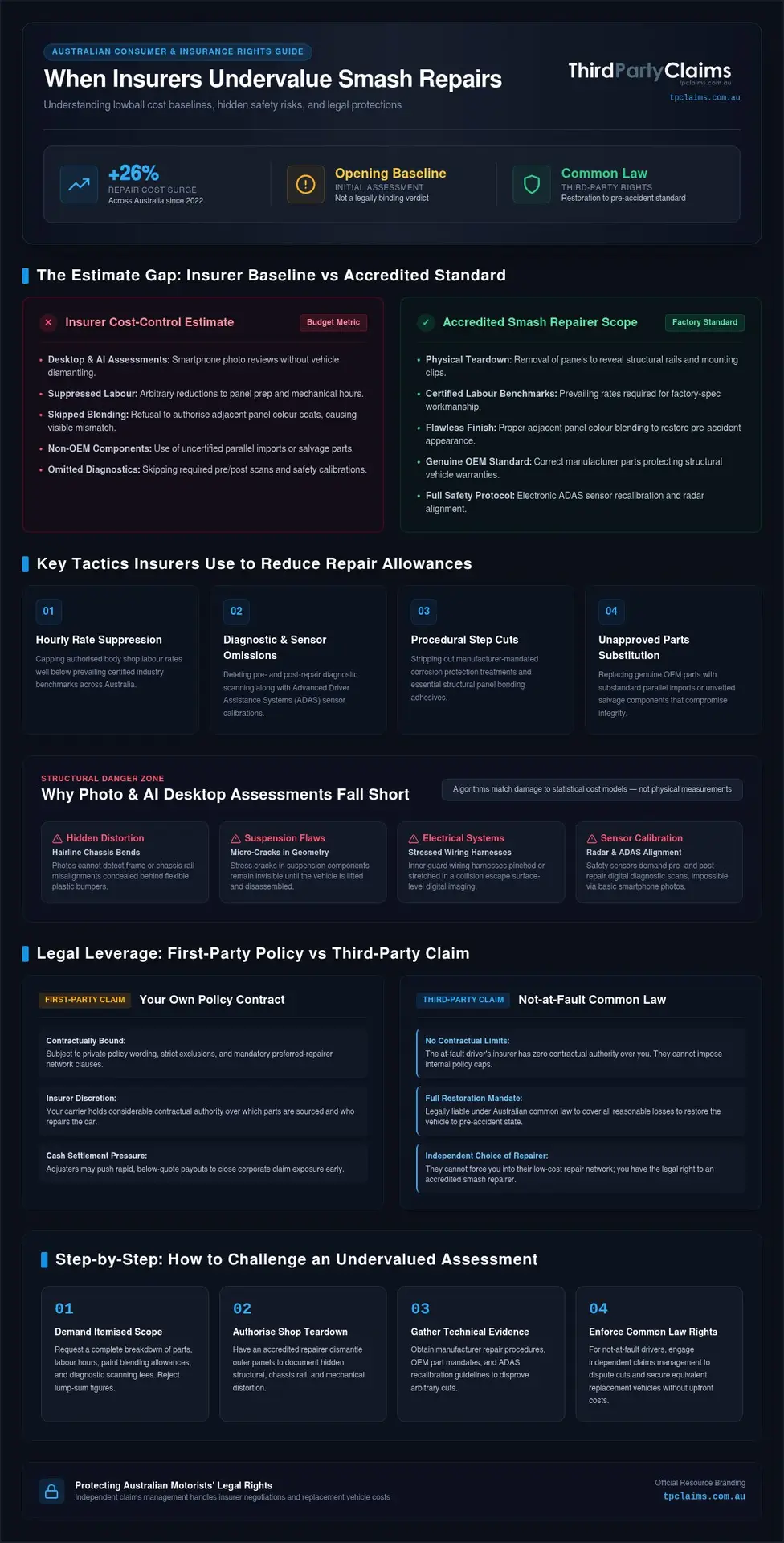
The gap between a safe repair and a cut-price estimate comes down to the scope of works. An adjuster often relies on a rapid visual check or smartphone photos. In contrast, an accredited smash repairer conducts a comprehensive vehicle teardown, removing damaged exterior panels to uncover underlying structural deformation, distorted chassis rails, or broken mounting clips.
Preliminary insurer assessments routinely omit digital diagnostic scans, radar alignments, and electronic safety sensor recalibrations. These systems are critical for modern vehicle crash protection, particularly in complex windscreen and sensor repairs—for a look at how dedicated vehicle glass and calibration teams operate, check out Pinnacle Auto Glass. Accepting a superficial estimate before a mechanical teardown leaves you vulnerable to hidden structural defects and unexpected repair shortfalls.
First-Party Policies vs Third-Party Property Damage Claims
Your legal leverage changes significantly depending on whether you claim through your own policy or directly against the at-fault driver. When claiming through your own comprehensive insurer, you are bound by private policy wording, strict exclusions, and mandatory preferred-repairer clauses that give the insurer considerable discretion.
Understanding how to deal with other driver insurance shifts the balance back in your favour. Under Australian common law, a negligent party’s insurer has no contractual authority over you. They cannot force you into their preferred repair network or impose internal policy caps. They are legally liable to cover all reasonable losses needed to restore your vehicle to its pre-accident condition. Recognising this difference empowers you to push back when facing an insurance company lowballing car repair estimate on a third-party claim.
Tactics Insurers Use to Slash Smash Repair Estimates
Repair costs across Australia have climbed 26% since 2022, driven by complex vehicle technology, radar systems, and advanced driver-assistance sensors. Rather than absorbing these legitimate industry expenses, many carriers cut operational corners. When you experience an insurance company lowballing car repair estimate figures, they generally rely on systematic reduction methods that prioritise company balance sheets over vehicle safety.
These reduction tactics target every stage of the quoting process. Understanding them allows you to spot where an adjuster has cut necessary procedures:
- Hourly rate suppression: Capping workshop labour rates well below prevailing certified industry benchmarks.
- Safety omissions: Stripping out pre- and post-repair diagnostic scanning alongside Advanced Driver Assistance Systems (ADAS) sensor calibration.
- Procedural cuts: Deleting manufacturer-mandated corrosion protection and panel bonding steps.
Desktop Audits and Artificial Intelligence Assessments
Insurers increasingly bypass physical shop inspections in favour of remote desktop audits and artificial intelligence assessment tools. An algorithm reviews digital photos taken on a smartphone, matching damage patterns against statistical cost models rather than physical vehicle measurements.
These photo-based estimates cannot detect hairline chassis distortion, micro-cracks in suspension geometry, or stressed wiring harnesses behind inner guards. Proper repairs require a full physical teardown by an accredited technician. Without dismantling the impact zone, an automated quote simply conceals structural damage beneath untouched outer bodywork.
Non-OEM Parts vs Genuine Manufacturer Specifications
Another prevalent cost-cutting tactic involves specifying non-genuine body panels, parallel imported components, or used salvage parts. The Motor Vehicle Insurance and Repair Industry (MVIRI) Code establishes baseline repair standards, yet adjusters regularly substitute factory Original Equipment Manufacturer (OEM) parts to save capital.
Non-OEM panels frequently exhibit poor metallurgical integrity and irregular fitment lines. They can alter engineered vehicle crumple zones and compromise safety. Installing recycled or uncertified parts can also void your active factory structural and rust warranties, permanently undermining your car’s resale value.
Compressed Paint Labour and Blending Deductions
Assessors routinely reduce paint preparation allowances and refuse adjacent panel blending. Modern multi-stage pearlescent and metallic automotive finishes cannot be accurately matched edge-to-edge. Skipping the blending of adjacent panels produces noticeable colour and texture discrepancies under natural sunlight.
Proper refinishing preserves vehicle value and corrosion warranties. Government guidance on how to make a car insurance claim outlines your entitlement to dispute deficient settlement offers. If you are not at fault and facing an insurance company lowballing car repair estimate, partnering with an independent specialist via TP Claims removes the pressure by managing technical negotiations directly with the at-fault insurer.
Busting Common Myths About Insurer Repair Assessments
Misleading advice often leaves drivers feeling trapped into accepting cut-rate assessments. In Australia, common law guarantees the right to full indemnity following an accident where you are not at fault. This means you are entitled to have your vehicle restored to its precise pre-accident condition without incurring personal expense. When an insurance company lowballing car repair estimate adjustments contacts you, separating reality from industry fiction is your strongest safeguard.
Challenging an insurer starts with dismantling three widespread misconceptions:
- Myth 1: You must send your vehicle to the insurer’s preferred contractor network.
- Myth 2: A cash payout calculated on wholesale trade pricing satisfies their legal liability.
- Myth 3: The figure produced by an in-house insurance assessor is legally binding.
Myth 1: You Must Accept Their Assigned Preferred Repairer
Insurers often direct claimants toward commercial network partners to keep assessment totals down. Contracted workshops agree to deeply discounted labour allowances and strict parts restrictions in exchange for high claim volume. This creates a structural conflict of interest between corporate cost control and thorough technical work.
You retain the right to engage an independent smash repairer. Independent technicians advocate directly for the safety of your vehicle rather than the insurer’s bottom line. They ensure factory procedures are observed rather than compromised to meet corporate key performance indicators.
Myth 2: Cash Settlements Must Equal Insurer Trade Rates
Assessors frequently push fast cash settlements based on internal wholesale figures. These quotes rely on discounted bulk-procurement rates that private motorists cannot access on the open market. Accepting a discounted trade-based figure leaves you personally liable for the remaining balance when you take your car to a retail bodyshop.
Under Australian legal principles, an adverse insurer cannot settle a claim using internal supplier discounts you cannot obtain. A reasonable settlement must reflect current, real-world retail repair costs from an accredited independent facility.
Myth 3: You Cannot Dispute an In-House Assessor Assessment
An adjuster’s report does not represent a final legal determination. The General Insurance Code of Practice requires insurers to act fairly, openly, and honestly when settling claims. Their assessments remain commercial estimates subject to formal challenge.
You can overturn a flawed scope of works by presenting independent photographic evidence, diagnostic scan data, and detailed trade quotes. Mastering proper techniques for negotiating with insurance companies after accident events shifts control away from the insurer. This proactive approach stops an insurance company lowballing car repair estimate figures from deciding the quality and safety of your vehicle’s repairs.
Step-by-Step: How to Challenge an Undervalued Repair Estimate
Pushing back against an unfair assessment requires a clear, methodical plan. When faced with an insurance company lowballing car repair estimate calculations, emotion won’t change the adjuster’s stance; structured technical proof will. By gathering objective data, you systematically expose every omission and compel the insurer to fund safe repairs.
Follow these five practical steps to protect your claim:
- Demand the itemised scope: Request the assessor’s complete line-item breakdown, including specific part numbers, labour allocations, and sublet operations.
- Secure independent evidence: Obtain a detailed technical quote from a certified smash repairer of your choice.
- Highlight warranty and safety breaches: Document how their proposed short-cuts violate factory tolerances or compromise safety systems in writing.
- Serve a formal dispute notice: Submit a written rebuttal rejecting their scope and affirming your common law right to full indemnity.
- Escalate unresolved files: Refer stubborn disputes to independent dispute channels or engage professional claims support.
Securing an Independent Loss Assessor Report
Insurance adjusters work for the company, not for you. Hiring an independent automotive assessing engineer balances the scales. An independent assessor conducts a forensic physical inspection, recording high-resolution photographic evidence before any teardown starts.
Their reports carry significant evidentiary weight during disputes. Assessors document hidden structural shifting, misaligned subframes, and damaged electronic sensor modules that desktop algorithms regularly overlook. This professional documentation transforms your dispute from an opinion into undeniable technical fact.
Drafting an Evidence-Based Rebuttal Letter
Once you possess comparative documentation, draft a concise rebuttal comparing the insurer’s line items directly against OEM repair manuals. Avoid vague complaints. Pinpoint exact discrepancies, such as inadequate prep time, excluded radar recalibration, or non-genuine panel substitutions.
State clearly that accepting an unapproved scope leaves the car non-compliant with manufacturer safety baselines. Conclude your notice by setting a firm five-business-day deadline for the claims officer to authorise the comprehensive independent quote.
Navigating Internal Dispute Resolution (IDR) and AFCA
If the adjuster refuses to adjust their figures, escalate the matter directly to the insurer’s Internal Dispute Resolution (IDR) department. Australian regulations mandate that insurers review complaints within strictly defined timeframes, generally providing a final response within 30 days.
Keep a comprehensive written log containing timestamps, assessor names, and transcripts of every phone call. If the IDR process fails to deliver a fair outcome, you can lodge a dispute with the Australian Financial Complaints Authority (AFCA) at no cost. AFCA provides independent, binding determinations on insurers. For a detailed walkthrough of the formal process, our guide to third party property damage dispute resolution covers every stage from stalled assessments through to binding outcomes.
If you were not at fault and want to avoid handling hostile adjusters yourself, let the team at TP Claims take over your claim negotiations to secure a proper, uncompromised repair.
How Independent Claims Management Protects Not-at-Fault Drivers
Handling the aftermath of a collision is disruptive enough without having to debate complex panel quotes with hostile insurance assessors. Corporate insurers often rely on everyday motorists lacking the technical background or spare hours to fight back. When an insurance company lowballing car repair estimate allocations stalls your progress, engaging a dedicated claims specialist immediately levels the playing field against aggressive insurer negotiation teams.
By stepping into your corner, an independent claims advocate removes the administrative burden entirely:
- Managing all verbal and written communications directly with the at-fault party’s insurer.
- Enforcing factory repair specifications and OEM parts requirements.
- Eliminating personal out-of-pocket expenses through direct third-party recovery.
Removing the Burden of Direct Insurer Confrontation
Claims specialists manage all technical rebuttals, photographic evidence, and scope negotiations on your behalf. Instead of enduring combative phone calls or deciphering confusing line-item codes, you gain genuine peace of mind. Your advocate ensures the repair facility receives full approval for required procedures, preventing compromised repairs and safeguarding your vehicle’s resale value.
Staying Mobile with an Accident Replacement Vehicle
Repair delays can severely disrupt your work, family commitments, and daily routine. Under Australian common law, not-at-fault drivers have a legal right to an equivalent accident replacement vehicle while their own car undergoes assessment and repair. An independent claims manager arranges a comparable vehicle and recovers the hire costs directly from the at-fault driver’s insurer, keeping you on the road without upfront fees.
A Transparent, No-Win-No-Fee Claims Framework
Professional third-party claims management operates on a strict no-win-no-fee structure for property damage disputes. Because your advocate recovers all legitimate repair and replacement car expenses directly from the responsible insurer, you avoid claiming through your private comprehensive cover. This preserves your valuable no-claim bonus and prevents premium rating penalties.
You never have to tolerate an insurance company lowballing car repair estimate figures or pushing unsafe short-cuts onto your vehicle. Take the stress out of your claim with TP Claims and let dedicated property damage specialists restore your car to true manufacturer standards.
Protect Your Vehicle and Demand Fair Repairs
You never have to accept a cut-price assessment that compromises your safety, factory warranty, or resale value. When facing an insurance company lowballing car repair estimate figures, remember that an adjuster’s opening assessment is simply a cost-containment metric, not a binding verdict. You hold the legal right under Australian law to demand genuine manufacturer standards, independent repairer choice, and full indemnity to return your car to its true pre-accident condition.
Disputing an insurer on your own can be stressful, but you don’t have to carry that burden. With dedicated national representation fighting for uncompromised vehicle safety, you can level the playing field without out-of-pocket costs. Operating on a strict no-win-no-fee third-party motor property claims recovery model, independent specialists manage the entire negotiation while providing a comparable accident replacement vehicle to keep your life moving forward. Let TP Claims handle the insurer and secure your full repairs so you can get back behind the wheel with total confidence.
Frequently Asked Questions
Why do insurance companies offer low car repair estimates after accidents?
Insurers systematically lower initial assessments to protect their profit margins and contain claim payouts. They routinely rely on automated desktop software, apply restricted workshop labour rates, and omit essential procedures like sensor recalibrations. When you encounter an insurance company lowballing car repair estimate figures, remember that their opening figure is an internal cost-control target rather than a reflection of factory repair standards.
Can I insist on using my own smash repairer instead of the insurer choice?
Yes, you have the right to select your own repairer, particularly when you are not at fault. Under Australian common law, an at-fault driver’s insurer holds no contractual power to force you into their preferred network. While comprehensive policies have specific wording regarding choice of repairer, third-party claims allow you to engage any accredited independent repairer who prioritises OEM standards.
What happens if an insurer refuses to pay for genuine OEM replacement parts?
You can reject substandard parts by presenting manufacturer repair procedures that mandate original components. Insurers frequently specify non-genuine or parallel-imported parts to trim invoices. If your vehicle remains under factory warranty, or if aftermarket components compromise structural crash performance, provide written evidence from your repairer. Insurers must cover safe, compatible parts that restore the vehicle to pre-accident integrity.
Am I legally obligated to accept a cash settlement from the other driver insurer?
No, you are never legally obligated to accept a cash settlement from an adverse insurer. Adjusters often offer quick cash payouts calculated using discounted internal wholesale rates, leaving you with substantial shortfalls at retail bodyshops. You are entitled to complete indemnity. This means you can reject an inadequate cash sum and insist on full coverage for independent repairs.
How does an independent loss assessor help overturn an undervalued repair quote?
An independent loss assessor conducts an impartial forensic inspection, producing a detailed engineering report that exposes arbitrary cuts. They identify structural misalignments, sensor damage, and paint procedures that remote adjusters miss. Their objective evidence carries considerable weight in formal disputes, making it exceptionally difficult for an insurance company lowballing car repair estimate items to defend an incomplete scope.
Can an insurer force me to write off my car instead of paying repairs?
An insurer cannot declare a vehicle an economic total loss without proving that legitimate repair costs exceed its pre-accident market value. If an adjuster pushes for a write-off based on a deflated valuation of your car, you can dispute it. Gather market listings of identical makes and models to prove your vehicle’s true worth and keep the repair pathway open. Alternatively, if you decide against proceeding with repairs or need to dispose of an uneconomical, written-off vehicle, you can learn more about Rapid Car Removal to see how damaged or unwanted cars can be sold directly for immediate cash in Melbourne.
What should I do if an insurance company ignores my amended repair quote?
Issue a formal letter of demand setting a strict five-day deadline for their response. If the insurer remains unresponsive, escalate your complaint directly to their Internal Dispute Resolution department or lodge a free dispute with AFCA. Alternatively, not-at-fault motorists can instruct an independent claims management specialist to take over negotiations and recover full repair costs without upfront fees.