
A driver’s denial doesn’t decide who was responsible. A clear, consistent trail of evidence can help show what happened and keep your property damage claim moving. If you’re asking how to prove liability when other driver denies fault australia, start by recording the facts while they’re still fresh.
It’s understandable to worry that an insurer will accept the other driver’s version, especially when your accounts conflict. You can strengthen your account by gathering objective evidence, preserving relevant records and setting out events in a clear timeline. No single item guarantees an outcome, but photographs, dashcam footage, witness details and repair documents may help support your version.
This guide explains what to collect after a crash, how to organise and share evidence, and how to respond if the other driver or their insurer disputes responsibility. It also covers practical steps to take when the disagreement stalls your property damage claim, so you can decide what to do next with greater confidence.
Key Takeaways
- Understand what liability means for damage to your vehicle, and why the other driver’s denial doesn’t settle the dispute.
- See which evidence may support your account, from scene photographs and dashcam footage to witness details.
- Learn how to prove liability when other driver denies fault australia by comparing both accounts with independent evidence and physical details.
- Use a practical sequence to organise records and present a clear account of the collision.
- Find out how TP Claims can manage a disputed third-party property damage claim and insurer negotiations on a no-win-no-fee basis.
What liability means when the other driver denies fault in Australia
Hearing the other driver reject your account can make it feel like your word is being weighed against theirs. But a denial is one side of a dispute, not a decision about who must pay for the damage. The first step is to understand what the claim needs to establish.
In plain English, liability means responsibility for damage arising from a collision. In a vehicle damage dispute, the question is how the circumstances of the crash connect to the damage being claimed. The focus is on the events leading up to impact and whether the available information supports the claim that the other driver was responsible. The general idea of What is liability? can help explain the term, but a specific claim depends on its own facts and the applicable rules.
What does liability mean in a property damage dispute?
Liability is responsibility for the loss connected to a collision. For example, if one driver says the other turned across their path, the dispute is not just about whether contact occurred. It also concerns whether the account of the manoeuvre fits the damage and other available evidence. This is a general explanation, not a conclusion about any particular crash.
An insurer may assess the accounts and evidence when deciding how to respond to a property damage claim. That assessment is different from a court making a legal determination. If a dispute reaches court, the court considers the material before it and applies the relevant law. An insurer’s view matters to the claim, but it does not determine what a court would decide.
Does the other driver’s denial decide who was at fault?
No. A denial doesn’t automatically defeat your claim, and it doesn’t prove the other driver’s account either. Each version needs to be considered alongside the available evidence, such as the collision circumstances, the location of the damage and any independent records. A confident statement is still an account to assess, not proof on its own.
In a court claim, the person seeking compensation generally needs to support their case. The civil standard is the balance of probabilities: the court considers whether a version is more likely than not. How that standard applies depends on the evidence, the issues in dispute and the relevant jurisdiction. Don’t treat any single detail as a guaranteed answer.
Keep property damage separate from personal injury. A vehicle damage claim concerns the cost of damage to property and who may be responsible for it. Compulsory Third Party (CTP) schemes relate to injuries, and arrangements vary across Australia. A no-fault feature in an injury scheme doesn’t decide who is liable for damage to your car. Keep communications and records clear about which type of claim you’re discussing.
So, how to prove liability when other driver denies fault australia is not about getting the other driver to agree with you. It means building a clear account that can be assessed against the available facts. The following sections explain what evidence may help and how to organise it without overstating what it proves.
Which evidence can help prove liability after an Australian car accident?
Once you’ve recorded the basic facts, gather material that helps explain how the collision happened. Each item may show a different part of the story: where the vehicles were, what each driver could see, how the impact occurred or what damage followed. No single piece needs to prove everything. Look for evidence that fits together and supports a consistent account.
Evidence gathered close to the event can preserve details that are easy to forget or lose. Use this checklist to organise what you have:
- Scene photographs: If it’s safe, photograph vehicle positions, damage, road markings, traffic signs, signals, visibility and road conditions.
- Dashcam or CCTV footage: Save recordings that may show the vehicles’ movements, timing and point of impact.
- Witness details: Record names and contact details, and note what each person says they saw.
- Vehicle damage: Photograph the damage from several angles and keep repair assessments, invoices and related records.
- Driver and vehicle exchange details: Keep the information exchanged after the crash, along with any claim references.
- Contemporaneous notes and messages: Write down your recollection promptly and preserve relevant communications with the other driver or insurer.
- Police records: Keep any report details or documents you receive, while remembering that a report is not automatically a ruling on fault.
What can photographs, footage and vehicle damage show?
Photographs can help put the collision in context. Take wide shots showing where the vehicles came to rest and how the road is laid out, then close-ups of damage, skid marks or debris, if visible. Include signs, lane markings and sight lines where they help explain what a driver may have seen. A photo of damage alone may not explain how the crash happened, but it can be compared with the accounts and other records.
Dashcam and CCTV footage may clarify timing and movement, such as whether a vehicle was turning or changing lanes before impact. Keep the original files in their original format, make a backup and avoid editing or trimming relevant footage. If CCTV may exist nearby, note its location and promptly ask the relevant owner to preserve the recording. Legal Aid NSW also explains how responsibility may be assessed in its guidance on determining fault in car accidents.
How can witnesses and official records support your account?
Witness information can be hard to recover later, so note contact details while they’re available. Record what the person says they observed, rather than asking them to agree with your interpretation. Keep your own notes factual too: write down the date, location, sequence of events and conditions, and distinguish what you remember from what you learned later. Clear notes help you explain your account consistently.
Store files, photographs, notes and correspondence together, labelled by date and source. If you need support organising evidence while a property damage claim is disputed, TP Claims’ property damage claims management includes support with the claims process and insurer negotiations.
How to assess conflicting evidence when a driver disputes fault
A driver’s denial doesn’t establish their version, just as your account alone doesn’t settle the dispute. The useful question is how each version fits with the available evidence. Compare specific details, such as direction of travel, timing and point of impact, rather than judging which driver sounds more certain.
Start by separating confirmed facts from claims that still need support. For example, vehicle damage may confirm where contact occurred, but it may not show who moved first. A recording might clarify movement yet leave a blind spot around the moment of impact. Assess each item for what it can actually show, and don’t stretch it beyond that.
What makes evidence more useful when accounts differ?
Evidence becomes more persuasive when separate sources support the same sequence. A timestamped recording, a witness’s independent observations and damage consistent with the described impact may reinforce one another. Keep original files and clear dates, and use the same factual description in your notes and claim documents. Consistency helps others follow your account, but no single photo, report or statement is automatically conclusive in every dispute.
A simple comparison can help you spot where the accounts agree, differ or need more information:
| Disputed point | Evidence that may support or clarify it | What to check |
|---|---|---|
| Which vehicle moved first? | Dashcam or CCTV footage, witness observations | Does the timing show the full sequence or only part of it? |
| Which lane was each vehicle in? | Scene images, road markings, independent accounts | Do the images show the relevant position before impact? |
| How did the vehicles make contact? | Damage photographs, repair assessment, scene details | Does the damage fit either account, or could it fit both? |
| What could a driver see? | Images of signs, sight lines and road conditions | Were visibility or road features accurately recorded? |
Use the table as an organising tool, not a scoring system. One item may be incomplete or open to more than one interpretation. Note the source and date for each piece of information, and mark gaps plainly instead of filling them with assumptions.
What if the evidence points in different directions?
Conflicting details don’t necessarily make a claim impossible to assess. Identify exactly what remains uncertain: perhaps the footage starts after the vehicles began moving, or a witness saw the impact but not the approach. Keep each account intact, then compare the parts that can be checked against independent material. An insurer may consider the full picture. If a matter proceeds to court, the legal determination depends on the evidence and applicable law.
Responsibility may also be shared if the evidence and relevant law support that outcome. Don’t assume that one inconsistency means you’re partly at fault, or that the other driver’s mistake answers every question. The result depends on the facts and may vary by jurisdiction. A careful comparison helps explain what is known, what is disputed and what further information could clarify the property damage claim.
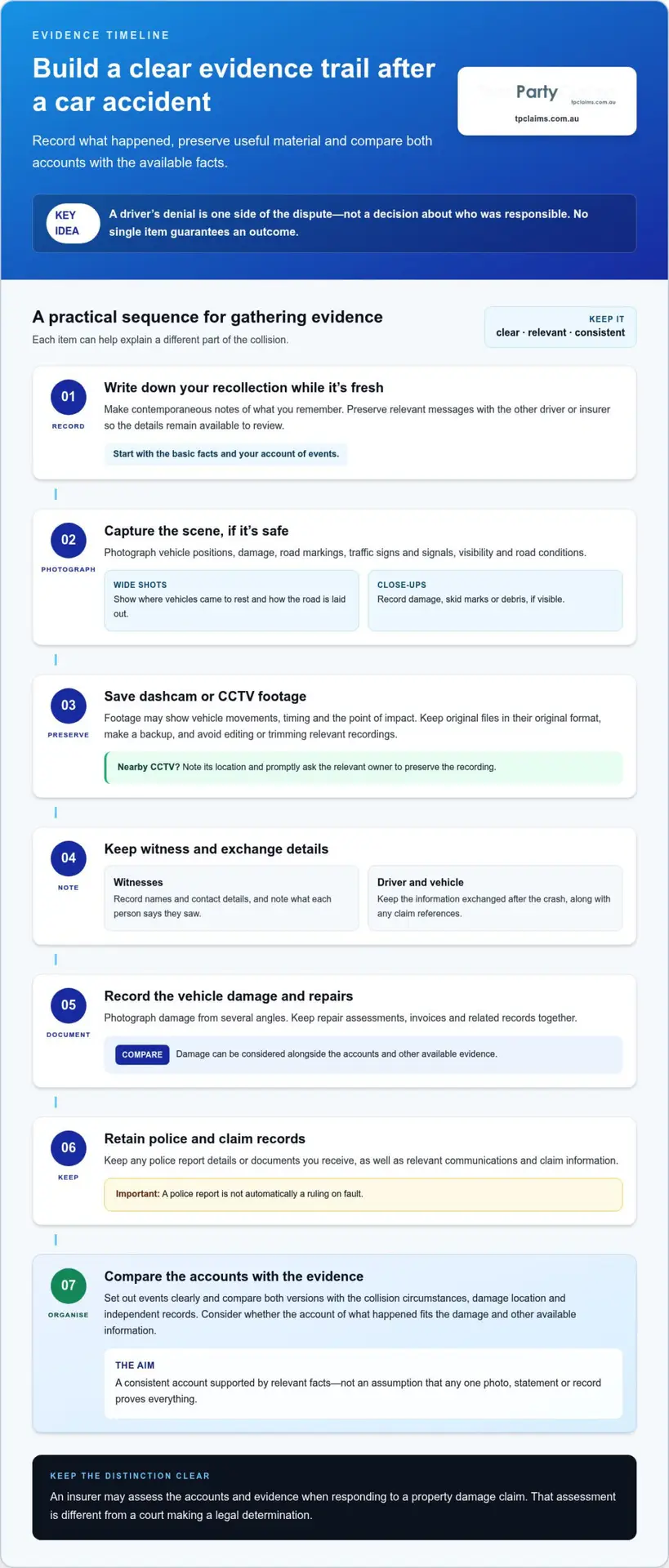
How to build a clear liability case after the other driver denies fault
A well-organised claim makes it easier to see how your account connects with the available evidence. Keep two tasks separate: first gather and preserve records, then explain what those records show. You can describe events accurately without making legal conclusions that the evidence doesn’t support.
What should you record and preserve first?
Work through these steps in order to turn scattered material into a clear record of the property damage dispute.
- Write a dated timeline. Record when and where the collision happened, the direction each vehicle was travelling and what you remember before, during and after impact. Mark which details the other driver disputes. Separate what you directly recall from information you learned later.
- Keep original evidence. Save photographs and footage in their original form, and make a backup. Keep repair assessments, invoices and other documents about the vehicle damage together. Give files clear labels showing the date and what they contain.
- Organise witness information. Keep names and contact details with a short note of what each witness says they observed. Don’t edit their account to make it fit yours; preserve their words as accurately as you can.
- File communications by date. Keep messages, emails, letters and claim correspondence in one place. Note when each exchange occurred and who sent it. If a phone call matters, write a brief factual note afterwards, including the date and main points discussed.
- Check local reporting requirements. Crash-reporting rules and processes can differ between Australian states and territories, and the circumstances of a crash may matter. Check the relevant jurisdiction’s current official guidance rather than assuming one national requirement applies.
How should you present your account to an insurer?
Once your records are organised, set out the sequence in plain, calm language. Keep it chronological and connect each important point to a supporting item. For example: “My vehicle was travelling along the road. The attached photograph shows the damage to its front side.” If footage or a witness supports a detail, identify the file or person rather than making broad claims about what it proves.
Respond to factual errors directly. If a letter gives the wrong date or describes a different point of impact, refer to the record that corrects it. Avoid hostile exchanges, guesses about what the other driver intended, or claims about speed and visibility that you can’t substantiate. If you’re unsure about a detail, say so instead of filling the gap with an assumption.
Be accurate and complete. Don’t hide information that appears inconsistent with your account; explain what you know and provide relevant context. Avoid signing or sending wording you don’t understand, and don’t make an admission or declare legal responsibility just to bring the disagreement to an end. Keep a copy of each document you send and note the date.
Building a clear record is a practical step in how to prove liability when other driver denies fault australia, but it doesn’t guarantee an outcome. If you want support organising a disputed property damage claim and managing insurer negotiations, get help with your property damage claim from TP Claims.
Next steps: help with a disputed property damage claim
A denial can leave you juggling evidence, repair documents and insurer communications while trying to work out what happens next. If the disagreement is becoming difficult to manage, support with the property damage claims process can help keep the paperwork and discussion organised. You don’t need to resolve every difference in the accounts before getting your records in order.
What can claims management support involve?
TP Claims manages third-party property damage claims and supports insurance negotiations. This can include organising claim documents, setting out the available information clearly and managing communications about the vehicle damage claim. The aim is to make the process easier to follow, not to promise that an insurer will accept a particular version or pay a claim.
The service is offered on a no-win-no-fee basis. That describes the basis of the claims management service, not a guaranteed outcome. The facts and evidence remain central to a disputed claim. Keep your focus on the property damage, such as the collision account, vehicle damage and related repair records. CTP and personal injury matters are separate from this property damage support.
If you’re still putting the broader recovery process together, the third-party property damage claim guide covers how the claim fits into the steps that may follow a crash.
Choose a clear next step without assuming the outcome
Before discussing the claim, bring together your dated timeline, photographs or footage, witness details, repair documents and insurer correspondence. A short list of the main points in dispute can also help explain what needs attention. You don’t have to make a legal argument: stick to what you remember and what the records show, and identify any gaps honestly.
For related information about the position of a driver who wasn’t at fault, read the not-at-fault car accident rights guide. Rights and processes can depend on the circumstances and relevant jurisdiction, so don’t assume one person’s experience applies to every claim.
Understanding how to prove liability when other driver denies fault australia starts with a clear evidence trail, but managing the claim and insurer correspondence can take time. TP Claims can help manage third-party property damage claims and negotiations, including claims involving uninsured drivers and complex truck collisions. If you’d like support with a disputed property damage claim, discuss claims management support with TP Claims. That conversation is a practical next step, not a promise about how the dispute will be decided.
Take the next step with a clear record
A disputed account can make it tempting to keep arguing about who said what. A more useful next step is to turn your records into a clear, dated account and keep the focus on resolving the vehicle damage claim. You don’t need to predict the outcome or make legal conclusions before asking for support.
If you’re still considering how to prove liability when other driver denies fault australia, remember that a well-organised claim gives the dispute a clearer basis for assessment, but can’t guarantee a particular decision. TP Claims manages third-party property damage claims and insurer negotiations, including claims involving uninsured drivers and complex truck collisions. Its claims management service is offered on a no-win-no-fee basis.
Bring your timeline and supporting documents into a conversation about practical help with your disputed property damage claim. Discuss your disputed property damage claim with TP Claims. A clear next step can make a difficult process more manageable, and you don’t have to work through the paperwork alone.
Frequently Asked Questions
Does the other driver’s denial mean I cannot prove liability?
No. A denial means the accounts differ, not that your property damage claim cannot be supported. The practical answer to how to prove liability when other driver denies fault australia is to show how your account fits the available records, including evidence created independently of either driver. If a key detail is uncertain, say so. A clear, honest account can be more useful than overstating what a piece of evidence proves.
Can a police report prove who was at fault in a car accident?
Not by itself in every case. A report may record information gathered after the crash, but it shouldn’t be treated as an automatic decision about responsibility. Check whether the details it records match your recollection, such as the vehicles involved and the location. If you identify a factual error, note it and raise it through the relevant process rather than assuming the report settles the property damage dispute.
Can dashcam footage from another vehicle be used as evidence?
It may help clarify events if it captures relevant details, such as the vehicles’ approach or the moment of impact. Ask the footage owner to keep the original recording and note when and where it was recorded. Avoid sharing it publicly or making assumptions about what it shows before reviewing the full clip. Whether it can be relied on in a particular dispute depends on the circumstances and applicable rules.
What if there were no witnesses to the car accident?
A lack of witnesses doesn’t automatically prevent you from supporting your account. Focus on other material that may help fill gaps, such as vehicle images, photographs of the road layout, contemporaneous messages or a recording from a nearby vehicle. Keep a note of what each item can and cannot establish. If evidence is limited, be upfront about that rather than presenting assumptions as confirmed facts.
Can both drivers share responsibility for a car accident in Australia?
Yes, responsibility may be shared, depending on the evidence and the law that applies in the relevant jurisdiction. For example, the available facts might suggest that more than one driver’s actions contributed to the collision. That possibility doesn’t mean you should assign a percentage based on your own impression. Set out the events and supporting material, then let the claim assessment consider the circumstances.
How soon should I request nearby CCTV footage after a crash?
Make enquiries as soon as practical. CCTV may be overwritten or deleted under the recording owner’s usual retention practices, which can vary. Identify the camera location, approximate time and direction of travel, then ask the owner to preserve any relevant recording. Keep a note of who you contacted and when. Don’t assume footage exists or that a request alone guarantees it will be retained or provided.
Can photographs of vehicle damage alone prove who caused the accident?
Usually, damage photographs show the location and appearance of impact, but may not reveal the full sequence of events or which driver caused the collision. Their value depends on what they depict and whether they align with other information, such as the road layout or repair findings. Keep original images and take photographs from different angles where possible. Avoid drawing a firm conclusion from damage alone.