
If the other driver caused the crash, does that mean their insurer will automatically pay for your car repairs? Not necessarily. Your not at fault car accident rights can depend on the evidence, the insurance cover involved and the claim pathway available where you live.
It’s understandable to feel unsure about whether to contact your own insurer or the other driver’s, whether you’ll have to pay an excess, or what happens if the other driver is uninsured. Being not at fault may support a property damage claim, but it doesn’t guarantee a particular outcome. Keep clear records, check the relevant policy terms and take one step at a time.
This 2026 guide explains the main ways to pursue vehicle damage, the evidence that may help establish what happened, and what to check before you agree to a settlement. It also covers delays, uninsured drivers and replacement vehicle options, while recognising that rules can vary across Australia. Use it to identify a practical next step, not as a promise of a result or a substitute for legal advice.
Key Takeaways
- Your not at fault car accident rights may support a property damage claim, but fault, evidence, policy terms and the other driver’s circumstances can affect your options.
- Compare contacting your own insurer, pursuing the other party or getting claims management support before choosing a pathway.
- Photos, witness details, dashcam footage and consistent accounts can help clarify what happened. Keep original evidence and relevant claim records.
- Prioritise safety, document the crash and check applicable deadlines. Be careful about what you say or sign before you understand its implications.
- Where liability is disputed or the other driver is uninsured, specialist support may help manage the claim process and insurer negotiations.
Not-at-fault car accident rights: what they mean
A crash can leave you dealing with repairs, calls and uncertainty all at once. In plain English, a not-at-fault property damage claim is a request to recover losses connected with damage to your car or other property when another driver is alleged to have caused the collision. Your not at fault car accident rights depend on the circumstances, not just on what either driver says happened.
Fault is assessed against the available facts and evidence. Insurance policy terms and the other driver’s circumstances can also shape which claim options are open to you. For example, the other driver may have insurance that covers damage to other people’s property, or they may be uninsured. Being not at fault doesn’t guarantee automatic payment, remove every possible cost or settle how much may be recoverable.
What rights may apply to damage to your car?
If the evidence supports that another party caused the crash, you may be able to pursue them for reasonably supported property damage losses. This could involve repair costs and, depending on the circumstances, other losses connected with the damage. These aren’t automatic entitlements. Liability and the amount recoverable depend on the facts, evidence and any relevant policy terms.
Keep the distinction clear: a property damage claim concerns your vehicle or other property. A personal injury claim concerns harm to a person and may involve a separate compulsory third-party (CTP) scheme. The rules and processes for injury claims vary across Australia, so don’t assume that an outcome under one type of claim determines the other. When physical harm is involved alongside car repairs, dedicated personal injury firms like Leon Legal Group show how legal processes and damages for bodily injury are handled separately from property claims.
Does compulsory third-party insurance cover your car?
Generally, no. CTP insurance relates to injury caused by motor vehicle use, not repairs to vehicles or other property. It’s different from third-party property damage insurance, which may cover damage a driver causes to someone else’s property, and comprehensive motor insurance, which may cover damage to your own vehicle subject to the policy terms.
Australia’s road rules have a shared national context, as outlined in this Australian road rules overview, but insurance arrangements and claim processes can differ between states and territories. Check the wording of relevant policies rather than assuming CTP will pay for car repairs. The next sections compare the main property damage pathways and the evidence that may help you decide what to do next.
Your Australian car accident rights depend on fault, evidence and location
After a crash, both drivers may have different accounts of what happened. Liability is assessed using the available facts and evidence, not simply decided by whoever says the other person was at fault. That assessment can shape whether you can pursue a property damage claim and what losses may be considered.
How is fault assessed after a crash?
Details that may help establish what happened include the road and weather conditions, the vehicles’ positions, the damage patterns and each driver’s account. Photos of the scene and damage, witness contact details, and dashcam footage can help preserve those details. Keep original files where possible, and make a clear, factual note of events while your memory is fresh. Separate what you saw yourself from anything someone else told you.
A police report or infringement decision may be relevant, but don’t assume it will settle every property damage claim. The insurer or other party may assess the evidence as part of their decision. Evidence about fault can inform a claim, but it isn’t the same as an insurer accepting liability or deciding what to pay.
If you’re trying to understand which losses might be considered, the Financial Rights Legal Centre explains how a driver may make a claim for reasonable costs after a crash involving an uninsured driver. The information is general, and how it applies depends on your circumstances.
Which rules can vary across Australian states and territories?
Claim processes, time limits and ways to challenge a decision can vary depending on where the crash occurred and what type of claim you’re making. A deadline for an injury claim, for example, may not be the same as a process or limit relevant to vehicle damage. There isn’t one deadline that can safely be applied to every Australian crash.
Confirm the requirements for the state or territory where the accident happened. Check current information from the relevant government body, scheme or insurer, and seek legal help if you’re unsure about a deadline or dispute option. Your not at fault car accident rights are best understood alongside the evidence and the rules that apply to your particular claim.
If the evidence is contested or insurer discussions become difficult, you could consider whether third-party property damage claims support is appropriate. TP Claims manages third-party property damage claims and insurance negotiations, including claims involving uninsured drivers. Claims support can help manage the process, but it can’t guarantee a particular decision or outcome.
Compare your options after a not-at-fault car accident
There’s no single best pathway for every crash. Your choice may depend on the other driver’s insurance, your own policy terms and how clear the evidence is. Use this comparison to identify who to contact and what to check first, without assuming a claim will be accepted or that every cost will be covered.
| Pathway | Who you contact | Useful evidence | What remains uncertain |
|---|---|---|---|
| Contact your insurer | Your own insurer, to check your cover and claim process. | Crash details, photos, the other driver’s information and repair assessments. | Whether your policy responds, what excess or conditions apply, and whether your insurer can recover costs from another party. |
| Pursue the other party | The at-fault driver or, if they have relevant cover, their insurer. | Evidence of the collision, liability and the losses you’re claiming. | Whether liability is accepted, what amount may be recoverable and how long discussions may take. |
| Seek claims management support | A provider that manages third-party property damage claims and negotiations. | Relevant crash records, correspondence, repair documents and details of the other driver. | Eligibility, applicable terms and the outcome of any claim or negotiation. |
Should you contact your insurer or the other driver’s insurer?
Start by checking the cover available and the conditions attached to it. Read your policy or ask your insurer about notification requirements, the excess and how a claim could affect your cover. An excess may apply under your policy. Don’t assume it will automatically be waived or reimbursed. If you contact the other driver or their insurer, keep your account factual and retain copies of messages and documents.
If you’re weighing up a third-party claim, see this third-party property damage claim guide for a broader overview. If an insurer disputes your complaint, the Financial Rights Legal Centre explains the role of the Australian Financial Complaints Authority (AFCA). Check the relevant process and eligibility before taking that step.
What if the at-fault driver is uninsured?
A lack of insurance can make recovery more complex, but it doesn’t necessarily rule out pursuing a claim. The available evidence, whether the driver is liable and their circumstances can all matter. There may be no insurer to handle the claim, and payment or recovery isn’t assured. For this situation, read the uninsured driver recovery guide.
Your not at fault car accident rights don’t determine which route is simplest on their own. Compare the policy conditions, evidence and practical uncertainties, then choose a manageable next step. If you seek claims management support, ask what information is needed and what terms apply before you agree to proceed.
Protect your not-at-fault claim with these practical next steps
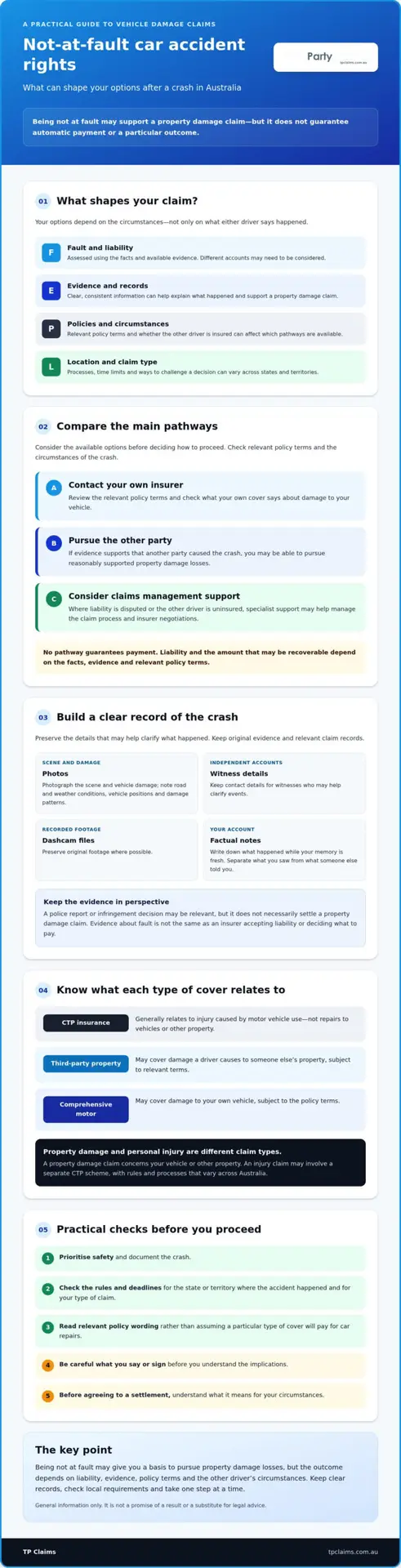
A crash can leave you shaken, so focus on one step at a time. Prioritise safety and urgent medical or emergency needs first. Once it’s safe, exchange details with the other driver and any witnesses, document the scene and damage, then notify the relevant insurer or party using the appropriate claim pathway.
Keep your account factual. Avoid guessing about what happened or accepting blame before you’ve had time to review the details. Your not at fault car accident rights may depend on evidence and the rules for your location and claim type, so check applicable deadlines promptly rather than assuming one national time limit applies.
What evidence should you collect?
If it’s safe, take photos of the vehicles’ positions, damage, registration details, road conditions and the wider scene. Record witness contact details, and preserve original dashcam footage and relevant messages. Don’t edit or overwrite files. A dated record can make it easier to keep the facts and claim documents organised.
Keep repair assessments, invoices, receipts, reports and correspondence together. Note the date and substance of calls, and save emails, letters and claim reference details. These records can help you explain the damage and track what has been discussed, without guaranteeing how liability or a claim will be decided.
What should you do before accepting a settlement?
Read the proposed terms carefully before agreeing or signing. Check what losses the settlement covers and whether it could affect later claims connected with the crash. If the wording is unclear, ask the sender to explain it in writing. Don’t sign a document you don’t understand or feel pressured to accept.
For a complex dispute, or a document that could have significant consequences, consider getting independent legal advice before you commit. Also verify any relevant claim or legal deadlines promptly with an authoritative source for the state or territory where the crash occurred. Acting early can help you preserve options, but it doesn’t guarantee a particular outcome.
If managing a third-party property damage claim or insurer negotiations feels difficult, you can ask about third-party claims support. TP Claims manages the claims process on a no-win-no-fee basis. Check the service terms and eligibility that apply to your circumstances before proceeding.
When claims management support may help after a not-at-fault crash
If liability is disputed, insurer negotiations are becoming difficult or the other driver is uninsured, managing a property damage claim can feel like another job on top of dealing with the crash. Support may help organise the claim and keep communication moving, but it can’t guarantee acceptance, payment or a particular outcome. Your not at fault car accident rights and options still depend on the evidence and circumstances.
What can a property damage claims manager help with?
TP Claims manages third-party motor vehicle property damage claims and insurance negotiations, including claims involving uninsured drivers. The firm manages the claims process for clients on a no-win-no-fee basis. This may involve coordinating claim documents and handling discussions with the relevant insurer or other party. It doesn’t include personal injury claims, comprehensive insurance or representation for at-fault drivers, and it isn’t legal or insurance advice.
Before proceeding, ask what work is included, what information you’ll need to provide and what conditions apply. Confirm the terms and eligibility directly before agreeing to proceed. No payment or claim outcome is guaranteed.
Could you need a replacement vehicle while your car is repaired?
A replacement vehicle may be a practical option while your car is off the road, but availability and costs aren’t automatic rights in every claim. Before committing, check whether the vehicle suits your needs, what terms apply, who may be responsible for charges and whether any costs may be recoverable in your circumstances. TP Claims provides accident replacement vehicles, subject to applicable terms. For more detail, read this not-at-fault replacement car guide.
A simple next step if you want help
You don’t need to have every answer before asking about support. Gather the information you have, such as the crash details, repair documents and insurer correspondence. Then ask whether your property damage situation falls within the service, what the terms are and what remains uncertain. That conversation can help you decide whether support is right for you, without assuming a particular result.
If you’d like to discuss your property damage claim and check service eligibility, contact TP Claims about claims support. Confirm the applicable terms before deciding how to proceed.
Take your next step with confidence
Your not at fault car accident rights may give you options to pursue vehicle damage, but the evidence, insurance cover and rules where the crash happened all matter. Keep your records organised, check your policy and confirm any relevant deadlines before choosing a claim pathway. An uninsured driver or a dispute can make the process harder, but you can take it one step at a time.
If you’d like help with a third-party property damage claim, TP Claims manages claims and insurance negotiations nationally, including assistance with uninsured-driver claims. Accident replacement vehicles may also be available, subject to eligibility and applicable terms. These services don’t guarantee a claim outcome.
Talk to TP Claims about your property damage claim and ask what support may suit your circumstances. With clear information and a manageable next step, you can move forward with greater confidence.
Frequently Asked Questions
What rights do I have if a car accident was not my fault?
If another driver caused the crash, you may be able to pursue them or their insurer for reasonably supported vehicle or property damage losses. Your not at fault car accident rights depend on the evidence, liability, relevant insurance and circumstances, so payment isn’t automatic. Keep photos, witness details and repair documents. Damage to property is separate from injury claims, which may be handled under a state or territory’s CTP scheme.
Can I claim car repairs from the at-fault driver’s insurer?
Yes, you may be able to claim reasonable repair costs from the other driver’s insurer if the driver is liable and the policy responds to the claim. Contact the insurer with clear details of the crash and supporting evidence, such as photos, repair assessments and witness information. The insurer may investigate liability and the amount claimed. Don’t assume it will accept fault or cover every cost without assessing the circumstances.
What happens if the at-fault driver has no insurance?
You may still be able to pursue the at-fault driver directly for supported property damage losses, but there may be no insurer to handle the claim. Whether you can establish liability and recover payment depends on the evidence and the driver’s circumstances. Keep records of all contact and avoid assuming recovery is guaranteed. Claims management support for uninsured-driver situations may be available, subject to the provider’s eligibility requirements and terms.
Do I have to pay an excess if I was not at fault?
It depends on your policy and the circumstances of the claim. Check your policy wording and ask your insurer whether an excess applies, and whether it may be waived or recovered if the other driver is identified and liability is established. Don’t assume being not at fault automatically removes an excess. Before authorising repairs or lodging a claim, clarify any applicable excess and how the insurer will handle the claim.
How long do I have to make a not-at-fault car accident claim in Australia?
There isn’t one deadline that applies to every Australian car accident claim. Time limits and claim processes can vary by state or territory and by claim type, including whether you’re claiming for vehicle damage or injury. Check the current requirements for the place where the crash happened as soon as possible. If a deadline may be close or you’re unsure which applies, seek guidance from an appropriate authority or legal professional.
Can I choose where my car is repaired after an accident?
Your options may depend on your insurance policy, the claim pathway and any repair process that applies. Before booking repairs, check whether your insurer requires an assessment, uses preferred repairers or has conditions about authorising work. If you’re claiming from the other driver or their insurer, confirm how repair estimates and approvals will be handled. Keep copies of assessments, quotes, invoices and related communications.
Can I get a replacement car if the accident was not my fault?
You may be able to use a replacement vehicle while your car is being repaired, but it isn’t an automatic entitlement in every claim. Check whether you’re eligible, what vehicle is suitable, what terms apply and who may be responsible for costs. Any recovery of those costs depends on the circumstances and supporting evidence. TP Claims provides accident replacement vehicles, subject to applicable eligibility requirements and terms.