
What can you do when the at-fault driver’s insurer keeps asking for more information but your car repairs or settlement remain unresolved? If you’re searching for “third party insurer delaying settlement car accident australia”, you’re likely looking for a clear answer, not another vague update.
It’s understandable to feel stuck when you don’t know what’s holding up the claim or when you’ll hear back. There isn’t one deadline that applies to every third-party property damage claim. Rather than guessing at a timeframe, ask what remains outstanding and keep a written record of the response.
This guide covers common reasons for delays, what to document and how to request a progress update in writing. It also explains how complaint options can differ for third-party claimants. TP Claims manages third-party property damage claims and insurance negotiations, including organising documents and communications as the claim progresses.
Key Takeaways
- A delay alone doesn’t confirm whether the insurer has accepted or rejected your claim, or why progress has stalled.
- A claim may move through several stages: considering liability, reviewing evidence of damage, discussing settlement and recording any agreement.
- If you’re searching “third party insurer delaying settlement car accident australia”, ask what’s outstanding and request a clear, dated update in writing.
- Complaint options can differ for third-party claimants. Identify the insurer’s process and check which external pathway may apply to your situation.
- TP Claims can organise claim documents, communicate with the insurer and manage settlement negotiations for third-party property damage claims.
Third-party insurer delaying a car accident settlement: what the delay means
Waiting for an answer about your damaged car can leave you unsure whether the claim is progressing or has stalled. A third-party property damage claim seeks recovery from the insurer of the driver considered at fault for the collision. You’re seeking compensation from another driver’s insurer, rather than making a claim under your own policy.
If you’re searching for “third party insurer delaying settlement car accident australia”, separate what you know from what you’re assuming. An unanswered email or a request for more documents doesn’t, by itself, show that the insurer has accepted or rejected the claim. It also doesn’t establish bad faith. The assessment or decision may still be underway. Ask what is outstanding and how it relates to your claim.
What counts as a third-party car accident settlement delay?
There’s no single number of days that makes every third-party property damage claim unreasonably delayed. The time involved can depend on the evidence, the damage and any disagreement about responsibility. Slow communication is not the same as a formal decision or a settlement offer. Look for a clear written position: what the insurer has decided, what it still needs, or what amount it is proposing.
A claim made by an insurer’s policyholder is not the same as a third-party claim. You’re seeking recovery from another driver’s insurer, so policyholder timeframes may not apply to your situation in the same way.
Why might the insurer not be ready to settle?
The insurer may still be reviewing who was responsible, how the collision happened or whether the available material supports the claimed damage. It may need photographs, a repair assessment, an itemised quote, invoices or other records connecting the damage to the accident. If the cause or extent of damage is unclear, the insurer may ask for more information before discussing an amount.
Some claims need closer review. Damage involving several parts of a vehicle, more than one vehicle, or conflicting accounts of the collision can raise questions that aren’t resolved by a single estimate. The insurer may also need to compare an assessment with repair documents or clarify which costs relate to the accident. These are possible reasons for delay, not proof that any one applies to your claim.
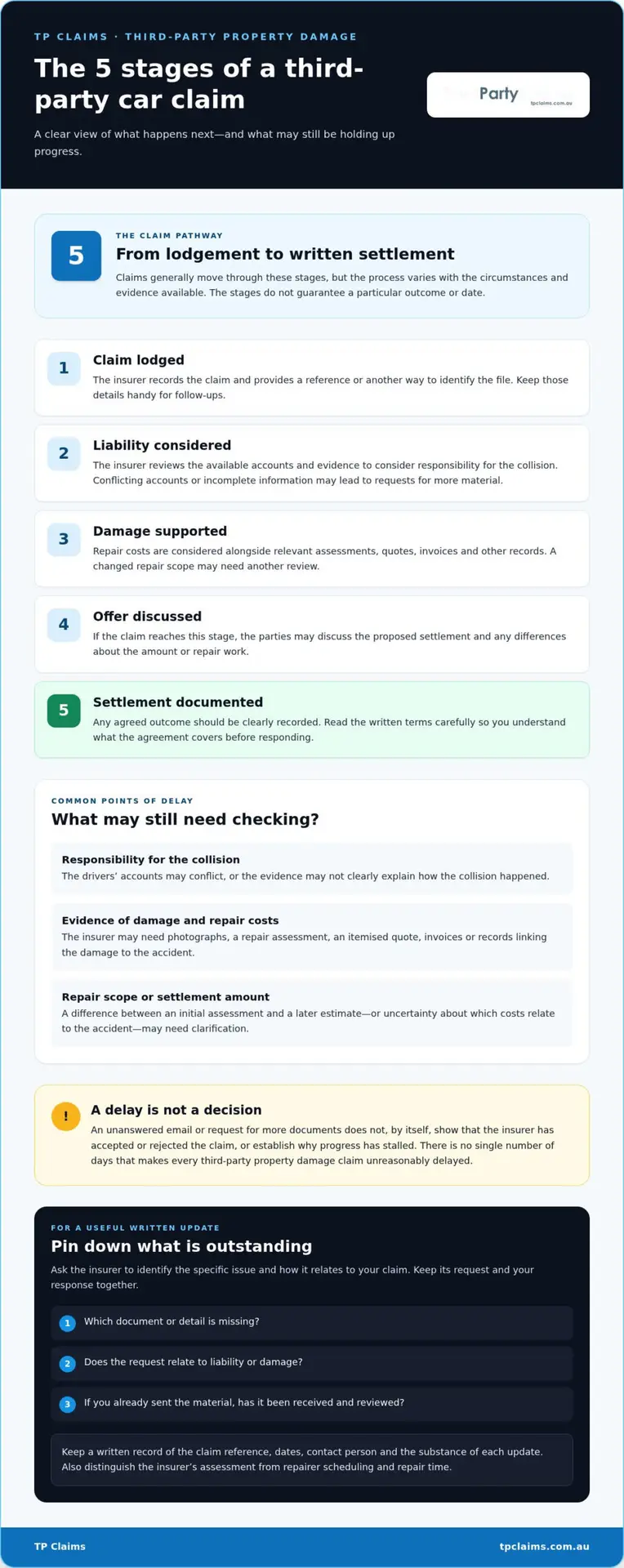
When the insurer asks for information, find out exactly what to provide and why it matters. If it says “more evidence is required”, ask which document or detail is missing, whether the request relates to liability or damage, and where to send it. Keep the request and your response together. If you’ve already supplied the material, note when and how you sent it, then ask whether it has been received and reviewed.
This helps distinguish a claim awaiting evidence from one involving a specific disagreement about responsibility, repair scope or settlement value. You can then focus your follow-up on the issue that is actually holding up progress.
How a third-party insurer assesses and progresses a car accident claim
After you lodge a claim with the other driver’s insurer, the next steps usually involve checking responsibility, reviewing the damage and deciding whether the information supports a settlement discussion. The process varies with the circumstances and evidence available.
A claim generally moves from lodgement, to a review of liability and damage, then to settlement discussions and written settlement documents. Those stages don’t guarantee a particular outcome or date.
- Claim lodged: The insurer records the claim and gives you a reference or another way to identify the file. Keep these details handy for every follow-up.
- Liability considered: The insurer reviews the available accounts and evidence to consider responsibility for the collision. If accounts differ or information is incomplete, it may need further material.
- Damage supported: The claimed repair costs are considered alongside relevant assessments, quotes, invoices and other supporting records. If the repair scope changes, the insurer may need to review the updated information.
- Offer discussed: If the claim reaches this stage, the parties may discuss the proposed settlement and any differences about the amount or repair work.
- Settlement documented: Any agreed outcome should be clearly recorded. Read the written terms carefully so you understand what the agreement covers before responding.
Which parts of the claim can hold up progress?
Responsibility may still be under consideration if the drivers’ accounts conflict or the evidence doesn’t clearly explain how the collision happened. Progress can also pause while the insurer reviews missing records, a repair scope or a difference between an initial assessment and a later estimate. New photographs, invoices or a revised repair quote may add useful detail, but they can also prompt another review.
Keep the insurer’s assessment separate from repairer scheduling and repair time. The insurer may still be considering the claim while a repairer arranges work. Alternatively, the insurer’s review may be complete while the repair itself is yet to begin. Ask which part is outstanding rather than treating every wait as the same delay.
What updates should a claimant keep track of?
A concise written record makes the claim easier to follow and helps you ask focused questions. Save the claim reference and note the date, contact person and substance of each update. Keep copies of information requests, your replies, submitted documents and delivery confirmations. When following up, ask which decision or document remains outstanding, whether anything is needed from you and who will provide the next update.
For broader context on preparing and supporting a claim, explore this Australian third-party property damage claim guide. TP Claims’ third-party claims management can help organise evidence, communicate with the insurer and manage negotiations.
Can you complain when the at-fault driver’s insurer delays settlement?
You can raise your concern with the insurer, but being able to make an internal complaint doesn’t automatically mean you can take the dispute to an external body. You’re a third-party claimant, not necessarily the insurer’s customer, and that can affect which complaint rights and escalation options apply.
People searching “third party insurer delaying settlement car accident australia” may come across advice written for an insurer’s policyholders. Be careful about applying it directly to your circumstances. A delay alone doesn’t mean every external complaint pathway is open to you, or establish that the insurer has breached a rule.
Internal complaint or external escalation: what is the difference?
An internal complaint asks the insurer to review how it has handled your concern. Put it in writing, label it as a complaint, explain what has happened and state what decision or response you’re seeking. Ask the insurer to confirm it has recorded your complaint and explain its process for responding to third-party claimants.
External dispute resolution is different. The Australian Financial Complaints Authority (AFCA) has eligibility and jurisdiction rules, so being a third-party claimant or experiencing a delay doesn’t, by itself, confirm that AFCA can consider your complaint. Check AFCA’s current rules or contact AFCA to understand whether your particular dispute falls within its remit before relying on that pathway.
The General Insurance Code of Practice is an industry code for insurers that subscribe to it. Its application depends on the insurer and the circumstances. Don’t assume that a policyholder’s Code rights or timeframes automatically apply to you as a third party. The Australian Securities and Investments Commission (ASIC) regulates financial services and insurance conduct, but it isn’t an individual claim-resolution service that decides your settlement dispute.
What if the delay is affecting you financially or practically?
Explain the impact briefly and factually. For example, say that you need the vehicle for work, describe a practical difficulty caused by the unresolved repairs, and identify the response you need from the insurer. Ask whether it can arrange an urgent assessment or identify another way to progress the outstanding issue. This is a request, not an automatic entitlement to priority handling or a particular outcome.
Keep the message focused: identify the claim, describe the effect of the delay, ask what decision or information is outstanding, and request a written update. Keep a copy with the rest of your claim records. For context on how timing can vary across third-party property claims, see this Australian guide to third-party claim timeframes.
If managing correspondence and claim documents is becoming difficult, TP Claims’ third-party claims management can help organise the claim, handle insurer communication and manage negotiations. First clarify the insurer’s position and identify which complaint pathway, if any, applies to your circumstances.
What to do if a third-party car accident claim is stalled
If you’re dealing with a third party insurer delaying settlement car accident australia, focus first on finding out exactly what is holding up progress. A calm, specific written follow-up is easier to track than repeated calls, and gives the insurer a clear question to answer. You don’t need to guess at a universal deadline or send your entire file again.
- Check your file: Find the claim reference and review the latest insurer correspondence. Note what you’ve sent, what the insurer has requested and whether it has acknowledged receiving your documents.
- Identify the unresolved issue: Is the insurer waiting to consider responsibility, review repair information or receive a particular record? If the latest update doesn’t say, write down what remains unclear.
- Request a dated update: Ask what action is outstanding, who needs to take it and when you can expect the next update. Request a date for the update, not a guaranteed settlement date.
- Record the response: Save the insurer’s reply, note when it arrived and add any agreed next steps to your file. If there’s no useful response, follow up against the date you requested.
Build a clear record before contacting the insurer
Bring the key material together first: claim reference, accident details, relevant photographs, repair documents and earlier messages. Keep the original files unchanged, and use a simple dated timeline to track when you sent each item, what the insurer asked for and what it replied. This helps you avoid sending different versions of the same document or overlooking an earlier answer.
Before writing, identify the precise gap. For example, you may have sent a repair estimate but not received confirmation that the insurer has reviewed it. State that distinction clearly. Your follow-up checklist is: claim reference, outstanding item, action requested and a dated record of the follow-up.
Make a focused progress request or complaint
Keep your message brief and direct. You could write: “I’m following up on claim [reference]. Please confirm what issue or document remains outstanding, what action is needed next, and who will provide an update. Could you let me know the date I should expect that update?” Attach only relevant documents, and refer to the date you previously sent them if they’re already on file.
If a progress request doesn’t resolve the concern, clearly label your next message as a complaint. Explain what has happened, why the lack of progress concerns you and what response you’re seeking. Avoid threats, accusations or legal deadlines you can’t support. They can distract from the specific action you want the insurer to take.
If keeping on top of insurer follow-ups is taking time away from other priorities, get help managing your third-party claim. TP Claims can organise documents, communicate with the insurer and manage settlement negotiations, without guaranteeing a particular decision or timeframe.
Get help managing a delayed third-party settlement with TP Claims
If repeated insurer follow-ups are taking up your time, claims management can bring the paperwork and next steps into one organised process. TP Claims manages third-party motor vehicle property damage claims and insurance negotiations for individuals and businesses across Australia.
What claims management can take off your hands
A claims specialist can help organise the evidence and correspondence in your file, track information requests and communicate with the insurer. This makes it easier to see what has been supplied, what still needs attention and what response you’re waiting for. TP Claims can coordinate the claim’s documents and follow-ups, so you don’t have to manage each exchange yourself.
Negotiation is also part of the service. If there are questions about repair information or the proposed settlement, TP Claims can manage communications and negotiations with the insurer on your property damage claim. This doesn’t guarantee that the insurer will accept the claim, agree to a particular amount or settle by a specific date. It provides practical support to progress the discussion and keep the file organised.
TP Claims operates on a no-win-no-fee basis. Review the applicable terms carefully to understand how they apply before proceeding. No-win-no-fee doesn’t mean every claim will be accepted or that a particular recovery is assured.
Choose a practical next step for your situation
If the insurer has identified a missing document or a specific question, a focused written follow-up may be enough to clarify what happens next. If you’re spending significant time chasing updates, sorting documents or managing negotiations, claims management can help take those tasks off your hands. The right next step depends on what’s unresolved and the support you need.
A replacement vehicle is a separate mobility option offered by TP Claims, not an automatic entitlement created by a settlement delay. It’s distinct from managing the property damage claim, so don’t assume that a delay alone means a replacement vehicle will be provided.
If you’d like support organising your claim and insurer communications, get help with a third-party property damage claim. TP Claims can manage the claim process and negotiations while keeping you informed of the steps being taken. Your claim will still depend on its circumstances and available evidence, but you don’t have to manage every insurer follow-up on your own.
Move your claim towards a clearer next step
A stalled claim can make it feel as though every decision is out of your hands. You don’t need to predict when it will settle to make progress. Focus on agreeing a clear next milestone: a response to a specific question, review of an outstanding document or confirmation of what happens next. That gives you something practical to track while the insurer considers the claim.
If you’re dealing with a third party insurer delaying settlement car accident australia, you can choose how much of the follow-up you manage yourself. A concise written request may clarify the hold-up. If keeping records together and pursuing updates is becoming a burden, claims support can help you move forward with a more organised plan.
TP Claims manages third-party property damage claims and insurer negotiations on a no-win-no-fee basis, subject to applicable terms. Accident replacement vehicles are also available as a separate service, not an automatic result of a delayed settlement. Get support with your third-party property damage claim and take the next step with a clearer plan.
Frequently Asked Questions
Is a third-party insurer allowed to delay a car accident settlement in Australia?
An insurer may need time to assess the facts and supporting material, but a delay alone doesn’t show whether the claim is being handled appropriately. There isn’t one settlement deadline that applies to every third-party property damage claim. If you’re searching “third party insurer delaying settlement car accident australia”, focus on whether the insurer can explain what remains unresolved and what action it needs next. Keep its response with your claim records.
How long should a third-party car accident claim take to settle?
There’s no reliable single timeframe for every claim. A straightforward claim with clear responsibility and complete repair records may progress differently from one involving disputed accounts, complex damage or changing repair estimates. Also separate the time taken to reach a settlement from the time needed to schedule and complete repairs. Ask the insurer for the next expected step and update date, rather than relying on a general estimate.
Can I complain to AFCA about the other driver’s insurer?
Possibly, but being a third-party claimant doesn’t automatically make your dispute eligible for AFCA. AFCA’s rules determine which complaints it can consider, and eligibility depends on the circumstances and the parties involved. You can ask the insurer to record and review your concern through its internal complaint process, then check AFCA’s current eligibility information before escalating. Don’t assume that a pathway available to the insurer’s own customer applies to you.
Does an insurer taking a long time mean my claim has been rejected?
No. A slow response or continuing assessment isn’t, on its own, a rejection. Look for clear wording that states the insurer’s decision and its reasons. If you’re unsure, ask directly in writing whether a decision has been made, what it covers and when the insurer communicated it. This can help distinguish an unresolved assessment from a formal position you may need to respond to.
What should I do if the insurer keeps asking for more information?
Ask the insurer to identify the exact information it still needs and explain what part of the claim it relates to. For instance, check whether it needs a clearer image, a particular page of an invoice or clarification about a repair item. If you’ve already provided it, refer to the date you sent it and how. Keep your reply focused, and retain a copy of the request and your response.
Can I get a replacement car while the insurer delays my settlement?
A replacement vehicle may be an option, but a settlement delay doesn’t automatically entitle you to one. TP Claims provides accident replacement vehicles as a separate service alongside its third-party property damage claims work. The vehicle option and settlement process are distinct, so don’t treat one as a guaranteed result of the other. Consider whether you need mobility support while the vehicle damage claim is being managed.