
What if the at-fault driver’s insurance doesn’t cover damage to their own car, but your vehicle is damaged? If the at fault driver only has third party property damage insurance, you may still be able to pursue a claim for your loss. Their policy may cover damage they cause to other people’s property, subject to its terms and the insurer’s assessment, but it doesn’t automatically guarantee payment.
It’s understandable to worry that you’ll be left with the repair bill or caught in a stressful back-and-forth with an insurer. The policy type matters, but it doesn’t answer every question about your claim. This guide explains the difference between the other driver’s cover and your options for seeking payment, including how your own policy may fit in.
You’ll also learn what details and evidence to organise, and what to expect when liability or the damage is being assessed. TP Claims manages third-party property damage claims and insurance negotiations, including claims involving uninsured drivers, on a no-win-no-fee basis.
Key Takeaways
- If the at fault driver only has third party property damage cover, their insurer may assess a claim for damage to your vehicle against the policy terms and available information.
- Be ready to explain what happened and provide relevant evidence, as both drivers’ accounts may be considered when the insurer assesses the claim.
- Compare claiming through the other driver’s insurer with making a claim under your own policy, where applicable.
- Keep insurer and claim contact details together, and organise photographs, repair information, accounts and correspondence to help progress your claim.
- TP Claims manages third-party property damage claims and insurance negotiations on a no-win-no-fee basis. The insurer’s decision and claim outcome are not guaranteed.
At-fault driver only has third party property damage insurance: what does that mean?
Finding out the other driver has limited cover can leave you wondering whether your damaged car will be paid for. The policy label alone doesn’t answer that. Third party property damage insurance relates to damage the insured driver causes to other people’s property, but the policy wording and the circumstances of the collision affect how the insurer responds.
The policy describes cover for the insured driver’s liability; your property damage claim is a separate matter for the insurer to assess. If the at fault driver only has third party property damage, that is different from insurance that covers damage to their own car. Don’t assume the other driver’s vehicle is covered for its own damage under this policy, or that your claim has already been accepted.
What third party property damage insurance is designed to cover
In plain English, this type of cover is intended to respond when the policyholder is responsible for damage to someone else’s property, such as another person’s vehicle. It isn’t the same as cover for damage to the policyholder’s own car. The exact response depends on the policy’s terms and exclusions, and on how the incident fits those terms. Policies can differ, so one insurer’s wording shouldn’t be treated as a national standard.
For a broader overview of how cover types differ, see Vehicle insurance. For your situation, the other driver’s policy details and the insurer’s assessment are more relevant than the label alone.
Does the policy type automatically decide your claim?
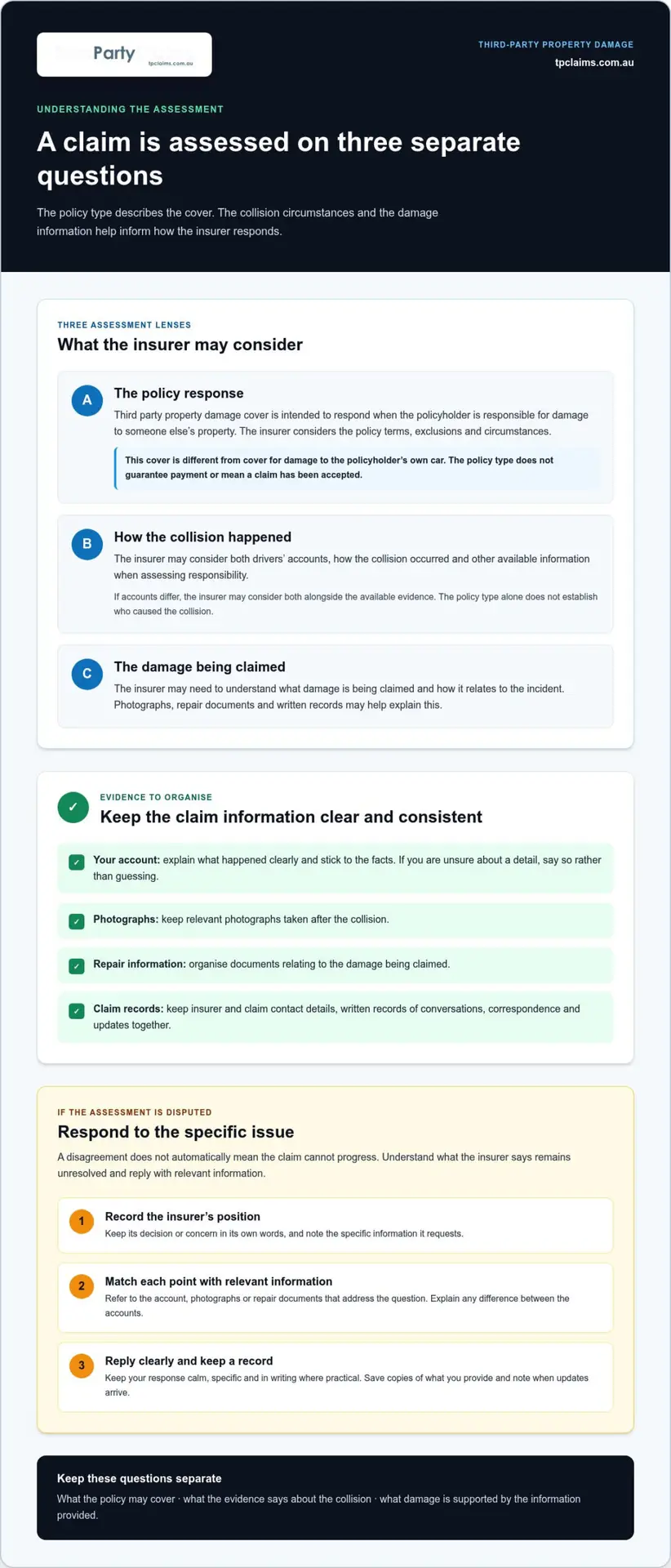
No. The policy type doesn’t establish who caused the collision, whether the insurer accepts responsibility, or how much damage is supported by the information provided. These are related but separate questions. The insurer considers the policy response, while the circumstances and available evidence help inform its assessment of fault and the claimed damage.
For example, two drivers might give different accounts of how a collision happened. The insurer may consider both accounts alongside other available information before deciding how to respond. Even if the driver has the type of policy that may cover damage to another person’s property, that doesn’t mean the insurer has accepted liability or agreed to the full amount claimed.
Uncertainty about the policy isn’t a reason to assume your claim is impossible. Clarify which insurer is handling the matter, what decision has been made, and what information that decision is based on. Keep the policy response separate from the evidence about the collision and your vehicle damage. This distinction helps you understand what the insurer is considering and what may need clarification next.
How a claim may be assessed when the at-fault driver has third party cover
Once a claim is raised, the insurer may need to understand what happened, what damage is being claimed and how the policy applies to the circumstances. The at-fault driver’s account and your account may both inform that assessment. An insurer’s involvement doesn’t, by itself, mean it has accepted liability or agreed to pay a particular amount.
The policy type describes the cover, while the evidence and circumstances of the claim inform the assessment. Focus on providing a clear account of the collision and relevant information about the damage. The insurer’s response will also depend on the applicable policy terms and the details of the claim.
What the insurer may need to understand
The insurer may consider the vehicles involved, how the collision occurred and the damage being claimed. Consistent accounts and dated supporting information can make the sequence of events easier to follow. Photographs taken after the collision, repair documents and written records of conversations may help explain what happened and how the damage relates to it.
Keep your information factual. If you’re unsure of a detail, say so rather than guessing. Policy wording can vary, so the insurer’s terms and the information it requests are more relevant to your claim than general descriptions of insurance cover.
If liability or the damage assessment is disputed
If the insurer challenges your account, the damage claimed or another part of the assessment, keep a written record of its position and the specific information it requests. Respond to each point directly. Refer to relevant documents or photographs, explain any difference in the accounts, and ask the insurer to clarify what remains unresolved.
A disagreement doesn’t automatically mean the claim can’t progress. It does mean you’ll want to understand the reason for the insurer’s position and respond with relevant details, rather than sending a general objection. Keep copies of what you provide and note when you receive updates, so the claim history stays clear.
- Record the insurer’s decision or concern in its own words.
- Match each question to the information you have, such as an account, photograph or repair document.
- Keep your reply calm, specific and in writing where practical.
For broader context on handling a property damage claim, see this third party property damage claim help guide. TP Claims manages third-party property damage claims and insurer negotiations. More information is available on TP Claims’ claims management support.
Your claim options: compare the other driver’s insurer and your own cover
If the at fault driver only has third party property damage, you still have different routes to consider. The right one depends on the circumstances, the information available and the wording of your own policy. This comparison shows what each option involves without assuming an insurer will accept a claim or that your own policy covers the damage.
| Route | What it involves | Information to organise |
|---|---|---|
| Claim against the other driver’s insurer | You contact the insurer handling the other driver’s claim to understand its process and provide your account and details of the damage. Its response depends on its assessment and the applicable policy terms. | Collision details, the other driver’s and insurer’s information, your account, photographs and available repair information. |
| Claim under your own policy | You contact your insurer and review your policy wording to understand what cover may apply and any notification requirements. Don’t assume your policy covers the damage until you’ve checked its terms. | Your policy details, incident information, photographs, repair documents and any claim or notification information requested by your insurer. |
| Claims-management support | A claims manager can handle property damage claim administration and insurer negotiations. This is a service, not an insurance policy, and it doesn’t guarantee a particular outcome. | Your account of the collision, insurer correspondence, contact details and relevant damage or repair information. |
When contacting the at-fault driver’s insurer may be relevant
Contacting the other driver’s insurer can help you understand how to submit your claim and what information it needs. Keep your communication factual: describe what happened as clearly as you can, distinguish what you saw from what you’re unsure about, and keep copies of documents and messages you send. The insurer’s response depends on its assessment and the relevant policy terms, so a claim enquiry isn’t the same as acceptance.
For wider context about the steps and considerations involved, this guide to not-at-fault car accident rights in Australia may help explain the broader picture.
When your own insurer or a claims manager may help
Your own insurer can explain how your policy applies and what information it needs from you. Read the policy wording rather than relying on the policy name alone, and note any notification instructions. If you want support with the claim process, TP Claims manages third-party motor vehicle property damage claims and insurance negotiations, including claims involving uninsured drivers. Claims management can reduce the burden of handling insurer communications. It is separate from insurance advice, which TP Claims does not provide.
Whichever route you consider, keep your accounts and documents organised. A clear record makes it easier to explain your position and respond to requests as the claim progresses.
What to do before progressing your property claim
A clear, organised record can make it easier to explain your claim and respond to questions. This is especially useful if you’re unsure what to expect because the at fault driver only has third party property damage cover. Start with what you know, keep original records unchanged, and add documents as they become available.
Build a clear record of the accident and damage
Use this checklist to gather the basics. You don’t need every document before you begin, but keeping information together can reduce the scramble when someone asks for it.
- Record insurer and claim contact details. Note the insurer’s name, claim reference and contact person or team, if provided. Add the date and method of each call, email or message.
- Write down your account of the collision. Record the date, location, vehicles involved and what you remember happening. Keep it factual, and distinguish what you saw from anything you’re uncertain about.
- Gather photographs and vehicle details. Save relevant images of the vehicles and visible damage, along with registration details and any other identifying information you have. Keep the original files where possible.
- Collect witness information and related records. If witnesses shared their details, store them with your notes. Keep relevant messages or documents together so you can find them easily.
- Add repair information as it arrives. File repair assessments, quotes, invoices and other documents about the vehicle damage. Keep dates and copies, and don’t alter the original records.
- Save every insurer communication. Keep copies of emails, letters, forms and material you send. If a request or decision is made by phone, note who you spoke to, when, and what was discussed.
Keep insurer communication organised
A simple timeline can help you follow what has happened and what the insurer still needs. Use one place to track contact dates, questions, documents sent and responses received. Where practical, ask for important requests or decisions in writing. If you speak by phone, make a brief written note afterwards to confirm your understanding and keep it with your records.
Deadlines and claim procedures can vary according to the circumstances and applicable requirements. Don’t rely on a general timeframe as if it applies to every claim. Follow relevant instructions from the insurer and verify the requirements that apply to your situation. For more on what can affect the process, see this guide to how long a third party property claim takes.
Getting paperwork in order is useful, but follow-ups and insurer correspondence can still take time. TP Claims manages property damage claims and insurance negotiations to help with the process.
How TP Claims can manage a third party property damage claim
Even after you’ve gathered your information and considered your options, dealing with an insurer can take time and effort. If the at fault driver only has third party property damage cover, you may still be unsure how to keep the claim moving or respond to requests for more information. TP Claims manages third-party motor vehicle property damage claims and insurance negotiations, helping take the administration off your hands.
What claims management can take off your plate
Managing a property damage claim can involve keeping track of documents, insurer communications and the steps involved as the claim progresses. TP Claims handles the claims process and insurance negotiations, so you don’t have to manage every exchange with the insurer yourself. The administrative work is managed on your behalf while you remain informed about your claim.
Claims management can make the process clearer, but it can’t guarantee that an insurer will accept a claim, agree to a particular amount or reach a decision within a specific timeframe. The insurer’s response depends on its assessment and the circumstances of the claim. TP Claims manages third-party motor vehicle property damage claims and insurer negotiations, not representation for the at-fault driver or personal injury claims.
Claims management may help if you’re finding it difficult to keep up with correspondence, understand what information has been requested or respond consistently as the insurer assesses the property damage claim. Support with the administration can ease the burden and keep the focus on the vehicle damage and the information relevant to the claim.
A practical next step if you need support
You don’t need every document ready to start organising the claim. Bring together what you already have, such as your account of the accident, vehicle details, damage photographs, repair information and insurer or claim contact details. Include any correspondence or documents you’ve already provided. A clear record can help explain where things stand and what has happened so far.
TP Claims manages property damage claims on a no-win-no-fee basis. That describes the service model; it isn’t a promise that a claim will be accepted or result in payment. You can discuss your circumstances and the information available without assuming the outcome in advance.
If handling insurer communications is adding stress, talk to TP Claims about your property damage claim and get support with the claims process and insurance negotiations.
Take the next step with a clearer plan
If the at fault driver only has third party property damage, it can be hard to know what to do while the insurer assesses your claim. Focus on what you can control: keep your information together, note what still needs clarification, and decide whether you want help managing the process. You don’t have to work out every detail before asking about support.
TP Claims manages third-party motor vehicle property damage claims through the claims process and insurance negotiations. Its claims management service operates on a no-win-no-fee basis, but no service can guarantee an insurer’s decision or a particular outcome. Support can help ease the administration while you move through the process.
If you’re ready to discuss your property damage claim, contact TP Claims to talk through your circumstances and a practical next step.
Frequently Asked Questions
Can I claim against an at-fault driver who only has third party property damage insurance?
You may be able to pursue a property damage claim, but the policy label doesn’t decide whether it will be accepted or what may be paid. If the at fault driver only has third party property damage cover, the insurer may consider the collision circumstances, available evidence, liability and policy terms. Keep notes of what happened and save relevant records. Claims-management support can help with the process if it becomes difficult to manage.
Does third party property damage insurance cover the at-fault driver’s own car?
Generally, this type of cover relates to damage the insured driver causes to other people’s property, not damage to their own car. The exact response depends on the policy wording, so don’t assume the other driver’s vehicle is covered for its own damage. If both cars are damaged, the policy name alone won’t tell you how the insurer will deal with each vehicle or claim.
Do I have to pay the at-fault driver’s insurance excess?
Don’t assume you’re responsible for an excess just because the other driver or insurer asks you to pay one. An excess is a term in an insurance policy, and whether a payment is relevant to you depends on the circumstances and the insurer’s position. Ask for the request and its basis in writing, keep a copy, and avoid agreeing to pay before you understand what the payment relates to.
Can I use my own insurer if the other driver has third party property damage cover?
Your options depend on the cover in your own policy and the accident circumstances. Check the wording for relevant cover and any steps for notifying your insurer, then contact them to understand their process. Your policy may set out how to report damage even if you’re also dealing with the other driver’s insurer. Don’t assume your own policy will pay for repairs without checking the terms that apply.
What if the at-fault driver’s insurer disputes who caused the accident?
A dispute doesn’t automatically mean your claim is over. Keep the insurer’s questions and position, then respond to the specific points it raises. If the insurer questions the direction of travel, for example, explain what you recall and refer to relevant information you have, such as a witness’s account. Keep your response calm and factual. A claims manager may help handle communications about the property damage claim.
How long can a third party property damage claim take?
There’s no single timeframe that fits every claim. The process may be affected by how promptly information is provided, whether the parties disagree about responsibility or damage, and what further steps are needed. Keep track of outstanding requests and follow up in writing if you need an update. For more detail about factors that may affect timing, read our guide to third party property claim timeframes.
Can I claim towing or storage expenses after the accident?
You may include towing or storage expenses for consideration, but don’t assume every cost will be accepted. Keep itemised invoices or receipts and note why the expense arose, such as where the vehicle was taken after the collision. If the insurer asks about a charge, explain how it relates to the accident and provide the available records. The assessment depends on the circumstances and any applicable requirements.