
What if the details another driver gave you after a crash are false? If you’re searching for “other driver gave fake details after accident australia”, you may be worried they’ll disappear, deny the collision or leave you unsure who to contact. It’s unsettling, but unreliable details don’t automatically mean you’re out of options.
You can take practical steps to protect your position. Record what happened while it’s fresh, preserve photos and witness details, and keep any messages or documents the other driver provided. If you’re concerned about the information, find out how to report the incident in your state or territory and keep a record of your follow-up.
This article explains what to collect, how to handle concerns about the other driver’s identity, and what you can do next with a property damage claim. If the claim becomes difficult to manage, TP Claims can help manage third-party property damage claims and negotiate with insurers on your behalf, without promising a particular outcome.
Key Takeaways
- Suspected false details can make identification and claim communication harder, but they don’t automatically make recovery impossible.
- If the other driver gave fake details after accident australia, preserve original photos, dashcam footage and messages, and note when and where each was recorded.
- Document any inconsistencies and use appropriate official reporting channels. Check the current police guidance for your state or territory.
- An unknown insurer doesn’t prove the other driver is uninsured. Keep the distinction clear as you work out your next steps.
- TP Claims can manage third-party property damage claims and insurance negotiations, including claims involving uninsured drivers.
Other driver gave fake details after an accident: what could it mean?
First, make sure you and anyone else involved are safe. If there’s an immediate danger or someone needs urgent help, contact emergency services. Once you’re safe, don’t assume that details that seem false mean you have no options. They may be incomplete, mistaken, out of date or deliberately misleading, and the next steps depend on what you can establish.
Keep the different kinds of information separate. A name may be wrong while a registration number is accurate; an insurer may be unknown even if the driver’s identity is correct. Each discrepancy can affect follow-up differently. A mismatch is a reason to preserve the information and check it through appropriate channels, not proof of what happened.
Which details should you treat as uncertain?
Review each item on its own rather than deciding straight away that the whole account is false. For example, a missing digit in a phone number does not tell you whether the name or registration is accurate.
- Name: Note the name given and any difference from documents or later messages.
- Contact information: Record the phone number, email or address provided, including what happens if you try to contact them.
- Vehicle registration: Write down the plate as you saw it and compare it with any record you have.
- Insurer details: Keep the insurer’s name and any policy or claim reference separate from the driver’s identity.
A typo, incomplete answer or outdated detail isn’t automatically deliberate deception. Record exactly what was said or written, when you received it and what appears inconsistent. Avoid changing or embellishing the account. That gives you a clear record to refer to if you make a report or discuss the property damage claim.
Does receiving false details mean you cannot make a claim?
No. Inaccurate information can make it harder to contact the other party or move a claim forward, but it doesn’t by itself decide who caused the collision or whether a recovery pathway is available. That depends on the circumstances and the evidence, including what can be established about the crash and the vehicles involved.
Also, not knowing the other driver’s insurer doesn’t prove they’re uninsured. The insurer information may simply be missing or wrong. Treat identity, insurance status and responsibility as separate questions until there’s evidence to clarify them.
People searching “other driver gave fake details after accident australia” may worry the incident is automatically a hit-and-run. Suspected inaccurate details alone don’t establish that. For general background on the term, see Hit and run.
Unreliable details are a problem to investigate, not proof that recovery is impossible. Stay factual, keep each discrepancy clear and let the available evidence guide what happens next.
What suspected fake details change – and what they do not
Unreliable information can create extra work. If a phone number doesn’t connect or a registration appears inconsistent, it may be harder to contact the other driver or pass accurate details to an insurer. That can slow communication while the information is checked. It doesn’t, by itself, mean a property damage claim cannot proceed or decide who was responsible for the collision.
Keep three questions distinct: who was driving, whether the vehicle or driver was insured, and how the crash happened. One answer doesn’t automatically settle the others. A dispute about the details supplied at the scene is not proof of fault, just as an argument about fault doesn’t establish that someone deliberately gave false information.
False, incomplete or mistaken: why the distinction matters
A registration character might have been transposed, or a driver might have given an incorrect phone number by mistake. A detail can also be incomplete or out of date. Those possibilities matter because suspicion alone doesn’t establish intent. Record what you received and what conflicts with it, then keep your description factual rather than labelling the other person a fraudster.
If the information continues to contradict itself, note each inconsistency and when you became aware of it. Repeated contradictions may be worth raising through appropriate reporting or claims channels, but they are not a reason to confront or threaten the other driver. Let the records and evidence speak for themselves.
Unknown insurance details are not proof of no insurance
An insurer’s name or policy number may be missing, inaccurate or simply not available to you at the scene. That makes it harder to direct claim communications, but it doesn’t confirm the driver’s insurance status. Keep that question open while you establish what information can be verified.
Missing insurer details do not establish that a driver is uninsured. Treat insurance status separately from responsibility for the crash. The evidence about how the collision happened may help assess responsibility, while the insurance question concerns a different part of the follow-up. Neither should be assumed from a single missing or inconsistent detail.
For someone searching “other driver gave fake details after accident australia”, this distinction can prevent an early assumption from narrowing the next steps. A claim’s practical pathway depends on the circumstances and available evidence. Keep copies of relevant records, including any later messages that clarify or contradict what was first provided. A clear timeline can help explain the issue without overstating what you know.
False information may raise concerns, but don’t assume it automatically amounts to a crime or guarantees a particular legal outcome. The significance depends on the facts and applicable law. Focus on what you can support: what was said, what you observed, what doesn’t match and how the discrepancy affects contact or the claim.
If the details are making a vehicle damage claim difficult to manage, third-party property damage claims support can help with claims management and insurer negotiations.
Evidence to preserve when the other driver’s details seem false
If you’re concerned the other driver gave fake details after accident australia, focus on preserving a clear, accurate record. Only document what you can safely and lawfully access. Don’t follow, threaten or confront the driver to get more information. A calm record made soon after the crash can help you explain what happened and identify which details need follow-up.
Keep original files where possible, and note when and where you created or received each record. Keep the original files and a dated incident note together, without assuming they will determine the outcome.
Build a clear record of the crash and information exchanged
Write a dated account while your memory is fresh. Separate what you directly saw or heard from your interpretation. For example, record the registration characters you observed, then separately note that they differ from the details the driver gave you. Include the time and location, vehicle description, damage, names of witnesses and the exact details exchanged.
- Save original photos of the vehicles, damage, scene and any written details you received.
- Keep messages and other correspondence in their original form, with dates and sender information visible.
- Gather repair assessments, towing records and relevant claim correspondence in one folder.
Don’t edit an image or rewrite a message to make it clearer. If you need to explain something, add a separate note that describes the change or discrepancy.
Preserve dashcam, CCTV and witness information
If you have dashcam footage, save the original recording promptly so it isn’t accidentally overwritten. Keep the source file unchanged; if you make a shorter viewing copy, retain the original as well. Note the camera’s date and time settings, as these may not match the actual time. Don’t assume a clip alone shows the full sequence of events.
Look for nearby cameras from a safe, public place and note their location. You can raise potentially relevant footage through appropriate, lawful channels, but don’t access private systems or try to obtain recordings improperly. Footage may not be available to you directly.
If someone witnessed the crash, record their contact details only if they offer them. Note what they say in their own words, where possible, and don’t pressure them to provide a statement or support a particular version of events.
Keep the material organised by type and date. A simple timeline can connect the crash, the details exchanged, later attempts to make contact and any new information. Label your own notes clearly as notes, rather than presenting them as original records.
For a property damage matter, a tidy file of photos, recordings, correspondence and repair documents can make it easier to explain what information is uncertain and what you observed yourself. Preserve first, then share relevant records through appropriate reporting or claims channels.
What to do next if the other driver gave fake details
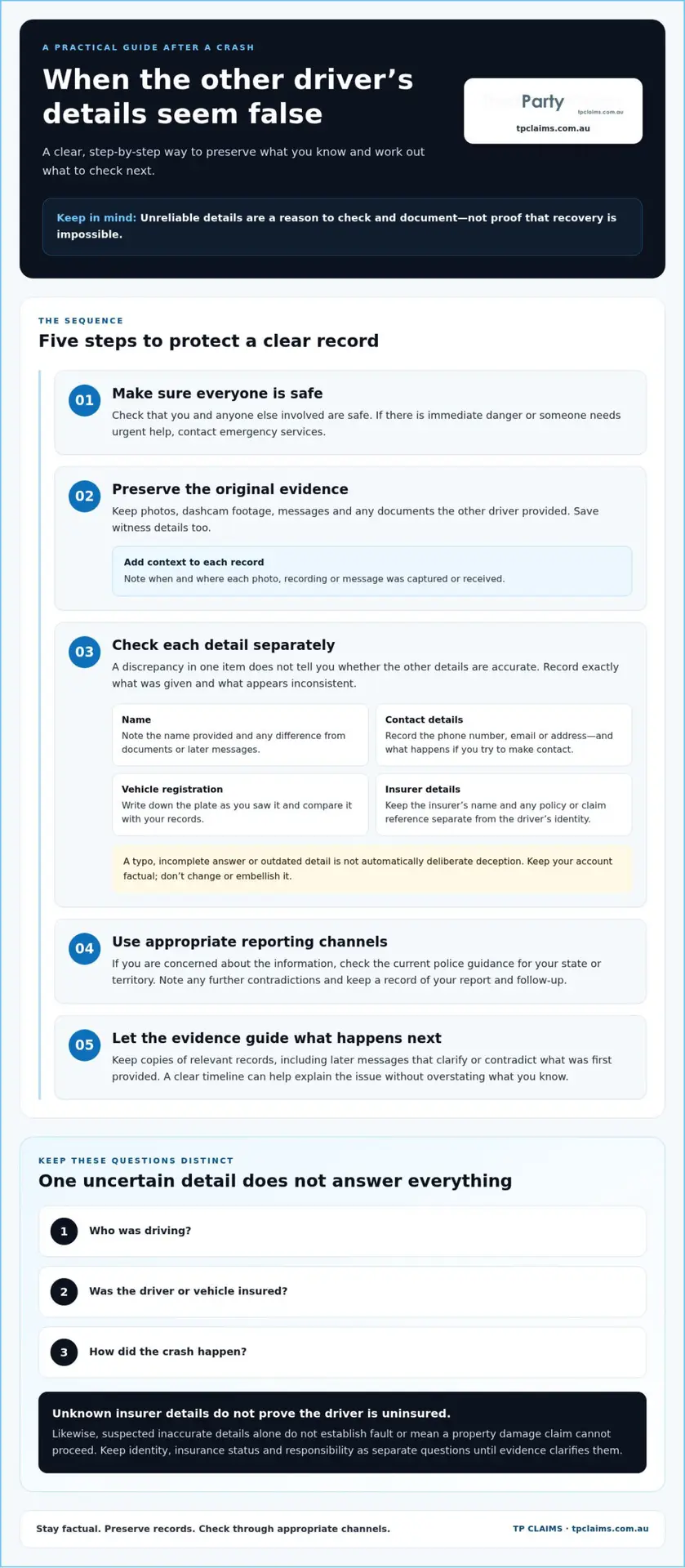
Keep your next steps calm and methodical. If anyone is in immediate danger or needs urgent medical help, call 000. Once it’s safe, focus on preserving the information you have and reporting concerns through appropriate channels. The right process can differ between Australian states and territories, so check current local guidance before relying on a specific reporting rule.
- Make the scene safe. Move out of danger if you can do so safely, and arrange emergency assistance if needed. Don’t follow the other driver or try to force them to provide more information.
- Preserve your records. Keep original photos, dashcam files, messages and any details the other driver gave you. Save them in a place where they won’t be accidentally deleted, and note when and where you received or created each record.
- Write down the discrepancy. Record the exact detail that seems wrong, such as a phone number that doesn’t connect or a registration that differs from what you observed. Clearly separate what you saw or heard from what you suspect. Avoid stating that someone deliberately lied unless that has been established.
- Check how to report it. Use official police channels where appropriate, and consult the police guidance for your state or territory to find out what reporting process applies to your circumstances. Keep any report reference or follow-up correspondence with your incident records.
Report the concern without making assumptions
Share a concise account: when and where the crash happened, what details were exchanged, and precisely what doesn’t match. Attach or refer to records you have, such as a photo of the vehicle or a message containing the information. Say “the registration I noted differs from the one provided” rather than claiming you know why. This helps authorities assess the facts without confusing observation with suspicion.
Reporting requirements and processes can vary across Australia and may depend on the circumstances. Check current official state or territory guidance rather than assuming the same rule applies everywhere. If you’re unsure which channel is appropriate, consult the relevant police service’s official information.
Keep the property damage claim moving
Organise the incident record alongside repair assessments, towing documents and claim correspondence. Clear, consistent information can help an insurer or claims manager understand the damage and progress discussions. If a detail remains uncertain, identify it as unverified rather than leaving it out or guessing. Avoid assuming the other driver’s insurance status or responsibility based only on information that appears inaccurate.
If you need broader context, read about third-party property damage claim help and not-at-fault car accident rights. If you’re searching “other driver gave fake details after accident australia” because the property damage claim feels hard to manage, get help managing a third-party property damage claim. TP Claims manages these claims and negotiates with insurers on clients’ behalf.
How TP Claims can help with a property damage claim
Unclear driver details can make a vehicle damage claim harder to organise, especially if communication stalls or insurer information is missing. TP Claims manages third-party motor vehicle property damage claims and negotiates with insurers on clients’ behalf. That means you can get support with the claims process while the available information and evidence are brought together.
Help is focused on damage to vehicles and other property. It does not depend on assuming the other driver is uninsured: a missing or unreliable insurer detail doesn’t establish their insurance status. TP Claims also manages claims involving uninsured drivers, where that status is part of the circumstances.
What claims management can take off your plate
A property damage claim can involve gathering documents, keeping track of communications and handling discussions with an insurer. TP Claims can manage the claims process and negotiations, helping keep the matter organised when details are unclear or follow-up becomes difficult. You can provide the records you have, including incident information and repair documents, so the claim can be managed with reference to the available material.
Claims management is provided on a no-win-no-fee basis. This describes the basis on which TP Claims manages claims; it is not a promise of recovery or a particular result. Any outcome depends on the circumstances and the information available.
When to seek support with an unclear or disputed claim
You may value support if contact details don’t work, information conflicts, or insurer communications become difficult to manage. TP Claims handles claims management and negotiations for property damage matters. The role is to manage the claim, not to provide insurance advice or determine the outcome in advance.
If you’re searching “other driver gave fake details after accident australia” because you’re unsure how to move a property damage claim forward, you don’t have to manage every discussion alone. You can talk through the matter and the information you have, without assuming that an uncertain detail proves the other driver was uninsured or settles responsibility for the crash.
For a clearer path through the property damage claims process, talk to TP Claims about your property damage claim. The team can manage the claim and insurer negotiations, while keeping you informed as the matter progresses.
Take the next step towards a clearer claim path
Uncertainty about the other driver can make it tempting to wait until every detail is clear. Instead, focus on a manageable next step: decide what you still need clarified and what information you can share about the property damage. You don’t have to solve every unanswered question before asking for support.
If you’re searching “other driver gave fake details after accident australia” because you’re unsure how to move forward, explain what happened in your own words and identify which details remain uncertain. A calm conversation can help you understand how your property damage claim may be managed, without assuming a particular outcome.
TP Claims manages third-party property damage claims and negotiates with insurers, including in claims involving uninsured drivers. Claims management is on a no-win-no-fee basis, but no particular recovery is guaranteed. You can take the next step at your own pace.
Talk to TP Claims about your property damage claim and discuss a practical way forward. You deserve clear support as you work through what comes next.
Frequently Asked Questions
Is it illegal to give fake details after a car accident in Australia?
Not automatically in every situation; whether an offence has occurred depends on the circumstances and the relevant state or territory rules. An incorrect phone number could be a mistake, while deliberate deception is a different concern. Write down the exact information provided and why it seems inaccurate. If you need guidance about whether specific conduct may be unlawful, speak with a qualified legal professional.
Can I make a property damage claim if the other driver gave me a fake name?
You may still have options, although an unreliable name can complicate follow-up. Give the claims contact a factual account, such as when you received the name and what makes you question it. If you have a repair assessment or correspondence referring to the crash, keep it organised with your incident records. People searching “other driver gave fake details after accident australia” should avoid trying to identify or confront the driver themselves.
What should I do if the other driver gave me a wrong registration number?
Record the number exactly as it was given and separately write down what you saw on the vehicle, if you observed it. Don’t fill in characters you couldn’t read or assume a mismatch was intentional. For example, note that two characters appear different, rather than guessing a replacement plate. Keep any relevant image in its original form and pass the discrepancy on through appropriate official channels.
Can police help if another driver gives false details after a crash?
Police may receive a report about the incident, but the process and response depend on the circumstances and local guidance. In a non-urgent report, explain what happened in order and identify which details you directly observed and which remain uncertain. Ask how to keep a reference number or record of your report. Don’t rely on police attendance or assume a report will resolve the property damage claim.
What happens if the other driver cannot be identified after an accident?
There isn’t one outcome that applies to every unidentified-driver crash. Relevant evidence, the circumstances and any applicable insurance arrangements can affect the available options. Keep documents that show the damage and costs, such as repair assessments and invoices, alongside your incident records. A claims manager can help organise a third-party property damage matter, but can’t promise a particular result or timeframe.
Should I contact the other driver if I think their details are fake?
Don’t follow, threaten or confront them. If you already have a way to contact the driver, keep any exchange brief and factual, and save the messages with their dates. Avoid accusations or pressure. If contact feels unsafe or the conversation becomes hostile, stop engaging and use appropriate official channels to raise the concern. Call 000 if there’s immediate danger or an urgent medical need.
Can dashcam footage help if the other driver gave false details?
It may provide a record of part of the incident, depending on what the camera captured. Check that the file plays, then keep the original recording and a separate backup. Note if the camera’s clock appears inaccurate, rather than changing the source file. Footage may not show the driver’s identity or the full crash, so describe only what it clearly records when sharing it through appropriate channels.