
Getting an independent assessment after a motor accident repair dispute can help clarify whether the proposed repairs, parts and labour are reasonable, and what damage relates to the crash. Insurers commonly assess a repair quote before approving work. In Victoria, an assessment should take no longer than five working days after a repairer provides an estimate.
It’s frustrating to face delays or disagree about who should pay, especially when you need your car back on the road. A separate assessment can give you a clearer basis for discussing repair costs and workmanship. This guide explains when to seek one, what evidence to gather, how responsibility may affect payment, and what to do if the other party says the car is a write-off. You’ll also learn how to compare a repair quote and understand the role of parts and repair quality, so you can take the next step with more confidence.
Key Takeaways
- Consider an independent assessment when there’s disagreement about the damage, repair scope or who is responsible.
- Keep clear photos and written records to support your account of the damage and the repair discussions.
- Use an itemised repair quote to examine whether the proposed parts, labour and work relate to restoring the vehicle.
- Record discussions about payment and repair arrangements, and keep the car from deteriorating while the dispute is unresolved.
Motor Vehicle Assessments – Why Is It Necessary And How Long Should It Take?
An independent assessment can help clarify damage, repair scope and liability when you dispute an insurer’s findings. Preserve relevant evidence and understand what the assessment can establish.
-
Check assessor qualifications
Choose an assessor with relevant automotive qualifications and experience assessing collision damage. Ask for a written report identifying the damage, proposed repair work, parts and labour considered, and how the findings support the estimate. A reasoned report is more useful in an insurance claim or dispute than an unexplained repair figure.
-
Choose an independent assessment provider
Use an independent motor vehicle assessor who can inspect the vehicle and prepare a reasoned report. Ask about the inspection method, report scope and fee before proceeding; the cost depends on the work required and is provided after a quote request. Insurers may assess vehicles in person or through digital images, but a separate inspection can offer an additional basis for reviewing disputed damage.
-
Obtain an independent damage assessment
To arrange an assessment, gather the insurer’s report, repair estimate, claim correspondence and clear photographs taken before repairs. Ask the assessor to distinguish accident damage from unrelated wear and explain whether the proposed work restores the vehicle’s pre-accident condition. In Victoria, an assessment should take no longer than five working days after a repairer provides an estimate. In South Australia, get the other party’s permission before an assessor inspects their vehicle.
-
Review insurer recommendations and policyholder rights
Compare the insurer’s findings with the independent report and your policy’s Product Disclosure Statement, especially its repairer-choice terms. Compulsory third party insurance covers injuries to other people, not damage to vehicles or property; comprehensive cover can include your vehicle, while third party property insurance generally covers damage you cause to others. Keep photos and claim records for police, insurers or court. If an insurer dispute remains unresolved, AFCA may handle complaints; processes differ between states, so check the applicable pathway. Seek legal advice for significant liability disputes.
Assessing repair quotes for reasonableness
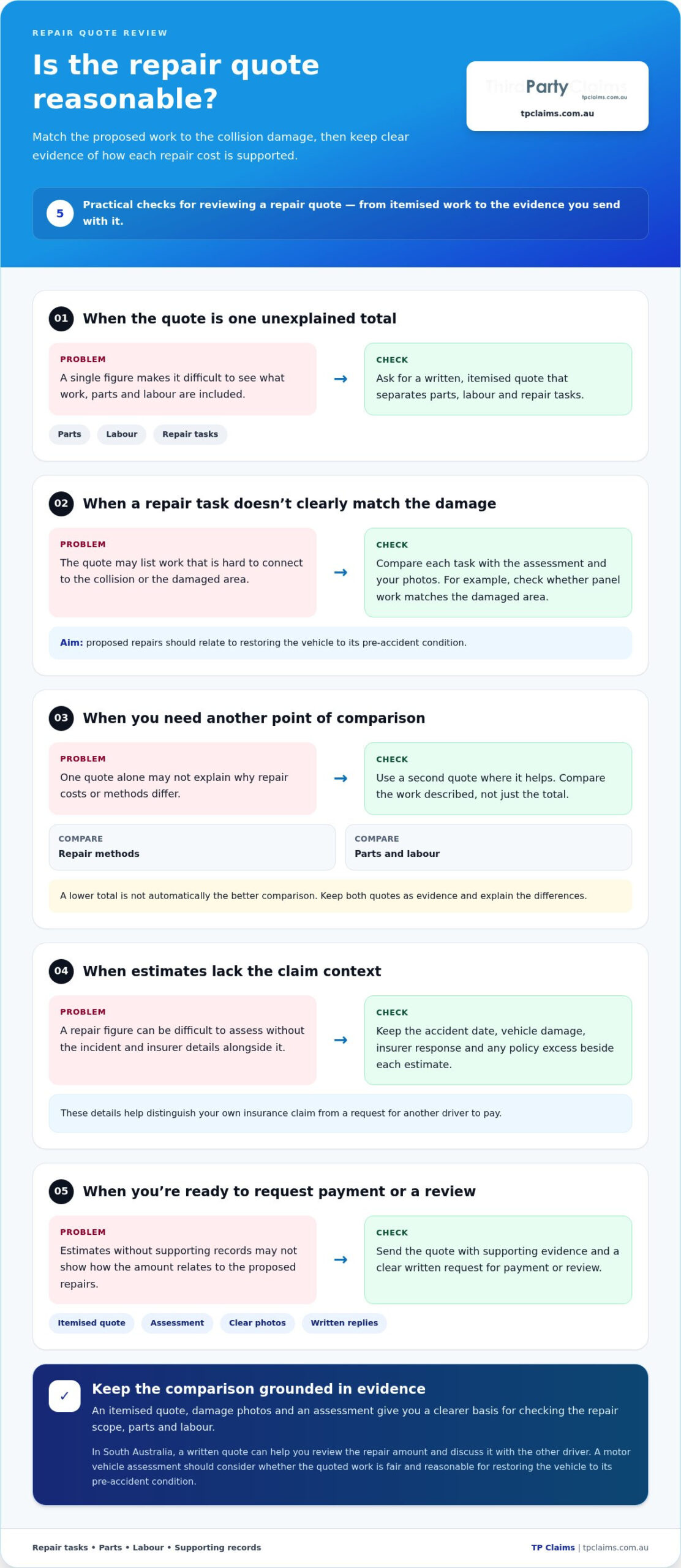
Check whether each proposed repair matches the collision damage and what’s needed to restore the vehicle. In South Australia, a written quote gives you a practical basis for reviewing the repair amount and discussing it with the other driver.
- Ask a repairer for a written, itemised quote separating parts, labour and repair tasks. This makes the proposed work easier to assess. Getting an independent assessment after a motor accident repair dispute can help you compare the quoted work with the damage and identify anything that needs clarification.
- Compare each repair task with the assessment and your photos. A motor vehicle assessment considers whether the quoted repairs, labour and parts are fair and reasonable to restore the vehicle to its pre-accident condition. For example, check whether the listed panel work matches the damaged area. Ask for a written explanation of unclear items.
- Use a second quote as a comparison where it helps. In South Australia, two quotes may help show the other driver how repair costs compare. Differences can reflect repair methods, parts or labour, so compare the work described rather than choosing the lowest total automatically. Keep both quotes as evidence and exchange them with a short explanation.
- Keep claim details beside each estimate. Note the accident date, the vehicle damage, the insurer’s response and any excess under your policy. These details help distinguish your own insurance claim from a request for another driver to pay. A written quote can provide a basis for discussing repair costs when another driver is believed to be at fault.
- Send the quote and supporting evidence with a clear request for payment or review. If you’re getting an independent assessment after a motor accident repair dispute involving an uninsured driver, keep estimates and written replies together to support your property damage claim. The record helps show how each figure relates to the proposed repairs.
Negotiating responsibility for repair costs
Keep responsibility for the collision separate from disagreements about repair work. Getting an independent assessment after a motor accident repair dispute can help clarify which damage and costs relate to the incident, but state clearly what outcome you’re seeking.
A finding that an insurer or repairer was at fault does not by itself determine who pays the assessor’s fee. Keep the invoice and make any reimbursement request in writing.
- Set out your position on liability. Describe what happened, identify the other parties and explain why you believe a particular driver is responsible. Refer to relevant evidence, such as dated photos or the assessor’s findings, and ask for a written response.
- Separate responsibility for the accident from responsibility for the repairs. If the other driver disputes liability, focus your message on the collision. If the disagreement concerns repair work, describe the specific issue and ask the insurer or repairer to address it. Getting an independent assessment after a motor accident repair dispute can support the discussion, but it does not replace a clear request.
- Make your payment request precise. State the amount sought, who you believe should pay and what documents support your position. In South Australia, compensation for vehicle damage is payable to its owner, and the liable driver can’t insist on paying the repairer directly.
- Decide how to handle repairs while the claim remains unsettled. In South Australia, you can have the vehicle repaired without the other driver’s approval, but you must pay the repairer yourself if the dispute is unresolved. If you pay, request reimbursement from the other driver and retain the final invoice.
- Keep the vehicle from deteriorating while waiting for payment. In South Australia, the other driver isn’t liable for extra repair costs caused by deterioration. Record the steps you take to limit further damage and keep related documents with your claim correspondence.
A finding that an insurer or repairer was at fault does not by itself determine who pays the assessor’s fee. Keep the invoice and make any reimbursement request in writing to the party you believe should pay.
Parts and repair quality
- Compare the repair report with the work actually completed. Match each listed task to the damaged area, then note anything that appears incomplete or unrelated. Ask the repairer for a written explanation of the work and parts used. This gives you a clear record to compare with the original quote and independent assessment.
- Ask for details of any disputed parts. Record the part description and where it was fitted, then compare those details with the assessment and invoice. If the documents describe different parts or repair methods, ask the insurer to explain the difference in writing and keep the reply with your claim records.
- Inspect the vehicle carefully before accepting completed work. Photograph visible concerns, such as uneven panel gaps, mismatched paint or loose trim, and note where each appears. Appearance alone does not prove poor workmanship. Use the photos to request a focused inspection and written findings about repair quality.
- Check what applies to the repair arrangement. Insurer-backed network repairs commonly include a workmanship guarantee for as long as the vehicle owner owns it. Read the relevant repair documents to understand what work it covers, then raise defects through the stated claims process. Keep copies of the assessment, repair invoice and all written replies.
- Consider safety before driving with disputed accident repairs. Concerns involving braking, steering, tyres, lights or structural damage need prompt attention; arrange an inspection before using the vehicle if you’re unsure it’s safe. Record the issue and contact the insurer or repairer to agree on the next action. If the vehicle can’t be used during repairs, explore accident replacement vehicle support while the claim is being resolved.
TP Claims: Third Party Property Damage Claims
TP Claims can help with third-party property damage claims arising from a motor vehicle accident. Its Third Party Property Damage Claims and Insurance Negotiation Services support you in pursuing eligible repair costs and discussing responsibility. If the at-fault driver is uninsured, Claims Management for Uninsured Drivers can help manage the claim and recovery process. Accident Replacement Vehicles may also be relevant when a damaged vehicle cannot be used, subject to conditions.
Bring together your assessment, repair quote, photos and correspondence so the claim can be considered with the key evidence in one place. This support is suited to property damage disputes, not personal injury claims or comprehensive insurance policies.
Contact TP Claims to discuss your motor vehicle property damage claim.
Move your dispute towards a clear next step
Once you have an independent assessment, use it to focus the discussion on what needs to happen next. Identify the point still in dispute, whether it is the repair scope, responsibility or the insurer’s response, and state the outcome you’re seeking. Keep the request calm and focused, with the relevant documents together so the other party can respond to the issue.
If you’re getting an independent assessment after a motor accident repair dispute, you don’t have to manage every claims conversation alone. TP Claims can help you work through the next steps in a third-party property damage matter and negotiate with an insurer. The right support can make a complex process easier to organise, while keeping your decisions grounded in the evidence.
Contact TP Claims for help with your motor vehicle property damage claim. A clear next step can help you move forward with greater confidence.
Frequently Asked Questions
Can I choose my own assessor if my insurer disputes the repair quality or cost?
Your policy terms may affect how a separate assessment fits with the insurer’s repair process. Check your Product Disclosure Statement and any repair authorisation before booking, especially if work is underway. Ask the insurer to explain in writing how it will consider an independent report, and keep the reply with your claim records.
What evidence should I collect before arranging an independent repair assessment?
Gather documents that show the claim history, not just the vehicle’s current condition. Include the policy schedule, claim number, repair authorisation, insurer decision and any police report details. Keep original digital photos with their dates, plus invoices for work already completed. A short record of calls, including the date and the person or team spoken to, can help clarify what was agreed.
How do I complain to an insurer about disputed accident repairs in Australia?
Write to the insurer’s complaints team, state the repair issue clearly and attach the documents supporting your position. Ask for a written response explaining its decision and how to request an internal review. If you’re in NSW and can’t resolve the dispute with your insurer, you can lodge a complaint with AFCA. Keep copies of your complaint and the insurer’s replies.
Can I get a second repair quote or assessment before authorising further work?
Before approving additional work, ask for an updated written scope and arrange another quote or assessment to compare the proposed tasks. Tell the insurer and repairer you’re seeking a review, and keep their written responses. If the vehicle may be unsafe, arrange an appropriate inspection rather than driving it or delaying necessary work to obtain another estimate.