
What if the clearest account of a crash isn’t the one argued most loudly at the roadside? If you’re wondering what to do when other driver disputes accident fault, it’s understandable to worry that an insurer might accept their version. You don’t have to settle the disagreement in the moment. A calm response and a clear record can help keep attention on what the available evidence shows.
Start by prioritising safety, then record the scene and vehicle damage, collect witness contact details and save any dashcam footage. Keep your account factual when speaking with the other driver or an insurer, and avoid guessing about details you’re unsure of. Even small pieces of evidence can help clarify how each person’s account fits the circumstances of the collision.
This guide explains what to preserve, how to communicate when accounts differ and what practical steps may follow. You’ll also learn when support with a third-party property damage claim or insurance negotiations could ease the work of coordinating a disputed claim. The aim is to create a useful, accurate record, not to win a roadside argument.
Key Takeaways
- If you’re considering what to do when other driver disputes accident fault, distinguish what you directly observed from assumptions or details reported by others.
- Organise relevant records so the timeline and evidence are easy to follow, then share information through appropriate claims channels.
- Keep written correspondence and note who you spoke with, when you spoke and what was discussed.
- If the disagreement continues, clarify which parts of the account remain contested and keep track of the responses you receive.
- TP Claims manages third-party property damage claims and insurance negotiations on a no-win-no-fee basis, helping reduce the coordination burden of a disputed claim.
When the Other Driver Disputes Fault, Start With a Clear Record
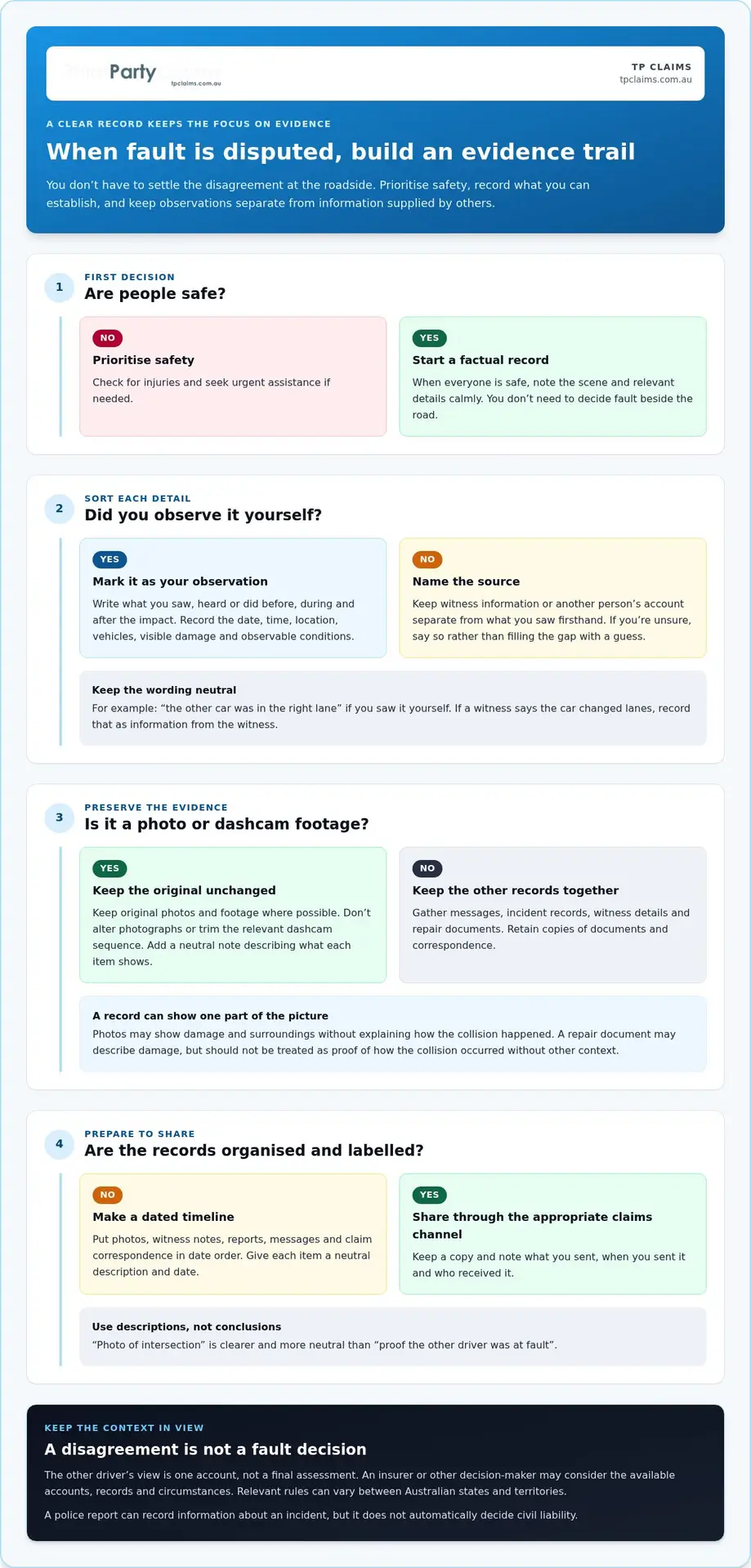
A disagreement at the scene doesn’t establish whose account is correct. If you’re searching for “what to do when other driver disputes accident fault”, start by looking after people and making a clear, factual record. Check for injuries and seek urgent assistance if needed. Make sure everyone involved is safe before turning your attention to vehicle damage or a claim.
What to do at the scene when accounts differ
If it’s safe and appropriate, exchange relevant details calmly. You don’t need to settle the question of fault beside the road. Record what you can observe and leave conclusions for the claims process.
- Write down the date, time and precise location, along with the vehicles involved and any visible damage.
- Note observable conditions, such as the road layout, traffic signals, weather and the position of the vehicles.
- Record witness contact details if they’re willing to provide them.
Keep your own observations separate from what someone else tells you. For example, note “the other car was in the right lane” if you saw it yourself. If a witness later says the other car changed lanes, record that as information from the witness, not as something you personally observed. Don’t argue, speculate about speed or distance, or agree to a version you believe is inaccurate. A calm, brief exchange helps you focus on safety and the facts.
Why a disagreement is not the same as a fault decision
The other driver’s view is one account of the collision, not a final assessment. An insurer or another decision-maker may consider the available accounts and records alongside the circumstances of the crash. The relevant rules can vary between Australian states and territories, so an outcome may depend on both the evidence and the rules that apply where the incident occurred.
A police report can record information about an incident, but it doesn’t automatically decide civil liability. Police involvement and an insurer’s assessment of responsibility are not interchangeable. A report may form part of the available information, but it doesn’t, by itself, settle every disagreement about who caused the collision. For a broad introduction to traffic collisions and related legal and financial issues, see the Traffic Collision Overview.
Each claim is assessed on the evidence available and its circumstances.
As soon as you can, write down your recollection in your own words while details are fresh. Include what you saw, heard and did before, during and after the impact. If you can’t remember something clearly, say so rather than filling the gap with a guess. Keep your notes with other records, and use the same careful approach in later conversations and written messages. Your immediate aim isn’t to win an argument at the roadside. It’s to preserve information that may help clarify what happened.
How to Build an Evidence Trail for a Disputed Car Accident
A useful evidence trail is more than a pile of photos. It’s an organised record that helps someone reviewing the claim understand what each item shows, when it was created and where it came from. If you’re working out what to do when other driver disputes accident fault, follow a simple sequence: gather, label, preserve and share.
- Gather: Collect relevant records, including original photos of vehicle damage, vehicle positions and scene features. Save dashcam footage, messages, incident records, witness details and repair documents.
- Label: Give each item a neutral description and date. Separate what you personally observed from estimates, assumptions and information another person supplied.
- Preserve: Keep original files where possible. Avoid editing the relevant dashcam sequence or altering photographs, and retain copies of documents and correspondence.
- Share: Provide relevant records through the appropriate claims channel. Note what you sent, when you sent it and who received it.
Which records may help clarify competing accounts?
Photos can show damage and surroundings, but they don’t necessarily explain how the collision happened on their own. Keep the original images and note what each one depicts, such as “rear damage, left side” or “intersection viewed from the north approach”. If a witness offers information, record their name and contact details, and distinguish what they saw firsthand from what they heard from someone else.
Save dashcam footage in its original form, including the relevant sequence, rather than trimming it to make a point. Keep messages, incident records and repair-related documents together. A repair document may help describe damage, for example, but shouldn’t be treated as proof of how the collision occurred without other context.
How to keep evidence useful and easy to follow
Create a dated folder or timeline while your recollection is fresh. Place photos, witness notes, reports, messages and claim correspondence in date order. Use descriptions rather than conclusions: “photo of intersection” is clearer and more neutral than “proof the other driver was at fault”.
Original, dated records help preserve context and make it easier to understand what was captured and when.
Keep a separate note of when you share records and with whom, and retain copies of the material you provide. For broader property damage context, TP Claims’ not-at-fault accident rights guide explains more about the claims process.
If coordinating records and claim correspondence feels like a lot to manage, TP Claims’ property damage claims management can help manage the claims process and insurance negotiations on a no-win-no-fee basis.
How to Communicate When the Other Driver or Insurer Disagrees
Clear communication can help keep a fault dispute focused on what’s known, rather than how strongly each person feels about it. If you’re deciding what to do when other driver disputes accident fault, use concise, factual language and be open about anything you can’t confirm. Claim processes vary by insurer, policy and circumstances, so don’t assume every claim follows the same steps.
What to include in a factual written account
Set out the sequence of events using your own observations. For example, describe which direction you were travelling, what you saw immediately before the impact and where the vehicles came to a stop. If you’re uncertain about a detail, say so. An estimate of speed or distance isn’t the same as a confirmed fact.
Refer to records that support your account, such as a photograph or dashcam file, without turning them into accusations. Keep your wording calm and consistent when communicating with the other driver, an insurer or another relevant party. You might write:
- “I was travelling straight through the intersection when the vehicles collided.”
- “I’m unsure of the other vehicle’s speed.”
- “I’ve attached photographs of the damage and the intersection.”
Only include statements that reflect what you know. Don’t adopt the other driver’s version just to end an uncomfortable conversation, and avoid apologising in a way that could be read as accepting responsibility if that isn’t what you mean. You can acknowledge their position without agreeing with it: “I understand that you see the events differently. I don’t agree with that account.”
How to handle requests and conflicting versions
Read letters, emails and claim messages carefully. Note any requested response dates, what information is being sought and who sent the request. If something isn’t clear, ask what information is needed or request the supporting documents being referred to. Keep a copy of your question and any reply.
- Save emails, letters and message screenshots in your claim folder.
- After a phone call, record the date, the person’s name, the organisation and the main points discussed.
- Check that a written summary reflects what you said before you confirm it.
- Don’t ignore formal correspondence or make commitments you don’t understand.
If you receive a version of events that conflicts with yours, identify the specific point of difference and refer to the relevant record. Avoid broad claims about the other driver’s honesty or motives. A calm reply can preserve a clear account, but it doesn’t decide fault by itself.
For a wider explanation of the property damage process, TP Claims’ third-party property damage claim help covers the broader steps involved. Keep your communications factual and retain a copy of what you send, so your account remains easy to follow as the claim progresses.
What to Do if the Fault Dispute Continues
If you’ve shared your account and the disagreement remains, take a measured next step rather than repeating the same argument. Review your records, identify exactly which points are still disputed, then decide what information or response is needed. Keep your expectations realistic: a complaint, negotiation or document may help move the discussion forward, but none guarantees a particular result.
- Review the evidence. Compare each account with the records available. Note what supports your version, what conflicts with it and what remains uncertain.
- Clarify the disagreement. Ask the other party or insurer to identify the specific issue they dispute and explain what information their position is based on.
- Keep a record. Save replies and note outstanding questions, who is responsible for responding and any follow-up dates you’ve set.
Formal complaint or dispute pathways can depend on who you’re dealing with, the insurer, the type of claim and the circumstances. Avoid assuming there’s one process that applies to every Australian motor vehicle claim. If you’re unsure which route applies, seek guidance suited to your situation rather than relying on a general template.
When to pause and get tailored advice
Consider independent legal advice if you receive court documents, face a formal demand, have a substantial claim in dispute or can’t understand the potential consequences of a response. Pay close attention to any dates or instructions in formal documents, as procedures can differ between states and territories. Claims management can help organise a property damage claim and insurance communications, but it isn’t legal advice or legal representation.
Don’t rely on a single time limit as though it applies to every claim. If a deadline appears in a document, or you’re uncertain about what it means, get advice specific to the document and your circumstances promptly.
How to keep the dispute manageable while it is unresolved
Use one chronology to track key events, correspondence and follow-ups. Keep a copy of each important message and note questions that are still unanswered. If you contact someone again, refer to the earlier communication and state clearly what response you’re seeking. This makes it easier to follow the history without assuming that silence means progress or agreement.
Keep property-related records together too, such as repair updates, invoices, assessment documents and transport records connected with the damaged vehicle. These may help explain the practical impact of the damage, although they don’t determine who caused the collision.
Timely, organised records make it easier to see what’s been addressed and what still needs attention. For a separate overview of timing considerations, read the third-party claim timeframe guide.
If coordinating a disputed property damage claim and insurer communications is becoming difficult, get support managing your property damage claim through TP Claims.
How TP Claims Can Help Manage a Disputed Property Damage Claim
Once you’ve taken practical steps to record the collision and communicate clearly, you may want support managing the property damage claim itself. For people searching “what to do when other driver disputes accident fault”, the claims process can feel like another job: organising records, following up with insurers and keeping track of what happens next. TP Claims manages third-party motor vehicle property damage claims, including claims involving uninsured drivers.
What claims management can take off your plate
TP Claims manages the claims process and insurance negotiations on a no-win-no-fee basis. This support can help coordinate claim-related steps and communications, so you’re not left trying to keep every part of a property damage claim organised on your own. The evidence and account you’ve gathered can provide useful context as the claim is managed.
Claims management doesn’t guarantee that another party or insurer will accept your version, establish fault in your favour or agree to a particular settlement. The outcome depends on the claim and its circumstances. The service concerns motor vehicle property damage claims. It isn’t personal injury representation or legal advice, so seek independent legal advice if you need guidance on legal rights, court documents or formal proceedings.
TP Claims also provides accident replacement vehicles while property damage claims are being processed and vehicles are being repaired. This can help you stay mobile if damage has affected your ability to get around during that period.
Practical next steps for discussing your situation
You don’t need to have a perfect file prepared before discussing a claim. A few key records can make it easier to explain what happened and where things stand. Gather what you have, then organise it so the important details are easy to find.
- Your incident timeline, including what you observed and which details remain disputed.
- Relevant photographs, witness information and any incident records.
- Insurer correspondence, including requests, responses and notes of important conversations.
- Information about vehicle damage, repairs and related transport needs.
Be ready to explain what remains unresolved, such as a disagreement about how the collision happened or uncertainty about the next claim step. TP Claims can explain its claims management process and relevant next steps for a property damage claim. You can discuss how insurance negotiations are managed and what information may help explain your circumstances. Having your records nearby can make the conversation more focused, but you don’t need to resolve the fault dispute before seeking help with managing the claim.
If you’d like support with the property damage claims process, discuss your claim with TP Claims.
Take the Next Step With a Clearer Plan
A disagreement over fault can leave you unsure how to move forward, but you don’t have to resolve every issue before getting support with the property damage claim. If you’re still asking what to do when other driver disputes accident fault, consider what would make the next stage easier: a clearer plan for managing claim paperwork, insurer discussions and practical transport needs.
TP Claims manages third-party property damage claims and insurance negotiations on a no-win-no-fee basis. TP Claims also provides accident replacement vehicles while claims are processed and vehicles are repaired. Claims support can help manage the process, but it can’t guarantee a particular finding on fault or settlement. If you need legal advice, seek it independently.
When you’re ready, discuss your situation and the records you have with TP Claims. Talk to TP Claims about managing your property damage claim, and take the next step with greater confidence.
Frequently Asked Questions
Does the police decide who was at fault in a car accident?
No. Police may attend, investigate or record information about a crash, but their involvement doesn’t automatically decide civil responsibility for damage. A police report may contain useful details, such as observations or accounts given at the scene, but an insurer, dispute body or court may consider other evidence and applicable rules. If a report contains an error, note the specific detail and ask how to provide a correction or clarification.
Can both drivers be partly at fault for a car accident?
Yes, responsibility may be shared, depending on what happened and the rules that apply in the relevant state or territory. For instance, both drivers’ actions may be relevant if one vehicle changed lanes while the other was travelling too fast for the conditions. Don’t assume that a shared-fault assessment automatically ends a claim or determines the amount recoverable. If the proposed split has serious consequences, get advice tailored to your circumstances.
What if the other driver changes their story after the crash?
A changed account doesn’t automatically prove that either version is correct. Keep the earlier and later statements, note when and where each was made, and identify precisely what changed. For example, record whether the driver first described travelling straight, then later said they were turning. Share the discrepancy through the appropriate claims channel, along with any records that may help explain it. Avoid accusing the other driver of dishonesty without evidence.
Should I admit fault if the other driver says the accident was my fault?
You don’t need to agree with the other driver’s view just to calm the situation. Keep your response neutral, such as, “I don’t agree with that account, and I’ll provide my information through the claims process.” Don’t guess about what happened or make a statement you don’t believe is accurate. If someone asks you to sign a statement or make a formal admission and you’re unsure of its effect, seek independent advice first.
Can I make a property damage claim if the other driver denies fault?
You can raise a property damage claim even if the other driver disputes responsibility. Their denial doesn’t, by itself, determine how the claim will be assessed. Provide the information requested through the relevant claims process, and keep a copy of your submission and any response. If the insurer disputes liability or asks for further material, find out which part of your account is contested. A claim can be considered, but an outcome isn’t guaranteed.
How long can a disputed car accident claim take to resolve?
There’s no single timeframe that applies to every disputed motor vehicle property damage claim. Progress may depend on how much information is available, whether further damage assessment is needed, how quickly relevant parties respond and whether they agree on responsibility. Keep a note of outstanding requests and follow-up dates, and ask for an update if you’re unsure what is holding up the next step. Don’t treat a general estimate as a deadline or promise.