
Can you recover trade vehicle repair costs without comprehensive insurance? If a crash wasn’t your fault, having no comprehensive cover doesn’t automatically mean you’re left to pay for every repair yourself. But when your ute or van is off the road, jobs are at risk and the other driver disputes responsibility, it’s understandable to worry about the cost and what to do next.
The key questions are whether the other driver was responsible and whether you can support your claim with clear evidence. This guide explains when you may be able to seek repair costs through a third-party property damage claim, and how to organise evidence of what happened and what repairs are needed.
You’ll learn how to organise photos, witness details, repair quotes and invoices, while keeping work moving. TP Claims manages third-party claims and insurance negotiations, and provides accident replacement vehicles to help not-at-fault drivers stay mobile while their claims are processed.
Key Takeaways
- You may be able to recover trade vehicle repair costs without comprehensive insurance by pursuing a claim against the driver responsible, but recovery isn’t guaranteed.
- Compare self-funded repairs, approaching the other driver directly and making a third-party insurance claim to understand the differences in upfront costs and negotiation effort.
- Separate established facts from disputed details, and build a clear record of the incident and repair needs.
- Keep original photos, messages, reports, quotes and invoices together so you can find key documents as the claim progresses.
- TP Claims manages third-party property damage claims and insurance negotiations, and provides accident replacement vehicles to help keep work moving.
Can you recover trade vehicle repair costs without comprehensive insurance?
A damaged ute, van or work truck can mean more than an inconvenient repair. You may face an unexpected expense while trying to keep booked jobs on track, arrange transport and respond to customers. If you’re asking whether you can recover trade vehicle repair costs without comprehensive insurance, the short answer is that you may have a pathway if another driver caused the damage. Payment isn’t guaranteed: responsibility, evidence, the circumstances of the crash and applicable rules all matter.
Comprehensive insurance generally covers damage to your own vehicle, subject to the policy’s terms. Third-party property damage cover generally relates to damage your vehicle causes to someone else’s property. The cover available depends on the policy. A third-party property damage claim is different: if another driver was responsible, you may seek the cost of repairing your vehicle from them or their insurer. For a general overview of cover types, see Vehicle insurance.
Insurance cover is protection provided by your own policy; a recovery claim is a request for a responsible party to pay for damage they caused. Not having comprehensive cover doesn’t decide who caused the crash or, by itself, rule out making a claim.
What does no comprehensive insurance mean after a crash?
Without comprehensive cover, damage to your own vehicle may not be covered by your policy. That’s separate from cover for damage your vehicle causes to other people’s property. Compulsory third-party insurance in Australia relates to injuries caused in a motor vehicle accident; it isn’t cover for repairing vehicles. The other driver’s account alone doesn’t establish responsibility. The available evidence and circumstances also need to be considered.
Why does a trade vehicle make the situation feel different?
A work vehicle may be central to your day. If your van carries tools or your truck is needed for booked jobs, damage can disrupt customer commitments as well as require repairs. You may need to weigh up repair options while working out how to keep operating. Keep any claimed lost income or business interruption separate from vehicle repair costs: whether those losses can be recovered depends on the circumstances and applicable rules, and should be verified for your situation.
Separate the immediate practical problem from the question of who should pay. Record how the damage affects the vehicle’s use, but don’t assume that disruption automatically forms part of a recoverable claim. Clear information about the crash and repairs helps distinguish what is known, what remains disputed and which costs relate directly to the vehicle.
What affects a claim for trade vehicle repair costs?
A claim is usually assessed by looking at three connected areas: who was responsible for the crash, what evidence supports the account, and whether the repair records relate clearly to the damage. These points matter together. A repair invoice can show what work was done, but it doesn’t establish who caused the collision. An account of the crash also needs supporting details if responsibility is disputed.
Clear liability information and well-organised repair evidence work together: one helps explain why you’re seeking payment, while the other documents the damage and repair work involved. Keep confirmed facts separate from assumptions. For example, record the time, location and vehicles involved as facts, and note any disagreement about how the collision happened as disputed. One driver’s version alone shouldn’t be treated as a final finding of fault.
How do fault and available evidence affect recovery?
Gather material that may help clarify the incident, and preserve it in its original form. Useful records can include:
- Names and contact details for the drivers and any witnesses.
- Photographs of vehicle damage, road conditions, signs and the surrounding scene.
- Dashcam footage, if available, along with the original file.
- Messages or reports that record what was said or observed after the crash.
Accounts can conflict, and gaps in the available information may make responsibility harder to assess. Avoid editing footage or presenting an uncertain detail as settled fact. The legal approach can depend on the circumstances and jurisdiction, so don’t treat this list as a definitive test of liability. Keep the evidence organised and note where accounts differ, so those points can be considered as the claim is assessed.
Which repair and business records should you organise?
Keep the repair trail together so it’s easy to see what was recommended, what was completed and what each document relates to. Save written estimates, itemised invoices, towing records and relevant communications. A quote is an estimate, and an invoice records work charged; neither guarantees that an insurer or another party will agree to pay the full amount.
For a trade vehicle, add factual records that explain its working role, such as the tools or equipment it carries and the types of jobs it’s used for. If bookings were affected, keep relevant schedules and customer communications too. These records provide context, but they don’t automatically make lost income, operating expenses, tools or other property recoverable. Keep those items separate from vehicle repair documents, and don’t present every business cost as part of the repair claim.
If you need support organising a claim and insurance discussions, third-party property damage claim management can help manage the process.
Repairing the vehicle privately or pursuing a third-party claim: what changes?
If your work vehicle is damaged, you may be weighing the urgency of getting it back on the road against the risk of paying before responsibility is resolved. There isn’t one route that suits every crash. Your options differ in who arranges the repair, who pays upfront and how much follow-up you need to manage. To recover trade vehicle repair costs without comprehensive insurance, weigh these practical trade-offs alongside the evidence and your policy obligations.
| Option | Control and upfront payment | Evidence and workload |
|---|---|---|
| Self-funded repair | You can arrange repairs directly, but you may need to pay the repairer yourself. Any later recovery is a separate matter and isn’t guaranteed. | Keep quotes, invoices and proof of payment. You handle the repair arrangements and any separate recovery discussions. |
| Direct approach | You contact the other driver to discuss the damage and possible payment. An agreed private arrangement may affect timing, but depends on both parties’ cooperation. | Set out the damage and proposed costs in writing, and keep copies of all communications. You’ll need to manage follow-up if there’s disagreement or delay. |
| Third-party insurance claim | You make a claim to the other driver’s insurer, if they have relevant cover. The insurer may need to assess the circumstances before responding. | Provide supporting information and respond to requests or questions. Negotiations may take time, particularly if responsibility or repair costs are disputed. |
These are broad differences, not guaranteed outcomes. Even if you’re considering a direct approach or arranging repairs yourself, check your own policy wording and contact your insurer if required by your policy. Notification requirements can vary. Keep your options open until you understand what the policy says and what any proposed payment or agreement covers.
When might a private repair arrangement be considered?
Some drivers consider agreeing on repairs or payment directly, but a private arrangement isn’t right for every situation. Before work begins, gather written quotes and make sure any agreement clearly records what damage it covers, who will pay and when. Keep messages and receipts. Check your policy obligations before deciding not to notify your insurer, even if you expect the other driver to pay.
What changes when the other driver is uninsured or disputes responsibility?
If the other driver is uninsured, there may be no insurer to handle a property damage claim on their behalf, so discussions may need to be directly with that driver. A driver who disputes responsibility or doesn’t respond can slow progress and make recovery more complicated. Don’t treat silence or a verbal offer as proof that the matter is settled. Keep your records and get legal advice if you’re unsure about your rights, a proposed agreement or possible next steps.
Before signing a final settlement or accepting payment, read the terms carefully. Check whether it releases only the documented vehicle repairs or also other damage or costs. Once you agree, it may be difficult to pursue items covered by that release. Court action isn’t an automatic or simple next step; consider advice on your circumstances before deciding how to proceed.
What steps can you take to prepare a trade vehicle repair claim?
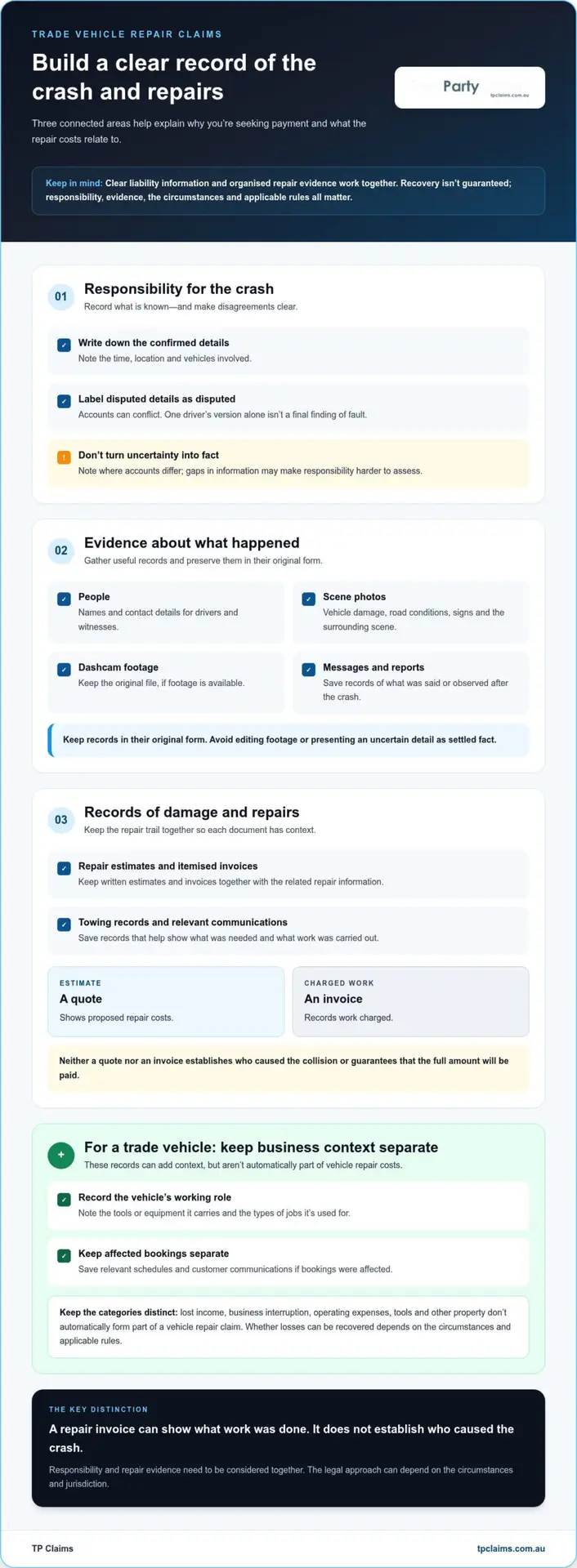
A clear claim file keeps the incident, repair work and impact on your business distinct and easy to follow. Start with what happened, then add supporting material as it becomes available. If you’re working out how to recover trade vehicle repair costs without comprehensive insurance, this sequence can help you prepare without overstating what the documents prove.
What should you collect before progressing the claim?
Build one accessible digital or paper file. Keep original photographs, messages, reports and invoices together, and use dated subfolders or clear filenames so you can find the right record quickly. Don’t edit original images or footage; make separate copies if you need to mark up or annotate anything.
- Record the incident: Note the date, time and location description, the vehicles involved, and the other driver’s contact and vehicle details. Add witness names and contact details if available.
- Preserve scene evidence: Save photos showing the damage and surroundings, plus any available dashcam footage. Keep related reports and communications, and note which details are confirmed or still disputed.
- Track the repair: Add written repair estimates, itemised invoices, towing documents and communications about the work. Keep each document with its date and make clear whether it is an estimate or a final invoice.
- Describe business use factually: Record what the vehicle is used for, any specialist setup or equipment, and relevant work commitments affected by the damage. Keep these details separate from financial loss calculations; they provide context but don’t establish that every business cost is recoverable.
This organised record can help you prepare for third-party property damage claim discussions or clarify details in truck collision property damage disputes. Keep the wording factual: a booking affected by vehicle damage records disruption, but doesn’t prove on its own that related losses will be paid.
How can you keep work moving while the vehicle is repaired?
List the vehicle functions your work depends on, such as carrying tools, transporting materials or accessing a worksite. Then note current bookings and practical transport needs. This gives you a grounded view of what must be covered while repairs are arranged, without assuming that every workaround or lost job forms part of a claim.
An accident replacement vehicle may help you stay mobile while repairs are arranged or claim discussions continue. Consider what type of vehicle your work requires, and keep records of arrangements and related communications. A not-at-fault accident replacement car guide can help you understand the topic; eligibility and recovery aren’t guaranteed.
If you want help managing the claim file and insurance negotiations, get support with your third-party property damage claim. An organised file makes it easier to explain the situation and manage the process while you focus on your work.
How TP Claims can manage a trade vehicle repair-cost claim
After a crash, you may be juggling repair arrangements, customer commitments and messages from the other driver or insurer. TP Claims manages third-party property damage claims and insurance negotiations for individuals and businesses, helping organise the claims process while you focus on keeping work moving. This support can help if you’re seeking to recover trade vehicle repair costs without comprehensive insurance, but no claim outcome is guaranteed.
Claims management is offered on a no-win-no-fee basis. That describes the service model, not a promise that a claim will succeed or that every possible cost or obligation is waived. Understand the terms that apply to your matter before proceeding. Each claim depends on its circumstances, available evidence and assessment of responsibility.
What does claims management take off your plate?
Managing a claim can involve sorting through incident details, repair records and communications, then handling insurance negotiations with the relevant parties. This can reduce the administration you need to manage yourself, especially when you’re also arranging repairs or rescheduling jobs. It doesn’t remove the need for accurate information or guarantee a particular response, settlement or timeframe.
TP Claims also manages claims involving uninsured drivers and complex truck collision disputes. If a trade vehicle is essential to your work, TP Claims provides accident replacement vehicles to help you stay mobile. Whether related costs can be recovered depends on the circumstances, so keep those costs separate from the repair claim itself.
What is a sensible next step after a work vehicle accident?
Start with the records you have: incident details, photographs or footage, witness information, repair estimates, invoices and any towing documents. Put them in one accessible file, and label what is confirmed and what is still disputed. A straightforward timeline can help explain what happened and how the vehicle’s damage connects to the repairs being claimed.
Include relevant business-use information, such as the vehicle’s work role and affected bookings, but keep factual records distinct from any request for business losses. Not every expense or disruption will necessarily be recoverable. The evidence and applicable rules need to be considered in the context of your particular claim.
For help managing the process, Talk to TP Claims about your trade vehicle claim. You can also see how TP Claims can help manage your claim.
Take the next step with a clear plan
A damaged work vehicle can leave you solving two problems at once: how to keep jobs moving and how to deal with the repair claim. You don’t need to have every detail settled before taking a sensible next step. Start with the information you have, keep new documents together, and be clear about what you still need to establish.
Whether you can recover trade vehicle repair costs without comprehensive insurance depends on the circumstances and supporting evidence. Organising your records can help you explain what happened and move the claim forward without assuming the outcome in advance.
TP Claims works with individuals and businesses on third-party property damage claims. Talk to TP Claims about your trade vehicle claim for help managing the next steps while you focus on getting back to work.
Frequently Asked Questions
Can I recover trade vehicle repair costs if I do not have comprehensive insurance?
Possibly. You may seek repair costs from the driver responsible for the crash or their insurer, even if you don’t have comprehensive cover. Whether you can recover trade vehicle repair costs without comprehensive insurance depends on the circumstances and evidence supporting responsibility and the repairs. Keep any pre-existing damage distinct from crash damage, and don’t assume an insurer has accepted liability until you receive clear confirmation.
Does the at-fault driver’s insurance pay for my work ute repairs?
It may, if the other driver is found responsible and their policy responds to the claim. The insurer will assess the circumstances and supporting information, so payment isn’t automatic just because you believe the other driver caused the crash. Keep a record of claim references and written responses. If the insurer disputes part of the repair scope, ask which items it disputes and why, rather than treating a partial offer as full agreement.
What if the driver who hit my work vehicle has no insurance?
You may still be able to pursue the driver directly for property damage, but recovery can be more difficult if they disagree, don’t respond or can’t pay. Keep communications factual and in writing, and avoid making assumptions about what a verbal promise means. TP Claims manages claims involving uninsured drivers. If you’re considering formal legal steps or an agreement, get advice specific to your circumstances before committing.
Can I claim lost income while my trade vehicle is off the road?
Possibly, but lost income isn’t automatically included or recoverable just because the vehicle was damaged. Keep records that show the actual effect, such as cancelled bookings, invoices, job schedules and steps taken to reduce disruption. Separate documented losses from estimates or ordinary operating expenses. Whether a loss can form part of a claim depends on the facts and applicable rules, so avoid relying on a projected figure alone.
Should I repair my trade vehicle before the claim is resolved?
You may need to arrange repairs before a claim is settled, particularly if the vehicle is essential for work, but consider how to preserve evidence first. Take clear photos and keep an inspection or repair report describing the damage before work starts. Save replaced parts or records of their disposal where practical. Tell the other party or insurer about the proposed repairs and keep copies of any responses, so there’s a record of the process.
Do I need to notify my insurer if I am not claiming on my policy?
Check your policy and contact your insurer if its terms require you to report an accident, even if you plan to seek payment from someone else. Notification doesn’t necessarily mean you’re making a claim under your own cover. Keep a note of when you notified them, who you spoke with and any reference number. If you’re unsure how a policy condition applies, ask your insurer to explain the relevant wording.
Can I use a replacement vehicle while my work vehicle is being repaired?
A replacement vehicle may help you stay mobile while repairs or claim discussions continue. Consider what your work actually requires: a standard car may not replace a ute with tool storage or a vehicle set up for carrying materials. TP Claims provides accident replacement vehicles. Don’t assume that using a replacement vehicle means its costs will be covered or recovered.
What records should a tradie keep after a vehicle accident?
Keep a dated record of the incident, driver and witness details, photos, available dashcam footage, messages, reports and repair paperwork. For a work vehicle, retain relevant booking changes and a short factual note of how the vehicle is used, such as carrying tools or materials. Store originals in one accessible folder and back up digital files. Clear labels can help you distinguish crash evidence from business records if questions arise.