
The repair bill may be only one part of what a car accident has cost you. If you’re searching for “recover out of pocket expenses car accident australia”, first separate property damage costs from personal injury expenses. They follow different claim pathways.
It’s understandable to wonder whether costs beyond repairs can be included, or whether missing receipts or a dispute about fault will affect your claim. You may be able to pursue reasonable, accident-related property expenses, but recovery depends on the circumstances and the evidence you can provide.
This guide explains which property costs to record, what documents can support them and how to identify whether a third-party property damage claim or your own comprehensive insurance may be relevant. It also explains why CTP generally relates to personal injury, not vehicle repairs, and what to do if liability or settlement discussions become difficult. If paperwork and insurer communications are adding to the pressure, claims management can help you pursue a documented property damage claim.
Key Takeaways
- Not every cost after a crash is automatically recoverable. Separate property damage expenses from costs related to a personal injury claim.
- Searching “recover out of pocket expenses car accident australia”? Fault, the connection between each cost and the collision, and supporting evidence can all affect a property damage claim.
- Match each expense with a dated receipt, tax invoice, payment record or written assessment. Keep a clear record of any disputed items.
- Review your policy documents, identify the relevant property damage claim pathway and support disputed expenses with the records that relate to them.
- When evidence, liability or settlement discussions become difficult, TP Claims can manage third-party property damage claims and insurance negotiations across Australia.
Which out-of-pocket expenses after a car accident may be recoverable?
An expense isn’t automatically covered just because it followed a crash. “Out-of-pocket expenses” are costs you’ve paid yourself, or amounts that remain unpaid after an insurer or settlement has responded. Whether you can recover them depends on the circumstances, including responsibility for the collision and evidence linking each cost to it.
A property damage claim focuses on losses connected with your vehicle and other property. CTP schemes generally relate to personal injury, while vehicle damage follows a separate claim pathway. If you’re trying to recover out of pocket expenses car accident australia, keep these types of costs separate and review the relevant policy documents and claim process. Where another driver’s negligence is relevant, the legal principle of negligence provides useful background, but it doesn’t determine whether a particular expense will be paid.
Which vehicle-related costs should you record?
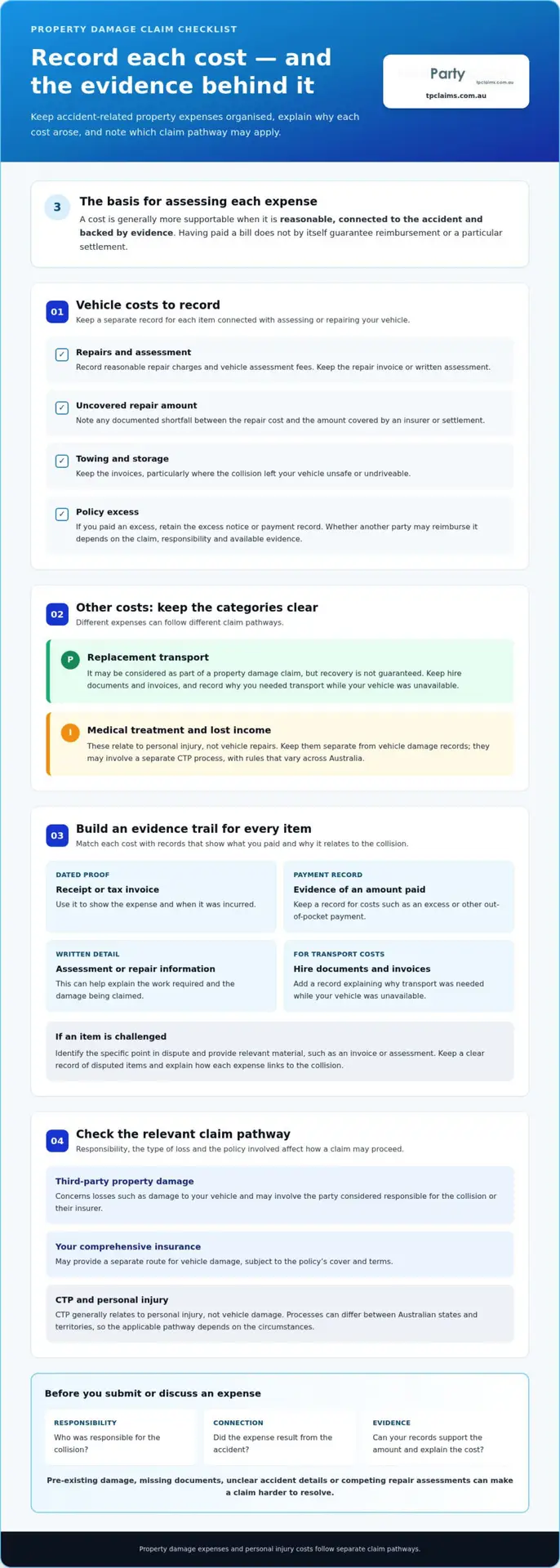
Start with costs directly related to assessing your vehicle and getting it back on the road. Record reasonable repair charges, assessment fees and any documented shortfall between the repair cost and what an insurer or settlement covers. Keep towing and storage invoices too, particularly if the collision left the vehicle unsafe or undriveable.
A policy excess may also be relevant if you paid it as part of a property damage claim. Whether you can seek reimbursement from another party depends on the claim, including responsibility and the available evidence. Keep the excess notice or payment record, and don’t assume it will automatically be reimbursed.
Are hire car, transport or personal injury costs treated the same way?
Replacement transport may be considered as part of a property damage claim, but you’ll need to support both the need for it and the cost. Keep hire documents, invoices and records that explain why you needed transport while your vehicle was unavailable. A replacement vehicle can help you stay mobile during the claim process, but its cost isn’t guaranteed to be recoverable.
Medical treatment costs and lost income relate to personal injury, not vehicle repairs. They may involve a separate CTP process, with rules that vary across Australia. Keep these expenses separate from your vehicle damage records and follow the relevant pathway. For broader context about your options after a crash, read this guide to not-at-fault car accident rights.
A recoverable expense is generally reasonable, connected to the accident and supported by evidence. These factors don’t guarantee payment or a particular settlement. Recording each cost clearly gives you a stronger basis to explain what you’re seeking and why.
What affects whether you can recover accident-related expenses?
A cost can be genuine and still be questioned as part of a claim. The key issues are who was responsible for the collision, whether the expense resulted from it and what records support your request. A reasonable bill doesn’t guarantee payment or a particular settlement. If you want to recover out of pocket expenses car accident australia, assess each item in context rather than assuming every cost will be accepted.
Expense recovery depends on responsibility, the loss and the evidence, not simply on having paid a bill. A repair invoice may show what work was done, for example, but other information may be needed to connect the damage to the accident or resolve disagreement about how the collision happened.
How do fault and the type of insurance pathway matter?
A third-party property damage claim concerns losses such as damage to your vehicle. It may involve the party considered responsible for the collision or their insurer. A comprehensive insurance policy may provide a separate route for vehicle damage, subject to its cover and terms. Neither pathway guarantees that every expense will be paid.
CTP generally relates to personal injury, not damage to your vehicle. Keep these issues separate: the applicable property damage process may depend on the circumstances and the policy involved. Processes can also differ between Australian states and territories, so don’t assume a pathway or outcome in one jurisdiction applies everywhere.
When might an expense be disputed or reduced?
A claim handler may question whether a cost was caused by the collision or whether the work was necessary. For example, if a repair assessment includes pre-existing damage, there may be questions about which repairs relate to the crash. An unclear account of how the accident happened, missing documents or competing repair assessments can also make a claim harder to resolve.
Make your case easier to follow by linking each expense to the collision and explaining any unusual item. If an amount is challenged, identify the specific point in dispute and provide relevant supporting material, such as an assessment or invoice. Clear records help keep the discussion focused on the evidence.
For an overview of the broader process, read this third-party property damage claim guide. If liability, evidence or settlement discussions are becoming difficult, TP Claims’ third-party property damage claims management can help manage the claim and insurance negotiations.
What evidence helps support out-of-pocket expense claims?
Clear records make it easier to explain what you paid, why the cost arose and how it relates to the crash. Start gathering documents as soon as you can. You don’t need a complete file straight away: create a simple expense log and add evidence as it becomes available.
For each cost, record the date, amount, purpose and the name of the business or person who charged you. Attach a dated receipt, tax invoice, payment record or written assessment to support the entry. If you’re working out how to recover out of pocket expenses car accident australia, this habit can help keep your property damage claim organised.
- Photographs: Save images of the vehicle damage and, if available, the accident scene. Keep the original files where possible.
- Repair and assessment records: Keep quotes, reports and documents describing the damage and recommended work.
- Communications: Save relevant emails, letters and messages from repairers, insurers and other parties, including decisions about costs.
- Expense log: Note each expense, its date and purpose, then refer to the document that supports it.
No single document guarantees that an expense will be accepted. Taken together, records can show the context for each item and help you respond if a cost is queried.
Which records support repairs, towing and storage?
For repairs, retain itemised invoices, quotes, assessment reports and proof of payment. These show what work was proposed or completed and what you paid. For towing and storage, keep invoices that state the dates and services provided, such as those issued by roadside recovery providers like Allout Towing. If an insurer paid only part of the repair cost, save its decision or payment statement so the outstanding amount is clear.
Keep these records together, but make sure each document is easy to match to a specific expense. A quote shows an estimated cost, while a paid invoice or transaction record can show what you incurred.
How should you document excess and replacement transport costs?
If you paid a policy excess, retain the relevant policy or claim document alongside a receipt or transaction record showing payment. For replacement transport, keep the hire agreement and itemised invoices, including the dates the vehicle was supplied and returned. Add a brief note explaining why you needed transport during that period.
Keep the explanation factual. Record how each expense arose and leave out unrelated or unsupported costs. Organised evidence can clarify what you’re asking to recover, although the outcome still depends on the circumstances and supporting material.
How do you pursue expenses after a not-at-fault car accident?
A clear process keeps your claim focused and makes it easier to respond if an expense is questioned. The right pathway can depend on the accident, your policy and where the collision occurred. Work through each step and keep a record of what you send and receive.
- Gather the accident details. Collect the date, location and a concise account of what happened, along with the other party’s details and any relevant insurer correspondence. Keep photographs, repair documents and records of previous discussions together.
- Identify the property damage pathway. Read the relevant policy documents to understand the process that may apply to your vehicle damage claim. Depending on your circumstances, this could involve a claim through your own comprehensive insurer or a third-party property damage claim. CTP generally concerns personal injury, not vehicle repairs. Processes can differ between Australian states and territories, so don’t assume the same steps or outcomes apply nationally.
- Prepare an itemised claim. Group expenses by type, such as repairs, towing or replacement transport. For each item, state the amount, why it arose and how it relates to the collision. Attach the matching invoice, payment record, assessment or other supporting document. Add a short, factual summary of the accident so the claim can be understood without piecing together scattered records.
- Send the claim and keep a copy. Keep a complete copy of what you submit, including attachments. Record the date, who you sent it to and any reference details. Save replies and note names, dates and agreed next actions after each conversation.
- Follow up disputed items calmly. If an expense is challenged, ask which item is in dispute and why, preferably in writing. Reply with the relevant records or context, and keep a copy of your response. If the disagreement continues, review the appropriate process for your state or territory before pursuing a complaint or review, as available options may vary.
For a wider overview, read this guide to claiming against an at-fault driver. If organising evidence or handling insurance discussions is becoming difficult, get help managing your third-party property damage claim with TP Claims.
How can claims management help you recover car accident expenses?
Organised records give you a clearer basis for explaining accident-related property losses. Managing the claim and negotiating with an insurer can still take time and persistence. Claims management can reduce the administrative load by organising claim details, handling communications and keeping discussions focused on the expenses you’re pursuing.
What can a property damage claims specialist take off your plate?
TP Claims manages third-party motor vehicle property damage claims and insurance negotiations for individuals and businesses across Australia. The service brings accident details, invoices, assessments and other supporting records together, then manages communications and negotiations about the losses being pursued.
Clear expense records matter. An itemised repair invoice, towing charge or documented repair shortfall can help explain what you’re claiming and why it relates to the collision. If an item is disputed, supporting material helps keep the discussion specific rather than requiring you to reconstruct the details each time.
TP Claims provides claims management on a no-win-no-fee basis. This describes the basis of its claims management service, not a promise that a claim will succeed or that every expense will be recovered. TP Claims manages third-party property damage claims and insurance negotiations.
What is a practical next step if you have expenses to recover?
Gather the accident details, expense log, receipts and invoices, repair assessments, payment records and relevant correspondence. Start with the records you have and add to them as further documents arrive. A clear account of what happened and how each cost relates to the vehicle damage can make the claim easier to discuss.
If you need transport while your vehicle is being repaired or assessed, TP Claims also provides accident replacement vehicles. Whether replacement transport costs form part of a claim depends on the circumstances and supporting evidence, so the service doesn’t guarantee that those costs will be recovered.
If you’d like support with the property damage claim and insurer discussions, talk to TP Claims about your property damage claim. A claims management specialist can help organise the process and pursue documented losses, while the outcome remains dependent on the claim’s facts and evidence.
Take the next step towards a clearer property damage claim
Recovering costs after a crash starts with separating vehicle-related losses from personal injury expenses and identifying the appropriate claim pathway. Keep an itemised record of each cost, with documents showing what you paid and how it relates to the accident. Fault, evidence and the circumstances of each expense can all affect the outcome, so payment alone doesn’t guarantee recovery.
If you’re working out how to recover out of pocket expenses car accident australia, you don’t have to manage every claim conversation on your own. TP Claims manages third-party property damage claims and insurance negotiations nationally, with claims management provided on a no-win-no-fee basis.
Gather your accident details, expense records and relevant correspondence, then talk to TP Claims about your property damage claim. TP Claims can help organise the process and manage the claim discussions.
Frequently Asked Questions
Can I recover out-of-pocket expenses after a car accident in Australia?
You may be able to recover accident-related expenses, but payment isn’t automatic. The outcome can depend on who was responsible, whether each cost is connected to the collision and the evidence available. Keep an itemised record with receipts, invoices and payment records. The claim pathway and processes can vary across Australian states and territories, so review the relevant policy documents and process for your circumstances.
What expenses can I claim after a car accident that was not my fault?
Depending on the circumstances, property damage expenses may include reasonable vehicle repairs, assessment charges, towing and storage, a repair shortfall, an excess paid or replacement transport. Keep documents showing what each cost was for and how it relates to the crash. These expenses aren’t guaranteed to be accepted. Medical expenses and lost income relate to personal injury and are dealt with separately from a third-party property damage claim.
Can I get my car insurance excess back from the other driver?
You may be able to seek reimbursement of an excess you paid, but recovery depends on the claim facts, including responsibility for the accident and the evidence. Keep the policy or claim document showing the excess, proof of payment and any correspondence about the damage claim. Don’t assume the excess will automatically be returned. The route for pursuing it may depend on the applicable policy and property damage claim process.
Does CTP insurance cover car repairs or other property damage?
Generally, no. Compulsory Third Party (CTP) insurance relates to personal injury caused by a motor vehicle accident, not repairs to cars or other property. Vehicle damage may instead be addressed through a relevant comprehensive insurance policy or a third-party property damage claim. The right pathway depends on the circumstances and applicable cover. CTP processes differ across states and territories, so keep injury matters separate from vehicle damage discussions.
What evidence do I need to claim accident-related expenses?
Gather dated, itemised receipts or tax invoices, proof of payment, repair quotes and assessments, towing or storage invoices, and relevant insurer correspondence. Photos of the damage and a clear account of the accident can provide useful context. Keep an expense log with each cost’s date, amount and purpose, and link it to the supporting document. No single record guarantees acceptance, but organised evidence helps explain what you’re claiming.
Can I claim towing and storage costs after a car accident?
Towing and storage costs may be considered if they resulted from the collision and are supported by evidence. Keep invoices showing the service provided, dates and charges, and note why the vehicle needed to be towed or stored. Whether the costs are accepted depends on the circumstances and the relevant claim pathway. Include them as separate, itemised entries rather than combining them with repair charges.
What can I do if the other driver or insurer refuses to pay my expenses?
Ask which expense is disputed and why, preferably in writing. Then respond with the relevant invoice, payment record, repair assessment or other information linking the cost to the collision. Keep copies of all messages and note dates and agreed next steps. If discussions remain difficult, review the applicable process for your state or territory. TP Claims manages third-party property damage claims and insurance negotiations nationally on a no-win-no-fee basis.