
What if the assessor’s lower estimate isn’t the final word on what your car needs? If you’re searching for “dispute insurance assessor vehicle repair quote”, you may be facing a gap between the repairs listed in the assessment and your repairer’s itemised quote. Technical terms and different descriptions can make it hard to see what’s missing.
It’s understandable to worry that challenging an estimate could delay repairs and leave you without your vehicle for longer. Start by comparing the documents operation by operation, then support each disputed item with repair evidence rather than a general disagreement.
This guide explains why an assessor’s estimate can differ, how to organise photos, repair notes and itemised quotes, and how to request a review from the insurer. You’ll also learn how claims-management support can help organise evidence and handle insurer discussions. TP Claims manages third-party property damage claims and insurance negotiations for not-at-fault drivers. TP Claims also provides accident replacement vehicles to help keep clients mobile while claims and repairs are being handled.
Key Takeaways
- An assessor’s estimate is an assessment of proposed work, and it may differ from a repair quote for several reasons.
- To dispute insurance assessor vehicle repair quote items, compare the documents operation by operation and separate confirmed damage from uncertainty.
- Build a factual request for review by identifying each gap, attaching relevant evidence and keeping a record of the insurer’s response.
- Before authorising disputed work, clarify the agreed repair scope and claim position, while treating safety concerns separately.
- Claims-management support can help organise evidence and manage insurer discussions while the repair scope is reviewed.
Why an insurance assessor’s vehicle repair quote may differ
A lower estimate can be unsettling, particularly when the repairer has listed work that doesn’t appear in the assessor’s document. A difference alone doesn’t prove either document is wrong. First, establish what each document covers and what information it was based on.
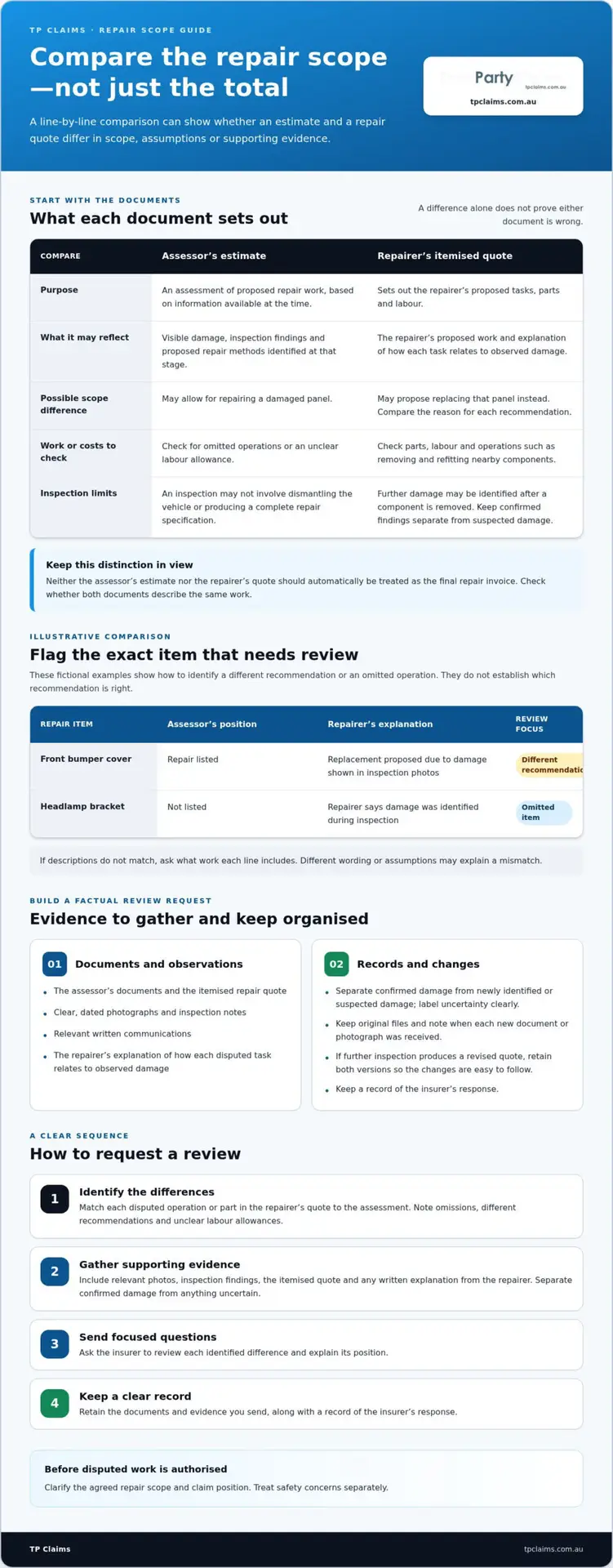
An assessor’s estimate is an assessment of proposed repair work based on the information available at the time. An itemised repair quote sets out the repairer’s proposed tasks, parts and labour. Neither should automatically be treated as the final repair invoice. For general background on how vehicle insurance works, see the linked overview.
What does an insurance assessor assess?
An assessor considers visible damage, inspection findings and proposed repair methods to estimate the work involved. The assessment reflects what could be identified at that stage of the claim. An inspection may not include dismantling the vehicle or producing a complete repair specification, so some work or costs may remain unresolved.
That doesn’t automatically make the estimate inadequate. Compare its scope with the repairer’s details and check whether both documents describe the same work.
Why might the repairer’s quote be different?
Repairers and assessors may make different assumptions about how to restore a vehicle. One document, for example, may allow for repairing a damaged panel while the other proposes replacing it. They may also differ on parts, labour or operations such as removing and refitting nearby components.
Some damage isn’t visible during an initial inspection. A damaged bracket or another concealed issue may only become clear after a component is removed. The repairer may then identify additional work and provide findings to support it. Keep newly discovered damage separate from damage that’s only suspected, so the reason for each proposed repair is clear.
Small omissions can also create a noticeable mismatch. A quote might include a repair operation or labour allowance that the assessment doesn’t show, or the documents may use different descriptions for related work. Before you dispute insurance assessor vehicle repair quote items, check whether each document covers the same parts and operations. This comparison can show whether the difference relates to scope, assumptions or evidence, rather than only the total.
What to check before disputing an assessor’s vehicle repair quote
Line up the documents before challenging the assessment so you can identify exactly where their repair scopes differ. An item-by-item comparison is more useful than focusing only on the total. It lets you ask specific questions about the proposed work without assuming that a difference means either document is wrong.
How to compare the estimate and repair quote line by line
Create a simple table showing each repair operation or part, the assessor’s position and the repairer’s explanation. Include any labour allowance or stated exclusion. For example:
| Repair item | Assessor’s position | Repairer’s explanation |
|---|---|---|
| Front bumper cover | Repair listed | Replacement proposed due to damage shown in inspection photos |
| Headlamp bracket | Not listed | Repairer says damage was identified during inspection |
These fictional examples don’t establish which recommendation is right. They show how to flag an omitted operation, a different parts recommendation or an unclear allowance for review. If the descriptions don’t match, ask what work each line includes. This can help distinguish a genuine gap from different wording or assumptions.
What evidence can support a request for review?
Gather the assessor’s documents, the itemised repair quote, clear dated photographs, inspection notes and relevant written communications. Ask the repairer to explain how each disputed task relates to the damage observed. Separate confirmed findings from newly identified or suspected damage, and label uncertainty clearly.
Keep the original files and note when you received each new document or photograph. If further inspection leads to a revised quote, retain both versions so the changes are easy to follow. Organised records help show what changed and why a particular repair operation is being raised.
For broader context on the claim process, read this third-party property damage claims guide. If you’d like help organising claim documents and insurer discussions, claims-management support can help manage the administrative load while the repair scope is reviewed.
How to challenge an insurance assessor’s vehicle repair quote
A clear, item-by-item request is easier to assess than a general statement that the estimate is too low. To dispute an insurance assessor vehicle repair quote, set out what differs, explain why each item needs review and attach evidence that helps the insurer assess the repair scope.
Use this sequence:
- Identify the differences. Match each disputed repair operation or part in the repairer’s quote to the assessor’s assessment. Note omissions, different recommendations and unclear labour allowances.
- Gather supporting evidence. Include relevant photos, inspection findings, the itemised quote and any written explanation from the repairer. Separate confirmed damage from anything that remains uncertain.
- Send focused questions. Ask the insurer to review each identified difference and explain its position.
- Keep a record. Save your request, attachments and responses. Note the date and details of phone conversations, decisions or changes to the repair scope.
How should you write a request to review the assessment?
Start with your claim reference and a short summary of the issue. Then list each disputed item separately. For example, explain that the assessor’s document allows for repairing a component while the repairer proposes replacement. Refer to the repairer’s explanation or a supporting photo, and ask the insurer to respond to that specific difference rather than simply requesting a higher estimate.
Keep the tone firm and factual. Don’t present suspected damage as confirmed or make claims the documents don’t support. Attach clearly named files, such as “repair quote” or “inspection photos”, and keep a copy of everything you send. This gives you a reliable record if you need to follow up.
What if the insurer maintains its assessment?
If the insurer doesn’t change its position, ask it to explain why and outline the process for raising your concern further. Complaint and review pathways can depend on the claim circumstances and applicable requirements, so don’t assume one process or timeframe applies to every case. Check the insurer’s written information and keep a dated record of its response, further discussions and any changes to the repair scope.
Keep track of new information as it emerges. Send relevant updates and retain earlier documents so it’s clear how the position developed. For wider context on making a claim after an accident you didn’t cause, see this not-at-fault accident rights guide.
When should you pause repairs or seek another review?
A disagreement doesn’t automatically mean you should stop all repair work. Before authorising work outside the scope discussed with the insurer, clarify what has been approved, what remains disputed and what costs or decisions may be affected. The next step depends on the claim and the vehicle’s condition, so keep the relevant claim contacts informed instead of making assumptions.
Safety comes first. If the vehicle may be unsafe to drive, don’t treat a repair quote disagreement as a reason to keep using it. Get the safety concern assessed and explain it promptly to the relevant claim contact. A dispute about the preferred repair method or extent of work is different from an urgent risk, and each needs a clear response.
What if hidden damage appears during repairs?
Further damage may become visible once work begins or components are removed. Where practicable, ask for the discovery to be recorded before the affected area is repaired or removed. Keep dated photographs, an updated itemised quote and a written explanation of what was found and how it changes the proposed work.
Notify the relevant claim contact promptly and keep copies of updates or decisions. If you need to dispute insurance assessor vehicle repair quote findings after new damage is identified, connect the new evidence to the specific repair item rather than relying on a revised total alone.
How can repair delays affect your next steps?
Unresolved differences can affect repair planning and how long you’re without your vehicle. Ask the repairer what work can proceed and what is waiting on a decision, then keep a written record of the answer. For more context on how claim progress can vary, read the third-party property claim timeframe guide.
If being without transport is adding pressure, TP Claims provides accident replacement vehicles to help clients stay mobile while property damage claims are being processed and repairs are under way.
Clear updates can help move a repair-scope dispute forward. Get support managing your claim and insurer discussions with TP Claims.
How TP Claims can help manage a repair quote dispute
A gap between an assessor’s estimate and a repairer’s quote can leave you juggling documents, repair questions and insurer conversations at the same time. TP Claims manages third-party property damage claims and negotiates with insurers for not-at-fault drivers. If you need to dispute insurance assessor vehicle repair quote items, TP Claims can help organise the evidence and manage insurer discussions while the repair scope is considered.
What claims-management support can take off your plate
With claims-management support, you don’t have to handle each part of the claim alone. TP Claims can help organise relevant information and manage insurer discussions, including keeping track of the assessor’s documents, repair quotes and explanations, then presenting the differences clearly to the insurer. Clear communication helps you understand what has been raised and what response has been received.
Claims management can reduce the administrative load, but it can’t guarantee that an insurer will agree to a requested repair or change its position. TP Claims provides its service on a no-win-no-fee basis under applicable service terms. Understand those terms, including the scope of the service, before proceeding.
What to have ready when you seek support
You don’t need to turn your paperwork into a perfect file first. Gathering key information can make it easier to understand the disagreement and manage the relevant claim steps. Start with:
- Incident details and your claim reference, if available.
- The assessor’s estimate or assessment documents and the repairer’s itemised quotes, including revised versions.
- Photographs of the damage, along with inspection notes or written explanations of newly identified damage.
- Insurer and repairer correspondence, plus a short timeline of calls, decisions and changes to the proposed repair scope.
Keep original documents and label newer versions by date. A simple timeline can show how the repair scope developed and make it easier to identify which questions still need an answer. If you’re without your vehicle, TP Claims also provides accident replacement vehicles while property damage claims are being processed.
You don’t have to manage every insurer conversation alone. Get help managing your vehicle damage claim with TP Claims.
Move your repair dispute forward with clear evidence
A difference between an assessor’s estimate and a repairer’s quote doesn’t, by itself, show which scope is right. Compare the documents item by item, support your questions with clear evidence and keep a record of the insurer’s responses. Before authorising disputed work, make sure you understand what’s agreed and what remains under review.
If you’re trying to dispute insurance assessor vehicle repair quote items, you don’t have to manage every claim conversation alone. TP Claims manages third-party property damage claims and negotiates with insurers for not-at-fault drivers. Its service operates on a no-win-no-fee basis under applicable terms, so understand the service scope and conditions. TP Claims also provides accident replacement vehicles to help clients stay mobile while property damage claims are being handled.
Get support to organise the claim and keep discussions moving. Get support with your vehicle damage claim.
Frequently Asked Questions
Can I dispute an insurance assessor’s vehicle repair quote?
Yes. Raise specific concerns with the insurer and support your request with evidence. Identify the repair items that differ, explain why you believe they need review, and include relevant documents such as an itemised repair quote or photographs. Ask the insurer to explain its assessment of each item. A disagreement doesn’t automatically change the claim position, and the appropriate review process depends on your circumstances and applicable requirements.
What should I do if the assessor’s quote is lower than the repairer’s quote?
Compare the documents line by line before responding. Check repair operations, parts, labour allowances and exclusions, then ask the repairer to explain disputed items in writing. For example, clarify why the repairer recommends replacing a component if the assessment allows for repair. Send the explanation with relevant photographs or inspection documents and request a review. Keep copies of what you send and note the insurer’s response and any changes to the proposed scope.
Can an insurance assessor change a repair estimate after hidden damage is found?
An estimate may be reviewed if further damage is found during inspection or repairs, but an update isn’t automatic. Photograph the newly identified damage where practicable, ask the repairer to itemise the additional work and explain why it’s needed, then notify the relevant claim contact promptly. Keep written records of the discovery and any revised documents. Next steps depend on the claim process and circumstances, so don’t assume additional work will be approved.
What evidence helps challenge an assessor’s vehicle repair quote?
Useful evidence can include the itemised repair quote, clear photographs, inspection findings and a written explanation linking each disputed repair to observed damage. Match the evidence to the specific item so the reviewer can follow your reasoning. Keep original documents, note when you received updated quotes or findings, and save copies of communications. This material can support a request for review, but it can’t guarantee that the insurer will change its assessment.
Should I start repairs while I dispute the assessor’s quote?
That depends on the vehicle’s condition, safety needs, claim position and which work remains disputed. Before authorising work, clarify what has been assessed, what’s agreed and what is still unresolved. Keep communicating with the relevant claim contact, especially if new damage is found or the repair scope changes. Don’t treat general information as a decision about your specific repair. If the vehicle may be unsafe, address that concern promptly with the appropriate people.
How do I ask an insurer to review a vehicle repair assessment?
Send a concise written request that includes your claim reference and identifies each repair item you believe needs review. Attach the relevant quote, photographs or repairer’s explanation, and ask the insurer to respond to the specific differences. Keep a copy of your request and attachments, and record when you receive a reply. If the concern remains unresolved, ask the insurer what further review or complaint process applies to your circumstances.
Can TP Claims help if I disagree with an assessor’s repair quote?
TP Claims manages third-party property damage claims and insurer negotiations for not-at-fault drivers, including discussions about vehicle damage. Having the assessment, itemised repair quote, photographs and relevant correspondence ready can help clarify the issue. TP Claims provides claims-management support on a no-win-no-fee basis, subject to its service terms. Get help managing your vehicle damage claim.