
What if the storage bill keeps growing while the insurer is still assessing your car? If you’ve searched “how to get third party insurer to pay storage fees car accident”, you’re likely looking for a fair way to recover costs without letting them spiral. Reimbursement isn’t automatic, but clear evidence can help show the charges were caused by the crash, necessary and reasonable for the time your vehicle remained in storage.
It’s frustrating to face charges while decisions about your damaged car are still pending. Notify the at-fault driver’s insurer promptly, keep a record of each charge and take reasonable steps to limit further storage time. If the insurer questions responsibility or the length of storage, a dated timeline and supporting messages can help explain what happened.
This guide covers the evidence to gather, how to make a written request and what to do if the insurer disputes the fees. Storage is one part of a wider third-party property damage claim, and the insurer will assess the circumstances and supporting information before deciding what it will pay.
Key Takeaways
- Storage fee recovery may be possible, but the insurer can assess responsibility, the accident-related cause, necessity and the period charged.
- Gather itemised invoices, towing records and updates about assessment, repairs or collection to explain why the vehicle remained in storage.
- Make a clear written request to the at-fault driver’s insurer, identify the amount and dates claimed, and ask for its position on liability and the charges.
- Compare a direct request to the at-fault insurer with other claim pathways, including how your own policy terms may affect your options.
- If liability is disputed or insurer requests become difficult to manage, claims management can help organise evidence and handle negotiations as part of your wider property damage claim.
Can a third-party insurer pay car storage fees after an accident?
Yes, recovery may be possible, but payment isn’t automatic. The at-fault driver may be responsible for loss caused by the collision, while their insurer may handle a claim under the driver’s policy. The insurer isn’t automatically liable for every charge simply because the vehicle was involved in an accident. As a general explanation, third-party liability insurance is designed to respond to claims made by someone outside the insurance contract, subject to the policy and circumstances.
To support a storage claim, explain how the collision led to the vehicle being stored and why it needed to remain there for the period claimed. The insurer may assess who caused the accident, whether the damage made storage necessary, and whether the duration and cost were reasonable. Liability and outcomes depend on the circumstances and applicable state or territory rules.
What makes accident-related storage fees part of a claim?
The storage should have a clear link to the collision. For example, the vehicle may have been unsafe or too damaged to drive and needed to remain at a facility while awaiting assessment or repair arrangements. Explain why it couldn’t reasonably be released, repaired or collected sooner. If you were waiting for an assessment or instructions, keep the dated messages that show when you requested them and when you received a response.
An invoice confirms that a charge was made, but doesn’t by itself establish that the full amount is recoverable. The insurer may consider the facility, daily rate, dates charged and steps taken to limit further costs. A timeline that matches the invoice can show what happened and why the vehicle stayed there.
Why might an insurer question the storage period?
An insurer may dispute liability, question whether the collision caused the need for storage or ask why it wasn’t notified sooner. Missing invoices, unclear dates or gaps in communication can make it harder to assess why charges continued. It may also question delays that appear avoidable, such as a gap between receiving notice that the vehicle could be collected and arranging collection.
A reasonable storage claim links each charge to an accident-related need and explains why the vehicle could not be moved or collected sooner. When making your request, connect the charges to the events rather than relying on the invoice alone. Keep assessment updates, release notices and messages with the insurer or storage facility so you can account for the period charged.
What evidence helps support a car storage fee claim?
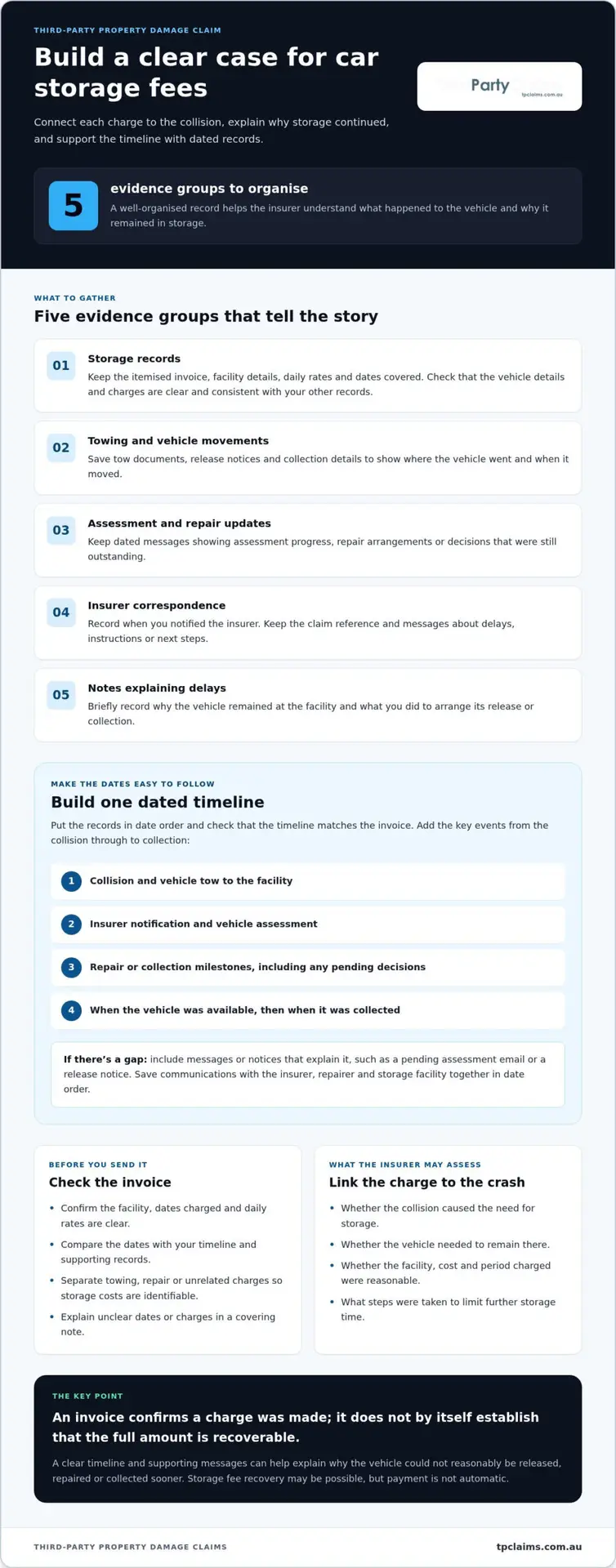
A well-organised record helps the insurer follow what happened to your vehicle and why storage continued. Keep the invoice with documents showing the vehicle’s movements and any delays. A dated timeline is especially useful when there are gaps between towing, assessment, release and collection.
Build a timeline from the collision to vehicle collection
Record the collision date and when the vehicle was towed to the facility. Add when you notified the insurer, when the vehicle was assessed, and any repair or collection milestones. Note when it became available for collection and when it actually left the facility.
If a delay was outside your control, keep the messages or notices that explain it. For example, an email about a pending assessment or a release notice can help account for a gap in the timeline. Save communications with the insurer, repairer and storage facility together, in date order.
Check the invoice and supporting records before claiming
Review the itemised storage invoice before sending it. Check that the vehicle details, facility, dates charged and daily rates are clear and consistent with your other records. If the document includes towing, repair or unrelated charges, separate those amounts so the insurer can identify the storage fees you’re claiming.
- Storage records: Itemised invoice, facility details, daily rates and dates covered.
- Towing and movement records: Tow documents, release notices and collection details.
- Assessment and repair updates: Dated communications showing progress or outstanding decisions.
- Insurer correspondence: Notification records, claim reference and messages about delays or next steps.
- Delay notes: A brief record of why the vehicle remained at the facility and what you did to arrange release or collection.
Put the documents in date order and check that the timeline matches the invoice. If a date or charge is unclear, explain it in your covering note rather than leaving the insurer to infer what happened. For more context on organising the wider claim, read the third-party property damage claim guide.
A consistent paper trail makes it easier to explain your request. TP Claims manages third-party property damage claims and insurer negotiations, including organising claim information. Get support managing your property damage claim.
Should you claim storage fees through the at-fault insurer or another route?
If the other driver’s insurer is handling the property damage claim, make a written request for the storage charges as part of that claim. This keeps the discussion connected to the collision and other damage, but the insurer may still assess liability and whether the costs are supported. Insurer involvement doesn’t guarantee payment or remove the need to explain the charges.
You can also manage storage as one part of the wider property damage claim, alongside vehicle repairs and other accident-related losses. Keep each expense itemised so the insurer can assess it separately. Storage, towing, repairs and replacement vehicle costs are different items, and an outcome on one doesn’t automatically determine the others.
What happens when the other driver’s insurer handles the claim?
Find out which insurer is handling the at-fault driver’s claim and use the claim reference if one has been provided. In your written request, state the storage amount, dates covered and why the vehicle remained at the facility. Attach the relevant invoice and records, and keep a copy of what you send. A specific request gives the insurer an amount and evidence to assess, without assuming it will accept the claim.
What if the at-fault driver is uninsured or the insurer disputes liability?
If the at-fault driver has no insurer handling the loss, there may be no insurer to claim against. Depending on the circumstances, recovery may instead need to be pursued against the responsible driver. If an insurer disputes liability, it may delay consideration of storage and other expenses while it assesses who was responsible and what losses are connected to the collision.
Your own comprehensive insurer may be another route, depending on your cover, excess and policy terms. Review your policy documents or speak with your insurer about how a claim would be handled and whether an excess applies. This route may affect how you pursue costs from another party, so keep the storage charges distinct from repair costs and other losses in your records.
For an overview of what can affect the process, see this guide to third-party claim timeframes. TP Claims manages third-party property damage claims and insurer negotiations, including claims involving uninsured drivers. Find out more about third-party claims support.
Asking a Third Party Insurer to Pay Storage Fees
A clear, prompt request gives the insurer the information it needs to assess the storage charges. Keep your communication in writing, save copies and ask for the insurer’s position on both liability and the fees. This creates a record if you need to clarify or challenge its response.
Notify the insurer and make a clear, documented request
- Notify the insurer promptly. Provide the accident date, your contact details, the vehicle details and the storage facility’s name. Include the claim reference if you have one. If you don’t know which insurer is handling the at-fault driver’s claim, ask the driver for the relevant details.
- Send a specific request. State the amount claimed and the dates it covers. Attach the itemised invoice, a timeline of key events and a short explanation of why the vehicle remained in storage. Include records that support any delay outside your control.
- Ask for written confirmation. Request confirmation that the insurer received your documents and ask how it will assess the request. Ask it to set out its position on liability and the storage charges in writing.
- Respond to any dispute point by point. If the insurer questions the amount or period, ask which charge or date it disputes and why. Reply with relevant records, such as an assessment update, release notice or collection communication, rather than resending an unexplained bundle of documents.
- Follow up and keep a record. If you haven’t received a response, follow up in writing. Keep the dates of calls, names of people you spoke with and copies of emails or letters.
Reduce avoidable storage time while the claim is assessed
Contact the storage facility promptly to understand its release requirements and whether charges continue to accrue. Ask what steps are needed to collect or move the vehicle, then record the answers. Update the insurer if assessment, repair or collection arrangements change, and note the dates so your timeline stays accurate.
Storage charges are separate from other property damage expenses. If you also need to consider mobility while your vehicle is unavailable, treat replacement vehicle costs as a separate issue and review this not-at-fault replacement car guide.
If the insurer rejects the request or doesn’t resolve your concerns, ask for its reasons and follow its current internal complaint process. Before escalating further, check which external complaint channel applies to your situation, whether you’re eligible and what time limits may apply. These details can depend on the type of claim and should be verified against current Australian guidance.
A storage-fee dispute can sit alongside questions about the wider property damage claim. TP Claims manages third-party property damage claims and insurer negotiations, helping organise the claim and its supporting evidence. Get support managing your property damage claim.
When claims management can help with disputed car storage fees
Managing a storage-fee request can become difficult when an insurer repeatedly asks for information, disputes liability or questions why your vehicle stayed at the facility. The storage bill may also be only one part of a broader property damage claim, with repairs, towing or other losses to organise. Claims management can bring the records and communications together so your position is presented clearly.
What support can claims management provide?
TP Claims manages third-party property damage claims and negotiates with insurers. This can include organising relevant documents, setting out the sequence of events and handling communication about the wider claim. If storage charges are disputed, the records can be presented as part of the claim, with an explanation of the amount and period being requested. The insurer will assess the charges based on the claim and supporting information.
For a storage-fee request, look beyond the invoice alone. A claims manager can help keep the storage request connected to the overall property damage claim and respond to insurer questions using the available information. TP Claims manages claims on a no-win-no-fee basis.
Choose a practical next step for your claim
Before discussing your claim, gather what you have so the key events are easy to explain. You don’t need to make the paperwork perfect first. Start with:
- the storage invoice, including the dates and charges;
- the collision and towing dates, plus when the vehicle was released or collected;
- insurer correspondence, claim reference and any written response disputing liability or fees;
- assessment, repair or collection updates that help explain why storage continued; and
- a short note of what you’ve already asked the insurer and how it responded.
These details help establish where the claim stands and what remains unresolved. If repeated requests or disputed liability are becoming hard to manage, TP Claims can manage the wider third-party property damage claim and the insurer negotiations involved. Get help managing your property damage claim.
Take the next step with a clearer claim
Storage fee recovery isn’t automatic. Your request is stronger when you can show how the accident led to the vehicle being stored, why the storage period was needed and how the charges are documented. Keep the invoice, timeline and insurer correspondence together, and ask for the insurer’s position in writing if it disputes the amount or duration.
If you’re still working out how to get third party insurer to pay storage fees car accident, remember that storage is one part of the wider property damage claim. Liability and the circumstances matter, so no particular outcome can be guaranteed.
TP Claims manages third-party property damage claims and insurer negotiations, helping organise evidence and manage the claim process on a no-win-no-fee basis. If you’d like support with your claim, get help managing your property damage claim.
Keep a clear record of the charges, key dates and insurer responses. TP Claims can help manage the property damage claim and negotiations.
Frequently Asked Questions
Can I claim car storage fees from the at-fault driver’s insurer?
You can ask the insurer to consider accident-related storage charges as part of a property damage claim, but payment isn’t automatic. Focus on showing why the vehicle needed to be stored and how long storage was necessary. Keep an itemised invoice and records explaining what prevented earlier release, repair or collection. The insurer may also assess liability and the amount charged.
Does the third-party insurer have to approve storage before it starts?
No, prior approval doesn’t necessarily determine whether the insurer will pay the full amount, though written approval can help show it knew about the charges. If storage has already begun, notify the insurer promptly, explain why the vehicle is at the facility and ask for its position in writing. Keep each response and update the insurer if the assessment, collection arrangements or storage period changes.
What evidence do I need to claim car storage fees after an accident?
Keep an itemised invoice showing the vehicle, storage facility, dates and charges. Add towing documents, insurer notifications, assessment or repair updates, and messages that explain any delay. A dated timeline can show when storage began, what happened while the vehicle was there and when it could reasonably be collected. These records help the insurer assess your request, but they don’t guarantee that every charge will be accepted.
How long can a car stay in storage before the insurer stops paying?
There’s no single nationwide storage period that guarantees payment. The insurer may consider why the vehicle remained at the facility, what caused any delay and whether you took reasonable steps to limit avoidable charges. Ask the facility about collection requirements, keep the insurer updated and record key dates. The relevant state or territory rules and the circumstances of your claim may affect how the storage period is assessed.
What should I do if the insurer refuses to pay my storage fees?
Ask the insurer to explain its decision and reasons in writing. Check whether it disputes liability, the storage period, the amount or the evidence, then respond to each point with relevant records. You can also use the insurer’s complaint process. Before pursuing an external dispute pathway, check whether it applies to your circumstances, including current eligibility requirements and time limits, as these details can vary.
Can I claim storage fees if my car is written off after an accident?
You can ask for necessary, accident-related storage charges to be considered even if the vehicle is later assessed as a total loss. The insurer may still assess responsibility, the amount charged and how long the vehicle remained in storage. Keep the assessment, collection or disposal communications and insurer correspondence. Once collection arrangements are clear, act promptly where possible and retain records that explain any delay.
Do I have to pay storage fees while the insurer assesses my car?
The storage facility may continue charging while the vehicle remains there, even if the insurer hasn’t decided whether it will consider your request. Contact the facility to check current charges and collection requirements, and notify the insurer about assessment delays. Keep a record of the dates and communications. Don’t assume that waiting for the insurer’s decision pauses the charges or means the full bill will be reimbursed.