
Could your business recover losses while a commercial vehicle is off the road after a collision? It’s understandable to expect compensation when damage stops a vehicle earning income. But if you’re researching “claiming demurrage for commercial vehicles australia”, the label alone won’t establish what you’ve lost or why another party should cover it. The key is showing a clear link between the collision, the downtime and a reasonable financial loss.
This guide explains what a demurrage or vehicle downtime claim may include, how it differs from other business losses, and what evidence can help support the amount claimed. You’ll learn how to document repair delays, lost income and replacement vehicle costs, then present those details clearly in a third-party property damage claim.
We’ll also cover practical next steps if an insurer questions whether the collision caused the loss or whether your records support it. TP Claims manages third-party property damage claims and insurance negotiations, including complex truck collision disputes, helping businesses coordinate the claims process.
Key Takeaways
- Demurrage is often used to describe vehicle downtime losses, but a claim needs to identify the specific financial impact, not rely on the label alone.
- When claiming demurrage for commercial vehicles australia, connect each claimed loss to the collision and the period the vehicle was unavailable.
- Build a clear timeline using accident details, repair assessments, invoices and records showing when the vehicle returned to service.
- Itemise the losses and organise supporting documents before submitting your claim, so the basis of the amount is easy to follow.
- TP Claims manages the broader third-party property damage process, including claim documents and insurer negotiations.
What does demurrage mean in a commercial vehicle accident claim?
A damaged truck or work vehicle can leave more than a repair bill behind. It may be unable to make deliveries, carry equipment or support scheduled jobs, putting pressure on your business while work continues without it. In an accident claim, name the actual loss you’re seeking to address rather than assuming every cost of downtime is “demurrage”.
Demurrage, downtime and loss of use: what is the difference?
Demurrage usually means a charge that arises when transport equipment, such as a container, is held beyond an agreed time. The general use of the term is outlined in What is demurrage? In a vehicle accident claim, businesses may use “demurrage” more loosely to describe financial impacts while a commercial vehicle is off the road.
These losses can be different in nature:
- Contractual demurrage: a charge imposed under an agreement because equipment was detained beyond the agreed period.
- Vehicle downtime or loss of use: the period the damaged vehicle can’t perform its usual work.
- Business income loss: income the business says it missed because the vehicle was unavailable.
- Substitute vehicle expenses: costs incurred to hire a suitable vehicle and keep operations moving.
A contractual charge is not automatically the same as lost income or a replacement vehicle expense. Keep these categories separate so you can explain what happened and avoid presenting different losses as though they were one charge.
When might an accident create a commercial vehicle loss?
Imagine a delivery truck is damaged in a collision and can’t be used until repairs are complete. If a replacement isn’t available, the business may have to cancel or reschedule deliveries. If it hires another truck, it may face a substitute vehicle expense instead. The collision, repair period and operational impact are connected, but each type of loss needs its own explanation and supporting records.
The word “demurrage” alone doesn’t show that the other party is liable, that the collision caused the claimed loss, or that the loss can be recovered. Those questions depend on the circumstances and applicable law. A clearly described claim focuses on what the business actually lost, how the accident led to that loss, and the relevant period.
There’s no government-set daily demurrage rate for commercial vehicle accident claims. The amount sought should reflect the particular financial impact being claimed, not an assumed standard figure. When claiming demurrage for commercial vehicles australia, specify whether you’re claiming contractual charges, lost business income, replacement vehicle expenses or another downtime-related loss. Precise wording gives the evidence and calculations a clear purpose.
When can a business claim commercial vehicle demurrage or downtime losses?
A vehicle being off the road doesn’t automatically mean every resulting business cost can be claimed from another party. Explain how the collision caused damage, why that damage made the vehicle unavailable, and what specific financial impact followed. Whether a loss may be recoverable depends on the circumstances, evidence and applicable law, so don’t treat any outcome as automatic.
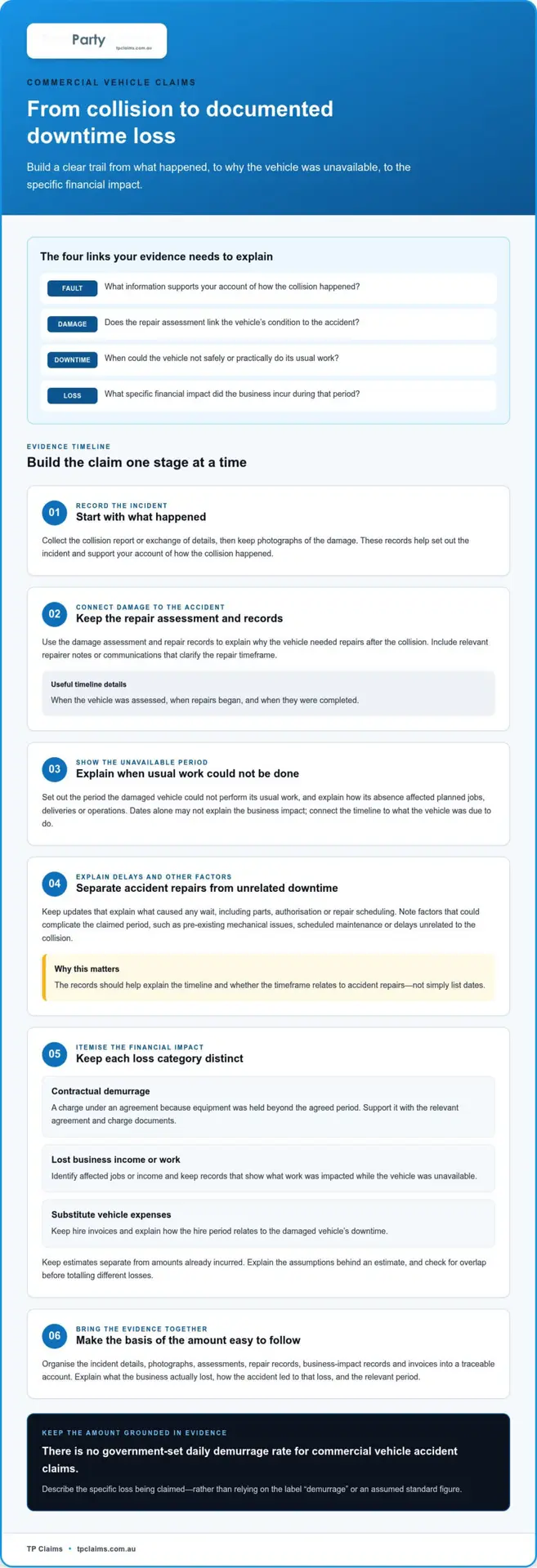
For a clear assessment, consider four connected questions:
- Fault: What information supports your account of how the collision happened?
- Damage: Does the repair assessment link the vehicle’s condition to the accident?
- Unavailability: When could the vehicle not safely or practically perform its usual work?
- Financial impact: What loss or expense did the business incur during that period?
What must the business connect to the accident?
Build a traceable account from the collision report or exchange of details, through photographs and the damage assessment, to repair records and the business impact. For example, show when the vehicle was assessed, when repairs began and finished, and how its absence affected planned work. The records should explain the timeline, not just list dates.
Account for factors that may have contributed to the downtime. Pre-existing mechanical issues, scheduled maintenance or delays unrelated to the collision could complicate the link between the accident and the full period claimed. If parts, authorisation or repair scheduling extended the wait, keep relevant updates and explain what caused the delay. Repairer notes or communications may clarify whether the timeframe related to accident repairs.
Which types of commercial loss need separate treatment?
Set out each loss category separately because its basis and supporting records may differ. A contractual demurrage charge might be supported by the relevant agreement and charge documents. Claimed lost work needs records showing which jobs or income were affected. A substitute vehicle expense needs invoices and an explanation of how the hire period relates to the damaged vehicle’s downtime.
Identify ordinary operating costs and other possible causes of a shortfall. A quiet trading period, a separate vehicle breakdown or work cancelled for an unrelated reason may not have the same connection to the collision. Keep estimates distinct from amounts already incurred, and explain the assumptions behind any estimate rather than presenting it as a confirmed cost.
Check for overlap before totalling the claim. If hiring a replacement vehicle allowed the business to complete work it would otherwise have lost, claiming both the full hire expense and the same lost income for that work could count the impact twice. Explain what each amount represents and how the figures relate. This breakdown is central to claiming demurrage for commercial vehicles australia, because the evidence needs to support the particular loss being put forward, not simply the label attached to it.
If the collision, downtime and financial records are difficult to bring together, third-party property damage claims management can help coordinate the broader claim and insurer communications.
What evidence supports a commercial vehicle demurrage claim?
With a work vehicle out of action, paperwork can quickly pile up across the driver, repairer, fleet team and accounts department. Bring it together in one claim file, organised by date and loss type. A clear record helps explain what happened, how long the vehicle was unavailable and how each claimed amount was calculated.
A strong evidence trail links the collision to the vehicle damage, the downtime and each amount claimed. Keep original documents where possible, and note the source of any summary or calculation you prepare. If a record is missing, identify the gap rather than filling it with an unsupported assumption.
Records that establish damage and downtime
Start with documents that show the vehicle’s condition and trace its repair timeline. Preserve the accident details, photographs and communications, then add repair and fleet records as they become available.
- Incident material: the incident report, details exchanged, photographs of the vehicle and any relevant correspondence about the collision.
- Repair documents: inspection findings, repairer assessments, work orders and invoices that identify the damage and work completed.
- Timeline records: booking and inspection dates, updates about parts delays, repair progress and the date the vehicle was collected or returned to service.
- Operational records: dispatch logs, fleet records or rosters showing when the vehicle couldn’t perform its usual duties.
Keep records of changes to the repair schedule too. If the vehicle was waiting for inspection, parts or repair work, dated updates can explain the sequence. If it was safe and available for some duties before repairs were complete, record that accurately. A precise timeline is more useful than claiming the vehicle was unusable for longer than the records support.
Records that explain the amount claimed
Match each claimed amount with documents that show what it represents. Contracts, customer invoices, booking records and business accounts may help explain the work or income affected. Use records from the relevant period and compare them with the specific jobs or activities disrupted, rather than relying on a broad estimate of lost business.
- Contractual charges: retain the agreement, the charge calculation and evidence that the amount was incurred.
- Lost work or income: keep job bookings, dispatch records, invoices and relevant accounts that support the work affected.
- Other expenses: retain invoices and payment records for costs included in the claim, such as a substitute vehicle.
For every figure, record the dates covered, calculation method and source document. Mark estimates as estimates, explain their basis and update them when actual records become available. Don’t include ordinary costs or losses that can’t be connected to the collision without clearly identifying and explaining them.
This organised approach gives the person reviewing the claim a practical route from the accident records to the amount sought. It also helps you spot inconsistent dates, unsupported figures or documents that need further explanation before submitting a claim for commercial vehicle downtime.
How to prepare and pursue a commercial vehicle demurrage claim
A well-organised claim helps the reviewer follow the story without piecing together scattered records. Keep the presentation factual: show what happened, how the repair progressed, what the vehicle could or couldn’t do, and how you arrived at each amount. This won’t guarantee a particular outcome, but it gives the claim a clear, reviewable basis.
How to organise the claim before sending it
Prepare a dated chronology that aligns the collision, damage assessment, repair activity and effect on operations. Separate the claimed losses into categories, then attach the documents that support each amount. A simple schedule can make the submission easier to follow:
- Notify the relevant parties about the collision and the property damage claim, and keep a copy of what you send.
- Preserve the records as they arrive, including repairer updates and documents showing when the vehicle was unavailable and returned to service.
- Itemise each loss by type and period. Explain the calculation and identify whether a figure is actual or estimated.
- Submit the supporting material with a concise explanation of how the records relate to the accident and the amount claimed.
If repair work took longer than expected, explain the reason using dated communications or repair records where available. Note operational changes too, such as the vehicle returning to limited duties before it was fully available. Keep copies of every submission and record responses, including the date and any requested information. That gives you a reliable reference if the claim is queried later.
What to do when the loss is challenged
An insurer may question whether the collision caused a particular loss, whether the claimed downtime is supported, or how an amount was calculated. Respond to each point directly. Identify the disputed item, explain its connection to the accident and refer to the relevant record. If evidence is missing, acknowledge that and provide what you can, rather than relying on a broad total that obscures the issue.
Recheck the figures before replying. If a vehicle was partly available for work, make sure the downtime calculation reflects that. Check for overlapping dates or amounts too, such as claiming lost work and a substitute vehicle expense for the same operational impact. If new repair information changes the timeline or calculation, update the schedule and explain the adjustment.
For a deeper look at issues that can arise in a truck-related property damage dispute, see this guide to truck collision property damage disputes. For information about the broader claim process, see this guide to third-party property damage claim help.
Gathering repair, business and insurer records can be difficult to coordinate while operations are disrupted. TP Claims manages third-party property damage claims and insurer negotiations, including complex truck collision disputes. Find out about support with your third-party property damage claim.
How TP Claims can help with a commercial vehicle damage dispute
A commercial vehicle claim can involve repair records, business accounts, operational documents and ongoing insurer communications. Coordinating these while trying to keep work moving is a real burden. TP Claims manages third-party property damage claims, insurance negotiations and complex truck collision disputes for individuals and businesses, bringing the claim process together so the evidence and communications are easier to manage.
This support can be useful when a vehicle’s downtime has affected business activity and you need to present different types of loss clearly. TP Claims can organise the broader property damage process and engage with the insurer about the claim. Any demurrage or downtime amount still depends on its evidence and the circumstances. Claims management is offered on a no-win-no-fee basis, but that does not guarantee a particular recovery.
What to have ready when seeking claims support
You don’t need a perfect claim file before seeking support. Start with what you have, and make clear where information is still outstanding. A brief summary can show how the collision affected the business and where the claim stands.
- Incident details: the date and circumstances of the collision, plus any details exchanged or reports available.
- Vehicle and repair records: photographs, damage assessments, repairer updates, invoices and documents showing when the vehicle was unavailable and returned to service.
- Claim correspondence: messages, letters or requests received from the insurer or other parties, alongside copies of any responses you’ve sent.
- Business impact: a short account of affected operations, supported by relevant bookings, dispatch records or financial documents.
- Loss breakdown: identify contractual charges, expenses such as substitute vehicle costs, and estimated business losses separately.
Even a simple timeline can help connect these documents. Note when the vehicle was assessed and repaired, when work was disrupted, and how each claimed amount was calculated. Flag estimates as estimates, and explain what records may help confirm them.
A simpler path through a complex truck claim
With one team coordinating documents, communications and insurer negotiations, you can spend less time chasing information across different parts of the claim. TP Claims provides claims management for third-party property damage matters, including complex truck collision disputes. The team can help keep the process organised while you focus on your business operations. TP Claims also provides accident replacement vehicles to help individuals and businesses remain mobile while property damage claims are being processed.
If you’re considering claiming demurrage for commercial vehicles australia, it’s reasonable to want clarity about what records to gather and how to set out the business impact. Bring together the collision details and records you have so far, including the repair timeline and a summary of downtime-related losses. Discuss the collision and available business records with TP Claims to understand the next steps for managing your property damage claim.
Take the next step with a clearer claim
Once a vehicle is back in service, the disruption doesn’t simply disappear. A well-organised claim file can help your business move forward with a clearer record of what happened and what remains in dispute. If you’re considering claiming demurrage for commercial vehicles australia, focus on explaining the loss accurately and keeping the documents behind each figure easy to follow.
You don’t have to manage every moving part alone. TP Claims handles third-party property damage claims, insurer negotiations and complex truck collision disputes. Claims management is offered on a no-win-no-fee basis.
Ready to discuss your situation? Share the collision details and business records you have so far, and take the next step at your pace. Talk to TP Claims about your commercial vehicle claim.
With the right support, you can approach the claim with greater clarity and keep your attention on getting the business moving again.
Frequently Asked Questions
Can I claim demurrage after a commercial vehicle accident in Australia?
You may be able to claim a documented loss caused by the collision, but recovery isn’t automatic. The outcome depends on matters such as responsibility for the accident, the reason the vehicle was unavailable, the financial impact and the supporting evidence. If you’re researching “claiming demurrage for commercial vehicles australia”, focus on the actual loss you want considered rather than assuming the term itself establishes entitlement.
What is the difference between demurrage and vehicle downtime?
Demurrage generally describes a charge under an agreement when transport equipment is held beyond an allowed time. Vehicle downtime describes the period a commercial vehicle can’t carry out its usual work. A business might incur a contractual demurrage charge, lose work, or pay for a substitute vehicle during downtime. These are distinct types of loss, so describe each separately and don’t treat “demurrage” as a catch-all calculation.
What evidence do I need for a commercial vehicle downtime claim?
Gather material that shows both the vehicle’s absence and the business impact. Useful records may include the repairer’s assessment, work orders, invoices, collection details, fleet or dispatch logs, job bookings and customer correspondence. Financial records can help explain the amount claimed. For example, a cancelled delivery booking may show an affected job, while an invoice alone may not explain why the vehicle couldn’t complete it.
Can a business claim lost income while a truck is being repaired?
A business may seek to claim income loss linked to collision repairs, but it needs to support the amount and its connection to the downtime. Compare affected work with relevant business records, such as invoices, bookings and accounts. Work out the income impact after deducting variable expenses that weren’t incurred, such as fuel or tolls. Don’t automatically deduct fixed costs like insurance or depreciation simply because the truck was off the road.
How do I calculate commercial vehicle downtime losses after a crash?
There’s no government-set daily rate for accident-related vehicle downtime. Calculate each loss from the business’s actual circumstances: identify the relevant dates, show the work affected or replacement expense incurred, and explain the method used. For lost income, use records that support the expected work and deduct variable costs saved during the downtime. Keep separate calculations for separate loss types, and check that overlapping amounts aren’t counted twice.
What happens if the insurer disputes my demurrage claim?
Ask for the disputed issue to be clearly identified, then respond directly with relevant documents. If the concern is the repair period, provide dated repair updates; if it’s the amount, show the calculation and source records. Recheck whether the vehicle was partly usable or whether another event affected operations. TP Claims manages third-party property damage claims and insurer negotiations, helping coordinate responses.
Can I claim replacement vehicle costs as well as demurrage?
You can include replacement vehicle expenses for consideration, but the claim should explain what each amount represents and how it relates to the collision. If a hired vehicle allowed the business to complete work, claiming the full hire expense and lost income for that same work could overlap. Keep the hire agreement, invoices and dates, and separate any remaining loss of work from the cost of the substitute vehicle.