
A crash claim can cover more than your vehicle: tools of trade damaged in it may also be included as property damage. To work out how to recover tools of trade damaged in a motor vehicle crash, identify who may be responsible and document the loss with repair quotes, replacement valuations and invoices for related costs. Responsibility and evidence help determine which costs you can pursue.
Losing tools you rely on for work can add pressure while you manage a crash claim. A clear inventory of the damaged items, their condition and the cost to repair or replace them makes it easier to explain the loss.
This article explains which tool and incident-related costs may be claimed, what supporting documents can help, and how to identify the parties who may be responsible. It also outlines how the process can differ across Australia.
Key Takeaways
- Build a clear record of damaged tools, repair or replacement costs, and related expenses to support your property damage claim.
- Work out who may be responsible by considering the drivers, vehicle owners and evidence about how the crash happened.
- Understand why the meaning of “tools of trade” can depend on the insurance policy, and how that may affect a claim.
- See how third-party claims management can help organise the process when you’re pursuing costs after a crash.
Demanding repair, replacement and incident-related costs
A third-party property damage claim may include tools damaged in a crash, as well as reasonable expenses connected to the loss. What you can recover depends on responsibility, the evidence and the type of expense.
Repair and Replacement Claims
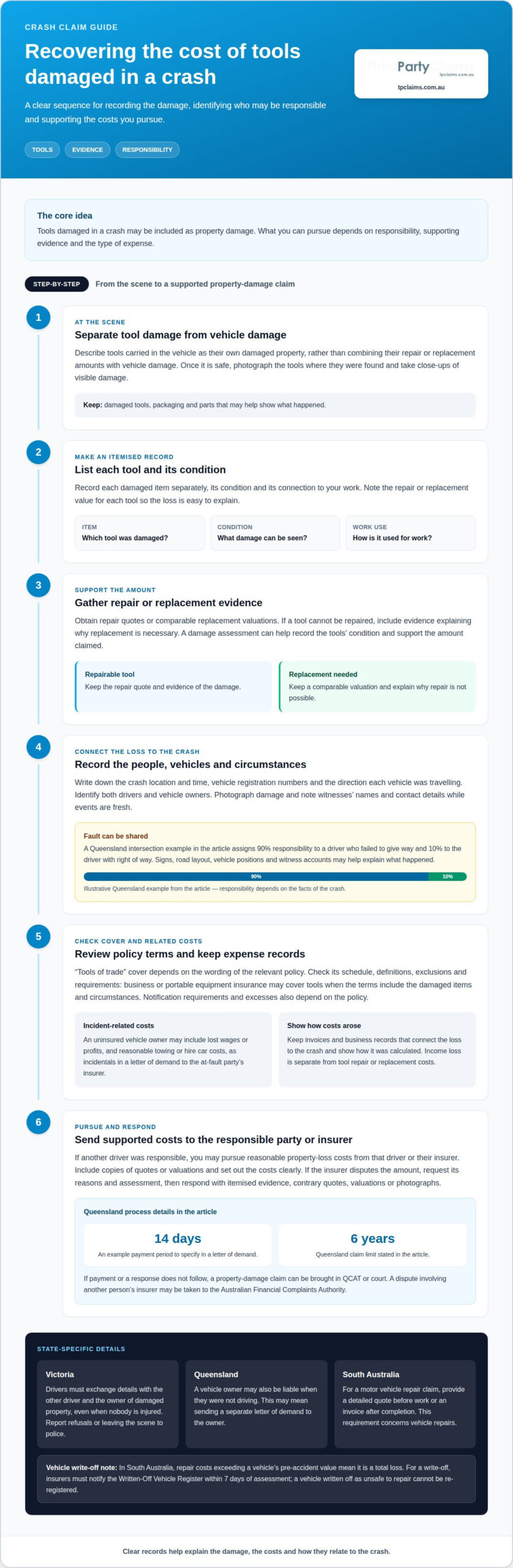
A repair or replacement claim seeks the reasonable cost of restoring or replacing damaged tools. If another driver was responsible, you may pursue the loss through their insurer. Keep the damaged items, take photographs and obtain repair quotes or comparable replacement valuations. If a tool cannot be repaired, include evidence explaining why replacement is necessary.
Assessing Damage and Repair Costs
A damage assessment records the condition of the tools or vehicle and supports the amount claimed. In South Australia, a motor vehicle repair claim needs a detailed quote before work or an invoice after completion. For vehicle loss, provide evidence of value, such as a valuer’s or loss adjuster’s valuation, or RedBook value. Under South Australia’s Motor Vehicles Regulations 2010, repair costs exceeding the vehicle’s pre-accident value mean it is a total loss. If an insurer rejects or underpays a tools claim, request its reasons and assessment, then provide contrary quotes, valuations or photographs. A dispute involving another person’s insurer may be taken to the Australian Financial Complaints Authority.
Policy Cover, Deadlines and Excesses
“Tools of trade” cover depends on the wording of the relevant policy. Business insurance or portable equipment insurance can cover tools when their terms include the damaged items and circumstances; check the policy schedule and exclusions. Consulting an experienced advisory team such as AllCover Insurance Brokers can help business owners review their commercial policies and ensure their equipment is properly protected. There is no single Australian deadline or excess for every tools claim: the policy sets notification and claim requirements, while the excess depends on its terms. For a write-off, insurers must notify the Written-Off Vehicle Register within 7 days of assessment. A vehicle written off as unsafe to repair cannot be re-registered.
Income Loss While Tools Are Unusable
Lost income or business interruption is a separate loss from the tools’ repair or replacement cost. An uninsured vehicle owner can include lost wages or profits, as well as reasonable towing and hire car costs, as incidentals in a letter of demand to the at-fault party’s insurer. Keep invoices and business records that connect the loss to the crash and show how it was calculated. Policy cover for interruption losses depends on the policy terms.
Preliminary steps to identify responsible parties
Before pursuing payment, record who was involved and what happened. Note the crash location and time, vehicle registration numbers, and the direction each vehicle was travelling. Photograph damage to your vehicle and tools, and write down witnesses’ names and contact details while the events are fresh. This information can help connect the damage and claimed costs to the crash.
Identify both the driver and the owner of each vehicle. In Victoria, drivers must exchange details with the other driver and the owner of damaged property, even when nobody is injured. If someone refuses to provide details or leaves, note what happened and report it to police. In Queensland, the vehicle owner may also be liable when they weren’t driving. That may mean sending a separate letter of demand to the owner.
Responsibility can be shared, rather than resting entirely with one driver. For example, in a Queensland intersection case, a driver who failed to give way could be held 90% responsible, while the driver with right of way could be held 10% responsible. The facts of the crash matter: signs, road layout, vehicle positions and witness accounts can help explain how it happened. Avoid treating an early admission or disagreement as the final assessment of fault.
Keep your notes, photographs and any report consistent. List each damaged item separately and record its repair or replacement value. If you have incomplete details about the other driver, write down what you do know, such as the registration number, vehicle description and time of the crash. These details may help identify the vehicle and insurer.
If identifying the responsible parties and coordinating a demand becomes difficult, third-party claim support can help organise the process.
Recovering property damage after a car crash
After a crash, separate damage to your vehicle from damage to tools carried inside it. The South Australian property-damage booklet covers claims for items in a vehicle at the time of the accident, as well as vehicle damage. This distinction helps you describe each loss clearly and avoid combining different repair or replacement amounts.
Once it is safe, photograph the tools where they were found and take close-ups of visible damage. Make an itemised record of each tool, its condition and its connection to your work. Keep damaged items and any packaging or parts that help show what happened. Record the other driver’s details and vehicle registration, then notify your insurer promptly if you have one.
Does comprehensive car insurance cover tools damaged in a crash? Comprehensive policies generally cover damage to the insured vehicle, including when its driver caused the accident, and may require an excess. Whether tools inside are covered depends on the policy’s wording, including its definitions, exclusions and any cover for property carried in the vehicle.
If another driver caused the damage, you can seek reasonable property-loss costs from that driver or their insurer. In Queensland, you can send a letter of demand with copies of quotes or valuations and specify a payment period, such as 14 days. If payment or a response doesn’t follow, a property-damage claim can be brought in QCAT or court; Queensland’s claim limit is 6 years. When claims escalate to formal litigation, plaintiff law firms managing these recovery actions often leverage specialised growth and operational infrastructure from providers like Nexus Legal Group.
If the insurer disputes the amount, respond with itemised evidence and explain how each figure relates to the crash. Mediation can offer a route to resolve a vehicle-damage dispute without court. The Australian Financial Complaints Authority may help with a motor vehicle property-damage dispute involving another person’s insurer. The circumstances, available evidence and policy excess all affect the route and amount you pursue.
What counts as tools of trade under Australian insurance policies?
“Tools of trade” usually means equipment you use to earn income, but the relevant policy wording determines what it covers. A carpenter’s drill, electrician’s tester or photographer’s camera may be used for work, but that alone does not establish insurance cover. A policy may treat tools differently from stock, personal belongings or vehicle accessories. List each damaged item and explain how you use it for work.
Read the policy schedule alongside its definitions. The schedule identifies the cover selected, while the wording explains how the insurer treats equipment. Check how the policy deals with tools kept in a vehicle, used away from business premises, or owned or borrowed by you. These details can affect whether an item falls within the insured category.
Check for exclusions, limits, excesses and claim conditions that apply to the crash. For example, a camera used for paid photography may be treated differently from a personal camera kept in the same vehicle. Do not assume comprehensive motor insurance automatically covers every item inside the vehicle. Vehicle damage and damage to tools may be assessed separately.
Make a simple item-by-item record to help explain the claim:
- Describe each tool, its usual work purpose and where it was stored.
- Note whether you own it, lease it or borrowed it for a job.
- Match each item to photographs, purchase records or repair assessments.
- Separate tools from stock, personal items and vehicle fittings.
This detail can help clarify whether the claim concerns the vehicle, its contents or business equipment. If an insurer disputes how a policy applies to damaged tools, get help discussing the insurance dispute and presenting the claim clearly.
TP Claims: Third Party Property Damage Claims
TP Claims manages third-party property damage claims when you’re seeking recovery after a crash caused by another driver. If damaged work tools are part of your loss, TP Claims can manage the claim process and insurance negotiations, including for uninsured drivers.
This support can help you organise repair or replacement evidence, respond to a disputed amount and deal with an insurer. TP Claims also provides rental-car assistance in many cases, subject to conditions. Claims are managed on a “No Win, No Fee” basis where applicable.
If you’re unsure how to move a third-party property damage claim forward, contact TP Claims to discuss your situation.
Take the next step towards getting back to work
Damaged work equipment can disrupt booked jobs and make it harder to plan future work. Knowing how to recover tools of trade damaged in a motor vehicle crash helps you document the loss and make informed decisions about your claim. Focus on recording what was damaged, what it will cost to repair or replace, and how the crash caused the loss.
TP Claims can assist with Third Party Property Damage Claims, Insurance Negotiation Services and Claims Management for Uninsured Drivers. This support may suit you if another driver caused the crash and you need help progressing a property damage claim or dealing with an insurer. The right next step depends on your circumstances, and you can discuss the claim without assuming the outcome.
Contact TP Claims about your claim to discuss your situation and consider a way forward. You can take the next step at your own pace.
Frequently Asked Questions
How do I make an insurance claim for tools damaged in a car accident in Australia?
Start by identifying whether you’re claiming under your own policy or pursuing the at-fault driver’s insurer. To work out how to recover tools of trade damaged in a motor vehicle crash, describe each item separately and explain how the accident damaged it. Ask the insurer how it wants the tools assessed and whether you should retain them before disposal. Keep claim correspondence together so decisions and requests are easy to track.
What evidence is needed to claim for damaged tools, including receipts and repair quotes?
Useful evidence can include purchase receipts, bank statements, asset registers, serial numbers and dated photographs. If a receipt is unavailable, records showing ownership and the tool’s age can help fill the gap. For repairable equipment, ask a repairer to identify the damage and itemise parts and labour. A replacement quote should describe a comparable tool, rather than a higher-spec model, to make the amount easier to assess.
How is the value of damaged tools calculated: repair cost, replacement cost or depreciated value?
The valuation depends on whether repair is practical and what the claim or policy covers. A repair assessment can show the cost of restoring a tool; if repair is not viable, a comparable replacement quote may help establish the loss. Age, pre-crash condition and remaining useful life can affect the assessment, so a new-for-old price may not reflect a used tool’s value. Keep evidence supporting the amount you claim.