
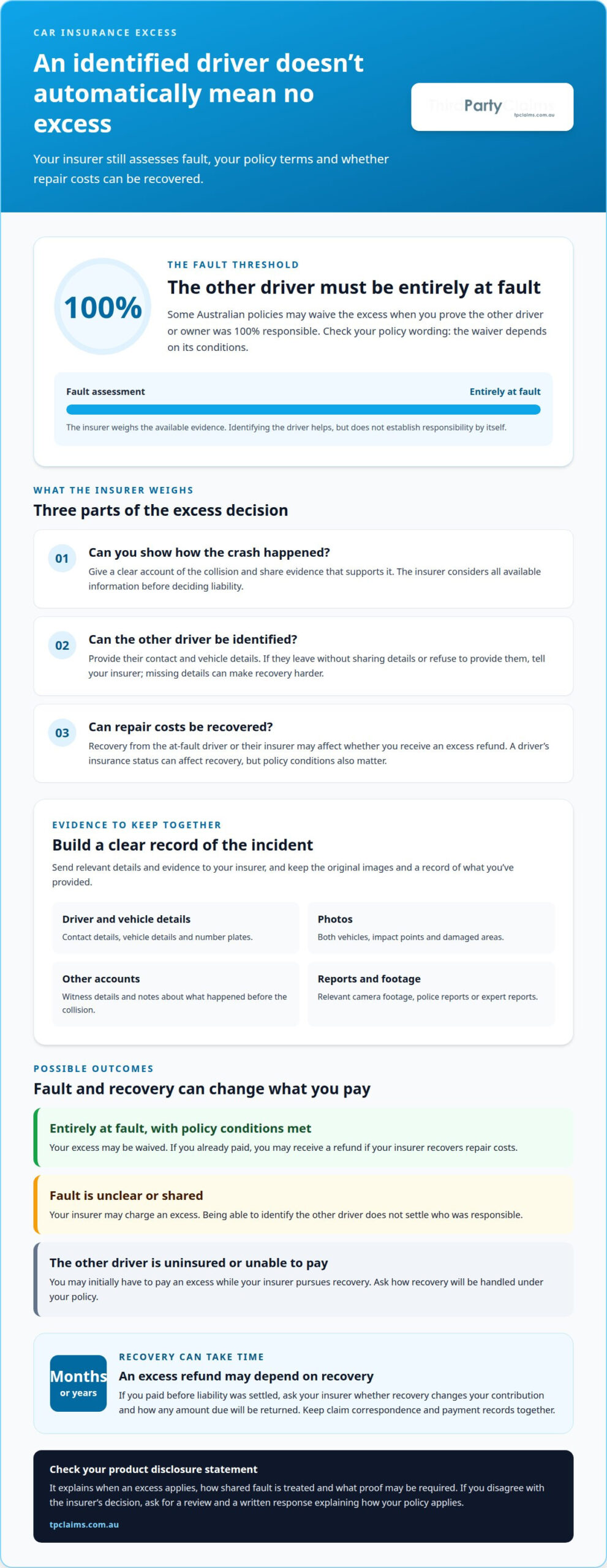
You may not have to pay an excess if the other driver is identified and entirely at fault. Whether you have to pay an excess if the other driver is known and at fault depends on whether you can show they caused the accident, provide their identifying details and your insurer is confident it can recover the repair costs. If fault is unclear or shared, you may still be charged an excess.
It’s frustrating to face an excess when you believe another driver caused the damage. This guide explains how insurers assess fault, why the other driver’s details matter and what may happen if they’re uninsured or can’t be identified. It also covers evidence that can support your account, so you can understand what may happen with your claim.
Key Takeaways
- You may avoid an excess when you can show the other driver was entirely at fault, provide their details and your insurer expects to recover repair costs.
- Collect the other driver’s contact and vehicle details, and preserve photos and other evidence that support your account.
- Being identified doesn’t settle fault by itself; the insurer assesses the evidence and may charge an excess if responsibility is unclear or shared.
- The other driver’s insurance status can affect recovery, so learn what may happen if they’re uninsured or unable to pay.
Who pays the excess on a car insurance claim?
Your insurer assesses liability using the accident circumstances and evidence in your claim. An excess is your contribution under the policy, while your premium is the amount you pay for cover. Your product disclosure statement explains when an excess applies, including under comprehensive car insurance.
Assessing liability
A liability assessment is your insurer’s decision about which driver caused the accident and whether responsibility was shared. It matters because unclear or shared fault can mean you have to pay an excess. If the other driver can’t be identified or disputes your account, your insurer may initially require payment while it assesses the evidence, including accounts, photographs, witness details and footage. A driver who runs a red light and causes an intersection crash is likely to be found at fault.
Refunding the excess
You may receive an excess refund if your insurer recovers repair costs from the at-fault driver or their insurer. If you paid before liability was settled, ask your insurer whether recovery changes your contribution and how it will return any amount due. Recovery can take months or years, so a refund may depend on that process, not simply on identifying the other driver. Keep claim correspondence and payment records together to track the decision and any repayment.
Disputing an excess decision
To dispute an excess, ask your insurer to review its liability decision and explain how your policy applies. Point out the evidence or circumstances you believe it overlooked, and request a written response addressing the relevant product disclosure statement. If the insurer’s internal complaint process doesn’t resolve the issue, you can take the complaint to the Australian Financial Complaints Authority (AFCA). RACQ says an excess may be required when liability is unclear or its insured is found at fault.
Identifying and providing details of the at-fault driver
The other driver’s identifying details can help your insurer assess your claim and pursue recovery. In Australia, drivers should exchange details and photograph vehicle damage. This creates a clearer record of the incident, especially if accounts later differ about who was responsible.
Record the other driver’s full contact details and give them to your insurer with your claim. Include a clear account of what happened, where the vehicles were positioned and which parts were damaged. Photos of both vehicles can show impact points, number plates and damage to areas such as a windscreen. Keep the original images so your insurer can review them alongside your description.
Other records can provide useful context. Send your insurer any relevant witness accounts, camera footage, police report or expert report. Notes about what happened before the collision can help explain why you believe the other driver caused it. For example, photos showing damage to the front and rear vehicles may support your account of a rear-end collision, but the insurer will consider all available evidence before deciding liability.
If the other driver leaves without sharing details or refuses to provide them, tell your insurer what happened. Your insurer may initially charge an excess after a not-at-fault accident if the at-fault driver flees or won’t provide identifying details. Missing information can make it harder to identify the responsible person and recover repair costs. Your product disclosure statement sets out the policy terms that apply to your excess.
Give your insurer new details or evidence as soon as you receive them, and keep a record of what you’ve sent. If missing details or a disputed account are complicating a property-damage claim, third-party property damage claims can help manage the claim process.
Excess when the other driver is at fault and identified
Knowing the other driver’s identity helps, but your insurer must still assess fault. Your policy and the available evidence determine whether an excess applies.
Excess waivers when the other driver is identified
An excess waiver means you don’t pay the excess under a policy condition. Some Australian policies waive it when you prove the other driver or owner was 100% at fault. That distinction matters: identifying a driver alone doesn’t establish responsibility. Your insurer considers the evidence and decides whether the other driver caused the accident entirely or shared responsibility.
If your insurer finds you partly at fault, it may charge an excess. Your account of the collision can support your position, but the insurer will weigh it against other evidence. Check your policy wording to see how it defines fault, what proof it requires and whether a basic or additional excess is listed.
The other driver’s insurance status
The other driver’s insurance status can affect recovery, but some policies focus on whether you can prove they were entirely at fault. If an at-fault driver is uninsured and unable to pay, you may initially have to pay your excess. This can happen even if you’ve identified the driver and supplied their details.
Ask your insurer how it will handle recovery and whether you need to pay the excess while it pursues the other driver. The outcome can affect when your repair claim is settled and whether you later receive a refund. Keep the insurer’s explanation with your claim records.
Comprehensive cover for not-at-fault accidents
Comprehensive car insurance covers damage to your own vehicle under the terms of your policy. For a not-at-fault accident, the excess may be waived when you prove the other driver or owner was 100% at fault, if your policy includes that condition.
Read your product disclosure statement for the excess rules, including how your policy treats shared fault. For example, if your insurer decides both drivers contributed, an excess may apply regardless of whether the other driver was identified. The policy wording helps you understand the financial impact before authorising repairs or accepting a settlement.
Must the other driver be insured to waive my excess?
The other driver doesn’t always need insurance for your excess to be waived. Some Australian vehicle policies waive the excess if you prove the other driver or owner was 100% at fault. The key issue is whether you meet your policy’s conditions, not simply whether the other driver holds cover.
Read the excess section in your product disclosure statement and note what evidence your insurer requires. Check whether a waiver depends on identifying the driver, proving they were entirely responsible, or meeting both conditions. Give your insurer the driver’s details and evidence supporting your account, then ask how those policy terms apply to your claim.
An uninsured driver can still be responsible for an accident. However, if they’re at fault, uninsured and unable to pay, you may initially have to pay your excess. Your insurer may need to pursue recovery from that driver. Recovery can take months or years, so payment and any later refund may not happen at the same time as your repair claim.
For example, you identify the driver and your insurer accepts that they were entirely responsible for the collision. If your policy allows a waiver in those circumstances, the driver’s lack of insurance doesn’t automatically prevent it. But if your insurer can’t recover costs from an uninsured driver, your policy terms and the evidence still matter. Identifying the driver alone doesn’t guarantee a waiver.
Ask your insurer to set out its decision, the policy clause it relied on and whether it will pursue recovery. Keep the written response with your claim documents. If the insurer charges an excess, ask whether it will review that decision if recovery succeeds or further evidence supports your account. This gives you a clear record of the issue and the next step.
If an uninsured driver is responsible and you need help managing the property-damage claim, get help with an uninsured-driver claim.
TP Claims
TP Claims helps eligible people manage third-party motor vehicle property damage claims when another driver is responsible. If fault is disputed, recovery is difficult or the at-fault driver is uninsured, TP Claims manages the claim and negotiates with insurers to help progress it.
If your car is off the road after a collision, TP Claims can also help arrange an accident replacement vehicle in many cases, subject to conditions. This support can ease the disruption while your property damage claim is being handled.
If you need support with a third-party motor vehicle claim, contact TP Claims to discuss your situation.
Choose a clear next step for your claim
Uncertainty about an excess can make it harder to decide what to do after a crash. If you’re still asking whether you have to pay an excess when the other driver is known and at fault, focus on understanding the policy decision and what remains to progress your property damage claim.
TP Claims manages third-party property damage claims, negotiates with insurers and handles claims involving uninsured at-fault drivers. This support may suit you if you need help with vehicle damage, insurer negotiations or recovery from an uninsured driver after an accident anywhere in Australia. Start with a free initial claim assessment, with no obligation.
Contact TP Claims for help with your property damage claim and take the next step with a clearer path forward.
Frequently Asked Questions
Do I have to pay an excess if the accident was not my fault?
Not always. Whether you have to pay an excess when the other driver is known and at fault depends on your policy and whether you can establish that the other driver was entirely responsible. If your insurer finds you partly responsible, an excess may still apply. Check the excess conditions in your policy documents to understand how they affect your claim.
What does excess mean?
An excess is the amount you contribute towards a claim under your car insurance policy. It’s separate from your premium, which is the amount you pay for insurance cover. Your policy documents explain when an excess applies and how it affects a claim. For example, if your insurer accepts a repair claim, the excess may affect the amount payable or whether you need to contribute.
In Australia, do I have to pay my car insurance excess if the other driver is at fault?
If you’re wondering whether you have to pay an excess when the other driver is known and at fault, identifying them doesn’t automatically waive it. Your policy may allow a waiver if you prove the other driver or vehicle owner was entirely at fault and meet the policy conditions. If fault is shared or unclear, your insurer may initially require payment.
When can an Australian insurer waive or refund an excess after a not-at-fault accident?
Your insurer may waive the excess if your policy allows it and you prove the other driver or owner was entirely at fault. A refund may follow if your insurer recovers repair costs after you’ve paid. These are different outcomes: a waiver means you don’t pay, while a refund returns an excess already paid. Ask your insurer which applies to your claim and why.
What details must I provide to prove the at-fault driver’s identity and fault?
Give your insurer the other driver’s full contact details and any vehicle information you collected. Support your account with damage photographs, witness details and notes about what led to the collision. A police report, camera footage or expert report can also help. For instance, photos showing the position and damage of both vehicles can give the insurer useful context when assessing the incident.
How do I recover an excess from the at-fault driver or their insurer in Australia?
If you claimed through your insurer, ask whether it is pursuing repair-cost recovery from the at-fault driver or their insurer, and whether recovered costs will trigger an excess refund. Keep your excess payment record and claim correspondence together. If you’re dealing with the other party directly, retain evidence of the damage, repair costs and communications, and ask your insurer how this may affect your policy claim.