
What happens to tomorrow’s jobs when your work vehicle is damaged today? If you’ve searched “sole trader commercial vehicle damage claim australia”, you may already be juggling cancelled appointments, delayed deliveries and calls with the other driver or their insurer. It’s a lot to manage when your vehicle helps keep your business running.
Before making a claim, get a clear record of what happened and the damage. The right process depends on the incident, the other driver’s position and any relevant insurance cover. Don’t assume your policy covers damage to your vehicle or someone else’s property. Keep evidence of the damage, repair costs and how you use the vehicle for work.
This guide explains what to gather, how common property damage claim pathways differ and how to keep the claim moving alongside your work. You’ll also learn how TP Claims’ third-party claims management and insurance negotiation can help with the administrative load, and how an accident replacement vehicle may help eligible clients stay mobile. The aim is to help you organise the claim and limit disruption while it is handled.
Key Takeaways
- A damaged work vehicle can disrupt both your transport and your business. Consider what work commitments depend on it as you organise the claim.
- Record the incident with photos, vehicle details, witness contacts and relevant communications where available.
- The right sole trader commercial vehicle damage claim australia pathway depends on factors such as liability, evidence and any applicable policy cover.
- Keep documents, repair assessments and claim updates together in one file. A dated log of follow-ups can help you track what happens next.
- Third-party claims management and insurance negotiation can reduce the administrative load. Understand the no-win-no-fee terms, and remember that no particular outcome is guaranteed.
Sole trader commercial vehicle damage claims in Australia: what is at stake?
A commercial vehicle damage claim seeks recovery for physical damage to a vehicle or other property after a motor vehicle incident. It concerns property damage, not personal injury or the tax treatment of your business.
That distinction matters. A claim for damage to your ute is separate from how you record vehicle expenses or handle tax. If you’re making a sole trader commercial vehicle damage claim australia, focus on what happened to the vehicle, who may be responsible and which recovery options fit the circumstances. Tax treatment depends on your individual situation, so keep it separate from the property damage process.
When a vehicle is central to your sole trader work
For a sole trader, a vehicle can be essential work equipment, not just transport. A tradie may rely on a ute to carry tools to jobs, a courier may need a van for deliveries, and a mobile service operator may travel between client appointments with equipment on board.
Damage can affect booked work, delivery commitments and your ability to reach customers. You may need to rearrange jobs while gathering incident information and organising repairs. Keep a record of the practical disruption, but don’t assume it establishes what losses can be recovered or what cover applies. Policies differ, and a business vehicle isn’t automatically covered for every kind of damage or interruption.
A sole trader operates a business as an individual, rather than through a separate company. The general overview of sole proprietorship provides background on this business structure. In practice, the same person may be managing client commitments, vehicle records and claim communications, so a clear process can help keep the work organised.
What this guide means by a property damage claim
Here, “property damage” means physical damage to your vehicle and, where relevant, other property involved in the incident. A claim may involve asking the responsible driver or their insurer to meet the cost of the damage. Responsibility, evidence and recovery options depend on the circumstances. If the other driver is uninsured or liability is disputed, the process can be more involved.
Compulsory Third Party (CTP) insurance in Australia relates to personal injury, not damage to vehicles or other property. A vehicle’s registration or CTP cover does not pay for property damage. Likewise, don’t assume your own policy covers damage to your work vehicle. Read the relevant policy documents and consider how the incident affects your claim pathway.
This guide focuses on property damage, not injury claims or business tax advice. For a broader explanation of how third-party property damage claims work, see the related third-party property damage claim guide. Start by recording what happened and collecting the vehicle information, so you can assess the practical options without mixing claim questions with tax administration.
What evidence helps support a sole trader vehicle damage claim?
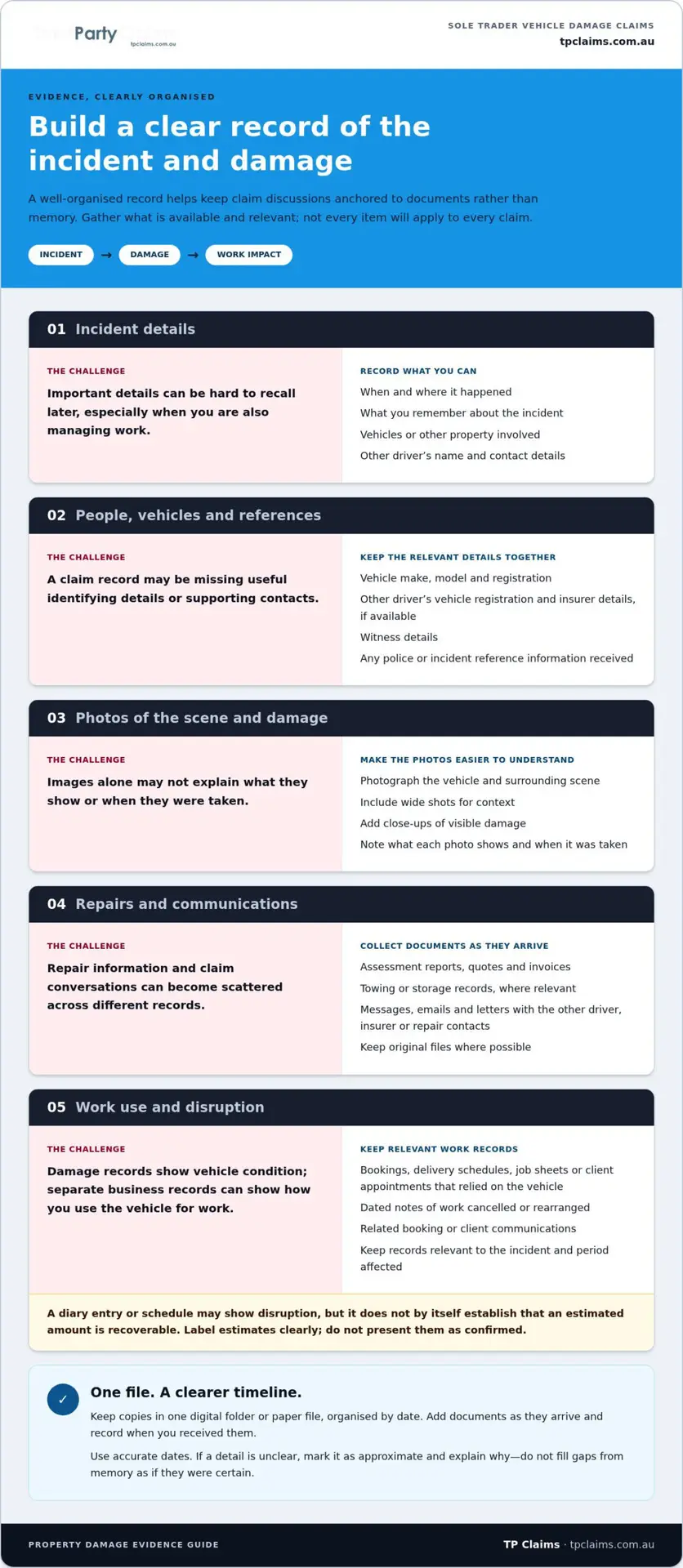
A clear record helps you explain what happened, identify the damage and keep claim discussions anchored to documents rather than memory. Not every item below will be available or relevant to every claim. Gather what you can, note anything you couldn’t obtain and keep original files where possible.
Build a clear record of the incident and vehicle damage
Start with the basics: when and where the incident happened, what you remember and which vehicles or other property were involved. Record the other driver’s name and contact details, vehicle registration and insurer details if available. Note any witnesses and any police or incident reference information you received.
Take photographs of the vehicle and the surrounding scene. Include wide shots for context and close-ups of visible damage. Add a short note explaining what each photo shows and when it was taken, rather than relying on images alone.
- Vehicle details: Make, model, registration and any other identifying information relevant to the damaged vehicle.
- Incident material: Your notes, photographs, witness details and available reference numbers.
- Repair records: Assessment reports, quotes, invoices and towing or storage records, where relevant.
- Communications: Messages, emails and letters exchanged with the other driver, an insurer or repair contacts.
Keep copies in one digital folder or paper file, organised by date. Add documents as they arrive and record when you received them. Use accurate dates; don’t fill gaps from memory as if they were certain. If a detail is unclear, mark it as approximate and explain why.
Show how the damaged vehicle supports your business
Damage records describe the vehicle’s condition. Separate business records can show how you use it for work. Depending on your circumstances, useful examples include bookings, delivery schedules, job sheets or client appointments that relied on the vehicle. Keep records relevant to the incident and the period affected.
If work was cancelled or rearranged, make a dated note of what changed and retain the related booking or client communication. Be specific about what happened. A diary entry or schedule may show disruption, but it doesn’t by itself establish that an estimated amount is recoverable. Label estimates clearly and don’t present them as confirmed losses.
For tax or GST questions, keep the relevant records and seek advice from a suitably qualified tax professional. A vehicle damage claim and your business tax reporting are separate matters; a claim document does not determine the tax treatment.
A simple timeline can bring the file together. List the incident, first report, vehicle inspection, repair documents and key communications in date order, then note which document supports each event. This makes gaps easier to spot and helps you respond consistently. If the paperwork is taking time away from your work, third-party property damage claims management can help manage the claim and related insurer discussions.
Which claim pathway may fit a sole trader’s damaged work vehicle?
There isn’t one route for every damaged work vehicle. Your options depend on factors such as who caused the incident, what the evidence shows and the terms of any policy covering your vehicle. A search for “sole trader commercial vehicle damage claim australia” may bring up both insurer claims and third-party recovery. These are different pathways, and you shouldn’t assume they can be swapped without considering the circumstances.
Before deciding what to do, separate what you know from what still needs to be clarified. Record the incident and damage, then compare the broad options below. Raising a claim does not automatically mean another driver or insurer will accept responsibility. Each pathway may involve an assessment of the circumstances.
Pursuing property damage from another responsible party
If you believe another driver was responsible, you may seek recovery for vehicle or other property damage from that party or their insurer. Evidence can help explain what happened, the damage sustained and how the incident unfolded. The other party may dispute liability or the amount claimed, so keep communications factual and retain supporting documents.
If the driver you consider responsible is uninsured, recovery can be more complex. You may need to communicate directly with them and work through the available claim process. The uninsured driver recovery guide explains this situation. For a more focused explanation of pursuing repair costs from another driver, see the guide to recovering car repair costs from an at-fault driver.
Reviewing your own commercial vehicle policy
If you have a policy that may cover the damage, read its wording and claim instructions carefully. The policy sets out the cover available and may explain any excess, notification requirements and information the insurer needs. Check the details for your vehicle and how you use it; don’t assume a work vehicle is covered for every type of loss.
Contacting your insurer about a possible claim and pursuing another party are not always interchangeable. A policy has its own process and conditions, while a third-party claim depends on responsibility and the evidence supporting it. The pathways may also affect how the damage is assessed and what information you need to provide. Focus on the written policy terms and the facts of the incident before deciding how to proceed.
For a practical starting point, note whether you have a relevant policy, whether you have the other driver’s details and whether responsibility is accepted, disputed or unclear. Keep a copy of any claim notification or correspondence. This helps you track what is known without treating an untested account as a confirmed decision. If discussions stall or the process becomes difficult to manage, third-party property damage claims management and insurance negotiation support can help progress the matter.
How can you manage the claim while keeping your business moving?
Claim administration can compete with the work that keeps your business running. A simple routine helps you keep the process moving without letting emails, assessments and follow-ups take over your week. Use this sequence as a starting point and adjust it to suit the claim and your workload.
- 1. Secure your records. Keep incident notes, photographs, repair documents and relevant business records together in one claim file. Save emails and letters as they arrive.
- 2. Clarify the claim route. Note whether you’re dealing with another driver or insurer, or making a claim under your own policy. Record what’s known, what’s disputed and what information is being requested.
- 3. Organise assessments. Track inspection arrangements, who is coordinating them and what documents you need to provide. Keep copies of assessment reports and repair communications.
- 4. Track communications. Record the date, who you spoke or wrote to, what was discussed and the next step. Set a follow-up reminder when a response or document is outstanding.
Keep claim administration manageable during a busy work week
Set aside a regular time to review correspondence and requests, rather than checking messages between every job. Use a calendar or diary to track follow-ups, and keep one dated log of calls, emails, decisions and actions. It gives you a quick reference if you need to explain the sequence later. If settlement wording is unclear, ask what it covers before agreeing. Don’t assume it resolves only the repair issue.
Your claim file can be a simple folder with sections for incident records, assessments, correspondence and business disruption. Use consistent filenames, such as the document type and date, to find items quickly. When you receive a request, note what’s needed and when you sent it. This makes unanswered questions easier to spot without relying on memory.
Plan for temporary transport and work disruption
List the trips your work vehicle normally supports, such as carrying equipment, visiting clients or making deliveries. Then consider practical interim transport for essential commitments. Keep a note of replacement vehicle arrangements and related receipts, but don’t assume those costs will be covered or recoverable. How transport costs are treated depends on the circumstances and applicable policy or claim terms.
An accident replacement vehicle may help eligible clients stay mobile while a claim and repairs are under way. If staying mobile is your immediate concern, explore not-at-fault accident replacement vehicle support as part of your planning.
Managing a sole trader commercial vehicle damage claim australia can mean coordinating work as well as claim tasks. A short weekly review can help you keep both in view: check upcoming work, the next claim action and any outstanding documents. If the paperwork or insurer discussions are adding to the load, get support managing your property damage claim through TP Claims’ claims management and insurance negotiation service.
How TP Claims can help with a sole trader commercial vehicle damage claim
A damaged work vehicle can leave you managing claim paperwork while trying to keep jobs on track. TP Claims helps individuals and businesses manage third-party motor vehicle property damage claims, including discussions with insurers. The service focuses on physical property damage, not personal injury claims or insurance advice.
What claims management can take off your plate
With claims management support, you don’t have to coordinate every part of the property damage process alone. TP Claims manages the claim and handles insurance negotiations, helping reduce the administrative load while you focus on clients, deliveries and day-to-day work. This can be useful if the other driver is uninsured or if responsibility or repair discussions become difficult.
The service is provided on a no-win-no-fee basis, subject to the applicable terms. This doesn’t guarantee that a claim will succeed, that you’ll recover a particular amount or that every cost will be covered. Before proceeding, understand the scope of the service and how the arrangement applies to your claim.
TP Claims also provides accident replacement vehicles for eligible clients. This may help you stay mobile while the claim and repair process is under way. Eligibility depends on the circumstances and applicable terms.
A straightforward next step after a work vehicle crash
You don’t need every detail neatly organised before discussing your claim. Start with the basics: when and where the incident happened, which vehicles were involved, what damage you’ve noticed and whether you have the other driver’s details. Photos, repair documents and relevant insurer communications can also help explain the situation. If information is missing, be clear about what you do and don’t know.
For a sole trader commercial vehicle damage claim australia, next steps depend on the circumstances, available evidence and applicable service terms. TP Claims manages property damage claims and insurer negotiations, keeping you informed about the process. Replacement vehicle support is considered separately and depends on eligibility.
If a crash has left you unsure how to progress a property damage claim, discuss the incident and the information you have with TP Claims. This can help you understand the next steps without assuming an outcome in advance.
Take the next step with a clearer plan
A vehicle damage claim doesn’t need to become another full-time job. A structured process can help you keep the claim moving while you focus on your business. If you’re weighing up a sole trader commercial vehicle damage claim australia, consider whether support with the claim process would make it easier to manage alongside your work.
TP Claims manages third-party property damage claims and insurer negotiations for individuals and businesses. The service operates on a no-win-no-fee basis, subject to applicable terms, and doesn’t guarantee a particular result. Accident replacement vehicles may also be an option for eligible clients, depending on the circumstances.
Start with the information you have and explain what’s still unclear. Talk to TP Claims about your vehicle damage claim for help managing the property damage claim and insurer negotiations.
Frequently Asked Questions
Can a sole trader make a claim if the damaged vehicle is used for work?
Yes. Using a vehicle for work doesn’t by itself prevent you from pursuing a property damage claim. Your business structure doesn’t remove the need to establish what happened, the damage and the basis for recovery. For example, if a van is registered to you personally but used for deliveries, explain that clearly and keep relevant records of its ownership and use. The available pathway depends on the circumstances and any applicable policy terms.
Can I claim for lost income while my commercial vehicle is being repaired?
Possibly, but lost income isn’t automatically recoverable because your vehicle is off the road. Whether a loss can be included depends on the circumstances, evidence and applicable claim rules. Keep records of the work affected, such as cancelled bookings, delivery changes and business accounts, and distinguish actual figures from estimates. Don’t assume gross takings equal the loss. A tax professional can help with tax questions, which are separate from assessing a property damage claim.
Do I need comprehensive insurance to claim against an at-fault driver?
No, you don’t necessarily need comprehensive insurance to pursue a third-party property damage claim against a driver you believe was responsible. Your own cover and a claim against another party are separate matters. A third-party claim still depends on the evidence and whether responsibility is established; the other driver or insurer may dispute it. Keep your vehicle and incident records together, and don’t assume that having no comprehensive policy guarantees recovery or changes how liability is assessed.
What if the at-fault driver does not have insurance?
You may still be able to pursue a property damage claim, but an uninsured driver can make the process more involved because there may be no insurer handling the matter on their behalf. Keep the driver’s details, registration, incident evidence and records of communications. Don’t rely on verbal promises alone. TP Claims manages claims involving uninsured drivers, with the process and next steps depending on the circumstances and applicable service terms.
Can I use a replacement vehicle while my work vehicle is being repaired?
A replacement vehicle may be an option, but it isn’t an automatic entitlement. TP Claims provides accident replacement vehicles for eligible clients, including individuals and businesses. If a ute, van or other work vehicle is unavailable, explain what you need a vehicle for and how the incident affects your transport. Eligibility depends on the circumstances. Keep a record of replacement transport arrangements and related documents while your damaged vehicle is being assessed or repaired.
Does GST affect a sole trader’s vehicle damage claim?
GST can raise questions about how repair costs or other claim amounts should be treated, but the answer depends on your business and tax circumstances. Don’t assume an invoice total is automatically the amount recoverable, or that a claim decision determines your GST reporting. Keep tax invoices and claim documents, and ask a registered tax professional how GST applies to your situation. This is a tax question, separate from managing the property damage claim.
How long does a sole trader commercial vehicle damage claim take in Australia?
There’s no single timeframe for every claim. The time needed can depend on how quickly the damage is assessed, whether the evidence is complete, and whether responsibility or repair costs are disputed. Keep a dated record of requests and responses, and follow up on outstanding items so you can see what is holding up progress. TP Claims manages third-party property damage claims and insurer negotiations, but no particular resolution time is guaranteed.