
What if an at-fault driver refuses to share their insurance details? If you’re searching “what happens if at-fault driver refuses to give insurance details australia”, it’s understandable to worry they’ll leave you with the repair bill. But not having their insurer’s details at the scene doesn’t automatically rule out your options.
Put safety first and avoid escalating the situation. Record what you can, including the vehicle’s registration, make, model and colour, and photograph the scene and damage if it’s safe. Witness details and a police report may also help establish what happened and identify the driver or vehicle owner.
This guide explains what to do at the scene, what information to gather and how to follow up if the driver won’t cooperate. It also distinguishes property damage claims from injury claims. TP Claims manages third-party property damage claims, including claims involving uninsured drivers, and handles the claims process and insurance negotiations.
Key Takeaways
- Put your safety first and avoid confrontation if the other driver won’t cooperate.
- A driver refusing to provide insurance details doesn’t automatically rule out a property damage claim.
- Registration details, photos and witness accounts may help identify the driver or vehicle owner and document what happened.
- Keep evidence, claim references, repair documents and communications organised as you follow up.
- Claims management can help reduce the administration involved in a complex property damage claim.
At-fault driver refuses insurance details: what should you do first?
Stay safe first. A driver withholding their insurer’s name can be unsettling, but it doesn’t automatically prevent you from taking steps afterwards. Don’t argue, threaten them or put yourself in danger by standing in traffic to get information. Focus on what you can safely record and report.
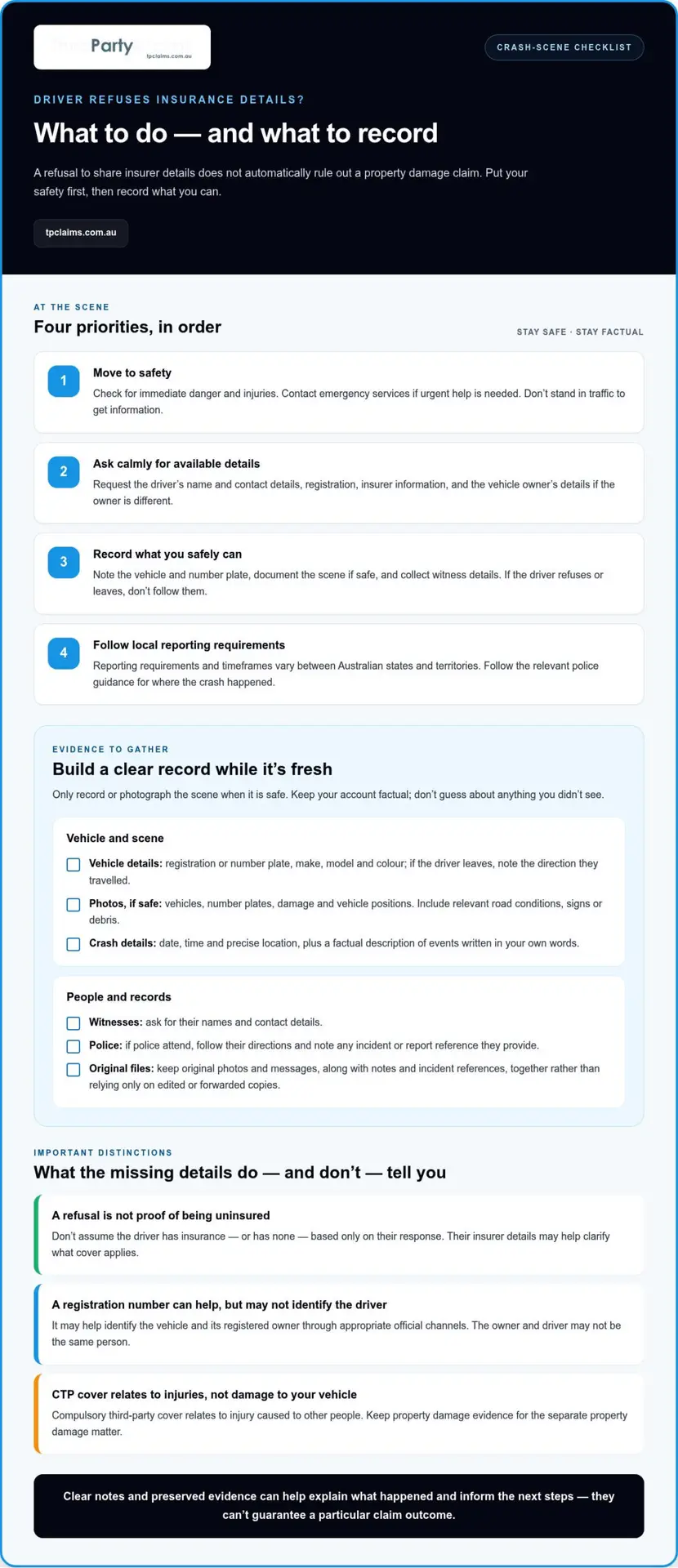
If you’re asking what happens if at-fault driver refuses to give insurance details australia, follow these steps:
- Move to safety. Check for immediate danger and injuries. Contact emergency services if urgent help is needed.
- Ask for available details. Calmly request the driver’s name and contact details, registration, the vehicle owner’s details if different, and insurer information.
- Record what you can. Note the vehicle and number plate, document the scene if safe, and collect witness details.
- Report the crash where required. Requirements and timeframes vary between Australian states and territories, so follow the relevant police guidance for where the crash happened.
What to do while you are still at the crash scene
Check whether anyone is hurt and whether the vehicles or debris are creating a hazard. If the other driver becomes hostile, stop trying to obtain details and move somewhere safe. If they refuse or drive away, don’t follow them. As soon as it’s safe, record their registration, vehicle make, model and colour, along with the direction they travelled.
Keep your request calm and straightforward. You can ask for the driver’s contact details and insurer, but don’t let a refusal turn into a confrontation. If police attend, follow their directions and note any incident or report reference they provide.
What details can you collect without insurance information?
Insurer details are useful, but they’re not the only information that may help explain what happened. Write down the date, time and precise location, then describe the events factually in your own words while they’re fresh. Note road conditions, traffic signals and other relevant surroundings, without guessing about anything you didn’t see.
- Photograph the vehicles, number plates, damage and their positions, if it’s safe.
- Capture relevant road conditions, signs or debris that may help show the scene.
- Ask witnesses for their names and contact details, and keep any messages or incident references.
Save original photos and messages rather than relying only on edited or forwarded copies. Keep your notes and files together, as they may help identify the driver or vehicle owner later. For general background on the Australian insurance system, see Insurance in Australia. Compulsory third-party cover relates to injuries, not damage to your vehicle, so retain your property damage evidence as well.
Why refusing insurance details does not automatically end a property damage claim
A refusal can leave you without an insurer’s name, but that’s different from having no way to identify the driver or vehicle owner. A registration number, witness account, photos or other reliable evidence may help establish who was involved and inform the next steps.
Refusing to disclose insurer details alone does not establish whether the driver is insured. Don’t assume the driver has cover, or that they don’t, based only on their response. The driver or their insurer can clarify what cover applies. Whether a property damage claim can proceed depends on the circumstances, available evidence, responsibility for the collision and applicable rules.
Refusing to disclose insurance is not proof the driver is uninsured
In Australia, compulsory third-party (CTP) cover relates to injury caused to other people. It doesn’t cover damage to your vehicle. A property damage matter is separate. The other driver’s insurer details may be useful, but not having them at the scene doesn’t establish whether that driver has insurance or what options may be available.
Rules about exchanging details and reporting a crash can vary by state or territory. For example, legal guidance explains the legal requirement to exchange details and what to do if someone refuses. Follow the requirements that apply where your crash happened rather than assuming one jurisdiction’s rules apply across Australia.
Why identifying the driver and vehicle still matters
A registration number may help identify the vehicle and its registered owner through appropriate official channels. The owner and the person driving may not be the same, so a number plate alone doesn’t prove who was behind the wheel. Photos, witness details and clear, consistent notes can help connect the vehicle to the collision and support your account of events.
Keep your records factual. Note what you saw, where the vehicles were and what the other driver said, rather than guessing about their identity or insurance. These details may help clarify the next steps, but they can’t guarantee a particular claim outcome. For wider context on your position after a crash, read Not-at-Fault Car Accident Rights in Australia: 2026 Guide.
TP Claims manages third-party property damage claims and insurance negotiations, including matters involving uninsured drivers. Learn more about third-party property damage claims support.
How to document the refusal and preserve evidence for your claim
Once you’re safely away from traffic, create a clear record while your memory is fresh. If you’re wondering what happens if at-fault driver refuses to give insurance details australia, accurate notes and preserved evidence can help explain what occurred and support the next steps. They won’t guarantee a particular claim outcome, but they can make your account easier to understand and assess.
Build a clear record of the refusal and collision
Write in your own words and stick to what you saw, heard and did. Record what details you requested, the driver’s response as closely as you can remember it, and whether anyone witnessed the exchange. Keep opinions and guesses separate from facts. Don’t speculate about the driver’s reasons, admit fault under pressure or post a public account while events are still being clarified.
Use this checklist to organise the material:
- Scene and vehicles: Note the date, time, location, vehicle descriptions, registration numbers, damage and relevant road conditions.
- Refusal and witnesses: Record what was said or done, who was present and how to contact any witnesses.
- Digital evidence: Save original photographs and dashcam files. Keep the date, time and context with each file, and don’t crop, edit or overwrite the originals.
- Follow-up documents: Keep repair assessments, towing records, messages, letters and any incident reference together.
A useful record brings together collision details, the refusal, witness accounts and original supporting files. Back up digital material so it isn’t lost if your phone or camera is damaged. If you share a copy, retain the original unchanged.
Report the incident through the appropriate channels
Reporting thresholds and timeframes differ across Australian states and territories, so follow the current police guidance for where the crash happened. If there’s immediate danger or someone needs urgent help, contact emergency services. Otherwise, use the appropriate non-urgent police reporting channel where reporting is required or you need to record that the other driver refused to provide details.
When you report, give a factual account and share the evidence you have. Note the report reference, the date you made the report and any instructions you receive. Keep copies of documents you submit or are given, and add them to your evidence folder. An organised record can help you explain the incident consistently if you later speak with an insurer or make a property damage claim.
Contact Your Insurer and Explore Claim Pathways
Once you’ve recorded the available evidence, take the next steps in an orderly way. If you have motor insurance, notify your insurer promptly where applicable and explain that the other driver didn’t provide their insurer details. Share what you know, including the registration number, any police report reference, photos and witness details. Ask how to lodge the incident and what information they need next.
Keep the process easy to track. Save your claim reference and bring related documents together, including repair assessments, invoices, towing records, messages and letters. Note who you spoke with and when. If details are missing, say so clearly rather than filling gaps with assumptions.
If you have comprehensive insurance or are making a third-party claim
If you’re making a claim through your insurer, review your policy and follow its notification process. Your insurer can explain its process, but cover, policy terms and outcomes vary. Keep copies of what you submit and any responses you receive.
If you’re pursuing a third-party property damage claim, organise the information that may help establish the other party’s identity, responsibility for the collision and the loss you’re claiming. Repair documents and clear evidence of the damage can help explain the amount claimed. For broader guidance, see Third Party Property Damage Claim Help: Your 2026 Australian Recovery Guide.
If the driver cannot be identified or may be uninsured
A refusal to share insurer details doesn’t prove the driver is uninsured. Keep the evidence you have to help clarify who was involved and what happened. If the vehicle or driver remains unidentified, the available pathways may differ from a case where you have their details. A hit to a parked car is a distinct situation, covered in Uninsured Driver Hit My Parked Car in Australia: 2026 Recovery Guide.
There isn’t one claim route that fits every crash. Your options can depend on your own cover, the evidence available and the circumstances, so don’t assume a particular outcome is certain. If keeping track of documents, correspondence and negotiations becomes difficult, claims management can reduce the administrative load. TP Claims manages third-party property damage claims, including matters involving uninsured drivers, and negotiates with insurers.
Find out more about third-party claim support.
When claims management can take the pressure off after a driver refuses details
Unclear insurer details can leave you managing evidence, repair paperwork and follow-up at the same time. Claims management can help when the evidence is complex, you’re unsure how to progress a third-party property damage matter, or insurer correspondence is difficult to keep on top of. A driver’s refusal doesn’t by itself determine whether a claim can be pursued. Each matter depends on its facts and supporting evidence.
What claims management can handle for a property damage matter
TP Claims manages third-party motor vehicle property damage claims, including matters involving uninsured drivers, and handles claim communications and negotiations with insurers. This can reduce the administration involved while you stay informed about the progress of your matter. The service focuses on damage to vehicles and other property, not personal injury claims or insurance advice.
Keep your own records, including photos, messages, repair documents and any claim or police reference. These help organise the information and provide a record of what has been shared. TP Claims works on a no-win-no-fee basis. Review the applicable service terms so you understand the arrangement. No particular claim outcome is guaranteed.
A simple next step when you are unsure what to do
Before seeking support, prepare a short timeline of the crash and what happened when you asked for details. Gather any driver or vehicle information you have, along with witness contacts, photos, dashcam footage, repair assessments and relevant correspondence. You don’t need to fill gaps with guesses. Make clear what you know and what remains uncertain.
If you’re still asking what happens if at-fault driver refuses to give insurance details australia, the next steps depend on the available evidence, the circumstances and the requirements that apply to your matter. A claims manager can help organise information, manage communications and negotiate with insurers, but can’t promise that a claim will be accepted or costs recovered.
For help managing a third-party property damage claim, discuss your property damage claim with TP Claims.
Take the next step with confidence
If you’re wondering what happens if at-fault driver refuses to give insurance details australia, remember that a refusal doesn’t automatically end your options. Prioritise safety, record the details you can and preserve clear evidence of the crash and any refusal. Then notify your insurer if applicable and consider the property damage claim pathway that fits your circumstances.
TP Claims manages third-party property damage claims and insurance negotiations, and assists with claims involving uninsured drivers on a no-win-no-fee basis. Every matter depends on its facts and evidence, so no outcome can be guaranteed.
To discuss support with your property damage claim, talk to TP Claims about managing your property damage claim.
Frequently Asked Questions
Can I still make a claim if the at-fault driver refuses to give their insurance details?
You may still be able to explore a property damage claim, but the refusal doesn’t guarantee a claim will succeed. Not knowing the other driver’s insurer is different from not knowing who was driving or who owns the vehicle. Their registration, witness accounts and other evidence may help clarify the situation. If you’re asking “what happens if at-fault driver refuses to give insurance details australia”, start by preserving evidence and notifying your own insurer if applicable.
What details should I collect if the other driver refuses to cooperate?
Record the other vehicle’s registration, make, model and colour, along with the date, time and precise crash location. If safe, photograph the vehicles, damage and road conditions. Write down what you asked the driver and how they responded, using factual notes rather than guesses. Collect witness names and contact details, and keep original photos, dashcam files, messages and any police incident reference together.
Should I call the police if a driver refuses to provide insurance details?
Follow the police reporting guidance for the state or territory where the crash happened. Reporting rules and timeframes can differ, so don’t assume the same requirements apply across Australia. Contact emergency services if there’s immediate danger or an urgent need for help. Otherwise, use the appropriate non-urgent police channel if reporting is required or you need to report the refusal. Keep any incident reference and documents provided.
Can I find the other driver’s insurer from their registration number?
A registration number may help identify the vehicle and its registered owner through appropriate official channels, but it doesn’t necessarily tell you which insurer covers property damage. The registered owner may not have been driving, either. Keep the plate details with your photos, witness information and notes, then follow the appropriate steps to clarify the identity and claim pathway.
What if the at-fault driver leaves without giving me any details?
Don’t follow or confront them. Move to a safe place and write down the registration, vehicle description and direction of travel as soon as you can. Save any dashcam footage and note witnesses who saw the crash or the vehicle leaving. Report the incident through the appropriate police channel for your jurisdiction, and follow its guidance on timing and information to provide. Notify your insurer if applicable.
Does refusing to provide insurance details mean the driver is uninsured?
No. A refusal alone doesn’t establish whether the driver is insured. Avoid assuming either way; the driver or insurer can clarify what cover applies. Also distinguish vehicle damage from injury: compulsory third-party (CTP) insurance relates to injury cover and doesn’t cover damage to your car. Record the refusal and keep evidence that may help identify the driver and establish what happened.
Can TP Claims help if the other driver will not provide insurance details?
TP Claims manages third-party motor vehicle property damage claims and insurance negotiations, including matters involving uninsured drivers. The service is provided on a no-win-no-fee basis, subject to the applicable service terms. Withheld insurer details don’t by themselves determine what options are available. Keep your evidence and documents organised so the circumstances can be considered. No particular claim outcome or recovery is guaranteed.