
What if you didn’t have to negotiate with the other driver’s insurer while trying to get your car repaired? After a crash, uncertainty about fault, repair costs or being uninsured can make a property damage claim feel like another problem to manage. A third party motor vehicle claim specialist can manage claim administration and insurer negotiations on your behalf, so you’re not left to chase every update yourself.
You’ll learn what a specialist does, what information and evidence can help support a claim, and what to expect as the insurer considers the damage. A property damage claim is about vehicle-related costs, not compensation for personal injuries. If you’re uninsured or the other party disputes the claim, support can help organise the information and keep the claim moving.
TP Claims manages third-party property damage claims and insurance negotiations, including claims involving uninsured drivers. TP Claims also provides accident replacement vehicles to help individuals and businesses stay mobile while property damage claims are being processed. Here’s how the process works and how TP Claims can take the follow-up burden off your shoulders.
Key Takeaways
- A third party motor vehicle claim specialist can organise the steps and insurer communication involved in pursuing vehicle property damage costs.
- Photos, incident details and supporting records can help inform how a claim is assessed. What’s relevant depends on the circumstances of the crash.
- Compare managing a claim yourself with specialist support to understand who handles paperwork, follow-ups and insurer negotiations.
- Before proceeding on a no-win-no-fee basis, read the engagement terms and understand any conditions that apply.
- TP Claims manages property damage claims, including uninsured-driver claims and truck collision disputes.
What a third party motor vehicle claim specialist does for your property damage claim
After a crash that wasn’t your fault, you may need to arrange repairs, gather records and communicate with the other driver’s insurer. A third party motor vehicle claim specialist can manage the property damage claim process and insurer negotiations on your behalf. This can reduce the paperwork, follow-ups and pressure of dealing with the insurer directly.
Property damage claim management is about pursuing costs related to your damaged vehicle or other property; injury compensation is a separate type of claim. Compulsory third party (CTP) schemes relate to motor accident injuries, not repairs to your car. TP Claims manages third-party property damage claims, rather than personal injury or CTP compensation claims.
The broader insurance term Third-Party Administrator (TPA) refers to an organisation that processes claims on behalf of another entity. For a property damage claim, a specialist can help collect and organise information, communicate with the insurer and negotiate a settlement. That support can mean fewer calls and forms for you to manage, while keeping you informed about the claim.
Which accident claims may need specialist support?
Support can be useful when responsibility for a collision is disputed, repair damage is contested or insurer negotiations are proving difficult. It can also help if the at-fault driver is uninsured and you’re unsure how to pursue your property damage claim. Truck collision disputes may involve more complex circumstances, so having the claim information and communications managed can be particularly helpful.
What a claims specialist does, and doesn’t do
A specialist can gather and organise details about the incident and damage, manage communication with the relevant insurer, and negotiate the property damage claim. This reduces the need for you to repeatedly explain the situation or chase updates yourself. The evidence and circumstances of each crash shape how the claim is handled, and no particular result can be guaranteed.
TP Claims manages third-party property damage claims, including claims involving uninsured drivers and truck collision disputes. It does not handle personal injury claims or represent at-fault drivers. Claims management is not legal advice, and a specialist cannot promise that a claim will succeed. The role is to manage the property damage claim process and insurer negotiations, so you can focus on getting back on the road.
How a third party motor vehicle property damage claim is managed
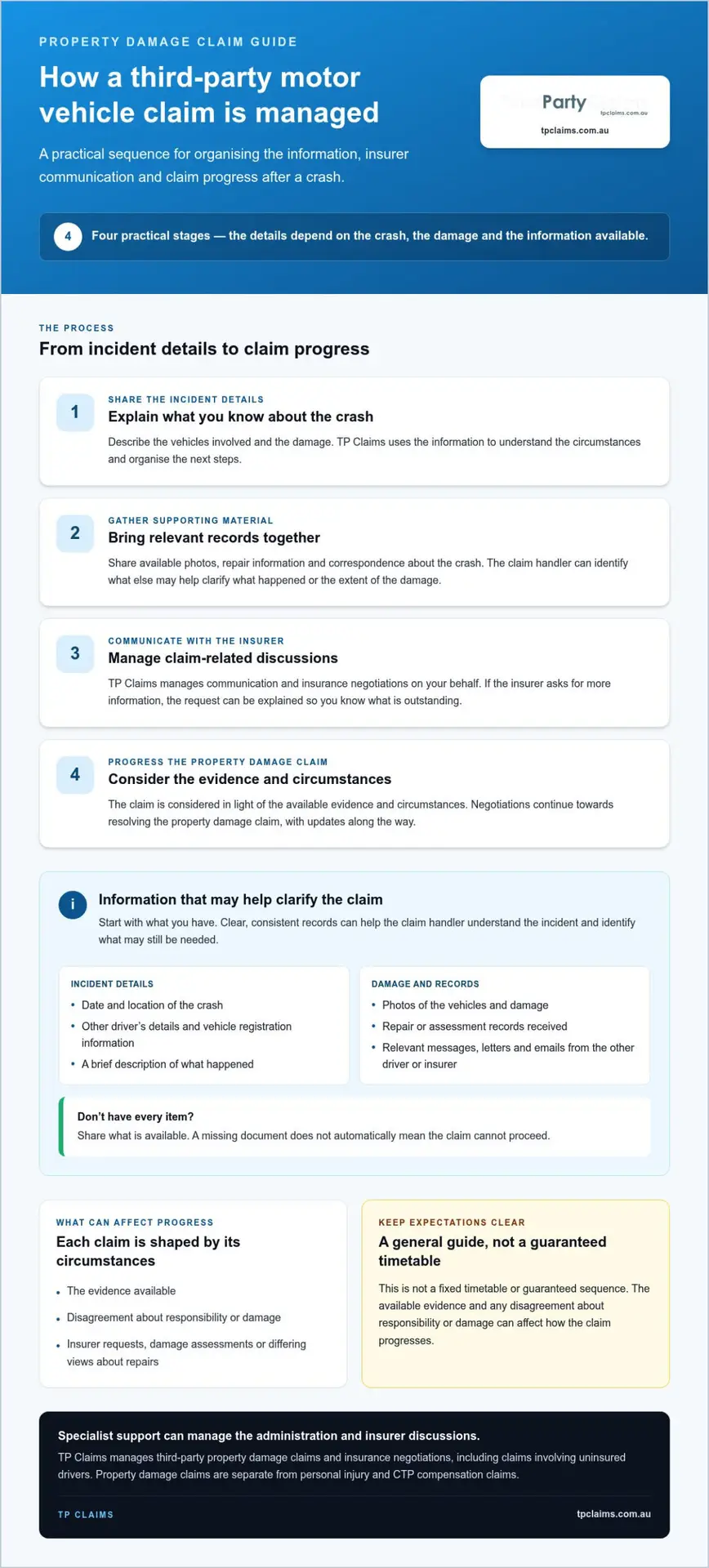
A property damage claim usually moves through a series of practical steps, but the details depend on the crash, the damage and the information available. A third party motor vehicle claim specialist can manage administration and insurer discussions, helping you understand what’s happening without having to drive every conversation yourself.
- Share the incident details. Explain what you know about the crash, the vehicles involved and the damage. TP Claims uses this information to understand the circumstances and organise the next steps.
- Gather supporting material. Bring together relevant records, such as photos of the damage, repair information and correspondence about the crash. The claim handler can identify what else may help clarify what happened or the extent of the damage.
- Communicate with the insurer. TP Claims manages claim-related communication and insurance negotiations on your behalf. If the insurer requests more information, the request can be explained so you know what’s outstanding.
- Progress the property damage claim. The claim is considered in light of the available evidence and circumstances. Negotiations continue towards resolving the property damage claim, with updates along the way.
This is a general guide, not a fixed timetable or guaranteed sequence. A clear account of the incident can help, but the available evidence and any disagreement about responsibility or damage can affect how the claim progresses. For a broader explanation of the steps, read the third-party property damage claim recovery guide.
What information helps get a claim moving?
Start with the information you have. Useful details may include the date and location of the crash, the other driver’s details, vehicle registration information and a brief description of what happened. Photos of the vehicles and damage can help show their condition after the collision. Keep relevant messages, letters and emails from the other driver or insurer together, and include any repair or assessment records you’ve received.
Clear, consistent records help the claim handler understand the incident and identify what may still be needed. If you don’t have every item, share what’s available. A missing document doesn’t automatically mean the claim can’t proceed.
How insurer negotiation and claim updates work
Insurer discussions can involve requests for information, damage assessments and differing views about responsibility or repairs. TP Claims manages those communications and negotiates the property damage claim on your behalf, while keeping you informed about progress and outstanding information. You can follow what’s happening without having to chase each update yourself.
If you want help managing a third-party property damage claim, find out how TP Claims can help.
How to assess whether a third party motor vehicle claim specialist suits your situation
There’s no single way to manage a not-at-fault property damage claim. You can handle the paperwork and insurer contact yourself, communicate directly with the insurer, or have a specialist manage the claim administration and negotiations. The right approach depends on how much time you can give the claim and whether there are disputes or complications to work through.
| Approach | Paperwork and follow-up | Negotiation and disputes |
|---|---|---|
| Self-managed claim | You collect the information, submit documents and follow up on progress. | You handle discussions about responsibility, damage and settlement directly. |
| Direct insurer communication | You provide requested information and keep track of correspondence and updates. | You speak with the insurer yourself about the claim and any points in dispute. |
| Specialist-managed claim | A specialist manages claim administration and insurer communications on your behalf. | A specialist negotiates the property damage claim and can manage claims involving an uninsured driver. |
This comparison is about property damage claims only. A third party motor vehicle claim specialist manages vehicle or other property damage recovery, not personal injury compensation or CTP injury claims.
When might you prefer help managing the claim?
Specialist support may suit you if insurer follow-ups are taking up time, responsibility is disputed or the repair damage is difficult to resolve. It can also be useful when the at-fault driver is uninsured and you’re unsure how to progress a property damage claim. For a business, a damaged vehicle can disrupt day-to-day operations; truck collision disputes can involve more involved claim details. A specialist can take on claim administration and negotiation, reducing the follow-up you need to manage yourself.
If you’re weighing up different recovery options, explore this guide to claiming against an at-fault driver.
What should you understand before proceeding?
Make sure you understand what the service covers, how the claim will be managed and what the engagement terms say. TP Claims manages property damage claims on a no-win-no-fee basis, but that phrase shouldn’t be taken to mean the service is unconditional or automatically free in every circumstance. Read the applicable terms carefully so you understand any conditions and how the arrangement works for your claim.
Consider how much direct insurer contact you’re comfortable handling, whether the damage or responsibility is disputed, and whether an uninsured driver or truck collision makes the claim more involved. These practical factors can help you decide whether to manage the process yourself or use a specialist.
No-win-no-fee claims: what to know before you proceed
A no-win-no-fee arrangement can make it easier to consider help with a property damage claim, but the phrase alone doesn’t explain every part of the service. TP Claims manages third-party property damage claims on this basis. Before proceeding, read the engagement terms so you understand how the arrangement applies to your claim and what, if anything, you’re responsible for.
It’s also important to keep the service in perspective. A third party motor vehicle claim specialist manages the property damage claim and insurer negotiations. No-win-no-fee isn’t a promise that every claim will succeed, that every service is free, or that a particular settlement will be reached.
What does no-win-no-fee mean for a property damage claim?
In plain English, it describes the basis on which TP Claims manages the claims process. The exact terms of engagement explain how it works for your circumstances. Review those terms before you proceed, paying attention to the service scope, any conditions and your responsibilities during the claim. If a point in the agreement is unclear, make sure you understand it before making a decision. Don’t rely on the label alone to assume what applies.
The claim itself depends on its circumstances and supporting evidence. For example, a clear account of the collision can help explain what happened, while a disagreement about responsibility or repair damage may require further communication and negotiation. The arrangement doesn’t remove those uncertainties or guarantee a particular outcome.
What outcomes and timing should you expect?
Each claim progresses according to its own details. The available evidence, the insurer’s assessment and any points in dispute can affect negotiations and how quickly the matter moves towards resolution. There’s no fixed timeframe or settlement amount that can be promised for every claim. A claims specialist can manage communications and keep you informed about progress, but the outcome depends on the claim.
If you’re also seeking to recover related expenses paid out of pocket, read the guide to recovering out-of-pocket accident expenses for more context.
For support managing a third-party property damage claim, learn about TP Claims’ claim management service.
How TP Claims can manage your third party motor vehicle claim
If you weren’t at fault and need help with vehicle property damage, TP Claims can manage the claim process and insurer negotiations on your behalf. As a third party motor vehicle claim specialist, TP Claims also manages claims involving uninsured drivers and truck collision property damage disputes.
Having someone manage the claim can take paperwork and repeated insurer conversations off your plate. Share the information you have, while TP Claims handles claim administration and works through negotiations with the insurer. Each claim is shaped by its circumstances and available evidence, so the process and outcome depend on the details of your situation.
If your car isn’t available while the property damage claim is being handled, TP Claims provides accident replacement vehicles to individuals and businesses. This mobility support can help you stay on the road while your claim is being processed.
What happens when you get started with TP Claims?
The first step is to discuss the accident, the damage to your vehicle and the claim information you have available. This gives TP Claims context about what happened and the issues that may need attention. Share relevant details and records you already have; you don’t need to have every part of the claim worked out before starting the conversation.
After engagement, TP Claims manages claim handling and insurer negotiation. This can include organising information, managing communications and progressing discussions about the property damage claim. You remain part of the process, with the claim circumstances guiding what happens next. No particular settlement or timeframe can be guaranteed.
For an uninsured-driver claim or a truck collision dispute, having the claim managed can bring the information and insurer discussions together in one process. You don’t have to navigate every conversation alone.
Get support with your next step
If you’re dealing with vehicle damage after a crash and want help understanding how the claim can be managed, share your situation with TP Claims. You don’t need to have all the answers before taking that step. Talk through what happened and the information you have, then consider how claims management and insurer negotiation can support you.
Talk to TP Claims about your property damage claim.
Take the next step towards a more manageable claim
A third party motor vehicle claim specialist can help take the administration and insurer negotiations off your hands after a not-at-fault crash. Understand the difference between property damage claim management and injury compensation, gather the information that may support your claim, and read the engagement terms so you know how the service works.
TP Claims manages third-party property damage claims, including insurance negotiations and claims involving uninsured drivers or truck collision disputes. TP Claims also provides accident replacement vehicles to help you stay mobile while your property damage claim is being handled. The claim circumstances and evidence shape how negotiations progress, so no particular outcome or timeframe can be promised.
You don’t have to manage every claim conversation alone. If you’d like support with your property damage claim, talk to TP Claims about managing your property damage claim. Take the next step when you’re ready and get help bringing the process into clearer focus.
Frequently Asked Questions
What does a third party motor vehicle claim specialist do?
A third party motor vehicle claim specialist manages the property damage claim process for a driver seeking recovery after a crash. This can include organising claim information, handling insurer communications and negotiating over vehicle damage. TP Claims manages third-party property damage claims, including uninsured-driver matters and truck collision disputes. The service focuses on property damage, not personal injury representation or advice about comprehensive insurance. No particular claim outcome is guaranteed.
Can a claims specialist help if the at-fault driver has no insurance?
Yes, TP Claims manages property damage claims involving uninsured drivers. The other driver’s lack of insurance doesn’t automatically mean you have to manage every step alone, though the circumstances and available evidence will affect how the matter progresses. To start organising the details, note what happened, record the vehicles and damage involved, take photographs if available, and keep any messages or correspondence you’ve received.
Is a third party motor vehicle claim specialist the same as a car accident lawyer?
No. A claims specialist manages property damage claims and insurer negotiations, while a lawyer may provide legal services such as personal injury representation. TP Claims focuses on third-party motor vehicle property damage claims. It doesn’t handle personal injury claims or represent at-fault drivers. Knowing this distinction can help you identify whether you’re seeking help with vehicle damage recovery or legal support for an injury matter.
How does no-win-no-fee claims management work?
TP Claims manages third-party property damage claims on a no-win-no-fee basis, but the phrase isn’t a blanket promise that the service is free in every circumstance or that recovery is guaranteed. The applicable engagement terms explain how the arrangement works for your claim. Read them carefully before proceeding so you understand the service scope, any conditions and your responsibilities. The claim’s circumstances and evidence still shape negotiations and outcomes.
Can a claims specialist help me get a replacement vehicle after an accident?
TP Claims provides accident replacement vehicles to individuals and businesses while property damage claims are being processed. This mobility support can help you stay on the road while your vehicle is unavailable. If you’re discussing a property damage claim, you can also raise your need to remain mobile.
What information should I have ready before discussing a property damage claim?
Have the accident date and a brief account of what happened, details of the vehicles involved, photographs of the damage if available, and any messages or insurer correspondence. These records can help explain the circumstances and clarify what information may be useful next. You don’t need to have every document ready before discussing your situation. What else is relevant will depend on the details and evidence of the claim.