
What if your car is fully repaired, but its accident history still affects what buyers are willing to pay? It’s understandable to wonder whether claiming for diminished value after accident damage could recover that difference. In Australia, a separate payment for a car’s reduced resale value isn’t generally a standard part of motor insurance cover. A completed repair doesn’t automatically mean you’re entitled to extra compensation.
The key question is what loss you can establish and how it relates to the damage and repairs. Australian property damage claims generally focus on restoring the vehicle to its pre-accident condition, so a lower resale value may not be treated as an additional loss on top of repair costs. The circumstances and available evidence matter.
This 2026 guide explains what diminished value means, when a car’s market value may be affected, and how to organise documents such as repair records and valuation evidence. You’ll also learn how to distinguish a potential loss in value from repair costs and choose a practical next step without assuming a claim will succeed.
Key Takeaways
- A repaired vehicle may still attract a lower resale price, but that doesn’t mean the loss is automatically recoverable as a separate payment in Australia.
- When considering claiming for diminished value after accident damage, look at the collision circumstances, repair history and evidence of the vehicle’s market value before and after repairs.
- Organise your evidence in a clear table, noting what each document supports and any limitations.
- Keep records, establish the repair position and gather valuation evidence before presenting the claimed loss and reviewing the response.
- TP Claims manages third-party property damage claims and insurer negotiations for not-at-fault drivers, helping with the claim process without guaranteeing a diminished-value outcome.
What does diminished value mean after a car accident?
It’s frustrating to get your car back after repairs and still wonder whether it may be worth less than it was before the crash. Diminished value describes a possible reduction in a vehicle’s market value that remains after repairs are completed. The repairs may restore the car’s condition, but its accident and repair history can still matter to a future buyer.
That doesn’t mean every repaired car has a provable loss, or that an insurer will pay a separate amount for it. In Australia, motor property damage claims generally focus on the reasonable cost of repairing a damaged vehicle. A further reduction in resale value is not usually a standard, separate insurance payment. Whether any additional loss could be recovered depends on matters such as who was liable, the evidence, the circumstances and the law that applies. The overview of What is diminished value? explains the broader concept, but it doesn’t establish whether a particular Australian claim will succeed.
How can a repaired car still lose market value?
Some buyers may take a car’s accident history into account, especially if records show substantial damage or repairs. But that response can’t be assumed for every vehicle. A documented repair history shows what work was carried out; it doesn’t, by itself, prove how much less the car would sell for.
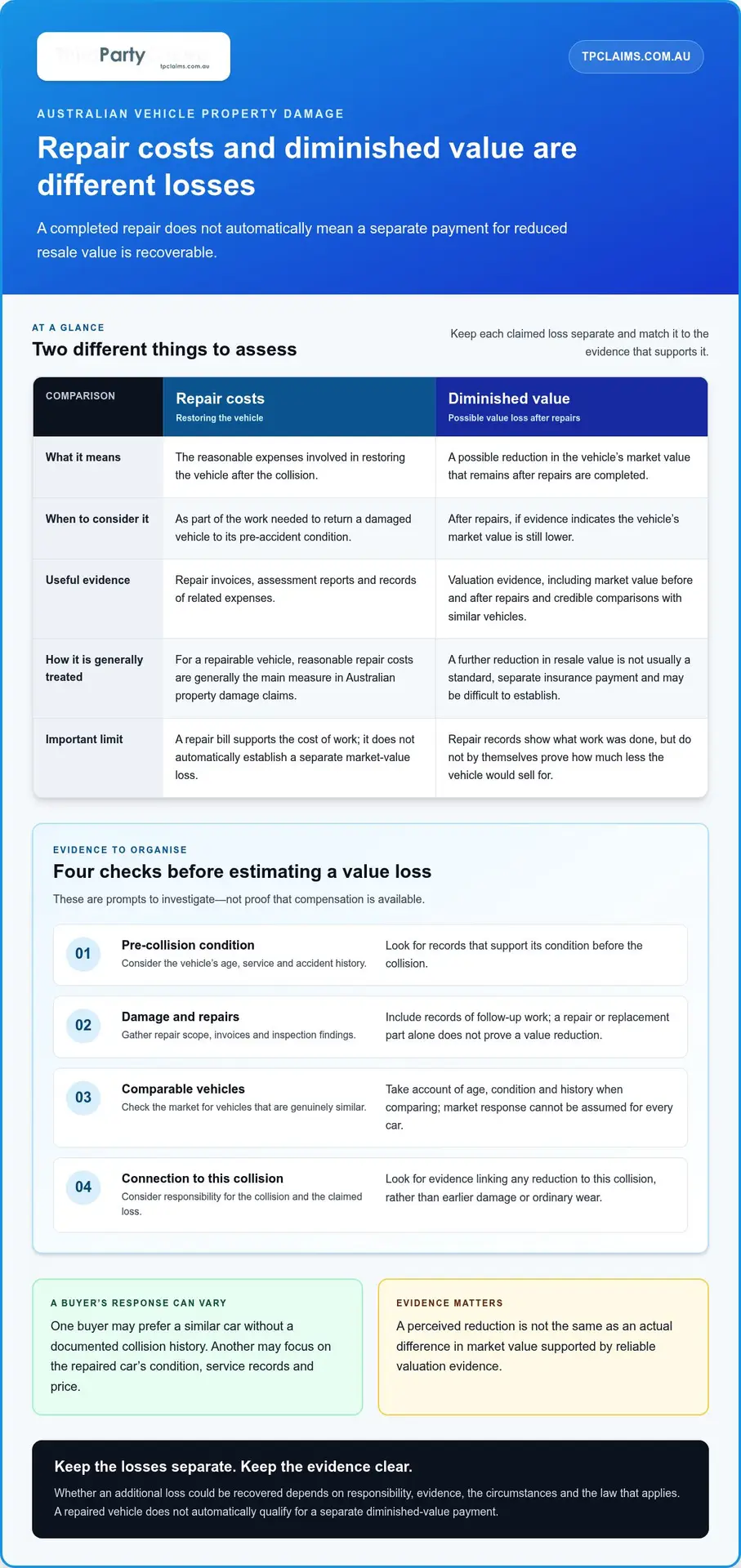
For example, imagine two similar cars offered for sale, with one having a documented collision and repair history. A buyer might prefer the car without that history, while another might focus on the repaired car’s condition, service records and price. To support a claim, you’d need evidence of an actual difference in market value, rather than relying only on the possibility that buyers may be cautious.
Is diminished value different from repair costs?
Yes. Repair costs are the reasonable expenses involved in restoring the vehicle after the collision. Diminished value refers to a potential loss that remains in the vehicle’s market value after those repairs. They describe different things, but that doesn’t mean both are automatically recoverable. In Australian property damage claims, the cost of reasonable repairs is generally the main measure for a repairable vehicle, and an additional market-value loss may be difficult to establish.
Keep repair invoices, assessment reports and records of related expenses together, but list each claimed loss separately. For related costs you may have paid because of the accident, see recovering out-of-pocket expenses after a car accident. Claiming for diminished value after accident damage calls for separate evidence and shouldn’t be treated as an automatic add-on to a repair claim.
When might claiming diminished value after an accident be worth investigating?
A lower resale price can feel like a real loss, but not every concern about a car’s history amounts to a recoverable claim. Treat the circumstances below as reasons to gather information, not as proof that compensation is available. If you’re considering claiming for diminished value after accident damage, look at responsibility for the collision as well as evidence of a loss linked to it.
What circumstances could affect a vehicle’s post-repair value?
Start with the car’s condition before the crash. Its age, service and accident history, and the market for comparable vehicles can all shape its value. A newer vehicle in strong condition may be viewed differently from an older car with previous damage, but no single factor decides the outcome.
The repair history matters too. Keep the repair scope, invoices, inspection findings and records of follow-up work. These documents can help show what damage occurred and how it was addressed. A particular repair or replacement part doesn’t automatically mean the car has lost value. Consider the quality and result of the work alongside evidence from the relevant market.
Useful prompts to investigate include:
- Was the vehicle in good condition before the collision, with records to support that?
- Do repair documents show the extent of the damage and work completed?
- Can you find credible comparisons for similar vehicles, accounting for age, condition and history?
- Is there evidence connecting any claimed reduction in value to this collision, rather than earlier damage or ordinary wear?
Does every repaired vehicle qualify for a diminished-value claim?
No. A repair doesn’t automatically establish a separate, recoverable loss. You may feel buyers would pay less because the car has an accident record, but a perceived reduction isn’t the same as a loss supported by reliable valuation evidence. A claim against another party also depends on establishing responsibility and showing that the loss you’re claiming is connected to the collision.
Rules and legal considerations can differ across Australia, so avoid assuming that one general explanation settles your circumstances or sets a deadline. The ACCC’s information about consumer rights to compensation provides broader consumer guidance, but it doesn’t determine the outcome of a motor vehicle property damage claim.
For wider context on what may matter in a not-at-fault property damage matter, read about not-at-fault car accident rights in Australia. If you’re dealing with a third-party property damage claim, TP Claims’ claims management support can help manage the claim process and insurer negotiations.
How is a car’s diminished value assessed and evidenced?
A sound assessment compares the vehicle’s supported market value before the collision with its supported value after repairs. The difference, if evidence establishes one, is not simply the repair bill or an estimate of what a buyer might feel. Diminished value is a valuation question, not simply the repair invoice total.
Build an evidence record that makes the comparison easy to follow. A simple table can separate each document, what it helps show and any limitation to keep in mind:
- Repair assessment and invoices: Show the damage identified and work completed. They don’t establish the car’s market value by themselves.
- Repair records and photographs: Help document the vehicle’s condition and repair history. Photos should be dated or clearly linked to the relevant stage.
- Vehicle history and condition records: Service records and earlier condition evidence can help establish the car’s pre-accident state. Previous damage or wear may also affect the comparison.
- Comparable vehicle listings: Listings for similar vehicles can provide market context. Asking prices aren’t proof of the prices buyers actually paid.
- Valuation report or assessment: May explain an estimated value difference, but its usefulness depends on the evidence and method behind it.
What documents can help support the claimed loss?
Keep accident photographs, repair assessments, invoices, repair records, vehicle history documents and dated records of the car’s condition. Save relevant communications about the collision and claim as well. Organise everything by date, and note what each item supports. For broader practical guidance on navigating the car insurance claim process, Financial Rights Legal Centre provides information about handling car insurance claims. Use valuation evidence separately to support any claimed market loss.
What should a useful valuation explain?
A clear valuation should identify the vehicle, the valuation date, the evidence considered and the method used. It should show how the pre-accident value and post-repair value were reached, accounting for relevant condition, history and comparable market evidence. This transparency lets another reader understand and assess the comparison rather than relying on an unsupported figure.
An independent assessment may help explain the reasoning, particularly if it draws on relevant vehicle and market evidence. To help establish a reliable market baseline, you can discover My Car Value to obtain vehicle valuation data. It doesn’t guarantee that an insurer or another party will accept the valuation. If you’re claiming for diminished value after accident damage, avoid unsupported estimates and don’t count repair costs again as a separate market loss without evidence that they represent distinct losses.
How do you pursue a diminished-value claim after an accident?
Keep the issue organised and evidence-led. A possible loss in market value may need to be raised separately from arrangements to repair the vehicle. Don’t assume that agreeing on or completing repairs has also resolved every other part of a property damage claim. Equally, setting out a separate amount doesn’t make it automatically recoverable.
A practical sequence can help you present your position clearly:
- Preserve records: Save accident details, photographs, repair assessments, invoices and communications with the other party or insurer.
- Establish the repair position: Record what work was completed and whether any repair concerns remain. Keep any inspection findings or follow-up records.
- Gather valuation evidence: Bring together evidence of the vehicle’s pre-accident condition and a reasoned comparison of its market value before and after repairs.
- Present the claimed loss: Explain how you calculated it, attach the supporting material, and distinguish it from repair costs and other expenses.
- Review the response: Keep the insurer’s reply and note its reasons. Consider those reasons against the evidence you supplied before deciding how to respond.
What should you prepare before presenting the loss?
Arrange documents in date order and create a short timeline covering the collision, repair stages and claim communications. Include information relevant to responsibility for the accident, along with photographs, repair documents and valuation material. Make the figures easy to follow: identify the value loss as a separate item and avoid counting repair costs or other expenses twice. Clear written communication helps everyone see what you’re claiming and why.
What if the insurer disputes the valuation?
Read the reasons carefully. Does the insurer question the vehicle’s pre-accident condition, the comparable vehicles, the valuation method or the link between the collision and the alleged loss? Compare each point with your supporting documents. If the assessment appears to rely on a different assumption or leaves a question unanswered, identify that gap neutrally and ask for a clear explanation in writing.
A further explanation or revised assessment may help clarify the disagreement, but it won’t guarantee a different decision. Keep copies of every response and record the date and substance of any settlement discussion. For broader information about the third-party process, see claiming against an at-fault driver. Claiming for diminished value after accident damage can be uncertain, so present the evidence without assuming the outcome. Get support managing a third-party property damage claim through TP Claims.
How can TP Claims help with a third-party property damage claim?
Once you’ve gathered the documents and considered the uncertainty around any claimed value loss, you may want support with the wider property damage claim. TP Claims manages third-party motor vehicle property damage claims and insurer negotiations for not-at-fault drivers, including claims involving uninsured drivers. That can take the administration and insurer communications off your plate while you focus on the information and decisions needed for your claim.
What does claims management take off your hands?
Managing a claim can mean keeping records organised, presenting relevant information and following up on the insurer’s response. TP Claims handles the claims process and negotiations for third-party property damage matters. Its claims management service operates on a no-win-no-fee basis, but that doesn’t guarantee that a claim will be accepted or that a particular amount will be recovered.
This support relates to third-party vehicle property damage claims and insurer negotiations. It isn’t a promise that a separate loss in resale value after repairs can be claimed or recovered. In Australia, diminished value is not generally a standard separate payment under motor insurance, so any position on it depends on the circumstances and supporting evidence.
What information should you have ready to discuss your claim?
You don’t need to have every detail perfectly assembled. Having the key records at hand can make it easier to explain what happened and understand practical next steps. Gather what you can from this checklist:
- Accident details: the date, a brief account of the collision and available information about the other party.
- Vehicle information: make, model and other identifying details, plus its current repair status.
- Repair evidence: assessments, invoices, repair records and photographs of the damage or completed work.
- Claim correspondence: messages, letters or decisions from the insurer or other party.
- Valuation material: any assessment or market comparisons you’ve collected to support a possible loss in value.
If you’re claiming for diminished value after accident damage, keep that issue distinct from repair costs and other expenses when explaining your position. TP Claims can help manage the broader third-party property damage claim and insurer negotiations, while the evidence and circumstances determine what may be pursued. Talk to TP Claims about your property damage claim to discuss what’s happened and consider a sensible next step.
Take a clear next step with your property damage claim
A repaired car can still leave you questioning its market value, but a possible reduction isn’t automatically a separate payment in Australia. Claiming for diminished value after accident damage depends on the circumstances and evidence, and a repair invoice alone won’t establish a remaining loss. Keep repair records, vehicle history and valuation material organised, and separate any claimed value difference from repair costs and other expenses.
If you’re a not-at-fault driver, TP Claims manages third-party property damage claims and insurer negotiations, helping take some of the administration off your hands. The claims management service operates on a no-win-no-fee basis, but eligibility, recovery and outcomes aren’t guaranteed. A separate diminished-value loss may not be recoverable, so it’s important to understand what the available evidence can support.
You don’t have to work through the broader claim process alone. Talk to TP Claims about your property damage claim and discuss a practical next step for your circumstances.
Frequently Asked Questions
Can I claim diminished value after a car accident in Australia?
Possibly, but a separate payment for reduced resale value isn’t generally a standard feature of Australian car insurance. A claim against another party would depend on establishing responsibility and supporting an actual loss with appropriate evidence. The circumstances and applicable law matter, and a completed repair doesn’t automatically create an entitlement to extra compensation. Consider the evidence carefully before assuming claiming for diminished value after accident damage will succeed.
Does repairing my car mean I cannot claim for diminished value?
No. Completing repairs doesn’t, by itself, prove or disprove a remaining loss in market value. A repaired vehicle may still have an accident history that affects how some buyers view it, but that concern alone doesn’t establish a recoverable amount. You’d need evidence comparing the vehicle’s supported pre-accident and post-repair values, as well as a clear connection between any difference and the collision.
How do you calculate diminished value after a car accident?
There’s no reliable universal percentage to apply. An assessment should compare the vehicle’s supported market value before the collision with its value after repairs, considering its age, condition, history and relevant market evidence. A valuation should state the vehicle details, valuation date, evidence and method used. Repair costs aren’t a substitute for this comparison, and asking prices alone don’t establish what similar cars sold for.
What evidence do I need for a diminished-value claim?
Gather documents that show the car’s condition, damage, repairs and market value. Useful material may include dated photographs, repair assessments and invoices, repair records, service or vehicle history documents, and relevant claim communications. Comparable vehicle listings can provide context, but may not show completed sale prices. An independent valuation may help explain a claimed difference, though it doesn’t guarantee that an insurer or other party will accept it.
Can I claim diminished value if the other driver was at fault?
Being not at fault may be relevant, but it doesn’t automatically establish that a separate diminished-value amount is recoverable. You’d still need to support the loss and show how it relates to the collision. The repair claim and any alleged remaining market-value loss are distinct issues. Keep records of the accident, repairs and valuation evidence, and consider the circumstances and applicable Australian rules before deciding what to pursue.
Can I claim diminished value from an uninsured driver?
A claim involving an uninsured driver may still be worth discussing as a third-party property damage matter, but that doesn’t mean a separate loss in resale value will be recovered. Responsibility, evidence and the circumstances all matter. TP Claims manages property damage claims involving uninsured drivers, but no outcome is guaranteed. Keep the other party’s details, accident records, repair documents and any valuation material together to help explain your position.
Is diminished value the same as my car’s repair costs?
No. Repair costs are expenses associated with restoring the vehicle after the collision. Diminished value is a possible reduction in market value that remains after repairs. They describe different kinds of loss, but that doesn’t mean both are automatically recoverable. Keep each item separate in your records, and don’t count repair expenses again as diminished value unless evidence supports a distinct remaining market loss.