
If you’ve searched “claim repair costs hit by company car australia”, you’re likely trying to work out who to contact and how to get your car repaired without being caught between a business and its insurer. A company logo can help identify the vehicle, but it doesn’t, by itself, prove who is responsible for the damage. The key steps are to establish what happened, identify the relevant parties and support your repair costs with clear records.
Record the driver’s details, vehicle registration and business identification. Keep photos, messages, repair assessments and itemised quotes together, and save copies of any correspondence. If fault or the proposed repair cost is disputed, organised records can help you explain your position and identify what still needs to be resolved.
This guide explains who may be involved, what evidence to preserve and how to move a third-party property damage claim forward. It also covers how claims management and insurer negotiation can reduce the communication workload while you focus on the next steps.
Key Takeaways
- A company logo alone doesn’t establish responsibility. Distinguish between the driver, vehicle owner and insurer when considering a claim.
- For a claim repair costs hit by company car australia, organised collision details and repair documents can help support your position.
- Repairer assessments, insurer assessments and a write-off position are different. Compare the documents and check what each one says before responding.
- Identify whether a dispute concerns fault, repair scope or vehicle value, and keep a written record of communications.
- TP Claims manages third-party property damage claims and insurer negotiations. The outcome still depends on the evidence and circumstances.
Hit by a company car in Australia? Start by separating the driver, owner and insurer
A business logo can help you identify who to contact, but it doesn’t establish who is legally responsible for a collision. A third-party property damage claim is a request to recover a loss, such as damage to your vehicle, from another party considered responsible for causing it. The circumstances of the collision and the available evidence matter.
There may be several separate contacts: the driver, the registered owner or business, and an insurer handling the vehicle’s claim. The business may own the car, lease it or manage it for someone else. The driver may be an employee, contractor or another authorised user. Establishing each role helps you direct questions and documents appropriately, rather than assuming the driver and owner are the same party.
The claim process can depend on how the collision happened, whether the vehicle was being used for work, the evidence about fault and whether relevant insurance is available. A work trip may be relevant, but it doesn’t settle responsibility on its own. Rules can also vary between states and territories, so don’t treat a company’s ownership or the driver’s job title as a final answer.
Does the company own the car, or is it only used for work?
Ownership and use are useful facts to establish, but they don’t prove by themselves who must pay. A vehicle displaying a business name could be owned by that business, leased or simply used for work. An employee driving between work tasks and someone using a work vehicle privately may present different circumstances, but neither detail alone decides liability. Record what you know and let the evidence and applicable state or territory law guide the assessment.
Who should you notify after the collision?
Record the driver’s name and contact details, the vehicle registration and any visible business identification. Ask for the relevant insurer or claims contact. Keep the conversation calm and factual; you don’t need to argue about fault at the roadside. If you can’t obtain some details, note what is missing and preserve your own account of what happened.
Once you have the details, send a written notice or claim enquiry to the appropriate contact and keep a copy. If you have your own insurer, you can also notify them and follow the steps in your policy. Be clear about whether you’re reporting the collision, asking who handles claims for the vehicle or seeking to recover repair costs. These are related, but they aren’t the same conversation.
If you’re working out whether you can claim repair costs hit by company car australia, keep the driver, owner and insurer roles distinct while you gather the facts. TP Claims’ Not-at-Fault Car Accident Rights in Australia: 2026 Guide provides broader context on issues that can arise after a not-at-fault collision. A clear record of who was involved and how the vehicle was being used gives you a practical starting point without assuming the company’s branding settles the claim.
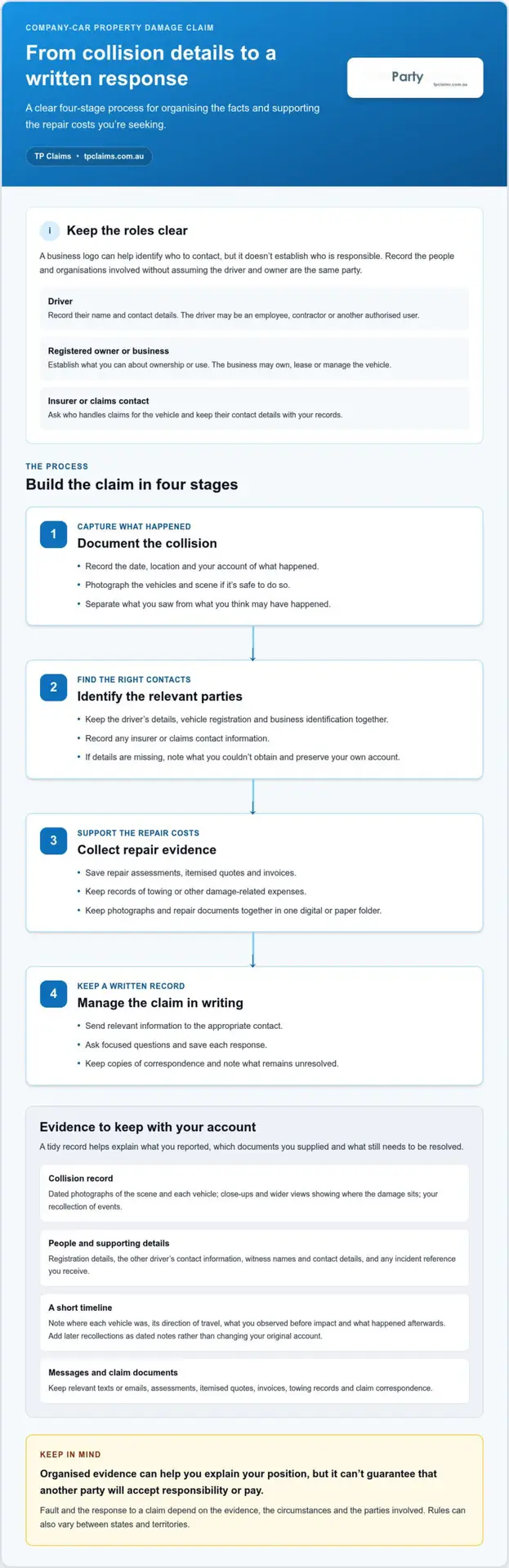
How a company-car repair claim works, from evidence to a response
An organised process makes it easier to explain what happened and support the repair costs you’re seeking. It can’t guarantee that another party will accept responsibility or pay. Fault and the response to a claim depend on the evidence, the circumstances and the parties involved.
Work through the claim in order:
- Document the collision. Record the date, location and your account of what happened. Photograph the vehicles and scene if it’s safe to do so.
- Identify the relevant contacts. Keep the driver’s details, registration, business identification and any insurer or claims contact information together.
- Collect repair evidence. Save assessments, itemised quotes, invoices and records of towing or other damage-related expenses.
- Manage the claim in writing. Send relevant information to the appropriate contact, ask focused questions and save each response.
Written communication creates a record of what you’ve reported, which documents you’ve supplied and what remains unresolved. Keep messages factual. For instance, describe a damaged rear bumper you photographed rather than assuming which part of the impact caused it. If you’re unsure about your own cover or how claims are handled, the Australian Government’s Car insurance in Australia resource explains insurance types and making a claim.
What information and evidence should you keep?
Save dated photographs of the scene and each vehicle, including close-ups and wider views that show where the damage sits. Keep the registration details and the other driver’s contact information. Add witness names and contact details, any incident reference you receive, and relevant texts or emails. Write down your recollection while it’s fresh, separating what you saw from what you think may have happened.
A short timeline can help you organise the details. Note where each vehicle was, the direction of travel, what you observed immediately before impact and what happened afterwards. If you later remember something else, add it as a dated note rather than changing your original account. That way, you can track how your recollection develops.
How should you document repair damage?
Keep repair assessments, itemised quotes, invoices, towing records and claim correspondence in one folder, whether digital or on paper. Ask for the observed damage and proposed work to be described clearly, with each repair item set out separately. That detail makes it easier to compare documents if the insurer questions the repair scope. Keep copies before sending anything, and record when and to whom you sent it.
There’s no universal response timeframe. The next step may depend on how quickly the relevant parties respond, whether more information is requested and whether fault or repair scope is disputed. If organising documents and insurer communications feels like a lot, TP Claims’ third-party property damage claims management can manage the process and negotiations. For broader claim steps, the Third Party Property Damage Claim Help: Your 2026 Australian Recovery Guide covers the recovery process. If you’re looking to claim repair costs hit by company car australia, keep a clear evidence trail and take each stage as it comes.
Repair estimate disputed? Compare the evidence before accepting a write-off outcome
A low repair estimate or write-off recommendation can be unsettling, especially if the damage looks minor from the outside. But visible damage may not show what’s underneath. Focus on the written assessments and the evidence behind them rather than judging the repair scope from appearance alone.
Compare the documents side by side. Check whether each assessment describes the same damage, parts and labour, and whether the reasoning is supported by photographs or repairer notes. A difference doesn’t automatically mean one assessment is wrong. It gives you specific points to clarify.
| Document or position | What it may cover | What to compare |
|---|---|---|
| Repairer assessment | Observed damage and proposed repair work | Itemised parts, labour, repair steps and supporting notes |
| Insurer assessment | The insurer’s view of damage and proposed costs | Items included or omitted, and the basis for those choices |
| Write-off position | A decision that the vehicle is not to be repaired, or is treated as a write-off | The written reasons, assessment documents and applicable vehicle status |
For example, one assessment may list damage to a bumper and nearby components while another describes only the visible bumper damage. Ask what evidence supports the difference. Don’t assume the repair method you prefer must be used or that you can insist on a particular outcome. The aim is to understand the assessment and present relevant information clearly.
What if the insurer says the car is a write-off?
In plain terms, a repairable write-off is a vehicle recorded as a write-off that may be eligible for repair, subject to applicable requirements. An unrepairable write-off has different restrictions and may not be eligible to return to the road. The consequences depend on state or territory rules. Request the written basis and assessment documents, then check current information with the relevant vehicle register before relying on what the classification means.
How can you respond to a low or disputed repair assessment?
Compare each line of the assessment with your photographs, repairer notes and other damage records. In writing, identify the specific item you believe is missing or inconsistent, such as a component shown in the photos but absent from the scope. Ask for an explanation of that item. Stay factual: a disagreement doesn’t prove bad faith, and your response won’t guarantee a changed decision.
If you’re trying to claim repair costs hit by company car australia, focus on evidence rather than assumptions. Separate a dispute about the damage or repair scope from a disagreement about vehicle value or the write-off classification. That makes it easier to understand what needs a response and which supporting documents may help clarify the issue.
Practical next steps when a business or insurer disputes your repair costs
A disagreement can feel like a dead end, but a clear record helps you focus on what needs resolving. First, work out whether the dispute is about who caused the collision, what repairs are needed or how the vehicle’s value has been assessed. These are different issues and may call for different evidence.
- Organise your records. Group photos, repair assessments, itemised quotes, invoices and messages together. A simple timeline can show what happened and when.
- Name the disputed issue. Is the other party disputing fault, a particular repair item or the vehicle’s value? Avoid responding to several issues as if they were one.
- Reply in writing. Refer to the relevant document, explain the point you disagree with and ask a clear question. Attach evidence that addresses that specific point.
- Keep a communication log. Save what you send and receive, note the dates, and record any outstanding questions or documents requested.
For example, if the business accepts that its driver was involved but challenges the repair scope, focus your response on the assessment, photos and repair notes. If responsibility itself is disputed, repair documents alone may not resolve the issue. Keep your account factual and don’t treat a disagreement as proof that either party is acting improperly.
How to keep insurer and business communications on track
Use concise updates that identify the collision date, the document you’re referring to and the question you need answered. Keep copies of every submission and note when a response arrives. While responsibility remains unresolved, avoid threats, admissions or accusations you can’t support with evidence. A calm written record makes it easier to follow what has been said and what still needs attention.
When could a claims specialist help?
If organising evidence and managing insurer correspondence becomes difficult, a claims specialist can assist with claim administration, evidence organisation and insurer negotiation. TP Claims manages third-party property damage claims on a no-win-no-fee basis. The outcome still depends on the evidence and circumstances. The guide How Long Does a Third Party Property Claim Take in Australia? (2026 Guide) explains why each claim can progress differently.
Seek qualified legal guidance if complex liability questions arise or legal proceedings are involved. If you’re working out how to claim repair costs hit by company car australia, support with the claim process can help you keep the next steps organised. Get support managing your property damage claim.
How TP Claims can manage a company-car property damage claim
Dealing with a business, driver and insurer can leave you unsure who to contact or what to do next. TP Claims manages third-party motor vehicle property damage claims across Australia, including claims involving company vehicles. The team handles the claims process and insurer negotiations on your behalf, reducing the administration and back-and-forth you need to manage.
Claims management doesn’t remove the need to establish what happened. The evidence, repair information and circumstances of the collision all matter, and no particular decision or payment can be promised. TP Claims manages the process using the information available, communicates with relevant parties and progresses the claim based on its individual facts.
What happens when TP Claims manages the claim?
The process starts with the details and documents relevant to your collision. These may include your account of what happened, vehicle and driver information, photographs, repair assessments and correspondence already received. TP Claims organises the matter around those details and handles claim-related communication and negotiation with the relevant insurer. You can stay informed while the team manages the administrative workload.
As the claim progresses, questions may arise about responsibility, damage or repair evidence. The response depends on the circumstances and material available, so claim management isn’t a guarantee of acceptance, a settlement amount, a timeframe or a particular insurer response. If you’re unsure what information to gather, the team can help you identify what may be relevant to managing your property damage claim.
Could you need a replacement vehicle while repairs are arranged?
Being without your car can disrupt work, family commitments and everyday plans. TP Claims also provides accident replacement vehicles as a separate practical service. A replacement vehicle isn’t an automatic entitlement or guaranteed outcome, and it’s distinct from seeking recovery for damage to your vehicle. Discuss your transport needs alongside the property damage claim so both issues can be considered clearly.
If you’ve been trying to claim repair costs hit by company car australia, you don’t have to manage every insurer conversation alone. TP Claims offers claims management on a no-win-no-fee basis, with each claim handled according to its evidence and circumstances. Bring the information you have, including repair documents or messages received so far, and discuss the situation with the team without assuming the outcome in advance.
Talk to TP Claims about your property damage claim and discuss a practical next step for your circumstances.
Take the next step with a clearer plan
A company vehicle can add extra contacts to an already stressful situation, but you don’t have to resolve every uncertainty at once. Choose one practical next step: identify what you still need to clarify and make a plan to address it. If you’re trying to claim repair costs hit by company car australia, help managing the claim can make the process easier to handle.
TP Claims manages third-party property damage claims and insurer negotiations across Australia, including claims involving uninsured drivers. Claims management is provided on a no-win-no-fee basis, with outcomes depending on the evidence and circumstances of each claim.
If you’d like support with your situation, talk to TP Claims about your property damage claim. Take the process one step at a time with a clearer path forward.
Frequently Asked Questions
Can I claim repair costs if a company car hit my car?
Potentially, yes, if the evidence supports that another party is responsible and you can substantiate your loss. If you’re searching “claim repair costs hit by company car australia”, keep original photos and the first repair assessment alongside any later updates. A company logo or registration record can help identify the vehicle, but doesn’t decide liability. If fault is contested or legal proceedings arise, seek qualified legal guidance.
Is the company responsible if its employee crashes a company car?
Not automatically in every case. The employee’s role, the vehicle’s ownership and how it was being used may all be relevant, but none settles responsibility on its own. For example, a work trip and private use may raise different questions about the circumstances. Record what you know about the trip without guessing, and have responsibility considered against the evidence and the law that applies in the relevant state or territory.
What evidence do I need to claim car repair costs?
Keep evidence that helps connect the collision, the damage and the repair work. Alongside photos and driver details, save messages that clarify what happened, such as a written account from the other driver or a witness. Keep both the original assessment and any revised version so you can see what changed. A dated folder or digital file makes it easier to retrieve documents if someone asks for more information.
Can I choose my own repairer after a company car hits me?
Repair arrangements depend on the claim and the process being followed, so don’t assume you can require a particular repairer or repair method. Before agreeing to a proposed scope, read the assessment and note any work you think it leaves out. Ask the relevant contact to explain how that item was considered. If you’re asked to approve work or make a decision you don’t understand, seek appropriate guidance first.
What happens if the insurer says my car is a write-off?
Ask for the decision and assessment documents in writing, including the information used to assess the vehicle and its damage. Check that the documents relate to your car and reflect the damage you’ve reported. Write-off classifications and their consequences can depend on state or territory requirements, so verify the current rules for where the vehicle is recorded. If information appears missing or inconsistent, get clarification before deciding how to respond.
How do I dispute a low car repair estimate?
Set out the specific difference rather than simply saying the estimate is too low. For example, point to a line in the repairer’s assessment that doesn’t appear in the insurer’s document, then attach the relevant page or photo. Ask for a written explanation of how that item was treated. Keep the exchange measured and retain each version of the estimate. If the disagreement remains unresolved or becomes legally complex, seek qualified assistance.
Can TP Claims help if the company or its insurer disputes my repair costs?
Yes. TP Claims assists individuals and businesses with third-party motor vehicle property damage claims, including insurer negotiations and claims involving uninsured drivers. The team manages the claims process on a no-win-no-fee basis, using the information available to progress the matter. The evidence and circumstances shape each claim, so don’t assume a particular outcome or timeframe. You can discuss your situation and the documents you have with the team to understand possible next steps.