
What if the tow bill keeps growing after the crash is over? Towing, storage and related charges can add pressure while you’re arranging repairs. If you’re looking into recovering towing costs from at fault driver, start by showing how each charge relates to the crash, why the service was needed and what you paid. Recovery isn’t automatic, but clear records can make your request easier to assess.
This guide explains which expenses may be worth including in a property-damage claim and what to collect, including itemised invoices, towing authorisations and payment records. An at-fault driver or their insurer may be asked to consider reasonable, accident-related towing and storage costs, but the circumstances and supporting evidence matter.
You’ll also learn how to present your claim, identify the right contact and respond if a charge is disputed. If towing costs are part of a wider vehicle-damage claim, a claims manager such as TP Claims may help organise evidence and manage communications, subject to service eligibility and terms.
Key Takeaways
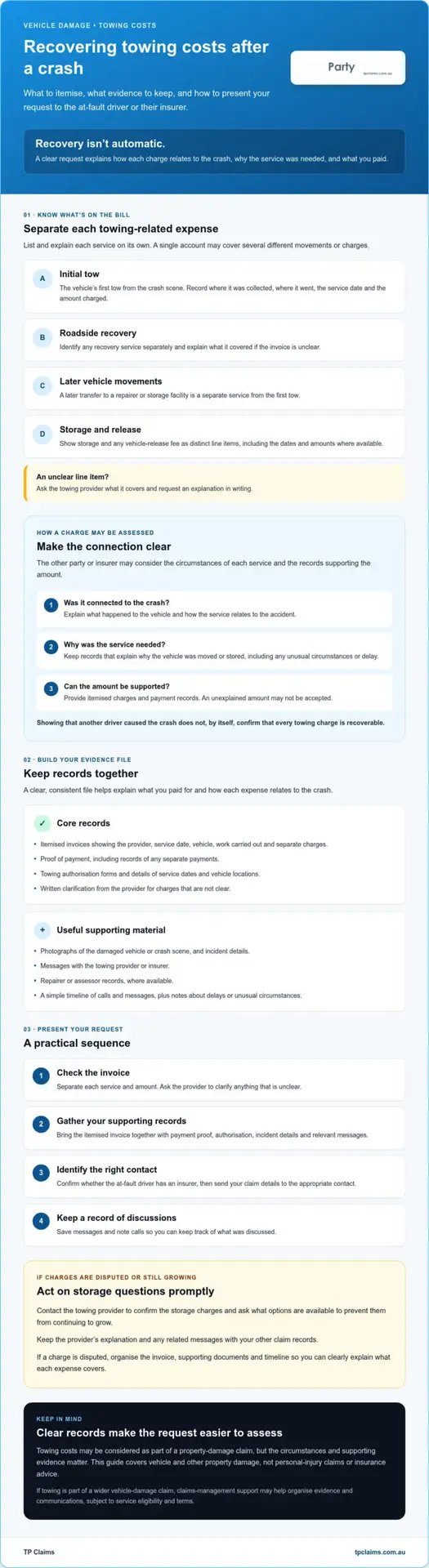
- Separate towing, roadside recovery, storage and release charges so you can explain what each cost covers.
- For recovering towing costs from at fault driver, show how each expense connects to the crash and provide records to support it.
- Confirm whether the at-fault driver has an insurer, then send your claim details to the appropriate contact and keep a record of discussions.
- Contact the towing provider promptly to confirm storage charges and ask what options are available to prevent them from continuing to grow.
- If the towing dispute is part of a wider vehicle-damage claim, consider whether claims-management support would help you organise the next steps.
Recovering towing costs after an Australian car accident: what may be claimed?
An unexpected tow can leave you with a bill before you’ve had time to work out what happens next. You may be unsure whether to approach the other driver, their insurer or someone else. Towing-related expenses can be included for consideration in a property-damage claim, but recovery isn’t automatic. The connection to the accident, the circumstances of each service and the records supporting each charge all matter.
A towing-cost claim is a request to recover reasonable, documented expenses for moving or holding a damaged vehicle after a crash. It may include more than the initial trip from the scene. Depending on what happened, the bill could cover roadside recovery, a later tow to a repairer or storage facility, storage while arrangements are made, or a fee to release the vehicle. List and explain each charge separately rather than treating the bill as one general towing expense.
This section focuses on vehicle and other property damage, not personal-injury claims or insurance advice. The legal basis for seeking compensation can involve negligence principles under Australian tort law, but how those principles apply depends on the facts and relevant jurisdiction. This guide offers general information, not a determination of liability in your situation.
Which towing-related charges should you identify separately?
Check whether the invoice separates the initial tow from roadside recovery, later movements, storage and release charges. For each item, look for the date, service provided and amount. For example, a tow from the crash scene and a later transfer to a repairer are separate services, even if they appear on the same account. If a line item is unclear, ask the towing provider what it covers and request an explanation in writing.
Does the at-fault driver have to pay every towing charge?
Not necessarily. Establishing that another driver caused the crash doesn’t by itself confirm that every amount on a towing invoice is recoverable. The person assessing the claim may consider whether the service was needed, whether the expense relates to the accident and whether the amount is supported by records. Keep documents that explain why the vehicle was moved or stored. Don’t assume an unexplained charge will be accepted.
For recovering towing costs from at fault driver, itemise each expense and explain what happened after the crash. Then gather the records that help the other party or insurer assess the connection and the amount claimed.
What evidence helps support a towing-cost claim in Australia?
Clear, consistent records help the person assessing your claim understand what you paid for and how each expense relates to the crash. An invoice may not explain why the vehicle needed towing, where it went or how long it was stored. Keep the paperwork and incident details together so you can provide a clear account to the at-fault driver or their insurer.
An itemised invoice helps link each towing charge to a specific service, date and vehicle. Keep the original invoice, proof of payment and any towing authorisation form you received. If a charge is unclear, ask the provider to explain it in writing and save their response. This is especially useful when the vehicle was moved more than once or stored for several days.
What should a towing invoice and receipt show?
Check that the paperwork identifies the towing provider, service date, your vehicle and the work carried out. Look for separate entries for the initial tow, any later movement, storage and release. Keep a receipt or other record showing what you paid, including any separate payments. If the invoice only says “towing services”, request an itemised version or written clarification.
How can you show the tow was connected to the accident?
Keep the invoice with records that explain what happened. Note where the vehicle was collected and where it was taken, and save relevant messages with the towing documents. If there was a delay or an unusual reason for moving or storing the vehicle, write down the circumstances while they’re fresh and retain any supporting records.
Use this checklist to organise your file:
- Essential records: itemised invoices, proof of payment, towing authorisation, and details of the service dates, vehicle and locations.
- Useful supporting material: photographs of the damaged vehicle or scene, incident details, messages with the towing provider or insurer, and repairer or assessor records where available.
Save copies in one place and keep a simple timeline of calls, messages, vehicle movements and charges. This can help explain how the costs accumulated and make it easier to spot missing information before you submit your claim. If towing charges are part of a wider vehicle-damage claim and organising the records feels difficult, property-damage claims management may be an option to explore. Clear documents can support recovering towing costs from at fault driver, but they don’t guarantee that every charge will be accepted.
How to pursue towing costs from the at-fault driver or insurer
Once you’ve gathered your records, send a clear request to the right contact. The at-fault driver may have an insurer handling the property-damage claim, or they may be uninsured. Confirm which applies rather than assuming. If there’s an insurer, ask for the relevant claim contact and any reference number. If there isn’t, keep communication with the driver in writing and retain copies of each exchange.
A straightforward claim sequence can help keep things organised:
- Organise your documents: group invoices, proof of payment and relevant accident records together.
- Identify the claim contact: confirm whether you’re dealing with the driver or their insurer, and note any claim reference.
- Submit a clear breakdown: list each towing-related charge and attach the document that supports it.
- Keep a communication record: save what you send and receive, and note dates and names.
This is a practical way to present your request, not a guarantee that every expense will be accepted. For a broader explanation of the process, see this Australian third-party property damage claim guide.
What should you include when you submit towing expenses?
For each charge, state the date, amount, purpose and supporting document. Briefly explain why the vehicle needed towing and where it was taken. If storage or a later transfer appears on the bill, identify it separately and include the relevant invoice or receipt. Keep a copy of the full submission and note when and to whom you sent it, so you can follow up with the right person.
What if the driver is uninsured or disputes the bill?
An uninsured driver doesn’t automatically mean there are no options to pursue a property-damage claim, but the next steps depend on the circumstances. If a charge is challenged, ask which item is disputed and why. Then respond with relevant records, such as the invoice, payment evidence or an explanation from the towing provider. Keep the exchange calm, specific and in writing.
If the towing dispute forms part of a wider property-damage claim, a claims manager may help organise evidence and manage communications. TP Claims manages third-party property-damage claims, including claims involving uninsured drivers. Check eligibility and applicable service terms. For a business vehicle or truck-related matter, see the commercial vehicle accident claims guide. In short, recovering towing costs from at fault driver means setting out the charges, explaining how they relate to the accident, sending supporting records to the appropriate contact and keeping a record of what happens next.
Towing costs disputed or growing? Practical ways to manage the next steps
A disagreement about towing expenses can involve different issues. The other party may dispute who caused the crash, or accept the circumstances but question whether a particular charge was necessary or properly explained. Clarify which issue is being raised. Ask for concerns in writing, then respond to the specific point with relevant records rather than resending the whole file without explanation.
You can manage a straightforward claim yourself if you’re comfortable organising documents, following up and communicating with the driver or insurer. If the towing dispute is part of a broader vehicle-damage claim, claims-management support may help coordinate records and insurer communications. Consider the complexity of your situation and how much support you want when deciding how to proceed.
What can you do if storage charges keep accruing?
Contact the towing provider promptly. Ask for the current amount, how charges are calculated, what payment or release requirements apply, and whether there are options to limit further storage. Request the details in writing and note calls, including the dates and who you spoke with. Don’t assume you can leave the vehicle, move it or withhold payment without checking how that could affect your circumstances.
When might claims-management support be useful?
Support may be useful if you’re finding it difficult to keep records organised, manage insurer communications or respond to disputed expenses. TP Claims manages third-party motor vehicle property-damage claims and insurance negotiations. It isn’t an insurer or a law firm. Check service eligibility and applicable terms before deciding whether support suits your circumstances.
For a heavy-vehicle dispute, the truck collision property damage recovery guide may help you understand the broader claim context. Complaint and dispute pathways can vary between insurers and jurisdictions, so check the insurer’s own complaint process and verify which options apply to your situation.
If you’d like help with a wider property-damage claim that includes disputed towing expenses, explore TP Claims support and review the relevant service terms. Whether you self-manage or seek support, act promptly to understand charges that may continue to accrue. Keep communications clear and retain the records, so you have an organised basis for recovering towing costs from at fault driver without assuming every expense will be accepted.
Choose your next step for recovering towing costs
You’ve already taken an important step by identifying the towing charges and gathering records. Match your next move to the state of your claim. If responsibility for the crash is clear, your records are complete and the charges are explained, send a concise request to the relevant driver or insurer and keep a copy. If liability is unclear, documents are missing or a charge is disputed, ask what information is needed and address each point before deciding how to proceed.
What to do today: a simple towing-cost action list
- Gather towing, storage, release and payment records in one place.
- Write down the accident details, vehicle movements and each provider or insurer you’ve contacted.
- Check that every charge has a date, purpose and supporting document.
- Ask the provider or claim contact to clarify any invoice item or response you don’t understand, and keep their reply.
This organised record helps you explain how each expense relates to the accident. It also makes it easier to see what still needs checking before you pursue recovering towing costs from at fault driver.
What to expect when you seek claims support
A claims manager may help organise documents and manage communications as part of a broader vehicle property-damage claim. TP Claims manages third-party motor vehicle property-damage claims across Australia, including claims involving uninsured drivers and truck collisions. Its claims management is offered on a no-win-no-fee basis, subject to eligibility and applicable service terms. Confirm the service scope, eligibility and terms for your circumstances before proceeding. No particular recovery or outcome can be guaranteed.
For a business vehicle or truck incident, the small business fleet accident claims guide may help you consider the broader property-damage claim. The towing expenses still need to be documented and assessed in context.
If you’d prefer support managing a property-damage claim that includes towing costs, you can discuss your property-damage claim with TP Claims. Start with the records you have, clarify what’s uncertain and choose the next step that fits your situation. Not every charge will necessarily be accepted.
Take the next step with a clearer claim
Recovering towing costs from at fault driver starts with a clear record: identify each charge, keep invoices and payment evidence, and explain how the expense relates to the accident. If the driver or insurer disputes an item, ask what needs clarification and respond with relevant documents. Recovery isn’t guaranteed, and the circumstances of your claim matter.
If towing expenses are part of a wider vehicle-damage claim, you don’t have to manage every conversation alone. TP Claims provides property-damage claims management across Australia, including support with insurer negotiations and claims involving uninsured drivers. Its claims-management service operates on a no-win-no-fee basis, subject to eligibility and applicable terms. Confirm the details for your circumstances.
Discuss your property-damage claim with TP Claims if you’d like to explore support. With your records organised, you can take the next step with greater confidence.
Frequently Asked Questions
Can I recover towing costs from the at-fault driver in Australia?
You may be able to include reasonable, accident-related towing expenses in a property-damage claim, but recovery isn’t automatic. Liability, the need for the tow and the records supporting the charges may all be considered. If the driver has an insurer, you can usually submit the expenses as part of your claim for assessment. If they’re uninsured, other options may still exist, but the appropriate steps depend on your circumstances.
What towing expenses can I include in a car accident claim?
You can ask for accident-related towing expenses to be considered, including the initial tow, roadside recovery, a later vehicle transfer, storage and release charges. List each expense separately and explain what service it paid for. Keep the invoice or other supporting record for each item. Whether a particular charge is accepted depends on its connection to the accident, the circumstances and the evidence you provide.
What evidence do I need to claim towing costs after an accident?
Keep itemised invoices, proof of payment and any towing authorisation form. Include the service dates, vehicle details, where the vehicle was collected and where it was taken. Accident details, photographs, relevant messages and repairer or assessor records may also help explain why the tow was needed. Organise the documents together, and ask the towing provider to clarify any vague invoice item in writing.
Can I claim storage fees as well as towing costs?
You can include storage fees in your request for assessment, but acceptance depends on the circumstances and supporting evidence. Keep records showing the storage dates, charges and reason the vehicle remained at the facility. Contact the provider promptly to confirm whether charges are continuing and what options or requirements apply. Explain how the storage relates to the accident, and don’t assume every amount will be recoverable.
What if the at-fault driver or their insurer refuses to pay towing costs?
Ask for the reason in writing and clarify whether they dispute liability, the need for a service or the amount charged. Respond to the specific issue with relevant records, such as an itemised invoice or an explanation from the towing provider. Keep copies of all communications. If the matter remains unresolved, check the insurer’s complaints process and confirm which further dispute options apply to your circumstances and jurisdiction.
How much towing cost can I recover after a crash?
There isn’t one recovery amount that applies to every Australian crash. Towing charges and applicable rules can vary by state or territory, and the circumstances of the tow matter. A claim may be assessed against the evidence of what service was provided, why it was needed and what was charged. Keep an itemised invoice and check whether local towing rules apply. Don’t assume a charge is recoverable simply because you paid it.
Do I have to pay the towing company before claiming the cost?
Whether you need to pay first depends on the towing provider’s terms and the arrangements made for your vehicle. Don’t assume the at-fault driver’s insurer will pay the provider directly or that a claim decision will arrive before payment is due. Ask the provider about payment, release and storage requirements, and keep invoices and receipts. If you’re unsure how a payment decision may affect you, seek guidance specific to your situation.
Can a business claim towing costs for a truck or fleet vehicle?
A business may include accident-related towing expenses in a third-party property-damage claim, subject to the circumstances and evidence. Keep the vehicle’s towing, storage and payment records, along with incident details and relevant repair or assessment documents. For a truck or fleet vehicle, make clear which vehicle each charge concerns and how it relates to the crash. Claims involving uninsured drivers or complex truck collisions may need additional claims-management support.