
A fleet accident can put a day’s work at risk long after the vehicles leave the scene. Jobs may need rescheduling, deliveries can be delayed, and you’re left coordinating drivers, repairs and insurers. If you’re looking for small business fleet accident claims help, a clear process can protect important evidence and help your business keep moving.
After an accident, it’s common to be unsure what to record, who should manage the claim or how to arrange transport while a vehicle is off the road. This guide sets out practical steps for the immediate response, preserving evidence and keeping records organised across vehicles and drivers. It also explains how a third-party property damage claim works and when external claims management may ease the administrative load.
You’ll also learn how an accident replacement vehicle may fit into your continuity plans, subject to eligibility and applicable terms. A consistent process helps you handle urgent tasks without losing sight of the work your business still needs to do.
Key Takeaways
- Prioritise safety and appropriate emergency assistance, then capture key incident details while they’re fresh.
- Keep one claim file for photos, driver accounts and insurer correspondence. Separate observed facts from later estimates or opinions.
- Compare ways to keep work moving, such as reallocating jobs, using another business vehicle or exploring replacement transport, subject to eligibility and terms.
- The right claim pathway depends on the policies and circumstances involved. Keep a dated record of notifications, assessments and responses.
- Small business fleet accident claims help may reduce the administration and insurer communication you manage. Check the service scope and no-win-no-fee terms before proceeding.
Small business fleet accident claims: what to do first
A vehicle incident creates two immediate demands: look after people at the scene and keep the business running. A simple response order helps drivers and managers avoid rushed decisions. Fleet management includes tasks such as accident management and subrogation, as outlined in this overview of fleet management functions. This section focuses on damage to vehicles and other property, not personal injury claims.
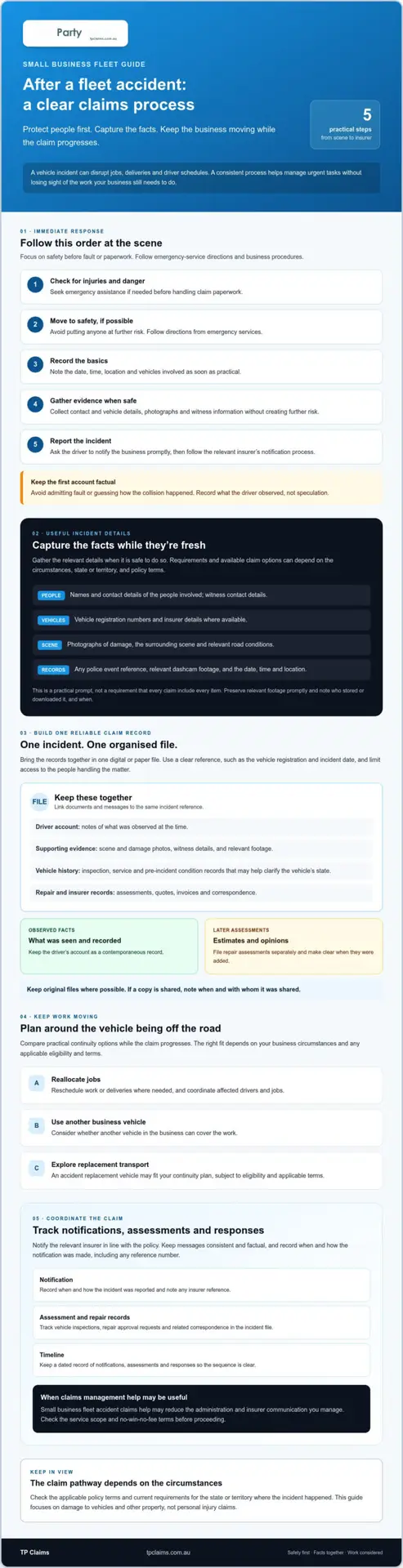
Use this sequence as a practical starting point, then follow emergency-service directions and your business procedures:
- Check for injuries and danger. Seek emergency assistance if needed before handling claim paperwork.
- Move to safety if possible. Follow emergency-service directions and avoid putting anyone at further risk.
- Record the basics. As soon as practical, note the date, time, location and vehicles involved.
- Gather evidence when safe. Collect contact and vehicle details, photographs and witness information.
- Report the incident. Ask the driver to notify the business promptly, then follow the relevant insurer’s notification process.
What should a business do immediately after a fleet vehicle accident?
Keep the first response focused on safety, not fault. The driver should check whether anyone needs help, contact emergency services where appropriate and move to a safe place if that can be done safely. At the scene, avoid admitting fault or guessing how the collision happened. A calm account of what the driver observed is more useful than speculation.
Which details should the driver record?
Once it’s safe, collect the names and contact details of the people involved, vehicle registration numbers and insurer details where available. Photograph the damage, surrounding scene and relevant road conditions without creating further risk. Note witness contact details and any police event reference provided. Record the incident’s date, time, location and vehicles involved while those details are fresh.
How should the business notify the right people?
Set a clear internal step for drivers to report incidents promptly, so the business can gather information before accounts become scattered. Notify the relevant insurer in line with the policy and record when and how you did so, including any reference number. Keep messages consistent and factual. Make clear which details came from the driver’s observations and which are later opinions or repair estimates.
Reporting duties and available claim options can depend on the circumstances and the state or territory. Check current requirements for the incident’s location, as well as the applicable policy terms. If you need small business fleet accident claims help, gathering the initial facts and records can make it easier to assess the next steps.
Build a clear fleet accident claim with organised evidence
After the initial response, bring everything relating to the incident into one file, whether digital or paper-based. A single record helps prevent driver notes, photos, repair documents and insurer messages from becoming scattered across inboxes and devices. Give the file a clear reference, such as the vehicle registration and incident date, and limit access to people handling the matter.
A useful claim record is dated, factual and linked to documents that support each detail. Keep what was observed at the time separate from later opinions or estimates. For example, file the driver’s description of the impact as a contemporaneous account, then keep a repairer’s assessment separately as a later technical opinion. This makes it easier to see what was known, when it was recorded and where each conclusion came from.
What evidence helps explain the collision and damage?
Choose the items relevant to the incident. The checklist below is a practical prompt, not a requirement that every claim must include every item:
- Scene and damage photographs, plus the driver’s notes and witness details.
- Any police event reference and relevant dashcam footage. Preserve footage promptly, and record who downloaded or stored it and when.
- Vehicle inspection, service and pre-incident condition records that may help clarify the vehicle’s state before the collision.
Keep original files where possible. If you share a copy, note when and with whom it was shared.
How should a business organise repair and claim records?
File repair assessments, quotes, invoices and insurer correspondence against the same incident reference. A simple timeline can track when the vehicle was inspected, when repair approval was requested or received, and when it was collected and returned to service. Retain original documents and note when your business received or supplied each one. This makes it easier to check the sequence if accounts of a decision or date differ later.
What business records can help show operational impact?
Record the vehicle’s usual work and the tasks affected while it’s unavailable. Schedules, dispatch records and job logs can help show the operational timeline, including work reassigned or delayed. Keep these records distinct from repair evidence: they describe business impact, not necessarily what another party or insurer must pay. Lost revenue and other consequential losses aren’t automatically recoverable, so internal records alone don’t confirm that a loss is covered.
If sorting documents and insurer correspondence is becoming burdensome, third-party property damage claims management may be an option to explore. Clear records can support the process, but they don’t guarantee a particular claim outcome.
Keep a small fleet operating while the accident claim progresses
A damaged vehicle can disrupt jobs, routes and staff travel, but it doesn’t have to leave the claim process in disarray. Treat business continuity and claim administration as related but separate tasks: keep a clear record of the incident while deciding how to cover essential work. The right option depends on the vehicle, the work it does and what’s available to your business.
How can a business manage vehicle downtime?
Start by identifying which jobs, routes or staff rely on the vehicle. Then compare practical options against the work that must continue. For example, a small van may suit some deliveries but not a job requiring a larger vehicle or specialist equipment.
| Option | When it may suit | What to check |
|---|---|---|
| Reallocate work | Jobs can be moved to another day or assigned to available staff. | Customer commitments, staff capacity and revised schedules. |
| Use another business vehicle | A fleet vehicle has suitable capacity and can be spared. | Vehicle suitability, existing bookings and the impact on other work. |
| Explore replacement transport | Essential work cannot be covered with available vehicles. | Availability, suitability, use conditions, costs and applicable claim terms. |
Record which option you choose and when. Schedules, dispatch notes or job logs can help explain how the business responded, but documenting a decision doesn’t mean its cost or any resulting loss will automatically be recoverable.
When might a replacement vehicle be worth exploring?
Consider the work the damaged vehicle performs, its capacity and any equipment or features needed to complete jobs safely. Before arranging replacement transport, check availability, eligibility, permitted use and who is responsible for costs. TP Claims offers accident replacement vehicles, subject to eligibility and applicable terms. For further detail, see replacement vehicle options for truck drivers.
How can a fleet manager keep the rest of the fleet prepared?
Use the same incident reporting process for every driver and business vehicle, and keep registration, insurance and maintenance records easy to find. After an incident, review whether a recurring operational pattern needs attention. That review can support safety planning, but it shouldn’t be treated as proof of fault in an individual claim.
Keeping continuity steps alongside organised claim records makes small business fleet accident claims help more practical: your business can respond to the incident while staying focused on essential work.
How to coordinate insurers, repairs and disputed fleet claims
Once the initial evidence is gathered, move the claim through a clear sequence: notify the relevant insurer, provide available records, obtain relevant repair assessments, respond to requests and keep a dated log of each step. An insurer’s role and the available claim pathway depend on the policies held and the circumstances of the collision. Check the policy requirements rather than assuming your own insurer or another driver’s insurer will handle every part of the matter.
Clear records help all parties understand the damage, timeline and claim communications. Keep copies of notifications, assessment documents and written responses in the incident file. For broader commercial vehicle context, see this commercial vehicle accident claim guidance.
What if the other driver or insurer disputes responsibility?
Keep communication calm and factual. Respond to specific questions using the evidence available, and distinguish what the driver observed from anything inferred later. If a point is disputed, ask for the reason in writing and save the response with the claim records. Don’t edit original notes or present assumptions as established facts. A disagreement doesn’t, by itself, determine the claim outcome.
What if the at-fault driver is uninsured?
Confirm the other driver’s details and preserve relevant evidence and correspondence. An uninsured driver can make the next steps less straightforward, but it doesn’t automatically mean a property damage claim is recoverable or impossible. The options depend on the facts and any applicable insurance cover. If a heavy vehicle is involved, truck collision property damage disputes provides further context.
How can a business keep the claim moving?
Nominate one person to coordinate updates between the driver, repairer and insurer. Keep an action list with dates for requests, responses, inspections and documents still outstanding. This helps prevent duplicate messages and makes it easier to follow up on the next required step. If you need small business fleet accident claims help, an external claims manager may take on claim administration and insurer communication. Confirm the service scope and applicable terms.
If the matter involves a third-party property damage claim or an uninsured driver, you can ask TP Claims about claims management. For legal rights or a dispute requiring legal interpretation, seek qualified legal advice.
When small business fleet accident claims help may be useful
Not every vehicle incident needs outside support. If the facts are clear, there’s one vehicle involved and a staff member can keep records and follow up without disrupting other work, your business may be comfortable managing the process internally. The decision often comes down to the time and coordination the claim requires, not simply the size of the fleet.
Which claim tasks can a business manage internally?
A designated staff member can maintain the incident file, coordinate updates and track outstanding actions. A consistent internal process may be enough when vehicle downtime is manageable and communications are straightforward. Your business still needs to check its policy requirements, keep its records accurate and respond to requests from relevant parties. Delegating tasks internally doesn’t transfer those responsibilities.
When should a business consider claims-management support?
Consider support if insurer discussions, disputed facts or a growing collection of documents are taking staff away from core work. An external claims manager may take on claim administration and insurer communication, but this doesn’t guarantee a faster decision, an accepted claim or a particular outcome. You’ll also need to provide relevant information and stay involved where your input is required.
Before proceeding, ask what tasks the service covers, what documents or decisions it needs from your business, and how it will keep you updated. Clarify the fee arrangement, including the precise scope and conditions of any no-win-no-fee terms. Don’t assume this means there are no conditions or costs. Confirm the terms before deciding.
What should the business do next?
Start with a secure, organised incident record. Check the applicable policy requirements and follow up on unanswered questions with the relevant insurer or other parties. Then weigh the likely administrative load against the time your staff can reasonably commit. That’s a practical way to decide whether small business fleet accident claims help from an external provider could suit your circumstances.
TP Claims manages third-party property damage claims for businesses, including claims involving uninsured drivers, and negotiates with insurers. If you’d like to explore whether that support fits your situation, discuss TP Claims’ business claim support. Ask about the service scope and terms before deciding whether to proceed.
Take the next step with a clear claim plan
A fleet accident can create pressure on both your claim and day-to-day operations. Keep incident evidence together, track communications and decisions, and choose a practical way to cover essential work while the vehicle is unavailable. These steps give you a clearer view of what’s happening and what needs attention next.
If coordinating paperwork and insurer discussions is taking time away from your business, small business fleet accident claims help may be worth exploring. TP Claims assists individuals and businesses with third-party vehicle property damage claims, managing claims and negotiating with insurers on a no-win-no-fee basis, subject to applicable terms. Ask about the service scope and conditions so you can decide whether the support suits your circumstances.
Talk to TP Claims about managing your business vehicle damage claim. With an organised record and support suited to your needs, you can take the next steps with greater confidence and keep your business moving.
Frequently Asked Questions
What should a small business do after a fleet vehicle accident?
First, check everyone’s safety and contact emergency services if needed. Once it’s safe, record the date, time, location, vehicles and people involved. Take photos of the scene and damage if practical, and collect witness details. Ask the driver to report the incident through your business process, then notify the relevant insurer in line with the policy. Keep claim documents and communications together in one incident file.
Can a small business claim for damage to a fleet vehicle?
A business may have options to claim for vehicle property damage, but the available pathway depends on the circumstances, responsibility, evidence and relevant insurance arrangements. Keep records of the incident, damage, repair assessments and communications to help explain the claim. Don’t assume every cost or business loss will be recoverable. Check the applicable policy requirements, and seek appropriate professional guidance if responsibility or the claim position is disputed.
What information should I collect for a business fleet accident claim?
Record the incident date, time and location, along with the driver and vehicle details. Collect other parties’ names, contact details and registration numbers, plus insurer details or a police reference if available. Keep photos of the scene and damage, witness details, relevant dashcam footage, repair documents and dated communications. A clear record helps show what was observed and how the claim progressed, without relying only on later recollections.
What happens if the at-fault driver has no insurance?
An uninsured driver doesn’t automatically determine whether your business can recover vehicle damage. Preserve the driver’s details, incident evidence, repair information and all relevant correspondence. The next steps depend on the facts, any applicable insurance cover and the processes available for your situation. Don’t assume recovery is either guaranteed or impossible. If you’re unsure how to proceed, seek guidance based on the specific circumstances before making decisions about the claim.
Can my business get a replacement vehicle while its fleet vehicle is repaired?
A replacement vehicle may help keep essential work moving, but availability, suitability, eligibility, costs and how it’s treated in a claim depend on the circumstances and applicable terms. Before arranging one, consider what vehicle the work requires and confirm the conditions of use and who is responsible for charges. TP Claims offers accident replacement vehicles, subject to eligibility and terms. Ask the provider to explain the current conditions before proceeding.
Should a small business manage a fleet accident claim itself?
Your business may be able to manage a straightforward claim internally by assigning one contact, keeping evidence together and tracking insurer and repair updates. If staff time is limited, documents are accumulating or responsibility is disputed, professional claims-management support may be worth considering. Ask what tasks are included, how updates work and what fees or conditions apply. No claims-management service can guarantee a particular outcome, so check the terms before deciding.
Does TP Claims handle small business fleet accident claims?
Yes. TP Claims assists businesses with third-party motor vehicle property damage claims and insurer negotiations, including claims involving uninsured drivers. The firm also offers accident replacement vehicles, subject to applicable eligibility and terms. TP Claims manages claims on a no-win-no-fee basis, but conditions may apply, so confirm the current terms before proceeding. Its services don’t include personal injury claims. Ask TP Claims what support may apply to your incident and business circumstances.