
The biggest truck isn’t always the best replacement. A replacement vehicle for truck drivers needs to keep your actual work moving, whether that means carrying the right load, meeting delivery needs or fitting your operating requirements. While your truck is off the road, the wrong choice can add another layer of disruption.
It’s understandable to focus on getting back behind the wheel quickly. But before you agree to a vehicle or hire arrangement, check that it suits the work you need to do and understand who is responsible for the costs and other terms. What’s available, how long you may need it and whether another party’s insurer may be involved can all depend on the circumstances of the accident and claim.
This guide compares common replacement options and the practical differences to consider, from vehicle type and capacity to day-to-day use. You’ll also find out what details to gather and which claim questions to ask before committing. That way, you can make a more informed choice and protect work continuity as you deal with the next steps.
Key Takeaways
- Match a temporary vehicle to the work it needs to perform, including load, equipment and delivery requirements.
- Compare rigid trucks, prime movers with trailers and other commercial options by practical suitability, not size alone.
- Before arranging a replacement vehicle for truck drivers, gather your truck and job details, expected downtime and relevant documents.
- Check who is responsible for hire costs, how long the vehicle may be needed and what the agreement requires. Expenses aren’t automatically covered in every claim.
- Record the damage, define your work needs and review the terms. Claims support may help manage communication and the property damage process, but doesn’t guarantee a vehicle or claim outcome.
Why a replacement vehicle matters to truck drivers after a collision
A truck off the road can disrupt more than one day’s work. You may miss a job, rearrange deliveries or leave customers and colleagues waiting while the damaged vehicle is assessed or repaired. For an owner-driver, downtime can interrupt the work that brings in income. In a fleet, an employer may need to reorganise vehicles, drivers and schedules to keep jobs moving.
A replacement vehicle is a temporary vehicle used while your damaged truck is unavailable. Arranging transport quickly and establishing who may be responsible for reasonable replacement expenses are separate issues. Whether expenses can be recovered depends on the circumstances, the vehicle’s suitability, the period it’s needed and the relevant claim. Don’t assume that a replacement or its costs will automatically be approved.
How truck downtime can affect a driver or business
For an owner-driver, a substitute may help maintain booked work, but it still needs to suit the jobs you can realistically take on. A fleet or employer may instead decide whether another vehicle can be reassigned, deliveries rescheduled or work shared across the team. In either case, the required replacement period can change as the truck is assessed, repairs progress and the claim develops. Keep a record of the disruption and any updates that affect how long you need transport.
What replacement vehicle for truck drivers means in practice
The right replacement vehicle for truck drivers is defined by the work it can perform, not by whether it looks like the damaged truck. Consider the load, body configuration, equipment, routes and operating needs involved. An ordinary passenger car may help with personal travel, but it won’t necessarily carry goods or perform commercial truck tasks.
A substitute also doesn’t have to be the same make or model. A different configuration may keep essential work moving, while a vehicle that seems similar may not meet the job’s practical requirements. The phrase Commercial motor vehicle offers broad background on commercial vehicles, but the US-focused reference shouldn’t be treated as an Australian legal definition. For your decision, focus on the vehicle and tasks involved in your Australian operation.
Before committing, describe the work the replacement must support and identify what your damaged truck can no longer do. That gives you a clearer basis to compare options and discuss the proposed vehicle, hire terms and likely duration. A suitable arrangement may help limit disruption, but the choice of vehicle and any claim for related expenses need to be considered on their own facts.
Compare replacement truck options by the work they do
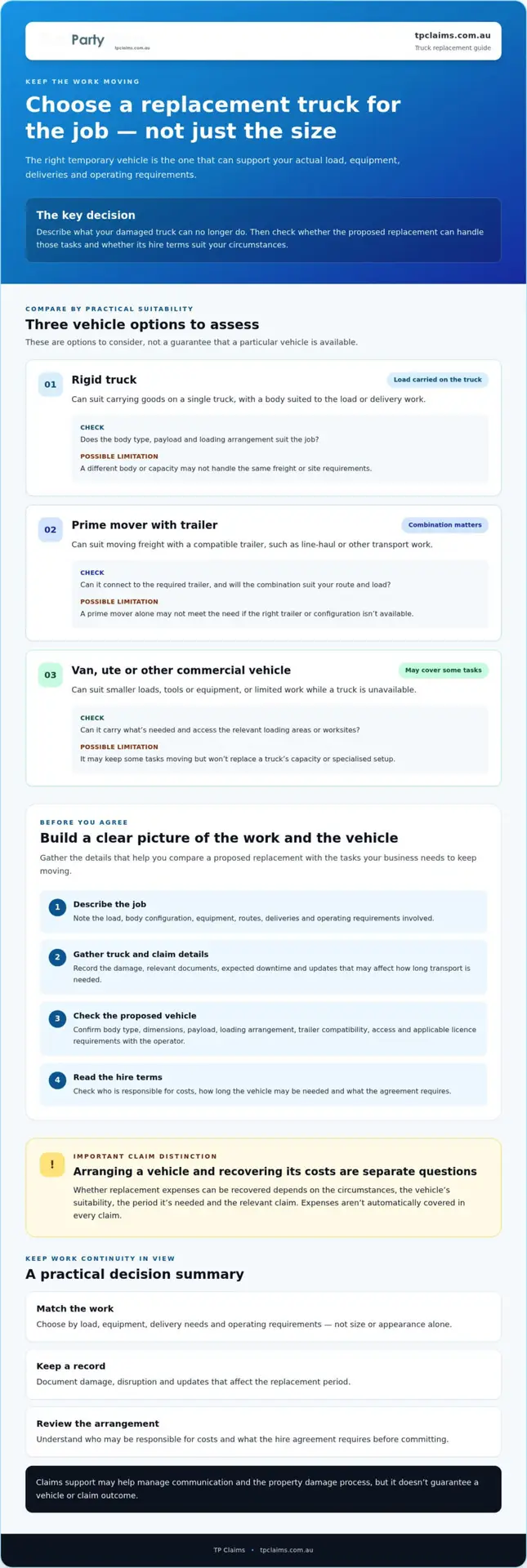
Compare each option against the job, not just the size or appearance of your damaged truck. A substitute may look similar but lack the body, equipment or loading setup your work depends on. The categories below are options to assess, not a guarantee that a particular vehicle is available.
| Vehicle category | Typical task | Questions to ask | Possible limitation |
|---|---|---|---|
| Rigid truck | Carrying goods on a single truck, with a body suited to the load or delivery work. | Does the body type, payload and loading arrangement suit the job? | A different body or capacity may not handle the same freight or site requirements. |
| Prime mover with trailer | Moving freight using a compatible trailer, such as for line-haul or other transport work. | Can it connect to the required trailer, and will the combination suit your route and load? | A prime mover alone may not meet the need if the right trailer or configuration isn’t available. |
| Van, ute or other commercial vehicle | Carrying smaller loads, tools or equipment, or handling limited work while a truck is unavailable. | Can it carry what’s needed and access the relevant loading areas or worksites? | It may keep some tasks moving but won’t replace a truck’s capacity or specialised setup. |
Rigid truck or prime mover: which arrangement fits the job?
A rigid truck carries its load on the vehicle itself. A prime mover is designed to work with a trailer, so it isn’t a direct substitute unless the trailer and connection suit the job. Check whether you need a particular body or trailer, then confirm dimensions, payload and applicable licence requirements with the operator before agreeing to use the vehicle.
Check work equipment, access and operating requirements
List the features your work actually needs. Depending on the task, that could include a tail lift, refrigeration or a specialised body. Check loading methods, site access, customer or contract requirements, and whether the proposed vehicle can meet them. Before use, confirm its registration, insurance, operating conditions and that the driver holds the appropriate licence.
These practical checks help you describe why a particular setup matters when discussing your options. Westfield Insurance’s commercial auto claims process offers a general claims overview, but it’s US-focused and shouldn’t be taken as Australian claims guidance. If you’re weighing vehicle suitability alongside a truck collision claim, you can discuss truck replacement options with TP Claims. Availability and claim outcomes depend on individual circumstances.
What to check before arranging a replacement vehicle
Before you commit, check that the proposed vehicle can handle the work you need to keep moving and that you understand the agreement. A like-for-like truck may not be available, and an identical make or model isn’t always necessary. Focus on functional suitability: can it carry the relevant load, use the required body or trailer, and meet the job’s operating needs?
Use this checklist to organise the key details before discussing options:
- Work needs: Note the jobs, loads, equipment and delivery commitments affected by the damaged truck.
- Vehicle details: Record the truck’s configuration and the features a substitute needs to perform essential tasks.
- Timing: Ask about the proposed start date, expected hire period and what happens if repair timing changes.
- Documents: Gather accident details, repair updates, work schedules and any information that explains why the vehicle is needed.
- Agreement: Get the charges, excesses, permitted use, responsibilities and return conditions in writing before signing.
Replacement arrangements and claim responsibility are separate questions. The agreement sets out what you’re accepting, while whether related expenses may be recoverable depends on the individual claim circumstances. For wider context, read this truck collision property damage dispute guide.
Questions to ask about the replacement vehicle agreement
Check the supplied vehicle’s details, who’s authorised to drive it and what work or travel is permitted. Ask who is responsible for maintenance, breakdowns, tolls, fuel and reporting an incident. Confirm how to request an extension, arrange the return and respond if repairs take longer than expected. Don’t rely on assumptions or verbal summaries; ask for the relevant terms in writing and clarify anything you don’t understand before agreeing.
Evidence to keep while the truck is being repaired
Keep one organised record of the accident details, repair updates, hire agreement, invoices and relevant communications. Note which work the damaged truck was used for, why the proposed vehicle type is needed, and what alternatives you considered. If the repair timeframe changes, save the update and record how it affects the replacement period.
Good records can help explain the decision and allow the claim circumstances to be assessed. They don’t guarantee that hire expenses will be reimbursed. Keeping the paperwork together can, however, make it easier to answer questions about suitability, timing and the terms you accepted.
How claim circumstances can affect a truck replacement vehicle
Arranging a vehicle and recovering its expenses are separate matters. Replacement vehicle expenses aren’t automatically covered in every circumstance, and no single outcome can be assumed from the fact that a collision occurred. Responsibility for the accident, the evidence available, whether the vehicle suited the work, how long it was needed and the agreement terms may all be relevant to an individual claim.
Claim processes and legal requirements can vary across Australia. Don’t rely on a general statement as a rule that applies everywhere. If a specific legal test, time limit or expense recovery rule matters to your situation, have it checked by a qualified professional familiar with the relevant jurisdiction.
Why reasonableness and evidence may matter
A clear record can help explain why you needed a replacement, what work it supported and why that vehicle type was selected. Keep the repair timeline, hire agreement, invoices and updates showing when your truck became unavailable and when its status changed. Note any work requirements the substitute met, such as carrying a particular load or using specific equipment. These documents can help clarify the circumstances, but they don’t guarantee that expenses will be accepted or recovered.
For related process considerations, see this commercial vehicle accident claims guide. It’s still important to check how the details apply to your own claim.
What to do if the other party or insurer disputes the arrangement
If someone challenges the vehicle choice, the period of use or the expenses, ask them to set out the concern and their reasons in writing. Keep your reply factual. Provide relevant information about the replacement vehicle, the work it supported, the damaged truck’s repair progress and the agreement terms. Keep copies of messages and note when key conversations took place.
A disagreement doesn’t, by itself, establish what the claim outcome will be. The not-at-fault replacement car guide offers general context on replacement cars, though a truck’s work requirements can raise different suitability questions.
Choosing a replacement vehicle for truck drivers is only one part of the picture. TP Claims manages third-party property damage claims, insurance negotiations and truck collision disputes, which may help with communications and the property damage process. If you’d like to discuss how your circumstances relate to these issues, contact TP Claims about your truck claim. Any vehicle arrangement or claim outcome depends on the individual circumstances.
A practical next step for truck drivers weighing replacement options
You don’t need to solve every part of the claim before you can take a practical next step. Work through the essentials in order: record the damage, define what work is affected, compare vehicles that could do that work, check the agreement terms, then seek guidance about the claim process. This helps separate the immediate transport decision from questions about responsibility or possible recovery of expenses.
A replacement vehicle for truck drivers needs to suit the tasks you’re trying to keep moving. Be ready to explain the truck’s role and which features matter, rather than relying only on its size or appearance. A suitable option may not be identical to your damaged vehicle, and neither vehicle supply nor recovery of related costs is guaranteed.
Prepare the information needed for an initial discussion
Gather the facts in one place so you can explain the situation clearly. Useful details include:
- Your truck type, the damage and its current repair status.
- Accident details and any claim correspondence you’ve received.
- The work affected, including the loads, equipment or operating features a substitute would need.
- Any replacement arrangement you’ve considered, with written terms and the expected period of use.
If repair timing changes or new information arrives, keep it with your records. A clear summary can make it easier to discuss options and identify what still needs to be checked.
How TP Claims may assist with the next steps
TP Claims manages third-party property damage claims and insurance negotiations, and provides accident replacement vehicles. Its claims management may help with communications and the property damage process, while the suitability of a vehicle, its availability and any claim outcome depend on individual circumstances. Ask about the relevant assessment, agreement terms and your responsibilities before you commit.
If you’d like to talk through your circumstances and possible next steps, discuss your truck accident claim with TP Claims. You can bring the details you’ve gathered and ask what may be relevant to your situation. There’s no need to assume the answer in advance; start with a clear picture of the work affected and the options you’re weighing up.
Choose a replacement that keeps your work moving
The right replacement vehicle for truck drivers is the one that suits the work, not simply the one that looks most like the damaged truck. Check capacity, configuration and operating needs, then read the agreement closely so you understand permitted use, responsibilities and return terms.
Keep records of the damage, repair progress, work affected and any replacement arrangement. They can help clarify the circumstances, but they don’t guarantee that expenses will be covered. Responsibility, vehicle suitability and the time needed may all depend on the individual claim.
TP Claims provides accident replacement vehicles for individuals and businesses, and manages third-party property damage claims and insurance negotiations. The team also assists with complex truck collision disputes. These services don’t guarantee vehicle availability, claim acceptance or recovery, but discussing your circumstances can help you understand the process and possible next steps.
Discuss your truck accident claim with TP Claims and explore the options that may fit your situation. With the right information and support, you can make your next decision with greater confidence.
Frequently Asked Questions
Can truck drivers get a replacement vehicle after an accident?
A replacement vehicle may be an option after an accident, but availability and responsibility for expenses depend on your circumstances. Fault, supporting evidence, the vehicle needed for your work, the agreement and the claim assessment can all be relevant. Don’t assume a particular truck or cost will be accepted. Keep accident, repair and hire records, and get the terms in writing before relying on an arrangement.
What type of replacement vehicle can I use if my truck is damaged?
The best replacement vehicle for truck drivers depends on the work, truck configuration and equipment required. A rigid truck may not suit work usually performed by a prime mover and trailer, while a standard passenger vehicle may not handle commercial tasks. Before agreeing to a substitute, check its capacity, body or trailer arrangement, loading method, site access and operating requirements with the provider and your business.
Who pays for a replacement truck after a not-at-fault accident?
Payment responsibility isn’t automatic, even after an accident where you believe the other party was at fault. It may depend on the claim assessment, available evidence, the vehicle’s suitability and the agreement you accept. Ask what charges apply, who is responsible for them and whether expenses may be considered as part of the property damage claim. Get confirmation in writing, and don’t assume an insurer has approved costs.
How long can I use a replacement truck while mine is being repaired?
The permitted period depends on the vehicle agreement, repair progress and claim circumstances. Ask who to contact if repairs take longer than expected, how an extension is arranged and when the truck must be returned. Keep repair updates and written records of any changes to the arrangement. Don’t assume a replacement will remain available for a particular period; confirm the end date and any extension directly.
Can I use a replacement truck for my usual work?
You can use a replacement truck for your usual work only if its capabilities and agreement allow it. Check its configuration, capacity, equipment, driver permissions and any restrictions before use. If your work involves a trailer, specialised body or particular site access, explain those requirements before accepting the vehicle. Confirm suitability with the provider and your business so you understand what tasks the substitute can and can’t support.
What documents should I keep when using a replacement vehicle?
Keep accident and claim details, the vehicle agreement, invoices, repair updates and relevant communications together. Record why a truck is needed for work, which features the substitute must provide and what arrangement you accepted. These documents can help explain the vehicle choice, timing and claim circumstances if questions arise. They don’t guarantee that an expense will be accepted or recovered, so check the claim position directly.
Can TP Claims help truck drivers with an accident replacement vehicle?
TP Claims provides accident replacement vehicles and manages third-party property damage claims, insurance negotiations and truck collision disputes. The relevant support and vehicle options depend on your circumstances, so confirm details directly rather than assuming a particular truck is available or every situation qualifies. To make an initial discussion more useful, gather your truck details, repair status, work requirements, accident information and any claim correspondence you’ve received.