
What if a damaged work vehicle puts deliveries, staff and your schedule under pressure? After a collision, a commercial vehicle accident claim can involve more than arranging repairs. You may also need to work out who was responsible, which insurer to contact and how to keep jobs moving while the vehicle is assessed.
It’s understandable if the next steps feel unclear. Clear records can help explain what happened and support a property damage claim. Claims management may also ease the work of dealing with insurers. Depending on eligibility and terms, an accident replacement vehicle may help your business maintain continuity while the claim is being processed.
This Australian guide explains the third-party property damage claim pathway, what evidence and records to gather, and the support options available to businesses. It also covers how responsibility, insurance status and repair arrangements can affect the process, and how TP Claims may help manage negotiations. The aim is to help you choose informed next steps and reduce avoidable disruption while your vehicle is off the road.
Key Takeaways
- A commercial vehicle accident claim concerns damage to a business vehicle. The right pathway depends on factors such as responsibility, insurance cover and claim complexity.
- Build a clear record of the collision using dated photos, relevant documents and a timeline. Follow safety and reporting requirements that apply.
- Nominate one person to handle claim communications and keep a dated log to track progress and reduce confusion.
- Consider whether self-managing the claim, contacting an applicable insurer or using third-party claims management best fits your situation.
- Find out whether claims management or, if you’re eligible, an accident replacement vehicle may help while the property damage claim is being processed.
What does a commercial vehicle accident claim cover?
Damage to a work vehicle can quickly disrupt deliveries, scheduled jobs and day-to-day operations. A commercial vehicle accident claim concerns damage to a vehicle used for business, such as a delivery van or a truck transporting goods. For a general description of what is a commercial vehicle, vehicle types and uses can vary. For this guide, the key question is whether the vehicle was being used for business.
This guide focuses on physical vehicle damage and third-party property damage claims. It doesn’t cover personal injury compensation. Who may be responsible, what insurance applies and whether recovery options are available depend on the collision, the evidence and relevant policy terms. Damage alone does not mean a claim will be accepted.
Which commercial vehicles and losses may be involved?
A claim may concern damage to a business car, van, ute, truck or fleet vehicle. The damage could include a dented body panel, broken lights or damage that leaves the vehicle unusable until it’s assessed. These are examples of possible vehicle damage, not a promise that every repair or related expense will be covered.
Keep vehicle damage separate from other effects of a collision. Cargo loss, injury, lost income and other business expenses may involve different processes or considerations. Ask which damage and related expenses can be considered in your claim and what documents are needed to assess them.
How is a property damage claim different from an injury claim?
Property damage concerns physical assets, such as a vehicle. Injury claims concern harm to people and may follow separate rules and processes. If a collision has affected both a vehicle and someone’s health, the property damage pathway will not resolve injury-related questions.
TP Claims manages third-party motor vehicle property damage claims for individuals and businesses, including insurance negotiations. For complex truck collisions, see the truck collision property damage disputes guide. If you have questions about an injury, speak with an appropriately qualified professional. Keep property damage enquiries focused on the vehicle, the collision and the relevant claim process.
What evidence can help support a commercial vehicle accident claim?
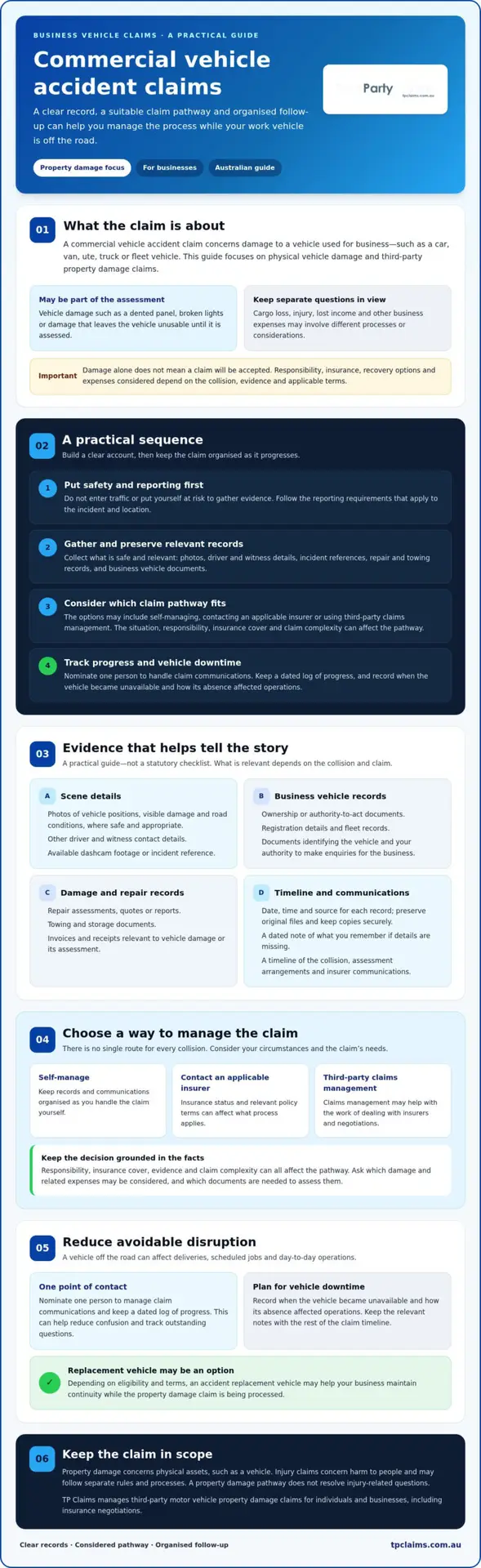
Good records help create a clear account of what happened, what was damaged and how the claim has progressed. Put safety first: don’t move into traffic or put yourself at risk to gather evidence. Follow any reporting requirements that apply to the incident and your location.
Useful evidence may include scene photographs, driver and witness details, incident references, repair and towing records, and relevant business vehicle documents. This is a practical guide, not a statutory checklist. What’s relevant depends on the collision and the claim.
What should you record at the scene and afterwards?
Where safe and appropriate, photograph the vehicles’ positions, visible damage and surrounding road conditions. Collect contact details for the other driver and any witnesses. Note any available dashcam footage or incident reference. Record when and where each item was gathered and who created it. Preserve original files and keep copies in a secure business folder.
If details are missing at the scene, write down what you remember as soon as practical. A dated note can help distinguish your immediate observations from information you receive later.
Which business and repair records may be useful?
Keep documents that identify the vehicle, show your authority to make enquiries on the business’s behalf and describe the damage being assessed. Depending on the situation, useful records may include:
- Vehicle ownership or authority-to-act documents, registration details and fleet records.
- Repair assessments, quotes or reports, plus towing and storage documents.
- Invoices and receipts relevant to the vehicle damage or its assessment.
- A dated record of when the vehicle became unavailable and how its absence affected operations.
Keep the records together and note when they were received or sent. A simple timeline of the collision, assessment arrangements and insurer communications can make it easier to explain the claim and follow up on outstanding questions.
Responsibility, damage and which expenses may be considered depend on the facts and applicable terms. Recording downtime helps show the practical effect on your business, but it doesn’t mean lost income or every expense will automatically be recoverable. Keep supporting documents and ask what information is needed for your claim.
If organising records and insurer discussions is adding to your workload, third-party property damage claims management may be worth considering. An organised evidence file can help support those discussions, but it can’t guarantee a particular outcome.
Which commercial vehicle accident claim pathway suits your situation?
The right route depends on what happened, who may be responsible, the cover in place and the terms that apply. You might self-manage a commercial vehicle accident claim, contact an applicable insurer or use a third-party claims manager. These options aren’t interchangeable: comprehensive cover, third-party cover and a collision involving an uninsured driver can each raise different questions.
Use this comparison to identify what to check, not as insurance advice. Review your policy documents and contact your insurer about its processes where relevant.
| Pathway | Who handles communication? | What to check | Possible limitation |
|---|---|---|---|
| Self-manage | Your nominated business contact gathers records and follows up with the relevant parties. | Evidence, who may be responsible, and which party or insurer to contact. | Chasing updates and organising documents can take staff time, especially if the facts are disputed. |
| Contact your insurer | Your insurer can explain its applicable claim process under your policy. | Cover, excess, notification requirements and relevant policy terms. | The process and implications of making a claim depend on your policy and circumstances. |
| Third-party claims management | A claims manager may coordinate claim information and insurer communication under agreed service terms. | What’s included, what you need to provide, and any fees or conditions. | Suitability depends on the claim, available evidence, responsibility and service terms. |
When might you manage the claim or contact your insurer?
If the damage appears straightforward and someone in your business can organise follow-ups, you may choose to manage communications directly. If you’re considering contacting your insurer, check your policy documents for applicable cover, excesses and notification requirements. Then ask the insurer how its process works. Don’t assume third-party cover and comprehensive cover respond in the same way. The effect of making a claim depends on your specific policy, so confirm the details with your insurer.
When might a third-party claims manager be worth considering?
If another driver may be responsible and you need to pursue property damage, a claims manager may help coordinate information and insurer discussions. This may be relevant if responsibility is disputed, records need organising or the other driver may be uninsured. Before agreeing to a service, ask what work it covers, what records your business must provide, and how fees, conditions and your responsibilities are set out.
For more background, read this guide to third-party property damage claim help. Comparing your options against the facts and policy terms can help you choose a practical next step.
How can a business manage the claim and reduce vehicle downtime?
A clear process helps your team stay organised while the vehicle is assessed and the claim progresses. Nominate one person to coordinate updates, keep a dated claim log and share relevant information with staff who rely on the vehicle.
- Make safety the priority. Check that people are safe, exchange relevant details where appropriate, and follow reporting requirements that apply to the collision and your location.
- Record the incident and notify relevant parties. Note who you contact, when you contact them and what they ask you to do. Save emails, reference details and document copies so the business has a consistent record.
- Arrange assessment and document vehicle movements. Find out how the damaged vehicle should be assessed. Keep repair assessments, towing records, storage documents and invoices. Before arranging towing, storage or repairs, check the relevant policy, insurer or other arrangements to understand any applicable conditions.
- Plan around the vehicle being off the road. List the tasks it normally handles, such as deliveries or equipment transport. Then consider whether another vehicle or a temporary schedule change could help. Record changes to the vehicle’s status in the claim log.
- Track progress and follow up. Note assessment dates, requests for information and confirmed next steps. Update the nominated contact and affected staff when the vehicle’s status changes, using confirmed information rather than assumptions.
As part of continuity planning, ask whether an accident replacement vehicle may be an option while the property damage claim is being processed. Check eligibility, availability and terms for your circumstances. Don’t assume a replacement vehicle will be provided or available by a particular time.
A single contact person and an up-to-date log can reduce crossed wires, keep records together and make follow-ups easier. They won’t determine responsibility or guarantee an outcome, but they help your business track decisions and outstanding information during a commercial vehicle accident claim.
If another driver may be responsible and insurer discussions are taking time away from running your business, third-party property damage claim support from TP Claims may be relevant. TP Claims manages property damage claims and insurance negotiations for businesses. Check the service terms and whether your situation is eligible.
How can TP Claims support a commercial vehicle accident claim?
Once you’ve considered the available pathways, decide whether you want to manage insurer discussions yourself or get help with the process. TP Claims manages third-party motor vehicle property damage claims and insurance negotiations for individuals and businesses. Its work focuses on vehicle damage, not personal injury claims or insurance advice.
Claims management support may reduce the time your business spends coordinating claim information and corresponding with insurers. It doesn’t remove your role entirely: you may still need to provide records, explain what happened and answer relevant questions. The evidence you gather can provide context, but responsibility, claim progress and any outcome depend on the circumstances.
What can claims management take off your plate?
TP Claims manages third-party property damage matters and insurance negotiations, including claims involving uninsured drivers and complex truck collision disputes. Before proceeding, clarify which parts of the claim the service will handle and what your business remains responsible for. No settlement amount, liability decision, claim speed or particular result is guaranteed.
The service is offered on a no-win-no-fee basis, but the specific terms and conditions matter. Ask about client responsibilities and any circumstances that may affect the arrangement, and make sure you understand them before deciding.
What should you ask before choosing claims support?
A short conversation can help you assess whether the service suits your situation. Consider asking:
- What work will you manage, including claim coordination and insurer negotiations?
- Which documents and information must our business provide?
- How will updates be shared, and who should our nominated contact speak with?
- What are the no-win-no-fee terms, conditions and client responsibilities?
- Could an accident replacement vehicle be available while the property damage claim is being processed, and what eligibility requirements and terms apply?
TP Claims provides accident replacement vehicles to eligible clients. Confirm eligibility, availability and terms rather than assuming a vehicle will be available or access is guaranteed.
If you’re considering support for a commercial vehicle accident claim, discuss the collision, vehicle damage and records you have with TP Claims to understand whether its third-party property damage claims management may suit your situation. Review the service terms before deciding.
Take the next step with a clear plan
A well-organised commercial vehicle accident claim starts with a clear record of the collision, the damage and each claim update. Then choose a pathway that fits your circumstances and nominate one person to coordinate communications. This helps your business track progress while considering ways to manage vehicle downtime.
TP Claims manages property damage claims and insurance negotiations for individuals and businesses, including complex truck collision disputes. Its claims management service is offered on a no-win-no-fee basis, subject to terms and conditions, including your responsibilities. Accident replacement vehicles may also be an option, subject to eligibility and applicable terms.
Discuss your commercial vehicle property damage claim with TP Claims to find out whether its support may suit your situation. With organised records and a practical plan, you can take the next steps with greater confidence and keep your business moving.
Frequently Asked Questions
What is a commercial vehicle accident claim?
A commercial vehicle accident claim concerns damage to a vehicle used for business, such as a work ute, delivery van or truck. It focuses on physical property damage, not compensation for injuries. Depending on the circumstances, a business may contact an applicable insurer or pursue a third-party property damage claim. Responsibility, available cover and possible recovery depend on the evidence and relevant policy or service terms.
Can a business claim for damage to a company vehicle if the other driver was at fault?
A business may be able to pursue a property damage claim if another driver was responsible, but the circumstances and supporting evidence matter. Record the collision, vehicle damage and relevant driver details, then check which claim pathway applies. Responsibility may be disputed, and an insurer or claims manager will need to assess the available information. A claim or recovery isn’t guaranteed simply because you believe the other driver was at fault.
What should I do after a commercial vehicle accident?
Prioritise safety, exchange relevant details where appropriate and follow reporting requirements that apply to the incident. If it’s safe, record the vehicles’ positions and visible damage, and keep witness or incident reference details. Notify relevant parties, such as an applicable insurer, and save a dated record of communications. Before arranging repairs, towing or storage, check the arrangements that apply and keep the related documents.
What evidence do I need for a commercial vehicle accident claim?
Useful records may include dated photographs, driver and witness contact details, dashcam footage, incident references and a written account of what happened. Keep vehicle registration, ownership or authority-to-act information, along with repair assessments, towing records and relevant invoices. Preserve original files and note when, where and by whom records were created. The information needed depends on the collision and the claim, so ask what else may be relevant.
Can I claim against an uninsured driver after a commercial vehicle accident?
You may still have a property damage claim to pursue if the other driver was uninsured, but the available options depend on the circumstances and evidence. Keep details that identify the driver and collision, along with records of your vehicle’s damage and assessment. TP Claims manages third-party property damage claims involving uninsured drivers. This doesn’t guarantee a particular outcome, so confirm whether the service fits your situation and what terms apply.
Can my business get a replacement vehicle while the damaged one is being repaired?
An accident replacement vehicle may be an option while a property damage claim is being processed, but eligibility, availability and applicable terms need to be confirmed. Don’t assume a replacement will be provided or available by a particular date. Ask what conditions apply, what information your business must supply and how vehicle use is handled. Meanwhile, consider which work tasks need cover and keep a record of the damaged vehicle’s status.
What does no-win-no-fee mean for a commercial vehicle property damage claim?
No-win-no-fee describes a claims management arrangement, but the exact meaning depends on its written terms and conditions. Before agreeing, ask what happens if the claim doesn’t succeed, whether any other responsibilities or costs may apply, and what your business must do during the process. Check that you understand the arrangement and any circumstances that could affect it. TP Claims offers claims management on this basis, subject to applicable terms and conditions.