
You’ve spent days gathering evidence, getting repair quotes, and carefully drafting a formal notice, only to be met with total silence. It feels like the at-fault driver is simply waiting for you to give up while your repair bills sit on the kitchen bench. If the frustrations of your letter of demand being ignored after a car accident are keeping you up at night, you aren’t alone in feeling powerless. It’s a common tactic used to avoid accountability, but silence doesn’t mean your claim has reached a dead end.
We understand how exhausting it is to navigate the legal system while trying to manage your daily life without a functional vehicle. You shouldn’t have to bear the burden of someone else’s mistake or spend your lunch breaks chasing an unresponsive driver. This guide from TP Claims shows you exactly how to escalate the situation and recover your costs without the stress. We will explore the latest 2026 court thresholds, the legal triggers that follow an ignored demand, and how a professional advocate can take over the headache so you can get your car repaired and move on.
Key Takeaways
- A letter of demand is your final formal notice before legal action, making it a critical piece of evidence for Australian courts and tribunals.
- If your letter of demand ignored car accident frustrations continue past 14 days, you must verify delivery and prepare a final notice of intent.
- Silence from the other driver often stems from stalling tactics or being uninsured, but these hurdles shouldn’t stop you from recovering repair costs.
- Professional claims management can remove the stress of the process by handling all negotiations and paperwork on your behalf.
- You can access a replacement vehicle to stay on the road while experts force the at-fault party or their insurer to finally respond.
Understanding the Letter of Demand in Australian Car Accident Claims
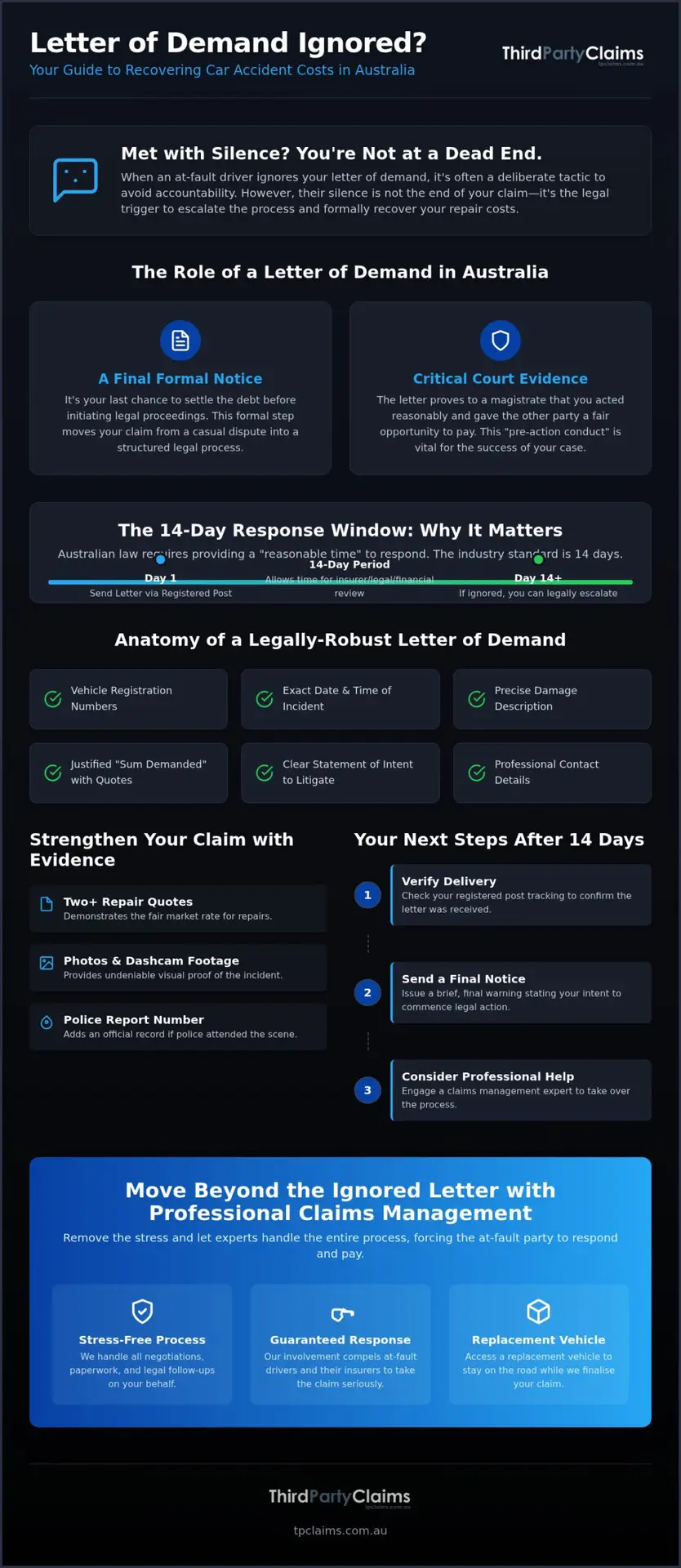
A Demand letter is the final formal step you take before initiating legal proceedings in an Australian court or tribunal. Think of it as a clear line in the sand. It moves your claim from a casual conversation about repair costs into a structured legal process. By sending this document, you are giving the at-fault driver one last chance to settle the debt without the added pressure of a court date. It’s a professional way to say that you’ve been patient, but now you require a resolution.
When a letter of demand ignored car accident situation occurs, the document itself becomes your most important piece of evidence. It proves to a magistrate that you acted reasonably and gave the other party a fair opportunity to pay. If you are struggling with a letter of demand ignored car accident case, remember that this silence is actually a procedural trigger for your next move. In the eyes of the law, this “pre-action conduct” is vital. If you skip this step and go straight to court, you might find yourself being penalised on costs, even if you win the case.
The Legal Weight of Your Demand
A well-drafted demand sets the tone for everything that follows. While a friendly text message or phone call might feel easier, they lack the colour and authority required for litigation. A formal demand clearly outlines the date of the accident, the rego of the vehicles involved, and the specific amount you are claiming based on independent quotes. This shifts the burden onto the at-fault party. Courts look favourably on claimants who follow this process because it shows a commitment to resolving disputes outside of an already crowded legal system. It transforms your request from an opinion into a documented debt.
Why 14 Days is the Industry Standard
You might wonder why you can’t demand payment within 24 hours. Under Australian property damage law, you must provide a “reasonable time” for the other party to respond. In the insurance and legal industry, 14 days is the accepted benchmark for what is considered reasonable. This window allows the at-fault driver to speak with their insurer, check their bank balance, or seek their own legal advice. It ensures that if the matter does escalate, the other party cannot claim they were blindsided or rushed into a decision.
If the driver is uninsured, this period is even more critical. They may need time to realise that the debt isn’t going away and that they need to find the funds for your repairs. Always send your letter via registered post so you have a verified record of the delivery date. This timestamp is the starting gun for your next steps. If that 14-day mark passes without a word, the law considers that you have exhausted all reasonable avenues for a friendly settlement.
Essential Components of a Letter of Demand for Property Damage
If you find your letter of demand ignored car accident situation is becoming a reality, the first thing to check is whether your document was legally robust. A vague request for money won’t stand up in court. Your letter must include the registration numbers of all vehicles involved, the exact date and time of the incident, and a precise description of the damage. This leaves no room for the other driver to claim they didn’t know which accident you were referring to. It’s about creating a paper trail that is impossible to dispute.
When making a claim, the “sum demanded” must be justified by facts, not guesswork. This means attaching independent repair quotes from a reputable smash repairer. You also need to state your intent to litigate clearly. Phrases like “I reserve the right to commence legal proceedings without further notice” show that you are serious. While you need to provide contact details, using a dedicated email address or a postal box can help you stay professional without opening your personal life up to potential harassment from an aggressive driver.
Supporting Evidence You Must Attach
It’s best practice to attach at least two professional repair quotes to show the market rate for the work. If the at-fault driver sees a single, high quote, they might think you’re overcharging. Photos of the accident scene, dashcam footage, and the vehicle damage provide visual leverage that is hard to ignore. If the police attended the scene, always include the police report number. This evidence forces the other party to acknowledge the reality of the situation rather than hoping the problem will just go away.
Drafting the ‘Statement of Claim’
Your account of the accident should be a concise, factual summary. Avoid emotional language or blame-shifting that could weaken the demand. Instead of saying “The driver was reckless,” state “The vehicle failed to stop at the give-way sign.” This professional approach makes it harder for insurers to find loopholes. Ensure you send the demand to the driver’s correct service address via registered post. If this feels like too much paperwork, you can always have experts handle the claim process for you, ensuring every legal box is ticked from the start.
Why Do At-Fault Drivers Ignore Letters of Demand?
It’s incredibly frustrating when you’ve done the right thing, yet your letter of demand ignored car accident worries continue because the other party won’t pick up the phone. Many at-fault drivers believe that by ignoring your formal notice, the claim will simply vanish into thin air. This “head in the sand” approach is particularly common among those who don’t have insurance. They might feel overwhelmed by the potential costs or mistakenly believe that silence protects them from legal repercussions. In reality, they are often unaware of the serious consequences of ignoring a letter of demand, which can include court-ordered costs and interest on top of the original repair bill.
Sometimes, the silence isn’t coming from the driver, but from their insurance provider. When a driver receives your letter, they usually pass it straight to their insurer. If that insurer is currently facing a high volume of claims or is attempting to stall for time, you might hear nothing for weeks. This isn’t just bad luck; it’s often a calculated tactic to see if you’ll give up or accept a lower settlement just to end the stress. They might also be hoping you aren’t aware that in most Australian states, you have a six-year statute of limitations to pursue property damage. They use silence to drain your energy, not because they have a legal right to ignore you.
Dealing with Uninsured Third Parties
Claiming against an uninsured driver adds a layer of complexity to an already stressful situation. Often, the lack of a response is a sign of financial distress. The driver knows they are at fault but simply doesn’t have the funds to cover your smash repairs. However, their financial situation doesn’t erase your right to be made whole. If you are in this position, it’s vital to understand the specific pathways available for recovery. You can learn more about this in our guide on How to Claim Against Someone Without Insurance: A 2026 Australian Guide.
When the Insurer is the One Ignoring You
If an insurer is the one being unresponsive, they might be testing your patience. They are experts at the “waiting game,” but you don’t have to play by their rules. Before moving to court, you might consider the Internal Dispute Resolution (IDR) process, which forces the insurer to review your case within a set timeframe. Don’t let their stalling tactics convince you that your claim is weak. Many common beliefs about why drivers don’t have to pay are actually false. For more clarity, check out Driver at Fault Refused to Pay Repairs? 5 Myths Debunked for 2026 to see how to counter these excuses.
Next Steps: What to Do When Your Letter is Ignored for 14 Days
You’ve waited the standard 14 days and heard nothing. It’s a frustrating spot to be in, but this is exactly where your strategy needs to sharpen. A letter of demand ignored car accident situation doesn’t mean your claim is dead; it just means the at-fault party is testing your resolve. Your first move is a simple administrative check. Log onto the Australia Post website and verify that your registered letter was actually delivered. If you have that signature on file, you have the proof needed to show a court that the other driver is intentionally being uncooperative.
Once receipt is confirmed, you need to begin gathering every scrap of evidence for a potential filing. This includes your repair quotes, accident scene photos, and any dashcam footage. You are building a case that shows you have been proactive while the other party has been negligent. At this point, you must evaluate the cost-benefit of your next move. Filing for a court hearing involves fees and significant time, so deciding whether to push forward alone or seek professional help is a critical crossroads.
The Final Notice: Your Last Warning
Before jumping into a courtroom, send a “Notice of Intent to Claim.” This is a shorter, sharper document giving the driver a final seven days to pay before you take further action. Keep this communication strictly in writing. While it’s tempting to call the driver and demand answers, a phone call leaves no record and can lead to heated confrontations. If they do pick up and offer you a settlement that is far too low, don’t feel pressured to accept it. You are entitled to be returned to the position you were in before the accident. If the letter of demand ignored car accident silence continues after this seven-day warning, you have officially exhausted all reasonable pre-court steps.
Small Claims Court vs. Professional Advocacy
At this stage, you face a choice. You could file a claim in your state’s small claims division, such as the Local Court in NSW or QCAT in Queensland. However, self-representation often comes with hidden costs. You’ll need to pay filing fees, spend hours researching rules of evidence, and potentially take time off work to attend hearings. In 2026, court backlogs remain a reality, meaning your car could stay damaged for months while you wait for a hearing.
Many drivers find that professional advocacy is a much faster, less stressful path. A claims manager can often bypass the court queue by negotiating directly with insurers or using legal leverage that an individual simply doesn’t have. This is especially useful in complex cases involving uninsured drivers. To understand how this works, read our guide on The Uninsured Third Party Claim Process: A 2026 Australian Guide. If you want to stop chasing an unresponsive driver and get back on the road, you can get professional help with your claim today and let experts handle the headache for you.
Professional Claims Management: Moving Beyond the Ignored Letter
Dealing with a letter of demand ignored car accident situation on your own is exhausting. You’ve followed the rules, sent the registered mail, and waited the required fortnight, only to be met with a wall of silence. This is where TP Claims steps in as your dedicated ally. We take the entire claims management process off your hands, shifting the burden of chasing an unresponsive driver or a stalling insurer from your shoulders to ours. This managed experience removes the stress of the legal system entirely. Our team understands that your time is valuable, and you shouldn’t have to spend it arguing with people who are intentionally ignoring you.
Professional negotiation usually results in much faster settlements than DIY attempts. Insurers and third parties often ignore individuals because they assume you won’t follow through with legal action. When a specialist firm takes over, the dynamic changes instantly. Our expert insurance negotiation services are designed to cut through the red tape that insurers use to delay payments. We use proven strategies to force a response, ensuring your repair costs are covered without you having to set foot in a courtroom. It’s about levelling the playing field and making sure you aren’t bullied into a lowball settlement or left with a damaged car and no way to fix it.
Why Choose a No-Win-No-Fee Specialist?
Choosing a no-win-no-fee specialist eliminates the financial risk that often comes with pursuing a claim. Unlike traditional law firms that might charge high hourly rates just to send a follow-up letter, our model ensures our interests are perfectly aligned with yours. We speak the “language” of insurance companies, navigating their complex internal dispute resolution processes with ease. This professional advocacy provides peace of mind, knowing that an expert is fighting for your fairness while you focus on getting your life back to normal. We handle the heavy lifting so you don’t have to.
Staying Mobile with an Accident Replacement Car
One of the biggest stresses after an accident is being stuck without a vehicle while the claim is being organised. We believe you shouldn’t be penalised for an accident that wasn’t your fault. That’s why we provide accident replacement vehicles to keep you mobile. We work to ensure the at-fault party’s insurer covers the cost of your hire car, so you aren’t left out of pocket. This seamless experience means your daily routine isn’t interrupted by someone else’s negligence. It is a practical solution to a chaotic situation. Let TP Claims handle the silence-contact us for a no-win-no-fee consultation today.
Take Back Control of Your Recovery
Dealing with a letter of demand ignored car accident situation is incredibly draining, but it doesn’t have to be your burden alone. You’ve learned that silence is often a stalling tactic and that having the right evidence is your strongest leverage. Whether you’re facing an uninsured driver or a stubborn insurance company, you have clear legal pathways to ensure you aren’t left out of pocket. Silence from the at-fault party is simply a signal that it’s time to escalate your approach with professional support. You have done the right thing by following the formal process; now it is time to ensure that effort results in a fair outcome.
You don’t need to navigate the stress of the legal system or chase unresponsive third parties yourself. Our expert property damage specialists are here to handle the entire negotiation process for you. We provide accident replacement vehicles to keep you on the road and operate on a no-win-no-fee basis, so you can pursue fairness without any financial risk. It’s time to stop the guesswork and start moving toward a resolution that gets your car repaired and your life back on track.
Start your no-win-no-fee claim with TP Claims today and let us turn that silence into a successful settlement. You deserve a partner who fights for your rights while you focus on what matters most.
Frequently Asked Questions
How long should I wait after sending a letter of demand before taking action?
You should generally wait 14 days before taking your next formal step. This is considered a reasonable period under Australian law for the other party to seek advice or contact their insurer. If your letter of demand ignored car accident frustrations continue past this point, you can escalate to a final seven-day notice or commence legal proceedings. Moving too quickly can sometimes be viewed unfavourably by a magistrate if the matter eventually reaches a hearing.
What happens if the letter of demand is returned to sender?
If a letter is returned, it usually means the driver has moved or provided an incorrect address. You must verify the service address provided at the accident scene or check the police report for the most current details. If they are intentionally avoiding service, you might need to hire a process server or seek a court order for substituted service. Having a professional handle these administrative hurdles ensures your claim stays on track despite their avoidance.
Can I still claim if the at-fault driver has no insurance and ignores my letter?
Yes, you can absolutely still make a claim. An at-fault driver is personally liable for the damage they cause, regardless of their insurance status. If they ignore your letter, it often indicates they are overwhelmed by the potential debt. We specialise in managing claims against uninsured parties on a no-win-no-fee basis. We handle the difficult negotiations and chase the payment so you don’t have to deal with the stress of their silence.
Do I need a lawyer to take someone to the small claims court for a car accident?
You aren’t required to have a lawyer in the small claims division, as these courts are designed for individuals to represent themselves. However, the process involves significant paperwork, filing fees, and strict rules of evidence that can be overwhelming. Many drivers find that using a professional claims management service is a more efficient alternative. It allows you to bypass the court backlog while experts handle the complex negotiations with the at-fault party on your behalf.
Will my own insurance company help me if the other driver ignores my demand?
Your own insurer will only assist if you hold a comprehensive policy. In that case, they may pay for your repairs and then recover costs from the other driver. If you only have third-party property damage insurance, your insurer generally won’t help you recover costs for your own vehicle. This is where a dedicated claims management firm becomes a vital ally, providing the advocacy you need to force a response from the unresponsive party.
What is the maximum amount I can claim in a letter of demand for property damage?
The maximum amount depends on the specific court or tribunal thresholds in your state. For example, the Small Claims Division in the NSW Local Court handles matters up to A$20,000, while Western Australia’s minor case limit is A$10,000. You should claim the full cost of repairs based on professional quotes, plus any associated losses like an accident replacement vehicle. If the value exceeds these limits, your case may move to a higher court division.
Is a letter of demand sent via email legally valid in Australia?
Sending a demand via email is legally valid in Australia, but it can be harder to prove the recipient actually opened the message. To ensure your evidence is ironclad for court, we always recommend using registered post. This provides a physical signature and a clear date of delivery. If you do use email, ask for a read receipt and follow up with a hard copy if you don’t receive a response within a few days.
Can TP Claims help if the at-fault driver is a truck or commercial vehicle?
Yes, we manage complex truck collision disputes and commercial vehicle claims. Accidents involving heavy vehicles often involve different insurance layers and corporate entities, making them harder to resolve than standard car claims. If your letter of demand ignored car accident issues involve a commercial operator, our team has the expertise to navigate their specific insurance requirements. We ensure these larger entities are held accountable for your repair costs and keep you mobile throughout the process.