
A driver’s refusal to pay is legally irrelevant to their liability; with the right advocacy, their cooperation is completely optional. It is incredibly stressful when a driver at fault refused to pay repairs, especially when you are left staring at a damaged car and wondering if the bill will have to come out of your own pocket. You might feel overwhelmed by the silence or confused by talk of letters of demand and liability, but you don’t have to face this alone. We know how heavy this burden feels, and we’re here to help you navigate the process with ease.
This guide reveals your legal rights and the exact steps you can take to recover every cent of your repair costs, regardless of how stubborn the other driver is being. We will debunk five common myths that often prevent Australians from getting the justice they deserve in 2026. You’ll learn how to compel payment and get your car back to its original state without the headache of handling the negotiations yourself. Our goal is to move you from a place of anxiety to total confidence, ensuring your vehicle is restored while we handle the difficult conversations on your behalf.
Key Takeaways
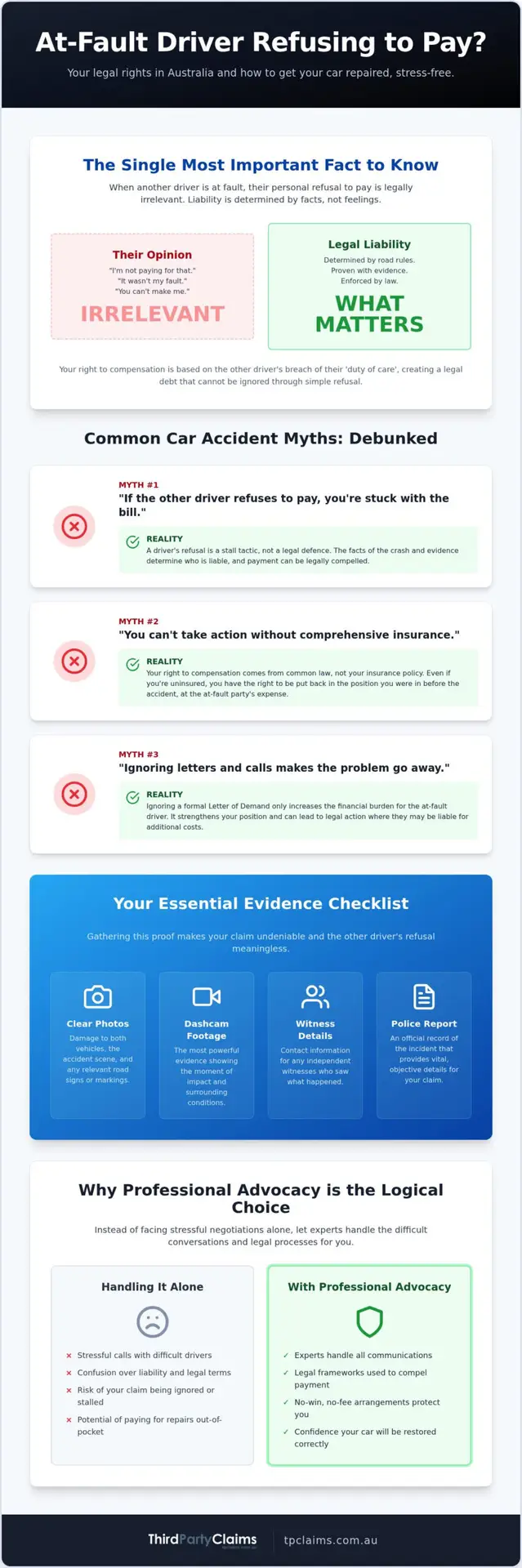
- Realise that a driver’s personal refusal doesn’t override their legal liability, as the facts of the accident determine who pays, not their opinion.
- Discover how to exercise your common law rights to have your car repaired at no cost, even if the driver at fault refused to pay repairs or ignores your claim.
- Learn why ignoring a formal Letter of Demand only increases the financial burden for the at-fault party and how this legal tool protects your interests.
- Get a clear, actionable checklist for collating evidence and professional quotes to ensure your claim is managed effectively from the start.
- Understand how professional negotiators can handle the stress of dealing with difficult drivers and insurance companies through a no-win-no-fee arrangement.
Myth #1: If the Other Driver Refuses to Pay, You’re Stuck With the Bill
It’s a sinking feeling when you’ve been hit, the other person was clearly in the wrong, but now they’re ghosting you or flat-out telling you they won’t pay. We understand how much stress this adds to an already difficult situation. You might think that if the driver at fault refused to pay repairs, the financial burden automatically falls on you. This is simply not true. A personal refusal isn’t a legal get-out-of-jail-free card. In reality, their cooperation is entirely optional when it comes to settling the debt they owe you.
Liability is determined by the facts of the crash, not by how loud or stubborn the other driver chooses to be. Often, a refusal is just a stall tactic. They hope that by being difficult or intimidating, you’ll simply give up and go away. When you have the right evidence, their opinion becomes irrelevant to the legal outcome. You have rights that protect you from being bullied into paying for someone else’s mistake.
Why ‘I won’t pay’ isn’t a legal defence
Every person behind the wheel in Australia has a ‘duty of care’ to other road users. This means they’re legally required to drive in a way that avoids causing damage or injury. When someone breaches a road rule, such as failing to give way or rear-ending your vehicle, they’ve breached that duty. This breach creates a legal debt. Whether they have a comprehensive policy or are completely uninsured, they’re still personally responsible for the costs of your repairs. Their insurance status doesn’t change their personal liability to you.
The difference between ‘not at fault’ and ‘not liable’
You need to understand that their attitude doesn’t change the legal reality of the situation. Liability is the legal obligation of one party to compensate another for losses caused by their actions or negligence. Even if the driver is being aggressive or dismissive, the insurance claim process or a formal legal demand can move forward without their permission. Our team knows how to bypass a stubborn driver by dealing directly with their insurer or using legal frameworks to compel payment, taking that weight off your shoulders.
To make their refusal meaningless, you should gather as much proof as possible to support your position:
- Clear photos of the damage to both vehicles and the accident scene.
- Dashcam footage that shows the moment of impact and the surrounding traffic conditions.
- Contact details for any independent witnesses who saw what happened.
- A police report number, which provides an official record of the incident and can be vital if the driver at fault refused to pay repairs.
With these facts in hand, you aren’t just asking for payment; you’re proving a legal debt that cannot be ignored. Professional advocacy ensures these facts are presented clearly to the right people, moving the process forward while you get back to your daily life.
Myth #2: You Can’t Take Action Without Comprehensive Insurance
A common misconception among Australian drivers is that you need a comprehensive insurance policy to chase someone for damages. Many people believe that if they only have third-party property cover, or no insurance at all, they’re simply out of luck. This is completely false. Your right to compensation doesn’t come from your insurance policy; it comes from the law. You have a fundamental common law right to be “put back in the position you were in” before the accident occurred.
This means the person who caused the damage is legally responsible for the bill, regardless of whether you have a big insurer backing you up. If you find yourself in a situation where a driver at fault refused to pay repairs, you aren’t stranded. Managed recovery services exist specifically to help not-at-fault drivers who don’t have the luxury of a comprehensive policy to do the heavy lifting for them.
Your rights as an uninsured not-at-fault driver
When you’re not at fault, the other driver is responsible for all your “reasonable” repair costs. Because you aren’t making a claim on your own policy, you don’t have to worry about paying an excess or losing your no-claim bonus. You can even claim against someone without insurance effectively if they were the ones who caused the bingle. While state insurance regulations and guidelines often focus on what policies must cover, they also affirm the basic responsibility of drivers to pay for the damage they cause to others.
Why your insurer might not help (and who will)
If you have third-party insurance, your provider generally only covers the damage you cause to others. They often won’t lift a finger to help you recover costs for your own car. Even some comprehensive insurers might decline to chase a third party if the repair amount is small, as it may not be “commercially viable” for them. This is where a specialised firm becomes your best ally. We manage the uninsured third party claim process from start to finish. Our no-win-no-fee model ensures that every driver has access to justice, providing the professional negotiation skills needed when a driver at fault refused to pay repairs. If you’re feeling stuck, you can check your eligibility for a managed claim to see how we can take the burden off your shoulders.
Myth #3: Ignoring Letters and Calls Makes the Problem Go Away
Many drivers believe that if they simply stop answering their phone, the problem will eventually vanish. This is a common tactic when a driver at fault refused to pay repairs, but it is a strategy built on a shaky foundation. In reality, staying silent doesn’t pause the clock; it actually accelerates the legal consequences. When a driver ignores your legitimate claim, they are often inadvertently opening the door for increased costs. These can include legal interest and court filing fees, which are eventually added to the original repair bill. You’ve likely already followed the standard steps for What to Do After a Car Accident, so don’t let their silence discourage you from the final step of recovery.
By shifting the conversation from a personal request to a formal legal demand, you change the power dynamic. You are no longer asking for a favour; you are asserting a legal right. This psychological shift is vital. It shows the other party that you are serious and that their silence has a real, mounting price. We see this often. Once a driver realises that ‘ghosting’ won’t stop the process, they often suddenly find the time to engage or pass the matter to their insurer.
The power of a formal Letter of Demand
A Letter of Demand is a critical document that sets out the facts of the accident, the exact amount owed, and a deadline for payment. Under Australian standards, this letter must be clear and concise. While you can write one yourself, a letter from a professional claims management firm carries significantly more weight. It signals that you have expert advocacy on your side. This is particularly effective when a driver at fault refused to pay repairs initially, as the formality of the document often breaks their resolve. Typically, we provide a 14-day window for the other party to respond. If that window closes without a satisfactory answer, it provides the necessary evidence that you have made a reasonable attempt to settle before escalating the matter to a tribunal or court.
When the at-fault driver is ‘untraceable’
It’s a common fear that if a driver provided false details or has moved house, your claim is dead in the water. However, professional investigators and claims managers have tools to locate evasive individuals through skip-tracing and database access. We can even utilise ‘substituted service’, which allows legal documents to be served via email or even social media if a person is intentionally hiding. You should never feel helpless just because someone is being slippery. You can still recover car repair costs from the at-fault driver by using a team that knows how to track down the necessary details for service. We handle the investigation so you don’t have to play detective.
What to Do When Negotiations Stall: A Practical Checklist
When the at-fault party stops responding to your emails or hangs up the phone, the path forward can feel like a dead end. It is a common frustration, but this is the moment to stop “asking” for cooperation and start “documenting” for recovery. If a driver at fault refused to pay repairs, your next move is critical to ensure you aren’t left out of pocket. We’ve seen hundreds of cases where a stubborn driver suddenly changes their tune once a structured, professional process begins.
Follow this checklist to regain control of the situation:
- Step 1: Collate all evidence, including the police report number if one was issued at the scene.
- Step 2: Obtain a professional repair quote from a reputable panel beater that clearly outlines the scope of damage.
- Step 3: Organise an accident replacement vehicle so your life doesn’t grind to a halt while your car is off the road.
- Step 4: Issue a final notice that clearly states your intention to commence formal recovery proceedings if the debt isn’t settled.
- Step 5: Engage a specialised advocate to handle the heavy lifting and stressful negotiations on your behalf.
Staying mobile with an accident replacement car
You shouldn’t be punished for someone else’s mistake by losing your mobility. Under Australian law, you have a right to a “like-for-like” replacement vehicle while your own car is being repaired or assessed. This means if you drive a family SUV or a delivery van for your business, you’re entitled to a similar vehicle to maintain your daily routine. The cost of this hire car is considered part of your loss and is added to the claim against the at-fault driver. This is a crucial right for families and small business owners who cannot afford to be without transport, yet many people don’t realise it’s available to them even when a driver at fault refused to pay repairs.
Gathering ‘bulletproof’ evidence
To dismantle a driver’s refusal, you need evidence that leaves no room for debate. Start with date-stamped photos of both vehicles and the accident scene from multiple angles. If there were no witnesses, don’t worry; the physical evidence often tells the real story. A professional assessment report can be a powerful tool here. It provides an expert, independent analysis of the impact, which can prove exactly how the accident happened. This level of detail makes it nearly impossible for the other driver to maintain a false version of events. If you’re ready to stop the back-and-forth and get your car fixed, you can start your claim with us today and let our team manage the recovery for you.
Why Professional Advocacy is the Logical Choice for Not-at-Fault Drivers
Most people feel terrified at the thought of entering a courtroom or filing a formal statement of claim. While some government services offer dispute resolution, these paths are often slow and require the other party to have insurance to be truly effective. When a driver at fault refused to pay repairs, you shouldn’t have to become a legal expert overnight just to get your car back on the road. Professional advocacy bridges the gap between your right to compensation and the complex system that often stands in the way.
A professional firm acts as your dedicated ally, standing between you and an adversarial system. We understand the specific tactics used to delay or deny legitimate claims. By involving experts early, you signal to the other driver that their refusal will no longer work. This shift in momentum often leads to a faster resolution than trying to manage the back-and-forth yourself.
The ‘No-Win-No-Fee’ advantage
One of the biggest hurdles for not-at-fault drivers is the fear of mounting legal costs. Traditional lawyers often require hefty upfront retainers, which can sometimes cost more than the repairs themselves. Our no-win-no-fee model completely removes this financial barrier. If we don’t recover the money from the other party, you don’t pay for our service. This structure aligns our interests perfectly with yours. We’re motivated to get the best possible result quickly, ensuring fairness without the financial risk that usually comes with seeking justice.
Taking the stress out of the settlement
Dealing with a hostile driver is emotionally draining. You’ve already had the shock of the accident; you shouldn’t have to endure aggressive phone calls or the anxiety of being ignored. When you choose a managed claim, you enjoy a truly hands-off experience. We handle everything from the initial quote from a reputable panel beater to the final settlement. While we speak the technical language of insurance companies to ensure your claim isn’t undervalued, you can focus on your work and family.
Speed is another major factor in why advocacy makes sense. A DIY approach can drag on for months as you try to navigate unfamiliar jargon and stalling tactics. We see it every day: a driver at fault refused to pay repairs until they realised they were dealing with experts who wouldn’t be intimidated. We manage the entire process, including the provision of an accident replacement vehicle, so your life doesn’t stop while the paperwork is being sorted. You deserve peace of mind and a car that’s back to its original condition. Let TP Claims handle your difficult at-fault driver today and experience the relief of having a capable advocate in your corner.
Take Back Control of Your Car Recovery
You don’t have to stay stuck in a cycle of stress and silence. We’ve debunked the myths that often leave not-at-fault drivers feeling helpless. Remember, a driver’s personal refusal doesn’t change the legal facts of the accident. Whether you have comprehensive cover or no insurance at all, your right to be put back in the position you were in before the crash remains solid. It is incredibly draining when a driver at fault refused to pay repairs, but their cooperation is no longer a requirement for your progress.
As specialists in third-party property damage, we handle the heavy lifting so you don’t have to. Our expert insurance negotiators manage the difficult conversations while we organise accident replacement vehicles to keep your life moving. You deserve a seamless experience that prioritises your peace of mind and fairness. Don’t let a stubborn driver dictate your future. Start your no-win-no-fee claim with TP Claims today and let us be the advocate you need. You’ve got this, and we’re here to ensure you aren’t left carrying the bill for someone else’s mistake.
Frequently Asked Questions
What happens if the driver at fault refuses to pay for repairs and has no insurance?
If an at-fault driver is uninsured and refuses to pay, they remain personally responsible for the debt. Their lack of insurance doesn’t wipe away their legal liability to restore your vehicle to its pre-accident condition. You can pursue them through a formal recovery process, which often starts with a Letter of Demand. We specialise in managing these difficult situations, ensuring that even without an insurer involved, the costs are recovered from the individual responsible for the damage.
Can I still get my car fixed if I only have third-party insurance?
You absolutely can get your car repaired if you aren’t at fault, even with only third-party insurance. While your own insurer won’t cover your repairs, the other driver’s liability covers your loss. You don’t need to pay an excess or rely on your own policy. We act as your advocate to negotiate with the other party or their insurer, ensuring your vehicle is repaired at no cost to you while protecting your no-claim bonus.
Is it worth going to court if the repair bill is under $5,000?
Pursuing smaller amounts is often very successful through small claims tribunals, which are designed to be accessible and cost-effective. You don’t always need a full court hearing to get results. Often, the mere threat of formal proceedings is enough to make a stubborn driver settle. Our team handles the negotiation phase to avoid court whenever possible, but we ensure the pressure remains on the at-fault party to settle their legal debt regardless of the amount.
How do I write a Letter of Demand that actually gets results?
A results-driven Letter of Demand must be clear, professional, and fact-based. It should include the accident details, a professional repair quote, and a strict 14-day deadline for payment. It needs to state clearly that legal action will follow if the debt isn’t settled. While you can write this yourself, a letter sent by a professional claims management firm often carries more weight, as it shows you have expert backing to follow through on the demand.
Am I entitled to a hire car if the other driver is being difficult?
You are legally entitled to an accident replacement vehicle if you are not at fault. This like-for-like replacement ensures you stay mobile while your car is being assessed or repaired. Even if the driver at fault refused to pay repairs or is being uncooperative, the cost of the hire car is part of your total loss. We provide these vehicles and include the hire costs in the final claim against the at-fault party or their insurer.
What if the other driver claims I was actually at fault?
Liability is determined by evidence, not by the other driver’s opinion or claims. If they try to shift the blame, we use photos, dashcam footage, and witness statements to prove the true facts of the accident. A professional assessment can often dismantle false claims by showing that the physical damage contradicts their version of events. We handle these disputes directly, standing between you and the other party to ensure fairness and protect your rights.
How long does it typically take to recover costs from a refusing driver?
The timeframe varies depending on the other driver’s responsiveness, but most straightforward claims are resolved within a few weeks to a few months. When a driver at fault refused to pay repairs, having a professional negotiator involved usually speeds up the process significantly. We keep you in the loop at every stage, managing the constant follow-ups and technical hurdles so you don’t have to worry about the delay or the stress of the chase.
Do I have to pay anything upfront to use a claims management service?
You don’t have to pay anything upfront when you partner with us. We operate on a strict no-win-no-fee basis, which means our interests are completely aligned with yours. We handle the entire claims process, from the initial negotiation to organising your replacement car, without any initial financial burden on you. This allows you to seek justice and get your vehicle repaired without worrying about the high costs often associated with traditional legal services.