
Recovering your costs after a property damage claim motor vehicle accident is often more like a debt collection exercise than a simple insurance filing. You’ve likely found yourself in a high-pressure situation, facing aggressive adjusters or the nightmare of chasing an uninsured driver who won’t take responsibility. It’s incredibly stressful to be left stranded without a car while repairs are organised, and the fear of being left out of pocket only adds to the burden. You need a capable advocate who understands the system and knows how to push back on your behalf.
This guide will show you how to successfully navigate the property damage claim process and recover your repair costs without the legal headache. We’ll explain the mechanics of insurance negotiation and show you how to secure an accident replacement vehicle so your life doesn’t grind to a halt. You’ll learn how to get your car back to its pre-accident condition with minimal fuss. Our goal is to provide a clear, low-friction path forward that removes the stress and ensures you aren’t left paying for someone else’s mistake.
Key Takeaways
- Understand how a property damage claim motor vehicle accident focuses purely on your financial losses and repair costs rather than personal injury.
- Learn the essential steps for gathering evidence at the scene and securing professional quotes to ensure your car is restored to its pre-accident condition.
- Discover why professional claims management can save you from the stress of aggressive insurers and help you avoid the common pitfalls of a DIY approach.
- Find out how to manage the “uninsured nightmare” and recover your costs even when the at-fault driver doesn’t have a policy.
- Explore your right to a like-for-like accident replacement vehicle so you can stay mobile while your repairs are being organised.
What is a Property Damage Claim After a Motor Vehicle Accident?
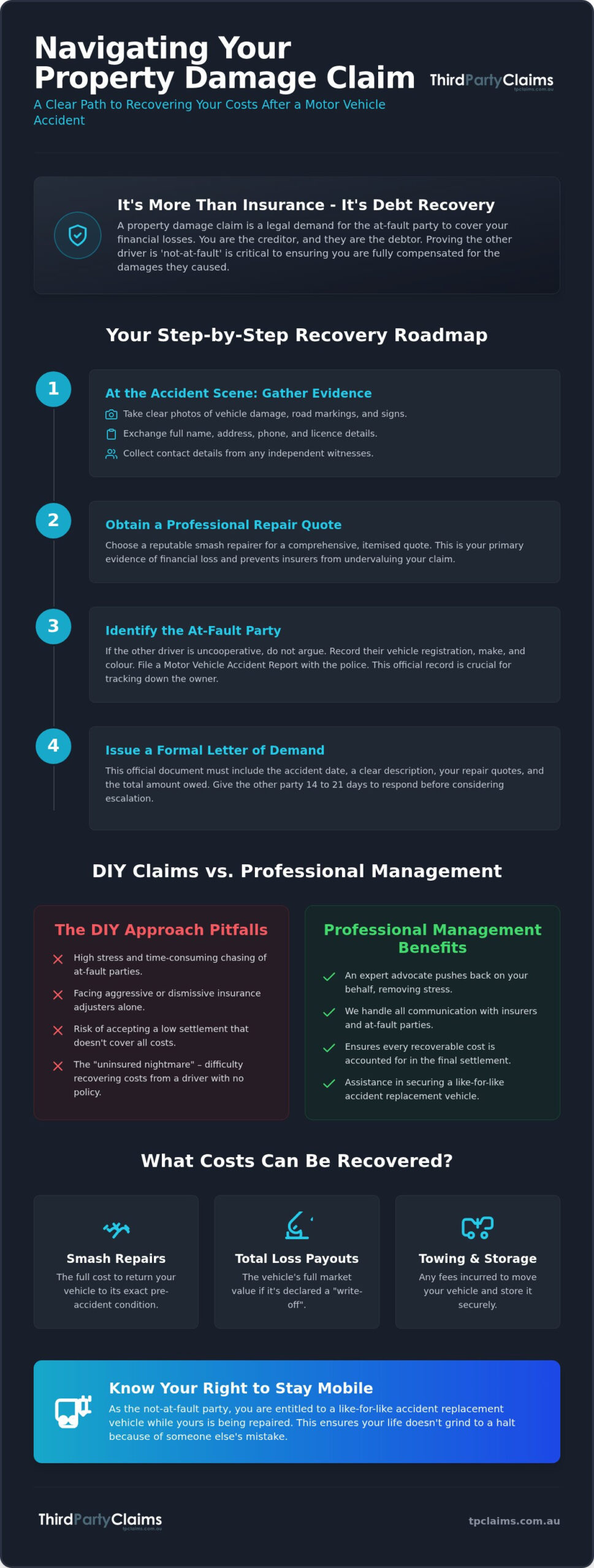
A property damage claim motor vehicle accident is essentially a legal demand for the at-fault party to pay for the damage they’ve caused to your assets. While many people view insurance as a simple administrative service, a third-party claim is actually a form of debt recovery. You’re the creditor, and the driver who hit you is the debtor. In the Australian context, “Third Party” refers to the other person involved in the traffic collision. It’s vital to distinguish this from personal injury claims, which focus on medical trauma and aren’t handled by our team. Our role is to act as your advocate, managing the complexities of property recovery so you aren’t left carrying the financial burden of someone else’s mistake.
Common Types of Recoverable Losses
When your car is damaged, the financial impact extends beyond a simple repair bill. A comprehensive claim covers several specific areas to ensure you aren’t out of pocket. Recoverable losses typically include:
- Smash repairs: The total cost required to return your vehicle to its exact pre-accident condition using reputable repairers.
- Total loss settlements: If your car is a “write-off” because repairs aren’t economical, you’re entitled to the market value of the vehicle.
- Towing and storage: Any fees paid to move your vehicle from the scene or store it securely while repairs are organised.
These expenses represent the tangible loss you’ve suffered. Securing a fair settlement means ensuring every one of these costs is accounted for by the at-fault party’s insurer without you having to chase them yourself.
Why ‘Not-at-Fault’ Status is Critical
Proving liability is the backbone of any property damage claim motor vehicle accident. Under Australian road rules, the driver who breached their duty of care is legally responsible for the resulting damages. This is based on the “Right to Recovery” principle in common law, which aims to put the innocent party back in the position they were in before the accident occurred. If the other driver’s insurer disputes liability, the process can quickly become adversarial. They might attempt to shift blame or offer a settlement that doesn’t cover your full costs. Having a persistent guide is essential here. We step in to handle the heavy lifting, protecting your “not-at-fault” status and ensuring the facts of the accident are clearly established so you receive the full compensation you deserve.
The Step-by-Step Process for Property Damage Recovery
You’ve just had an accident. Adrenaline is pumping, and your mind is likely racing with questions about what comes next. To protect your interests, you must follow a methodical process for property damage recovery. Start at the scene. Take clear, high-resolution photos of the damage to all vehicles involved, the road markings, and any relevant street signs. Exchange details with the other driver, including their full name, address, phone number, and licence number. If there are witnesses, their contact details and statements can be the deciding factor in a disputed property damage claim motor vehicle accident.
Once you’ve cleared the scene, your next priority is obtaining a professional repair quote. Choose a reputable smash repairer who provides a comprehensive, itemised breakdown of the costs. This isn’t just a number; it’s your primary evidence of financial loss. Having a solid quote prevents the at-fault driver’s insurer from underestimating the damage or offering a settlement that doesn’t cover the full cost of restoring your vehicle to its pre-accident condition.
Identifying the At-Fault Party
It’s a common frustration: the other driver refuses to cooperate. If they won’t hand over their insurance details, don’t argue. Simply record their vehicle registration, make, and colour. You can provide this information when you file a Motor Vehicle Accident Report with the police. This official record is essential for tracking down vehicle owners through government databases. It transforms a “he-said, she-said” situation into a documented event that insurers cannot easily dismiss. This report serves as a vital piece of evidence when establishing liability for your property damage claim motor vehicle accident.
The Letter of Demand: Your First Formal Move
This is where your claim becomes official. A formal Letter of Demand must include the date of the accident, a clear description of the event, and the total amount required for repairs. Attach your repair quotes and any evidence gathered at the scene. In Australia, it’s standard to give the other party 14 to 21 days to respond before you consider escalating the matter. Professional wording is vital here. Insurers are trained to spot weaknesses in DIY letters, but they tend to act much faster when they see a structured, legally sound demand that shows you’re serious about recovery.
Negotiating with a multi-billion dollar insurance company is exhausting. They have teams dedicated to minimising payouts, and they often hope you’ll simply give up. If you want to avoid the stress of the back-and-forth, you can let our insurance negotiation services take the lead. We ensure the dialogue stays focused on fairness, handling every phone call and email so you can get back to your normal life while we secure your settlement.
DIY Claims vs. Professional Claims Management
Managing a property damage claim motor vehicle accident yourself often feels like taking on a second job you never applied for. While the process might seem straightforward on paper, the reality involves hours of phone calls, endless emails, and the constant stress of being ignored by large insurance companies. Errors in your initial paperwork or a lack of technical knowledge can lead to lengthy delays or even a rejected claim. Professional managers bring industry expertise to the table, knowing exactly which levers to pull to speed up a settlement and ensure you aren’t being lowballed by an adjuster.
A common question is whether you should simply use your own comprehensive insurance policy. While this is an option, it often comes with hidden drawbacks. Claiming through your own insurer usually requires you to pay an upfront excess, which can be hundreds of dollars, and it may impact your no-claim bonus. By choosing professional claims management, you’re pursuing the at-fault party directly. This protects your own insurance record and ensures you don’t face out-of-pocket expenses for an accident that wasn’t your fault. If you’re feeling overwhelmed by the process, seeking third party property damage claim help from specialists can level the playing field against insurers who prioritise their profits over your repairs.
Understanding the No-Win-No-Fee Model
Many Australians assume that no-win-no-fee arrangements are reserved for personal injury cases, but this model is actually a powerful tool for property recovery. It removes the financial barrier to high-quality advocacy, allowing you to access expert help without worrying about upfront legal costs. No-win-no-fee is a risk-free path to recovery that ensures your interests are aligned with your advocate’s. For uninsured drivers who are not at fault, this service is a genuine life-saver, providing the professional muscle needed to take on well-funded insurance firms without any personal financial risk.
Why Insurers Negotiate Differently with Professionals
Insurance adjusters are trained to protect their company’s bottom line. They often use stalling tactics or complex jargon to devalue small claims, hoping that unrepresented individuals will eventually give up or accept a smaller payout. However, they tend to change their tune when dealing with professionals who understand the General Insurance Code of Practice. We act as a dedicated shield, standing between you and aggressive adjusters. Because we know your rights and the standard timelines for settlement, we can prevent insurers from using unfair tactics to delay your car repairs or your payout.
Special Situations: Uninsured Drivers and Truck Collisions
While a standard property damage claim motor vehicle accident is complex, certain scenarios introduce unique challenges that can leave you feeling vulnerable. The most common nightmare occurs when the at-fault driver has no insurance at all. In these cases, you aren’t just dealing with a company; you’re dealing with an individual’s personal finances. Another high-stakes situation involves heavy vehicles. Truck collisions often lead to significant damage and involve corporate entities with deep pockets and aggressive legal teams. You need a persistent ally who knows how to handle these specific pressures and ensure you aren’t left carrying the cost.
Claiming Against an Uninsured Party
If the person who hit you is un-financial or simply uninsured, your right to recovery doesn’t vanish. You’re still entitled to be restored to your pre-accident position. However, the process shifts from insurance negotiation to direct debt recovery. This might involve setting up formal payment plans or, if they refuse to pay, seeking a court order to enforce the debt. The court has the power to issue garnishee orders on wages or seize assets to satisfy the claim. We specialise in managing these difficult cases, providing the constant follow-up required to ensure an uninsured driver doesn’t simply walk away from their responsibilities.
The Complexity of Truck and Heavy Vehicle Claims
Collisions involving trucks are rarely straightforward. Because these vehicles are usually owned by businesses, you’ll likely be dealing with vicarious liability. This means you’re claiming against the transport company rather than just the driver. These cases require specialised evidence, such as driver logbooks, GPS telematics data, and maintenance records, to prove a breach of duty. Repair costs for heavy vehicle damage are often substantially higher, and the delays can be longer due to the specialised parts required. If you need a detailed breakdown of how to navigate the truck accident property damage claim process against a corporate fleet, understanding the specific evidence requirements and legal obligations involved is essential. Managing a property damage claim motor vehicle accident against a corporate fleet requires a firm hand and a deep understanding of heavy vehicle regulations.
Don’t let the complexity of a heavy vehicle or uninsured driver dispute stop you from getting what you’re owed. If you’re facing one of these difficult scenarios, our specialists in claims management for uninsured drivers and truck disputes can take over the entire process for you, handling the heavy lifting while you focus on getting back on the road.
Staying Mobile: Accident Replacement Vehicles and Final Steps
Being without your vehicle after a property damage claim motor vehicle accident is more than just an inconvenience; it disrupts your work, family commitments, and daily routine. Many drivers don’t realise they have a legal right to remain mobile while their car is in the shop. This is where the concept of a “like-for-like” replacement vehicle comes in. If you’re not at fault, you shouldn’t have to downgrade to a tiny hatchback if you usually drive a family SUV or a work ute. We ensure you stay in a vehicle that matches your needs while your own is being restored.
The cost of this replacement vehicle is recovered directly from the at-fault party’s insurer. This means you aren’t forced to pay upfront for a hire car and hope for a refund later. By managing the process professionally, we ensure the insurer acknowledges their liability for your loss of mobility. This approach removes the financial pressure and lets you go about your life as if the accident never happened.
Your Right to a Replacement Car
Eligibility for a not-at-fault replacement vehicle generally hinges on the fact that you weren’t the one who caused the accident and you have a demonstrable need for a car. To avoid being stuck with a hire car bill, it’s essential to use a service that specialises in recovering these costs directly from the at-fault party’s insurance company. In Australian law, the loss of use of your vehicle is recognised as a legitimate and recoverable loss. This principle ensures that the innocent party is not disadvantaged by the time it takes to complete repairs.
The Logical Conclusion of Your Claim
The final phase of your property damage claim motor vehicle accident involves more than just picking up your keys. Before you drive away, you must carefully inspect the repair quality. Ensure the paint matches, the panels align correctly, and the car feels right on the road. A successful settlement means every single cost associated with the accident is covered, from the initial towing and emergency storage to the full repair bill and the hire car fees.
Closing the claim correctly ensures there are no trailing liabilities or unresolved disputes that could resurface later. We manage this entire transition, acting as your persistent advocate from the moment of the collision until your life is back to normal. We handle the technical dialogue with insurers to ensure they don’t miss a single item on the invoice, giving you total peace of mind. If you’re ready to move past the stress and get your vehicle restored to its pre-accident condition, Let TP Claims handle your property damage recovery today.
Get Back on the Road with Confidence
You’ve learned that a property damage claim motor vehicle accident doesn’t have to be a source of endless stress. By understanding your right to a like-for-like replacement vehicle and the power of professional negotiation, you can bypass the headache of dealing with aggressive insurers yourself. Whether you’re facing a complicated truck collision or the frustration of an uninsured at-fault driver, you have a clear path to full recovery. You shouldn’t have to risk your own no-claim bonus or pay an expensive excess for an accident that wasn’t your fault.
You don’t have to carry this burden alone. Our team provides national claims management expertise and specialist support for uninsured drivers to ensure you aren’t left out of pocket. We stand as your dedicated ally against a complex system, managing every detail from repair quotes to final settlements. Start your risk-free property damage claim with TP Claims today and benefit from our protective no-win-no-fee advocacy. It’s time to stop chasing and start moving forward. We’re here to handle the heavy lifting so you can reclaim your peace of mind.
Frequently Asked Questions
Can I make a property damage claim if the other driver has no insurance?
Yes, you can still pursue a property damage claim motor vehicle accident even if the at-fault driver is uninsured. In these cases, the debt is owed by the individual personally rather than an insurance company. We specialise in managing these difficult scenarios by establishing liability and setting up enforceable payment plans. If the driver refuses to cooperate, we help facilitate the recovery process to ensure the debt is settled through the appropriate legal channels.
What happens if I don’t have insurance but the accident wasn’t my fault?
Being uninsured yourself doesn’t take away your right to recover costs from an at-fault party. If you’re not at fault, the other driver or their insurer is legally responsible for your repair bills and associated losses. TP Claims acts as your advocate in these situations, providing the professional negotiation power you need to secure a settlement. We manage the entire process on a no-win-no-fee basis, so you don’t face upfront costs while seeking fairness.
How much does it cost to use a claims management service like TP Claims?
We operate on a strict no-win-no-fee basis for property damage recovery. This means you don’t have to worry about paying any upfront management fees or out-of-pocket expenses while we handle your claim. Our revenue is generated through the successful negotiation and management of settlements with the at-fault party’s insurance company. We focus on ensuring you receive the full cost of repairs and remain mobile without the financial stress of traditional legal fees.
Will I have to go to court for a car damage claim?
Most property damage claims are resolved through professional negotiation without ever stepping foot in a courtroom. Insurers generally prefer to settle valid claims once clear evidence of liability and repair costs is presented. While court is a possibility if a driver or insurer remains completely unreasonable, our goal is to reach a fair settlement through persistent advocacy. We handle the technical dialogue and paperwork, shielding you from the adversarial nature of the legal process.
How do I get a replacement car while mine is being repaired?
If you’re not at fault, you’re entitled to an accident replacement vehicle to keep you mobile while your car is in the shop. We provide like-for-like vehicles to ensure your daily routine isn’t disrupted. The costs for this hire car are recovered directly from the at-fault driver’s insurance company. You won’t be stuck with a bill as long as the claim is managed correctly and your need for a vehicle is demonstrated under Australian law.
What if the other driver’s insurance company denies liability?
It’s common for insurers to deny liability initially to protect their bottom line. When this happens, we step in to challenge their decision using the evidence gathered at the scene, such as photos, witness statements, and police reports. We understand the tactics adjusters use and know how to apply pressure using the General Insurance Code of Practice. Our persistence ensures that your property damage claim motor vehicle accident is assessed fairly and that liability is correctly attributed.
Is there a time limit for filing a property damage claim in Australia?
Yes, there are strict statutory time limits for filing a claim in Australia. Generally, you have six years from the date of the accident to commence court proceedings for property damage in most states. However, it’s always best to start the process as soon as possible while evidence is fresh and witnesses are easy to contact. Delaying your claim can make the negotiation process more difficult and may impact your ability to recover certain costs.
Can I claim for property damage if it was a truck or commercial vehicle?
Yes, we specialise in handling complex truck collision disputes and claims involving commercial fleets. These cases often involve higher repair costs and more technical evidence requirements, such as driver logbooks or telematics data. We manage the dialogue with corporate insurers and transport companies to ensure they take responsibility for the damage caused. Whether it’s a small delivery van or a heavy vehicle, understanding the full truck accident property damage claim process can help you prepare for the unique challenges these cases present. We provide the expertise needed to navigate these high-stakes recovery efforts.